

When it comes to trail cameras, the best batteries are almost always lithium AAs. Their incredible lifespan, rock-solid performance in freezing weather, and steady power output make them the clear winner for anyone who wants long-term, set-it-and-forget-it scouting.
Choosing the Right Power Source for Your Trail Camera
Picking the best batteries for your trail camera is more than just grabbing a pack at the checkout counter. It’s a strategic decision that directly impacts your camera's performance, reliability, and ultimately, your scouting success. The wrong choice can mean missed shots, grainy night photos, or a dead camera right when the big bucks start moving.
The goal is simple: find a power source that can handle your camera's demands, your local weather, and how often you’re willing to hike back in to check on your gear.
This is especially true for modern cellular models. They’re thirstier for power, and a steady, reliable source ensures your camera can both snap a picture and successfully send it to your phone. It’s a critical function for any smart 4G trail camera. Think of batteries as the heart of your entire scouting system—if the heart is weak, the whole thing comes grinding to a halt.
Why Lithium Is the Top Performer
In the field, lithium AA batteries consistently run circles around other types. There are a few key reasons for this. First, they're engineered to deliver a consistent voltage throughout their entire life. This is a huge deal. Alkaline batteries, on the other hand, slowly bleed power, which leads to annoying problems like a weak flash or sluggish trigger speeds.
But the real game-changer for lithium batteries is their sheer resilience. They work almost perfectly in sub-zero temperatures that would kill a set of alkalines, keeping your camera clicking away through the coldest winter hunts.
Their advanced chemistry also delivers a much longer runtime. Field tests show that a good set of lithiums can last up to seven times longer than their alkaline counterparts. While they cost more upfront, this longevity often makes them the cheaper option in the long run. Plus, they have an incredibly low self-discharge rate, meaning they can sit in a camera for months before the season and still be ready to go.
When you boil it down, the decision-making process is pretty straightforward. It all comes down to what trail camera users need most: long life and cold-weather reliability.
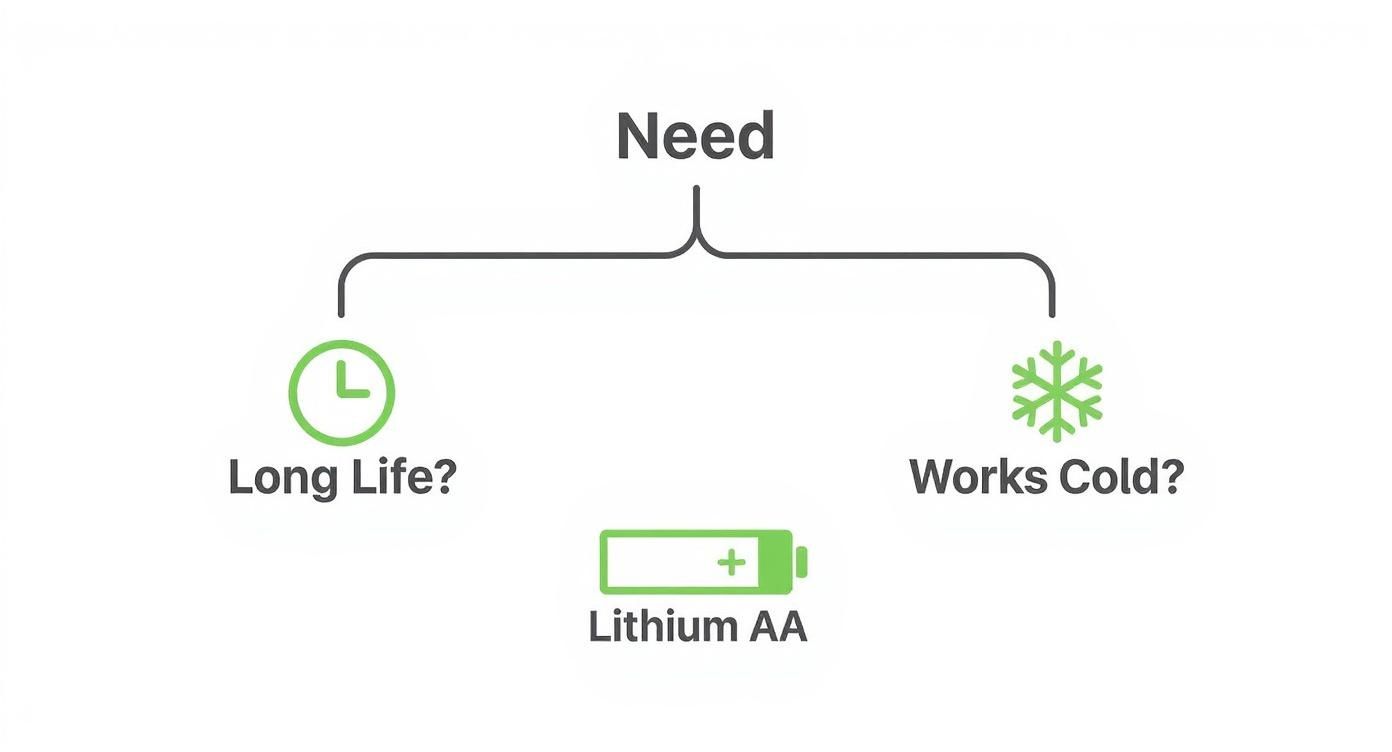
This simple breakdown shows that if long-term sets and winter scouting are on your agenda, both paths lead straight to lithium AAs. They’re simply the best tool for the job.
A Quick Comparison of Your Options
To make the choice even clearer, here’s a quick look at how the three main battery types stack up against each other for the things that really matter out in the woods.
Quick Comparison of Trail Camera Battery Types
| Battery Type | Best For | Cold Weather Performance | Runtime | Cost |
|---|---|---|---|---|
| Lithium | Long-term deployments, cold climates, and cellular cameras. | Excellent | Longest | High upfront |
| Alkaline | Short-term use in mild weather, budget-conscious setups. | Poor | Short | Low |
| NiMH | High-traffic areas with easy access for frequent recharging. | Fair | Medium | Medium (reusable) |
This table really highlights the trade-offs. While alkalines and rechargeable NiMH batteries can work in certain situations, their serious limitations in the cold and over long periods make lithium the most dependable—and ultimately, the most cost-effective—choice for serious scouting.
How Different Battery Chemistries Actually Work
To pick the right batteries for your trail camera, you need to know what makes them tick. Not all batteries are created equal—the chemical recipe inside dictates everything from runtime to how well they work when the temperature drops. This isn't just for science class; understanding battery chemistry is the secret to getting the best performance out of your camera.
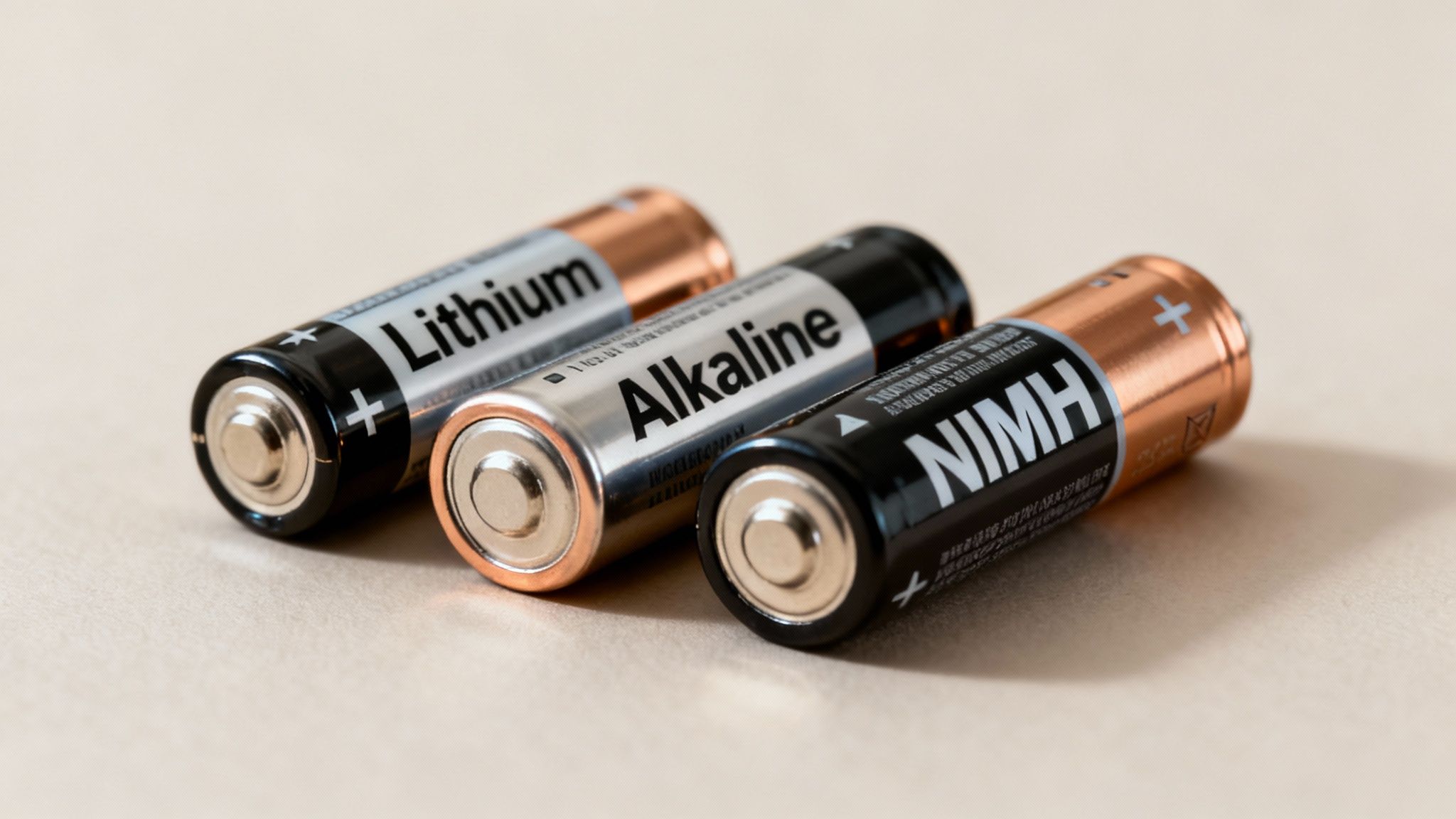
Let's break it down with a simple analogy. Think of each battery type as a different kind of athlete competing in the same race: powering your trail cam. Their performance is going to vary a lot based on their unique strengths and weaknesses.
Alkaline: The Sprinter
Your standard alkaline battery is a sprinter. It rockets off the starting line with a strong burst of energy, delivering the full 1.5 volts your camera needs. At first, everything looks great. The camera boots up fast, and the flash seems bright.
But just like a sprinter, an alkaline battery can’t hold that top speed for long. As it discharges, its voltage steadily drops. This gradual fade is the enemy of modern electronics. Your camera might say the battery is "half-full," but the reduced power is already hurting its performance.
This voltage drop is exactly why cameras running on alkalines start taking dim night photos or have slower trigger speeds long before the battery meter hits empty. They just run out of steam, fading out instead of finishing strong.
Lithium: The Marathon Runner
Now, let's look at the lithium battery—the undisputed marathon runner of the group. Lithium batteries start strong with a slightly higher voltage (around 1.7V fresh from the package) and maintain a rock-steady 1.5V output for almost their entire life. They hold a consistent pace, mile after mile.
This unwavering power delivery is a huge advantage for trail cameras. It means your camera’s flash, sensor, and cellular modem always have the juice they need to perform at their best. You get consistently bright night photos and fast trigger speeds from the first picture to the very last.
- Steady Voltage: Guarantees consistent performance without the slow fade you see in alkaline cells.
- High Energy Density: Packs more power into the same AA-sized package, giving you a much longer runtime.
- Cold Weather Champion: The chemical reaction inside a lithium battery isn't bothered by the cold, making it the hands-down winner for winter scouting.
NiMH Rechargeables: The Gym Enthusiast
Nickel-Metal Hydride (NiMH) rechargeables are the gym enthusiasts. They can be "recharged" again and again, which makes them seem like a cost-effective and eco-friendly choice. But they come with some serious trade-offs you need to know about.
First off, NiMH batteries operate at a lower voltage, usually around 1.2V. While many devices can handle this, some sensitive trail cameras will see that lower voltage and think the battery is already half-dead. This can lead to inaccurate power readings and premature shutdowns.
On top of that, NiMH batteries have a high self-discharge rate. Think of it as a slow, constant energy leak. A fully charged NiMH battery can lose a big chunk of its power just sitting in your camera, making it a bad choice for setups you might not check for months. Modern low self-discharge (LSD) versions are better, but they still can't match the stability of lithium.
Why This Matters for Your Camera
Understanding these differences is everything because they directly impact your results in the field. A camera running on fading alkalines might miss a clear night shot of that target buck, while one with steady lithiums will perform flawlessly. When you're weighing your options, especially with powerful lithium-ion batteries, it's also smart to understand safety concepts like what thermal runaway is in lithium-ion batteries. This knowledge ensures you're using them safely and effectively.
At the end of the day, the best batteries for your trail camera are the ones that meet the hardware's demands. The stable, long-lasting, and weather-resistant power of lithium batteries makes them the superior "athlete" for the grueling endurance event that is a full season of scouting.
What Really Drains Your Trail Camera Batteries
Knowing your battery chemistry is only half the battle. If you really want to get the most out of your trail cameras, you need to understand what’s actually eating up all that power out in the field. More often than not, two major culprits are responsible for a dead camera: freezing temperatures and the camera’s own settings.
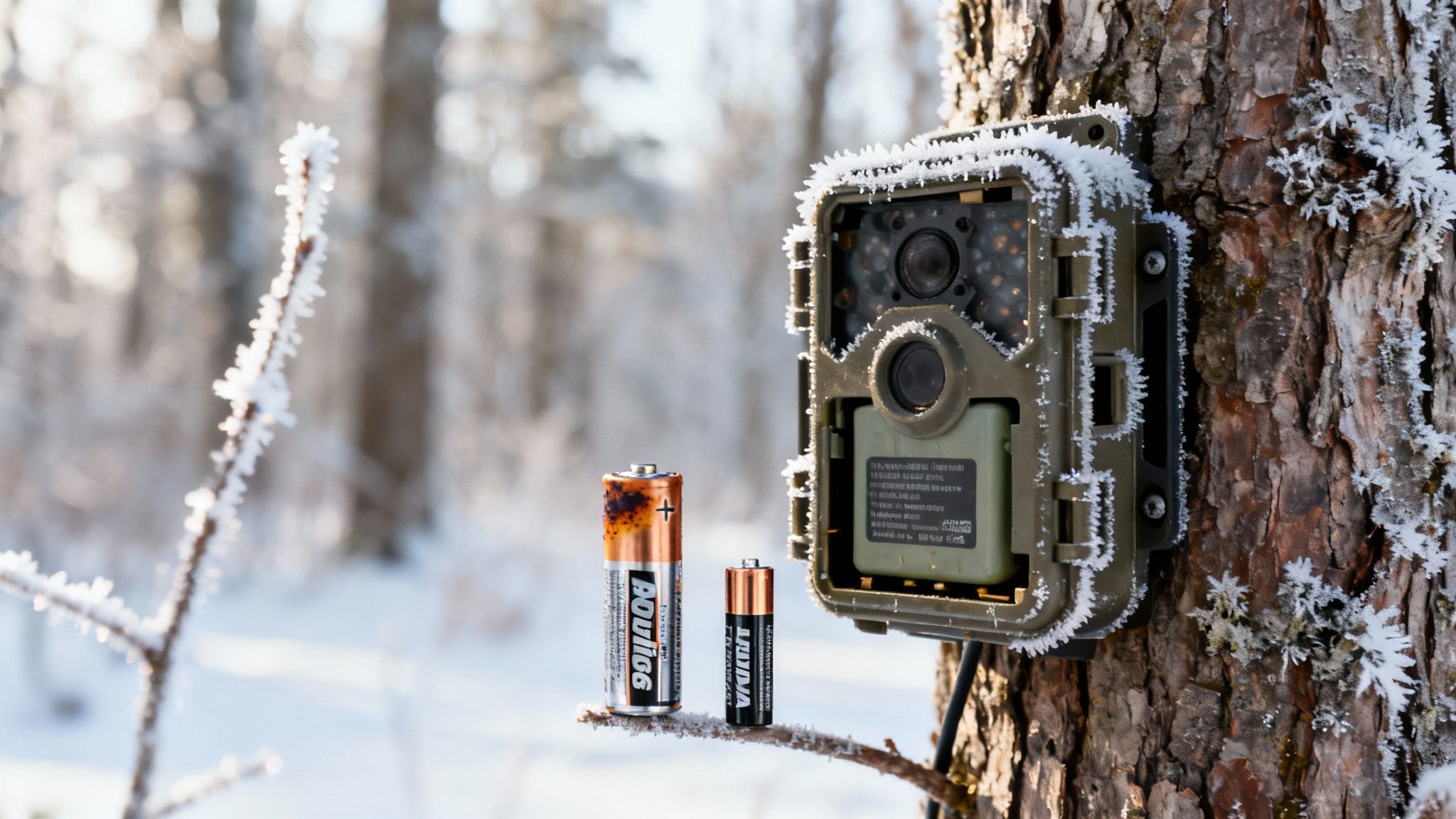
Think of batteries as tiny power plants running on a chemical reaction. And just like any chemical reaction, its performance is tied directly to the environment. This is where cold weather becomes a serious problem, especially for standard alkaline batteries.
The Cold Weather Killer
When the temperature drops below freezing, the chemical reaction inside an alkaline battery slows to a crawl. It’s like trying to pour molasses in January—everything just gets sluggish. The battery simply can't generate power fast enough to keep up with what your camera needs.
This slowdown causes a massive voltage drop. So, even if a battery is technically "full," it can't deliver enough juice to run the flash, the sensor, or the cellular modem. It’s the classic reason a set of alkalines that worked perfectly in October suddenly dies during the first real cold snap.
On the other hand, lithium batteries use a completely different chemical process that’s far less bothered by the cold. Their internal reaction keeps chugging along efficiently even in sub-zero temps, delivering consistent power all winter. This makes them the undisputed champ for any serious cold-weather scouting.
How Your Camera Settings Drain Power
Beyond the weather, the single biggest drain on your batteries is the camera itself. Every feature you turn on takes a sip of power, but some are far thirstier than others. Your camera’s settings are the knobs you can turn to directly control how long your batteries will last.
Here are the primary power hogs to keep an eye on:
- Video Recording: Hands down, capturing video is the most power-intensive thing your camera can do. A camera recording just a 30-second video clip uses exponentially more energy than one snapping a single photo.
- Cellular Transmission: For cellular models like the Magic Eagle, sending photos and videos over a 4G network is a major power draw. The camera has to fire up its modem, hunt for a signal, and then transmit the data—all of which burns through battery life.
- Night Vision Flash: The infrared (IR) flash required for night shots needs a big burst of energy. Cameras set up in high-traffic areas that trigger constantly overnight will drain batteries much faster.
- High-Resolution Photos: While not as demanding as video, capturing large, high-megapixel images still requires more processing power and energy than smaller, lower-quality pictures.
Estimating Your Runtime: A Practical Example
Once you understand these drains, you can start making smart trade-offs. Let's walk through two common scenarios to see how different settings can drastically change your battery life. For a deeper dive, check out our complete guide on how long trail camera batteries last.
Scenario A: "Photo Mode"
- Settings: 3-photo burst, medium resolution, 1-minute delay.
- Activity: Captures 10 events per day (30 photos total).
- Estimated Drain: This is a pretty low-power setup. The camera spends most of its time asleep, only waking up for a few seconds to shoot and send. A fresh set of lithiums could easily last for an entire season.
Scenario B: "Video Mode"
- Settings: 20-second HD video, 1-minute delay.
- Activity: Captures 10 events per day (200 seconds of video total).
- Estimated Drain: Now we’re in high-power territory. Each trigger forces the camera to record and process video, which eats a ton of energy. In this mode, that same set of lithiums might only last for a few weeks to a month.
By getting a feel for these power dynamics, you can configure your camera for the perfect balance of performance and longevity. If you’re setting a camera in a remote spot and need maximum runtime, stick to photos. If you’re after detailed footage from a hot scrape, just be prepared for more frequent battery swaps. Choosing the best batteries is the first step, but optimizing your settings is how you truly win the power game.
Exploring Solar and External Power Solutions
While lithium AA batteries are the undisputed champs for most trail camera setups, some situations just demand more juice. For those remote food plots, high-traffic fence crossings, or power-hungry cellular cameras, constantly swapping batteries isn't just a hassle—it's downright impractical.
This is where solar and external power solutions come in. Think of it as upgrading from a canteen to a self-refilling reservoir. Instead of rationing a finite supply, you’re tapping into a continuous source that can keep your camera running for months, or even an entire season, without you ever setting foot in the woods. This is especially true for cellular models like the Magic Eagle, which need that extra power to send photos and connect to the network.
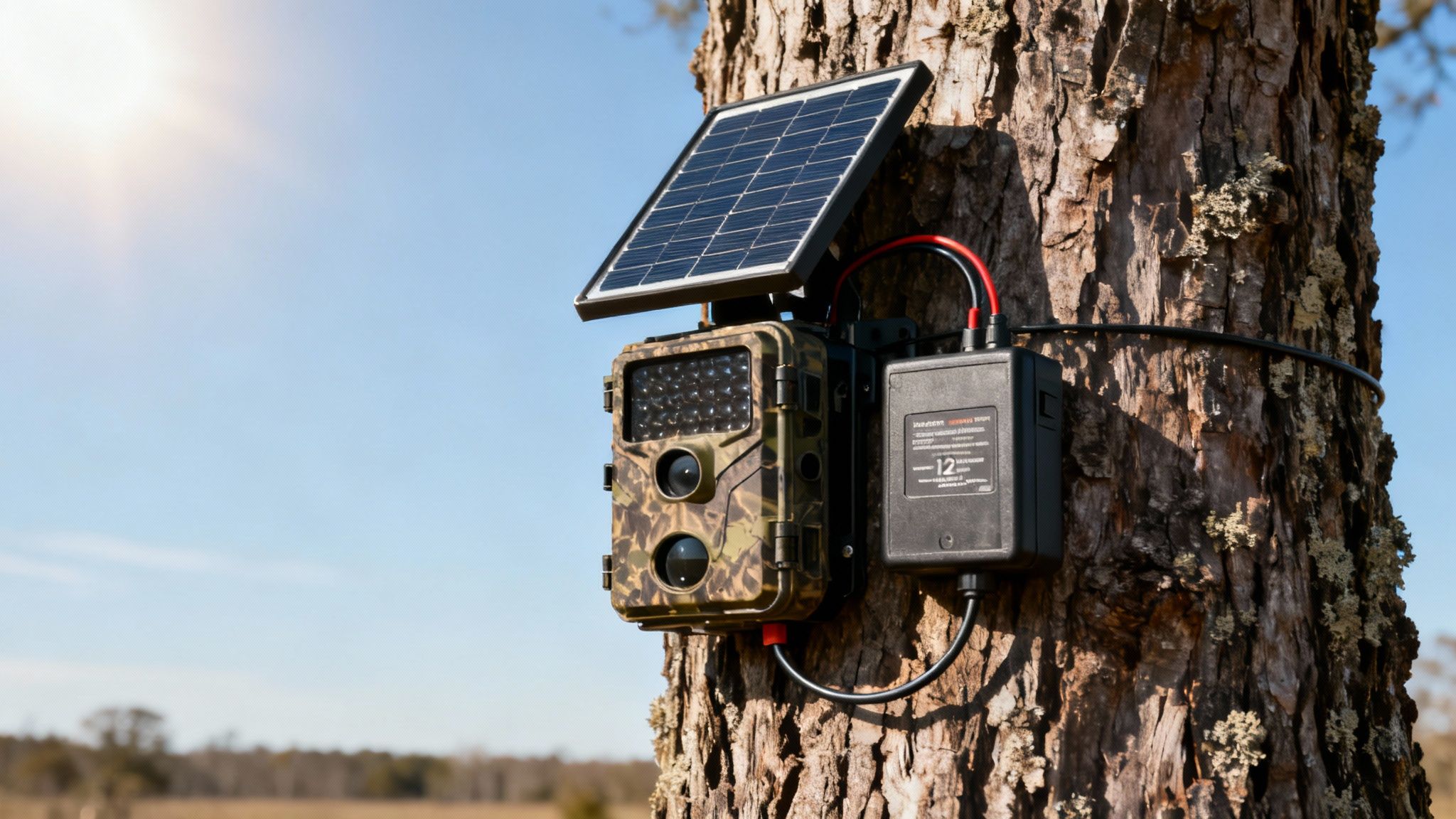
This move toward set-it-and-forget-it power is a big deal in the hunting and wildlife world. The trail camera market is exploding, projected to hit over $900 million in 2025, and solar-powered models are a huge part of that growth. In fact, in 2023, these energy-sipping cameras made up nearly 20% of all shipments because they turn a weeks-long deployment into a months-long one with way less maintenance.
How Solar Panels Work for Trail Cameras
Integrated solar panels are a game-changer, but they aren’t magic. They work by constantly trickle-charging a built-in or connected rechargeable battery pack whenever the sun is out. This constant top-off ensures the camera has a full tank to pull from at night or on those cloudy, drizzly days.
For this system to work, placement is everything. The goal is to soak up as much direct sunlight as possible.
- Go South: In the Northern Hemisphere, mount the panel facing south to catch the sun as it travels across the sky.
- Dodge the Shadows: Keep the panel clear of thick tree canopies, low-hanging limbs, or anything else that could block the light.
- Get the Right Angle: An angled mount is better than a flat one. It helps the panel catch more direct rays and lets rain wash off any dust or pollen that builds up.
A classic mistake is sticking a solar-powered camera deep in a thicket where it only gets a few minutes of direct sun. It might work for a little while, but the panel won't be able to keep up with what the camera is using, and you'll eventually find a dead battery.
When to Use an External 12V Battery Box
For those truly demanding situations—like a spot with almost no sunlight or a camera sending constant video—a big external battery box is the ultimate power move. These are basically small, weatherproof boxes holding a sealed 12V lead-acid or lithium battery, kind of like what you’d find on a small boat or an ATV.
Hooking one of these up gives you a massive power reserve that can run a camera for months on end, even with the most aggressive settings. They’re perfect for security monitoring on a remote property line or a research project that needs to capture nonstop video. And if you’re planning for the long haul, knowing the expected lifespan of solar batteries is key to making a smart investment.
Making the Right Investment Decision
So, is a solar or external setup the right call for you? It really just boils down to a simple cost-benefit analysis.
Consider a Solar or External Pack If:
- Your camera is in a remote or tough-to-reach spot.
- You’re running a cellular camera that sends high-resolution photos or videos.
- The camera is on a busy trail, triggering hundreds of times a day.
Stick with Lithium AAs If:
- You can easily get to your camera every few months for a quick battery swap.
- It's in a low-traffic area with just a few triggers here and there.
- Your camera is tucked away in heavy shade where a solar panel would be useless.
At the end of the day, these advanced power options are all about maximizing your camera's uptime while minimizing your disturbance in the field. By investing in the right power source, you ensure your camera is always ready to capture that critical moment, no matter how far off the beaten path you are.
Installation and Maintenance Best Practices
Choosing the right batteries for your trail camera is half the battle. How you install and maintain them is what really separates a reliable, season-long deployment from a frustrating one full of dead cameras and missed opportunities.
The truth is, poor habits can sabotage even the most expensive lithium batteries. Following a few simple rules, however, will keep your gear running at its absolute peak.
The single most important rule? Always use a full set of new, identical batteries. I know it's tempting to mix a few old cells with new ones or combine different brands to use up whatever you have lying around. Don't do it. This is a recipe for disaster.
Mixing batteries creates an imbalance in voltage and capacity that drains the stronger cells faster. Worse, it can cause the weaker ones to leak corrosive acid, which will permanently destroy your camera’s sensitive electronics.
Proper Battery Installation
Getting the installation right is about more than just popping in a fresh set. It's about creating the cleanest possible electrical connection to ensure every last drop of power is used effectively. Before you head out to the field, take a minute to prep your camera and batteries.
Follow these simple steps every single time you change your batteries:
- Start Fresh: Always begin with a complete set of brand-new, identical batteries. Never mix brands, types (like alkaline with lithium), or old with new.
- Clean the Contacts: Use a clean, dry cloth or even a simple pencil eraser to gently wipe the battery contacts inside your camera and on the batteries themselves. This tiny step removes any minor corrosion or grime that could interfere with the connection.
- Check Polarity: This sounds basic, but it's easy to get wrong in a hurry. Double-check that you’ve inserted each battery according to the positive (+) and negative (-) diagrams inside the battery compartment. Installing even one backward can prevent the camera from powering on or cause damage.
Nailing these steps is a core part of effective field deployment. For more foundational tips, our guide on how to set up a trail camera offers a complete walkthrough for beginners.
Long-Term Care and Off-Season Storage
Your maintenance routine shouldn't stop when the season ends. How you store your gear during the off-season has a massive impact on its longevity and readiness for the next year. Neglecting your cameras for months can lead to irreversible damage.
The number one cause of trail camera failure is battery corrosion. It almost always happens when cameras are stored with old alkaline batteries left inside. This simple mistake has ruined countless devices.
Before you put your cameras away, always remove the batteries. This single action prevents the slow, damaging leaks that cheap alkaline batteries are notorious for.
Store the camera in a cool, dry place, away from extreme temperature swings—think a closet, not a hot garage or attic. Do the same for your spare batteries. A climate-controlled environment is your best bet.
By following these simple installation and maintenance habits, you're protecting your investment and ensuring your camera is always ready for action. It’s the small, consistent things that prevent big problems and keep your scouting system running flawlessly, year after year.
Making the Right Power Choice for Your Needs
Choosing the best batteries for your trail camera isn’t just about grabbing a pack off the shelf. It’s a strategic decision. You have to match the power source to your camera’s location, the local climate, and exactly how you plan to use it. Get this right, and you turn a simple purchase into a real field advantage.
For the vast majority of users, lithium AA batteries are the undisputed champs. Their longevity is incredible, they deliver consistent power, and their performance in freezing weather is unmatched. If you want a reliable, set-it-and-forget-it deployment, this is your best bet. They’ll keep your camera running flawlessly from day one until you finally make it back out to your spot.
Situational Power Strategies
Of course, lithium isn’t the only answer. Different situations call for different tools.
- Rechargeable NiMH Batteries are a smart, practical choice for high-traffic spots you can get to easily, like a backyard feeder. Since you'll be swapping batteries more often anyway, their reusability makes them super cost-effective over the long run.
- Solar Panels and External Packs are the definitive solution for those remote, hard-to-reach locations. These setups are perfect for power-hungry cellular cameras, giving them a nearly endless supply of juice that minimizes human disturbance and keeps your camera online.
Battery life is one of the most critical factors for any trail cam user. The cellular camera market, valued at around USD 350 million in 2024, has only amplified the need for durable power solutions. While lithium AAs are a fantastic foundation, it's amazing what modern solar panels can do. We're now seeing them keep a cellular camera’s battery above 60% even in dense woods, proving just how much they can extend your time in the field. You can dig into more insights on the cellular trail camera market and its power demands at marketsizeandtrends.com.
Ultimately, the best power strategy is the one that keeps your camera running when it matters most. Take a minute to think about your environment and camera settings. That little bit of planning lets you pick the right batteries with confidence, so you never have to worry about missing that crucial shot. Your choice should buy you peace of mind, knowing your scout is always on duty.
Frequently Asked Questions About Trail Camera Batteries
Even after you get the hang of battery chemistry and power drain, questions always pop up out in the woods. Getting straight answers can save you from making costly mistakes and help you get the absolute most out of your trail camera.
Here are the answers to the questions we hear the most.
Can I Mix Different Brands or Types of Batteries?
Definitely not. You should never mix battery brands, different types like lithium and alkaline, or even old and new batteries in the same camera. Think of it like a team of dogs pulling a sled—if one dog is weaker or older, it just drags the whole team down and wears everyone out faster.
This imbalance messes with voltage and capacity, leading to terrible performance, a much shorter runtime, and even battery leakage. That leaked acid can destroy the metal contacts inside your camera and permanently fry its electronics. The only safe and reliable way is to always install a complete set of fresh, identical batteries.
Are Rechargeable Batteries a Good Choice for Cellular Cameras?
While you can use them, we generally don't recommend rechargeable NiMH batteries for cellular trail cameras. Cellular models are power-hungry because sending photos and videos over a network takes a lot of juice. The lower voltage of NiMH cells—usually 1.2V compared to a lithium battery's 1.5V—can cause all sorts of performance glitches or make your camera think its batteries are low way too early.
But the biggest problem is their high self-discharge rate. They lose power just sitting there, which is a deal-breaker for a camera you might leave in the woods for weeks or months at a time. For any cellular camera, your best bet is to stick with premium lithium batteries or a dedicated solar power setup.
How Do I Know When My Batteries Are Dying?
Most modern cameras, including the Magic Eagle, have a battery life indicator on the screen or in the mobile app. But you should also learn to spot the subtle clues the camera gives you when it's running on fumes.
Keep an eye out for these classic signs:
- Dimmer Night Photos: A weak IR flash is one of the first things to go. Your nighttime images will start looking dark, grainy, or poorly lit.
- Slower Trigger Speeds: The camera might lag, taking longer to wake up and snap a picture. This is how you end up with photos of an animal's back half walking out of the frame.
- Blank Captures: You might pull the SD card and find empty photos or videos. This happens when the camera has just enough power to detect motion but not enough to finish capturing the image.
- Short Videos: Your camera might fail to record for the full 30 seconds you set, cutting clips short to save what little energy it has left.
If you start seeing any of these issues, it's a clear signal your batteries are on their last legs. Swapping them out right away will make sure you don't miss that buck you've been waiting for.
Ready to power your scouting with a camera built for the long haul? The Magic Eagle EagleCam 5 is engineered for maximum power efficiency and is fully compatible with the best lithium and solar solutions on the market. https://magcieagle.com