

Getting more bucks on trail cams is about thinking like a deer, not just a photographer. It’s a game of strategy, not luck. Real success comes from putting your camera in high-traffic spots where bucks naturally travel, feed, and chase does, especially once the rut kicks in.
The Modern Hunter's Edge in Scouting Mature Bucks
Trail cameras have completely changed the game for modern deer hunters. They’ve turned scouting from a guessing game into a data-driven pursuit. Your camera is out there 24/7, silently gathering intel on deer movement, herd density, and the quality of bucks roaming your property. This tech is invaluable because it lets you pattern specific animals without constantly contaminating the woods with your scent.
Ever since these cameras blew up in the early 2000s, whitetail hunters have leaned on them to ID and track target bucks. Today, a huge chunk of hunters—around 62% in North America—use trail cams to scout before the season even starts. It’s not just hype. Wildlife management surveys in Wisconsin and Illinois during the fall 2023 rut found that cameras captured bucks on 78% of deployments. Those setups yielded an average of 12 unique bucks for every 100 nights the cameras were out. That's proof they work. You can dig into more of this data over at Skyquestt.com.
Key Takeaway: The goal isn't just getting cool pictures of bucks. It’s about collecting actionable intelligence that tells you where a buck lives, when he moves, and how you can put yourself in the right spot for a successful hunt.
Before we dive deep into the specific tactics, let's look at the foundational pillars of a solid trail camera strategy. Think of these as the core principles that separate a camera that gets lucky from a camera that consistently delivers.
Core Strategies for Capturing More Bucks
A quick overview of the key pillars for successfully getting bucks on your trail cameras, which we'll detail throughout this guide.
| Strategy Pillar | Primary Goal | Key Tactic |
|---|---|---|
| Location Intelligence | Identify high-traffic buck corridors. | Place cameras on pinch points, funnels, and transition zones. |
| Seasonal Adaptation | Match camera placement to buck behavior. | Move cameras from feed to scrapes as the rut approaches. |
| Scent & Bait Strategy | Attract bucks and hold them for clear photos. | Use legal scents and food sources to create camera "traps." |
| Smart Technology | Filter noise and identify target animals efficiently. | Leverage cellular cams and AI to get instant, relevant intel. |
These pillars work together. Master them, and you’ll stop guessing and start patterning.
From Photos to Patterns
A memory card full of buck photos is a great start, but the real magic is turning those images into a predictable pattern. By looking at timestamps, weather conditions, and locations, you start to answer the questions that matter. This guide is built to walk you through the core pillars of an effective trail camera strategy, turning raw data into a real advantage.
We'll cover:
- Strategic Placement: Identifying those high-percentage spots beyond the obvious game trails. We’re talking funnels, pinch points, and the subtle transition zones between feeding and bedding areas. Knowing how to find deer bedding areas is a foundational skill here.
- Seasonal Adjustments: You can't set it and forget it. We'll show you how to adapt your camera setups and settings to match changing buck behavior, from early-season velvet patterns to the chaos of the peak rut.
- Intelligent Data Analysis: Stop wasting time scrolling through endless pictures of does and raccoons. We’ll get into using modern tools, like the AI species recognition in the MAGIC EAGLE app, to instantly filter images and build a precise profile of your target bucks.
Mastering Camera Placement for Maximum Buck Traffic
Getting consistent photos of bucks on trail cams has nothing to do with luck. It’s all about smart placement. I’ve seen guys spend a fortune on high-end cameras only to point them at dead zones. If you want to gather real intel on the mature bucks on your property, you’ve got to move beyond the obvious game trails.
Think of the landscape as a roadmap. Bucks, especially the old, wary ones, are creatures of habit and efficiency. They use the terrain to their advantage, sticking to routes that offer the most cover and the easiest path from point A to B. Your job is to find those high-percentage travel corridors.
Identify Natural Funnels and Pinch Points
The absolute best spots are almost always natural funnels or pinch points. These are just terrain features that squeeze deer movement into a narrow, predictable path. They are goldmines for trail cameras because they concentrate all the traffic from a much larger area into one spot.
Start looking for places where deer are naturally forced into a tight space:
- A skinny strip of woods connecting two big timber blocks.
- The inside corner of a field where two fencelines come together.
- A creek crossing or beaver dam that offers the only dry way to get across the water.
- A saddle in a steep ridge that creates an easy pass from one side to the other.
A camera in one of these locations lets you take inventory of nearly every buck traveling through that part of your land. You’re not just watching a single trail; you’re monitoring the entire hub.
This decision tree helps visualize how all the pieces of modern scouting—placement, seasonality, and data analysis—fit together.
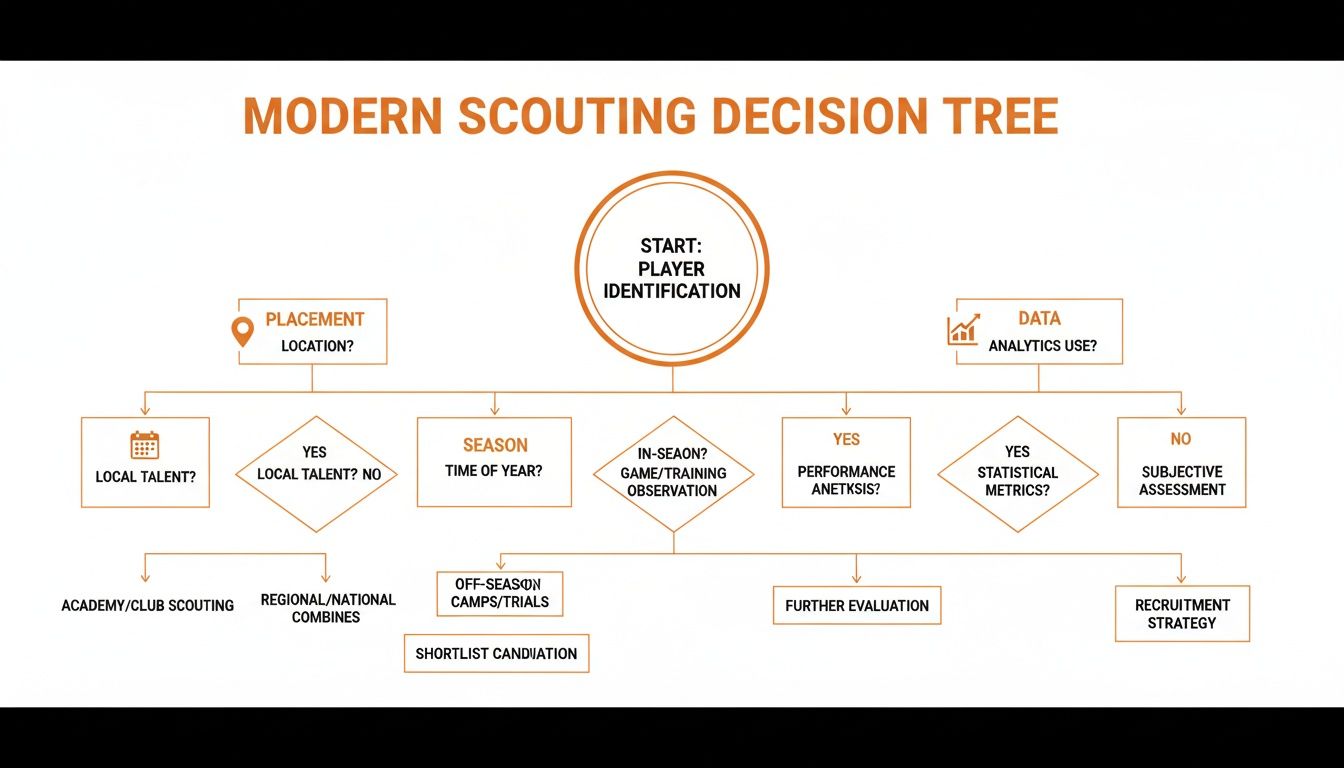
The key takeaway here is that these elements aren't isolated. A fantastic spot in August might be a complete dud during the November rut.
Adapt Your Placement to the Season
A buck's priorities change completely throughout the year, and your camera spots need to change with them. A "set it and forget it" strategy will always leave you one step behind the deer.
Early Season (Summer to Early Fall)
Right now, bucks are still in their predictable bachelor groups, and their lives revolve around nutrition. The best setups are low-impact and centered on food and minerals.
- Mineral Sites: A well-established mineral lick is a magnet for bucks finishing out their antler growth.
- Food Sources: Hang cameras on the edges of soybean fields, food plots, or near white oak stands just before the acorns start dropping.
Pre-Rut and Rut (October to November)
Once testosterone starts flowing, bucks shift from food to breeding. Their movement gets more random, but it's still predictable if you focus on doe activity.
- Scrape Lines: Find those primary scrapes along field edges or ridges and set your camera to watch the action. You can even make your own mock scrape to pull bucks to a specific tree.
- Doe Bedding Areas: The downwind sides of known doe bedding areas are prime real estate for catching bucks cruising for a hot doe.
Pro Tip: When you're setting up on a scrape or a food pile, don’t point the camera right at it. Angle it down the trail leading in. This way, you’ll catch bucks coming and going, which tells you a lot more about their direction of travel.
By thinking like a buck and placing your cameras on these strategic terrain and seasonal features, you turn your scouting from a passive hobby into an active intel-gathering operation. It’s the difference between seeing a few deer and actually patterning the specific buck you plan to hunt.
Dialing In Your Camera Settings to Capture Every Buck
A great spot is useless if your camera settings aren't dialed in. Getting the parameters right is what separates a blurry, worthless photo from a crystal-clear image of that target buck you've been after. The settings you choose need to match your goal for that specific camera location.
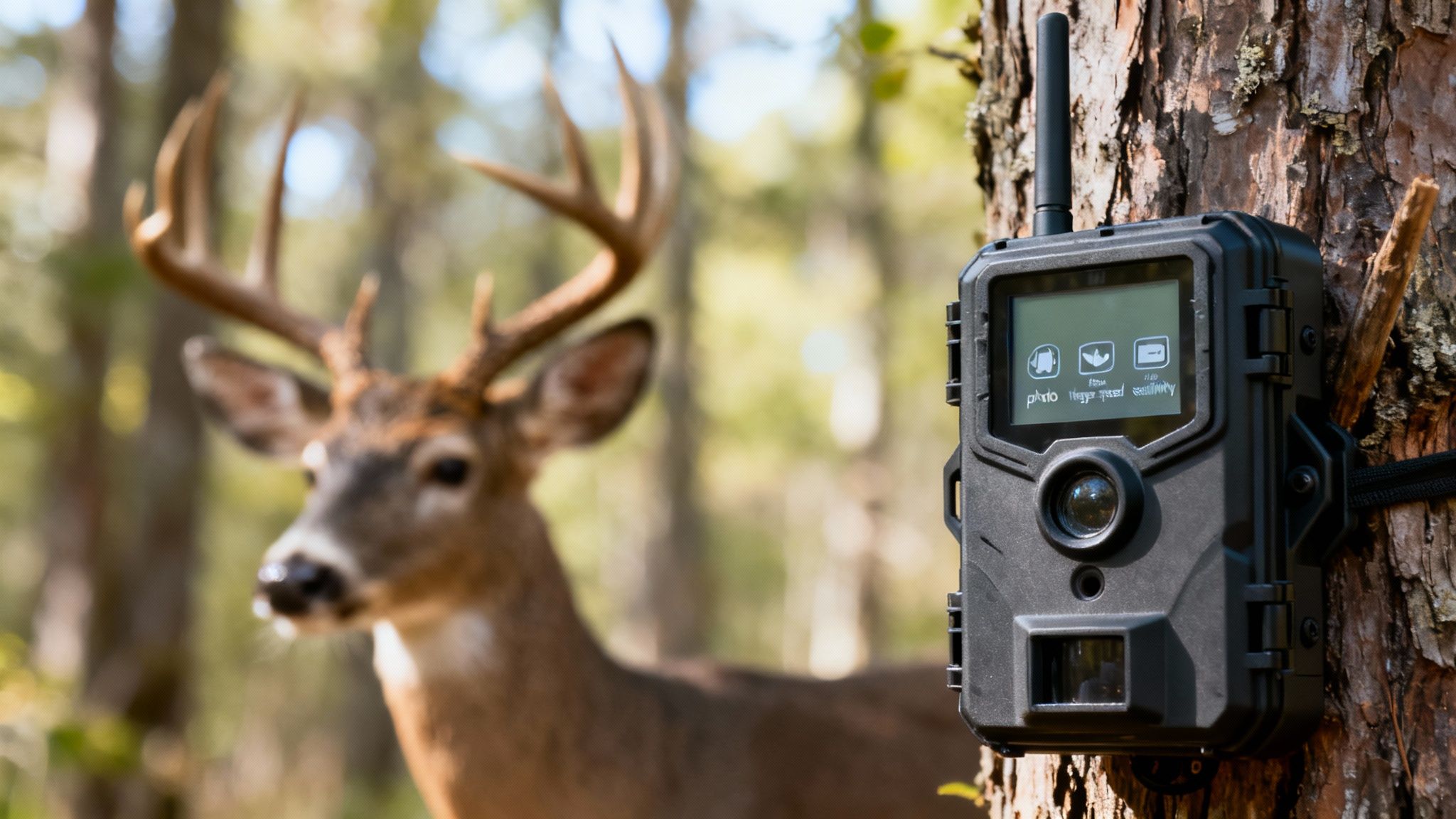
First up, you need to decide on your camera's capture mode. High-resolution photos are fantastic for identifying individual bucks, but video gives you something pictures can't: behavioral context. You can watch how a buck works a scrape, see how he interacts with does, and get a feel for his personality.
Many modern cameras, like our EagleCam 5, have a hybrid or burst mode that grabs both a series of photos and a short video clip. It’s the best of both worlds, giving you a sharp still for your records and a video to break down his behavior.
Fine-Tuning Trigger Speed and Sensitivity
Your trigger speed and delay are absolutely critical. They determine whether you get the shot you want or just drain your battery and fill your SD card with junk. For a camera on a hot trail where bucks are moving through quickly, you need a fast trigger speed—anything under 0.5 seconds is the goal. A slow trigger will just get you a picture of his back end as he leaves the frame.
On the other hand, if you've got a camera watching a food plot or mineral lick where deer hang out, a longer delay between photos is a much smarter move. Setting a 1- to 3-minute delay will keep you from getting a hundred pictures of the same doe munching on clover. It saves battery life and, just as importantly, saves you from sorting through endless duplicate images.
Field Tip: Mature bucks are incredibly cagey. A standard red IR flash can be enough to spook them for good. Your best bet is always a no-glow (black flash) camera to stay completely invisible and capture their natural behavior without tipping them off.
Sensitivity settings are also a huge piece of the puzzle, especially for preventing false triggers. High sensitivity is great for catching deer at a distance, but it can also go off every time the wind blows a branch or a squirrel scurries by. I always lower the sensitivity in windy spots or during the summer when the foliage is thick. You can get a much deeper dive into this in our guide on what PIR sensitivity on a trail camera is.
Cellular and AI Settings for Smarter Scouting
If you're running cellular cams, the settings menu unlocks a whole new level of scouting efficiency. The ability to filter your notifications is an absolute game-changer. No more getting your phone blown up every time a raccoon wanders past.
With an app like MAGIC EAGLE, you can set up the AI to only ping you when it detects a buck. This immediately pushes the most important intel to the top of the pile, letting you react to a target buck's appearance in near real-time. This isn’t just about making things easier; it’s about getting actionable data right when it matters. Timely, targeted notifications for bucks on trail cams mean you spend less time sorting and more time strategizing your next hunt.
Decoding Buck Behavior with Seasonal Trail Cam Data
Your trail camera is more than just a picture-taker; it's a non-stop scouting tool that tells a story. The real magic in getting bucks on trail cams isn't just seeing a big rack—it's piecing together those individual photos to understand a buck's seasonal patterns. A mature buck is a completely different animal in August than he is in November, and your camera strategy needs to change right along with him.
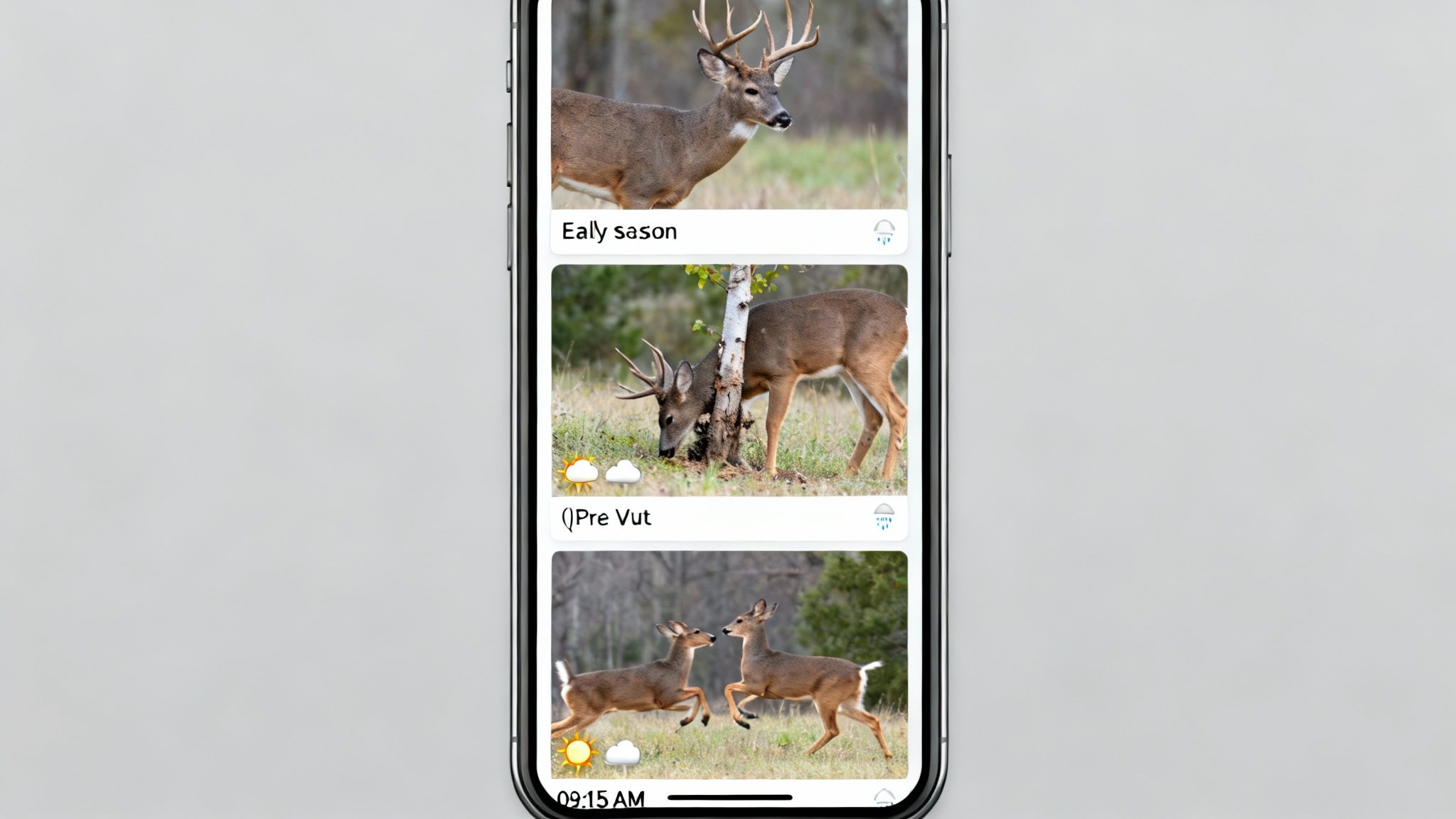
This all starts by paying close attention to the details: the timestamps, the weather data, and the specific locations of your photos. When you connect those dots, you turn a simple picture gallery into hard evidence that can help you predict a buck's next move.
Early Season Velvet Intel
Late summer is all about taking inventory. Bucks are still in their relaxed bachelor groups, and their world revolves around one thing: food. They’re packing on weight and finishing out their antler growth, which makes their patterns incredibly predictable.
- What to Look For: Pay close attention to which bucks are running together. There's almost always a dominant buck in the group, and this social club usually sticks together until the velvet peels.
- Actionable Data: Note the exact times they hit food sources like soybean fields or clover plots. Early-season bucks are often surprisingly visible in daylight, giving you a perfect baseline for their behavior before hunting pressure changes the game.
Once you know who’s on your property, you can start tracking individual deer as the season progresses and things start to heat up.
Trail cameras have completely changed our understanding of deer movement. We're not just guessing anymore; we have hard numbers. In one 2022 study, cams logged bucks on 55% of total triggers, which shot up to 82% during the November rut when bucks can cover up to 5 miles in a single night. Here's the kicker: mature bucks (3.5+ years old) showed up in just 18% of daytime photos but dominated 68% of nighttime pictures. It confirms what we've always suspected—the big ones are ghosts that only our cameras can consistently catch. You can dig into more of these hunting camera market findings on MarketGrowthReports.com.
Pre-Rut and Peak Rut Chaos
As fall sets in, those bachelor groups will dissolve almost overnight. Testosterone takes over, and your camera data will show it. You’ll suddenly see bucks showing up alone, thrashing saplings, and opening up scrapes. That's your signal to move cameras off the food and onto these new communication hubs.
When the peak rut hits, all bets are off. Bucks will be chasing does everywhere, showing up in spots you’ve never seen them before. The most valuable pictures you can get now are of new bucks cruising through or bucks actively dogging does. A sudden influx of unfamiliar faces is the surest sign that the rut is on and bucks are traveling far outside their normal home ranges.
Patterning with Precision
This is where you bring it all together. Using an app like MAGIC EAGLE, you can start layering weather data over your buck photos. You might realize your target buck only shows his face in daylight when the temperature plummets below freezing, or right after a good rain. That's not a coincidence; it's a huntable pattern.
Recognizing that a specific buck is most active on cold fronts between 8 a.m. and 10 a.m. is the kind of intel that fills tags. You’re no longer just sitting in a stand hoping he walks by; you're using data to predict his movement with startling accuracy. This is how you turn your trail cam from a fun toy into an absolute killer of a hunting tool.
Getting Smart with Cellular and AI Scouting
The jump from old-school SD card cameras to modern cellular models has completely changed the scouting game. It’s arguably one of the biggest leaps forward we’ve seen. Cellular trail cams give you a live window into what’s happening in the woods, sending photos and videos straight to your phone.
This instant feedback loop means you can make critical, in-season adjustments without tromping into your best spots over and over again, leaving your scent all over the place. Instead of waiting weeks to finally pull a card, you get an immediate buzz on your phone the moment a target buck walks by. This lets you react to fresh sign and capitalize on changing patterns, moving in for a hunt only when the time is perfect.
Let AI Do the Heavy Lifting
But the real magic of today’s cameras isn’t just the cell signal—it's the smart software working behind the scenes. We've all been there, sifting through hundreds of photos of squirrels, raccoons, and does just to find one or two good buck pictures. It’s a huge time sink.
This is where AI species recognition becomes your best scouting partner. It instantly filters out all the noise so you only see the animals you actually care about.
An app like MAGIC EAGLE automates this entire process for you. You can set it to send notifications only when it identifies a buck, immediately separating the good stuff from the digital clutter. This allows you to build a specific photo library for each target buck, which makes tracking his movements throughout the season incredibly easy. You can read more about how AI species identification technology creates smarter scouting here.
It’s all about scouting smarter, not just harder. Let the tech do the tedious sorting for you.
Build a Live Digital Scouting Map
Modern cellular apps do more than just send you pictures; they turn your phone into a scouting command center. Using interactive mapping features, you can drop pins for every camera location, feeder, mock scrape, and—most importantly—every single buck sighting.
Before you know it, you’ve built a comprehensive, live digital map of your entire hunting property. You’re no longer just relying on memory. This map shows you exactly how a buck moves between different camera locations, connecting his bedding areas to food sources and his favorite rutting hubs. It's a living, breathing picture of his patterns, all updated in real-time without you ever leaving home.
The old argument about bucks being “camera-shy” is pretty much a myth. A multi-year study by the University of Georgia deer lab found that only 12% of bucks showed any kind of camera-shy behavior. And even then, 87% of those bucks came right back to the area within 48 hours. The takeaway? Bucks pattern food and does way more than they worry about a PIR sensor.
The technology just keeps getting better, too. Tools on the horizon, like advanced AI photo enhancer tools, could soon help us clean up blurry or low-light images, revealing critical details about bucks on trail cams that we might have missed before. This constant innovation is making remote scouting more precise every single season.
Traditional vs Smart Cellular Scouting
The difference between old-school scouting and today's methods is night and day. Here's a quick breakdown of how smart cellular cameras change the game.
| Feature | Traditional Trail Camera | Magic Eagle Smart Cellular Camera |
|---|---|---|
| Intel Gathering | Manual SD card pulls (weeks or months between checks) | Real-time photo/video transmission to your phone |
| Property Disturbance | High. Requires frequent trips, leaving scent and noise. | Minimal. Check intel from anywhere without entering the woods. |
| Photo Sorting | Manual. Sift through thousands of images of non-targets. | Automated. AI filters by species (buck, doe, turkey, etc.). |
| Pattern Analysis | Relies on memory and spreadsheets. | Live digital mapping with GPS pins for sightings and camera locations. |
| Reaction Time | Slow. By the time you see the data, the pattern is old. | Instant. React to a buck's presence within minutes, not weeks. |
| Theft/Damage | High risk. You only know it's gone when you go check on it. | Low risk. Instant tamper alerts and GPS tracking. |
The table makes it clear: leveraging modern cellular and AI features isn't just about convenience—it's about gathering better, more actionable intelligence while keeping your hunting spots undisturbed. It’s a strategic advantage that’s hard to ignore.
Common Questions About Scouting Bucks with Trail Cams
Even with the best game plan, specific questions always pop up out in the timber. Let’s break down some of the most common hurdles hunters face when trying to get more bucks on trail cams. Nailing these little details can be the difference between a good season and a great one.
Getting these small adjustments right will turn your trail cam from a simple picture-taker into a powerful intel-gathering tool for patterning that mature buck you're after.
How High Should I Mount My Trail Camera to Avoid Spooking Bucks?
Most guys will tell you to mount it at chest height, somewhere around 3 to 4 feet off the ground. This gives you a great, natural-looking shot of the deer. And for a lot of places, that works just fine. But on properties where deer see a lot of human pressure, mature bucks get real smart, real fast, about cameras mounted at eye level.
For those super-wary old bucks, try getting the camera way up high—I’m talking 6 to 8 feet up—and angling it down sharply. This gets it completely out of their normal line of sight. Just be sure to trim any small, leafy branches in front of the lens that might sway in the wind and give you a thousand pictures of nothing.
Expert Tip: If you're running a cellular camera that has a live-view feature, you can dial in that angle perfectly from your phone. This means you can confirm the field of view without making another trip into the woods and leaving more scent behind.
This "high-set" method is especially deadly over mock scrapes or mineral licks where a buck is already on high alert.
What Is the Best Way to Use Scents with My Trail Camera?
Scents are a killer way to stop a buck exactly where you want him, giving the camera more than enough time to grab a whole series of clear photos. The trick is all in the placement—you want to position the scent so he has to turn broadside to your camera to investigate.
During the pre-rut and rut, I like to hang a scent wick soaked in doe-in-estrus or a dominant buck lure from an overhanging branch. Place it right in the sweet spot of your camera’s detection zone. The whole point is to make him stop, work the licking branch, and give you that perfect, stationary pose.
In the early and late seasons, food-based attractants can be pure magic. But always—and I mean always—check your local regulations. Baiting is illegal in many states and counties.
How Many Trail Cameras Do I Really Need for My Property?
There's no magic number here, but a good rule of thumb is to start with one camera for every 50 to 100 acres, depending on how thick the habitat is. For a pretty standard 100-acre piece of ground, running two or three cameras lets you cover a key food source, a major travel corridor, and a potential bedding area all at once.
This multi-cam setup helps you piece together a much bigger story of how different bucks are using your entire property. This is where cellular cameras really shine. You can hang them in those sensitive sanctuary spots and get daily updates without ever putting boots on the ground and bumping deer.
How Can I Fix Blurry Night Photos of Bucks?
Blurry night pictures are almost always caused by motion blur. It happens when a buck walks or trots past faster than your camera's shutter speed can freeze the action. The fix is usually a simple tweak to either your location or your camera's settings.
First, try moving the camera off a hot-and-heavy travel corridor and onto a spot where deer are more likely to stop and linger, like a food plot edge or a scrape. That alone often solves the problem. Second, dig into your camera's settings menu. Many newer models have a "motion blur reduction" or "fast shutter" mode that prioritizes a quicker shutter to deliver crisp, clear night images. Lastly, make sure that camera is strapped down tight to a solid, thick tree to kill any camera shake.
Ready to stop guessing and start getting real-time intel on the bucks you're hunting? The Magic Eagle EagleCam 5 delivers instant AI-filtered notifications, GPS anti-theft protection, and crystal-clear images directly to your phone. Scout smarter and hunt harder by visiting https://magiceagle.com to see the difference for yourself.