

The best camera for wildlife photography isn’t a single model you can pull off a shelf. The real answer depends entirely on your mission. For those frame-worthy, artistic shots, nothing beats a DSLR or mirrorless camera. But for 24/7 remote scouting, a modern cellular trail camera like the Magic Eagle EagleCam 5 is a game-changer.
What Really Makes a Great Wildlife Camera?
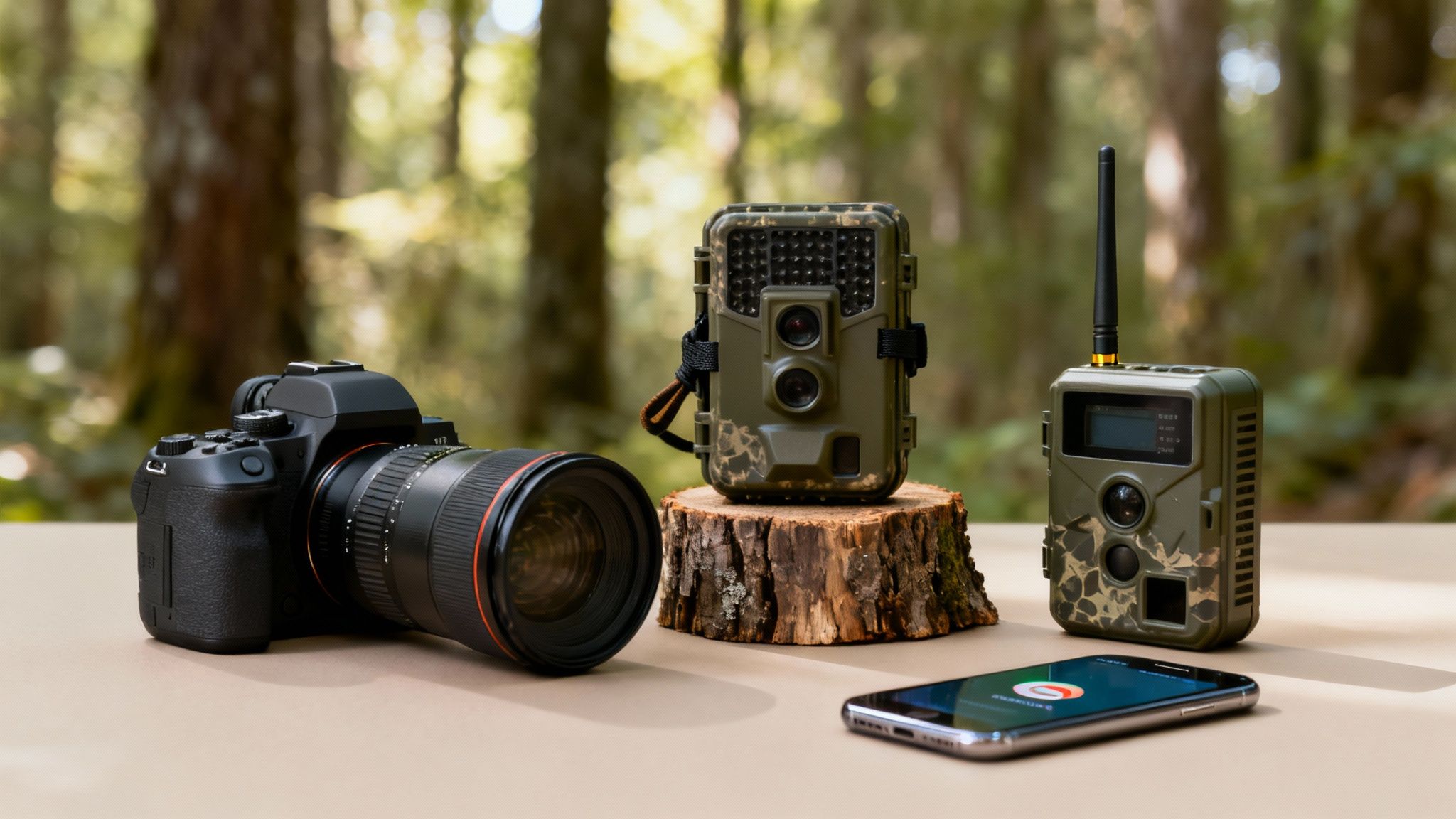
Before you even look at specs, the first question to ask is simple: What job does this camera need to do? It's a critical first step because the world of wildlife cameras is full of specialized tools built for very different tasks.
Think of it like picking a vehicle. You wouldn't take a sports car to haul lumber any more than you'd enter a dump truck in a road race. It’s all about matching the tool to the goal.
The Right Tool for the Job
Your mission in the field dictates the gear you need. There’s no one-size-fits-all solution, but breaking it down by purpose makes the choice crystal clear. Are you out there creating art, or are you gathering intel from afar?
- For the Artist: If your goal is capturing those breathtaking, high-resolution images you see in galleries, a DSLR or mirrorless camera is your paintbrush. These systems give you complete manual control, creative freedom, and unmatched image quality.
- For the Scout: If you need to monitor animal behavior, pattern game movement, or just keep an eye on your property without being there, a trail camera is your silent, tireless observer. It works day and night, rain or shine.
The biggest mistake people make is buying a camera based on specs alone, without first defining its purpose. A camera with the highest megapixel count is totally useless if it can't survive a downpour or send you a photo from a remote ridge when you need it most.
A Quick Guide to Wildlife Camera Types
To help you decide, here’s a quick breakdown of the main camera categories, their strengths, and where they fall short.
| Camera Type | Primary Use Case | Key Strengths | Key Limitations |
|---|---|---|---|
| DSLR/Mirrorless | Artistic photography, high-quality video | Superior image quality, lens variety, full manual control | Expensive, fragile, requires active use, not weatherproof |
| Passive Trail Cam | Basic remote scouting, long-term monitoring | Affordable, long battery life, simple to use | Requires manual SD card retrieval, no real-time updates |
| Cellular Trail Cam | Real-time remote monitoring, security, research | Instant photo/video transmission, remote settings, app control | Requires data plan, higher initial cost, needs cell signal |
| Smartphone | Casual, opportunistic shots | Always with you, easy to share, good in ideal lighting | Poor zoom, limited low-light ability, not durable |
This table gives you a starting point, but technology is always evolving.
The Rise of Specialized Solutions
This guide will cover all the options, but it’s crucial to see how much specialized tech has advanced. Modern cellular trail cameras, like the Magic Eagle EagleCam 5, have moved way beyond just taking pictures. They are now intelligent monitoring systems built for real-time remote access.
Instead of just collecting data for you to check days or weeks later, these cameras deliver instant intel straight to your phone. That’s a massive advantage for anyone who needs timely information, whether for hunting, research, or managing land. Choosing the right outdoor cameras for wildlife is all about matching the technology to what you actually need to accomplish.
And the demand for these smart tools is exploding. The global market for trail cameras is set to grow from about USD 1.2 billion in 2024 to an estimated USD 2.5 billion by 2033. This boom is driven by a mix of recreational photography, serious research, and the simple fact that cellular connectivity makes remote monitoring easier and more powerful than ever before.
Understanding the Three Main Types of Wildlife Cameras
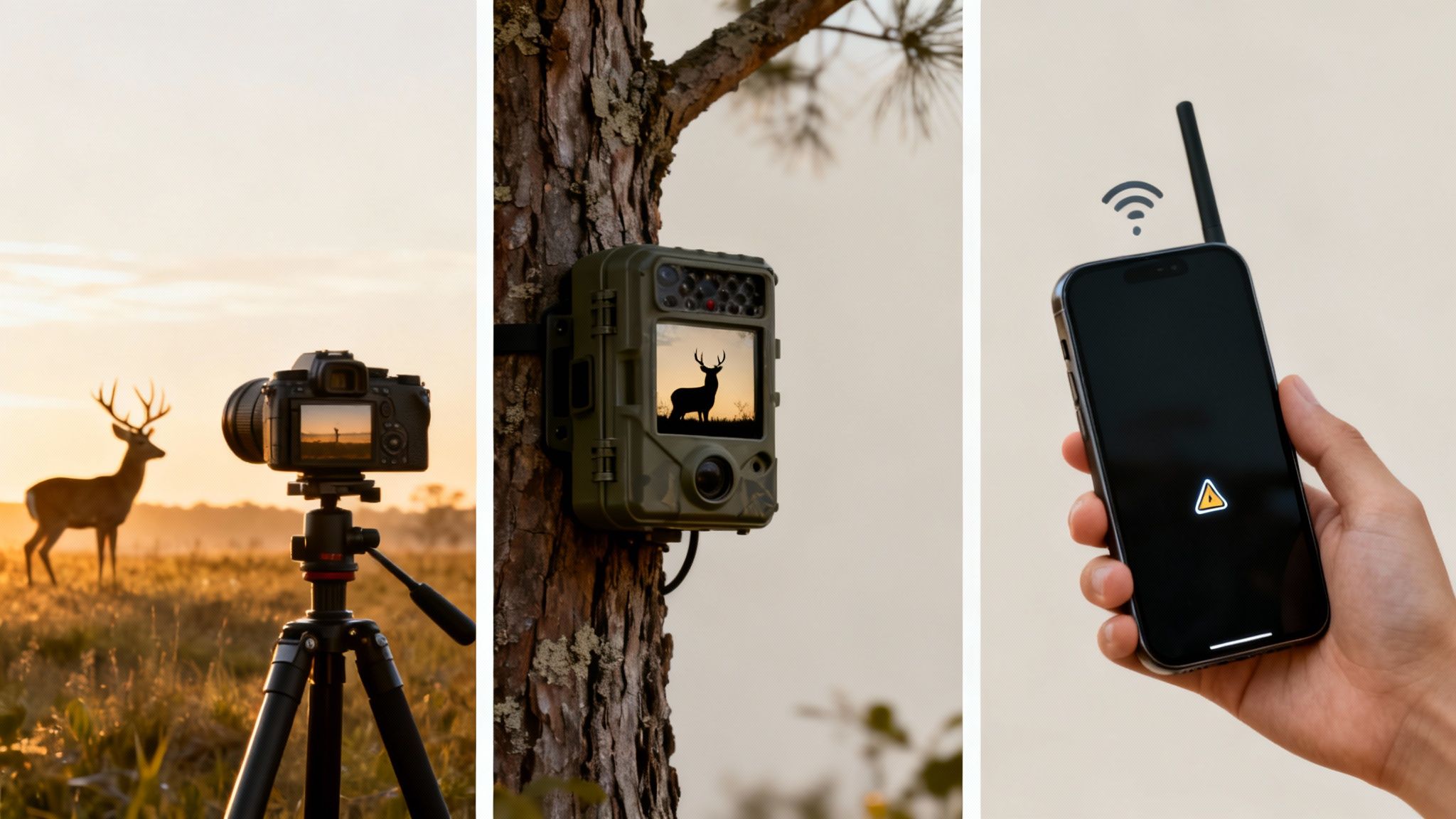
When you're trying to find the best camera for wildlife photography, it's easy to get lost in brands and model numbers. A better approach is to think in categories. Each type of camera is really a specialized tool built for a specific job out in the field.
Let's break down the three primary tools of the trade. Understanding what each one does best is the key to matching the right gear to your goals.
To make it simple, think of it this way: a DSLR is the professional artist, a standard trail cam is the diligent field researcher, and a cellular trail cam is the real-time security guard.
DSLR and Mirrorless Cameras: The Artist’s Toolkit
When people imagine professional wildlife photography, they're picturing a DSLR or mirrorless camera. These are the systems behind those breathtaking, high-resolution portraits you see in magazines and galleries. Their biggest advantage is giving you complete creative control over every single detail of the image.
With interchangeable lenses, you can go from a wide-angle shot capturing an animal in its environment to a massive super-telephoto lens for a tight portrait from hundreds of yards away. You get to manually dial in settings like aperture, shutter speed, and ISO to nail the exact artistic effect you want, whether it's a creamy blurred background or a tack-sharp action shot.
But all that control comes at a cost. These cameras are expensive, can be fragile, and—most importantly—require you to be physically there, holding and operating them to get the shot. They just aren't designed to be strapped to a tree and left in the woods for weeks.
Standard Trail Cameras: The Silent Observer
A standard trail camera (often called a passive or traditional trail cam) is a totally different animal. Picture it as a silent field notebook, automatically and dutifully recording everything that walks by. You set it up in a promising spot, and its motion sensors trigger photos or videos whenever wildlife shows up.
Its main strengths are affordability, simplicity, and an incredible battery life that can often last for months on a single set of batteries. It’s the perfect tool for long-term, low-impact monitoring when you don't need instant updates. You can deploy a whole fleet of these cameras over a large area to map out animal patterns without breaking the bank.
The key trade-off with a standard trail camera is the information delay. You won't know what it has captured until you physically hike out to the camera, retrieve the SD card, and review the footage back home. This can mean days or even weeks between an event happening and you knowing about it.
Cellular Trail Cameras: The Real-Time Scout
Cellular trail cameras take remote monitoring to the next level. Just like a standard trail cam, they get set up in the field and trigger automatically. The game-changing difference is the built-in cellular modem, which lets them instantly send photos and videos right to your smartphone.
This feature turns them into your live surveillance system for the wild. Instead of waiting weeks to check an SD card, you get an alert the moment a buck strolls past your stand or a predator gets near your property. Models like the Magic Eagle EagleCam 5 push this even further with features like live-streaming, giving you a real-time window into a remote location from anywhere in the world.
This instant access is a massive advantage for anyone who needs timely intelligence, including:
- Serious Hunters: Reacting to real-time game movements.
- Wildlife Researchers: Monitoring endangered species without causing disturbance.
- Land Managers: Keeping an eye on remote property lines or feeders.
While they do require a data plan and have a higher initial cost, the ability to get immediate, actionable information makes cellular trail cameras an indispensable tool for modern wildlife management and scouting. They effectively close the gap between seeing something and being able to act on it.
Key Camera Features That Actually Matter in the Field

It’s easy to get lost in technical spec sheets. They're packed with numbers and acronyms that don't always add up to better wildlife photos. When you’re actually out there, only a handful of features truly separate a good camera from a great one. Knowing what to look for helps you choose based on real-world performance, not just marketing hype.
Think of it this way: a powerful engine is useless in a car with bad tires. In the same vein, sky-high megapixels mean nothing if the camera is too slow to catch the action or dies in the first cold snap. We're going to focus on the "tires" of wildlife photography—the features that give you the grip and reliability you need to succeed.
Trigger Speed and Burst Rate
Picture a sprinter at the starting line. Their reaction time—that split second between the starting gun and their first move—decides the race. A camera's trigger speed is exactly like that. It’s the delay between the sensor detecting motion and the camera actually snapping the first picture.
For fast-moving animals, this is non-negotiable. A trigger speed of 0.5 seconds might sound quick, but it’s often too slow to capture a buck as it steps into a clearing. Top-tier trail cameras boast trigger speeds of 0.2 seconds or less, which is the difference between a perfect broadside shot and a blurry photo of a tail leaving the frame.
The burst rate, or frames per second (FPS), is just as important. It determines how many photos the camera can fire off in quick succession, which is key for capturing the subtleties of animal behavior or just making sure you get one perfect shot out of a fast-moving sequence.
Sensor Size and ISO Performance
A camera's sensor is like the retina of your eye. A bigger sensor can gather more light, which is incredibly important since most interesting animal activity happens during the low-light hours of dawn and dusk. This is where sensor size and ISO performance work hand-in-hand.
ISO is a measure of the sensor's sensitivity to light. A higher ISO number lets the camera "see" better in the dark, but there's often a trade-off: digital noise, which shows up as grainy speckles in your photos. A camera with a larger, higher-quality sensor can handle high ISO settings with minimal noise, delivering clean, detailed images even when it’s nearly dark.
This combination is what allows a camera to give you a usable photo of a coyote at twilight or an owl after sunset. When you're comparing cameras, don't just look at the maximum ISO number; hunt for real-world examples of its low-light performance.
When you're picking a camera, look for proof of clean, low-noise images at high ISOs (like 3200 or 6400). That’s a far better sign of real-world performance than a spec sheet that just lists a massive, but often unusable, maximum ISO.
Weatherproofing and Power Efficiency
A wildlife camera is worthless if it can't survive the very environment it's designed for. Durability isn't a luxury; it's a basic requirement. This is where IP ratings (Ingress Protection) come into play.
- IP66: This rating means the camera is completely sealed against dust and can handle powerful jets of water. It’s a solid standard for gear that will face heavy rain and wind.
- IP67: This goes a step further, guaranteeing the camera can be fully submerged in up to one meter of water for 30 minutes without failing.
Beyond durability, power efficiency decides how long your camera can operate on its own. For trail cameras left in the field for weeks or months, battery life is everything. A camera that needs new batteries every few days is a non-starter for remote scouting.
Look for models built for multi-month battery life, often supported by efficient PIR (Passive Infrared) sensors that sip power. You can learn more about how these crucial sensors work in our guide to understanding PIR sensitivity on a trail camera.
Serious photographers and researchers consistently prioritize these same features: lightning-fast trigger speeds, great low-light sensitivity, and rock-solid power efficiency. Cameras with sub-0.2 second trigger speeds are in high demand, while rugged, waterproof designs (IP66/IP67) and multi-month battery life are now considered standard for any serious field deployment.
Why Cellular Trail Cameras Are a Modern Game Changer
Traditional wildlife photography methods, whether you're behind a DSLR or just pulling SD cards from a passive trail camera, have one thing in common: a time delay. You end up learning about animal behavior days or even weeks after it actually happened. But what if you could shrink that gap from weeks to seconds? That's exactly where cellular trail cameras come in, and they completely change the game.
These devices aren't just cameras you leave in the woods; think of them more like intelligent, remote monitoring systems. By building in 4G connectivity, they transform passive data collection into active, real-time intelligence. This shift is a huge deal for anyone who needs to make decisions based on what's happening right now.
From Delayed Data to Instant Insight
Imagine your standard trail camera is a mailbox. You have to physically drive out, walk to your spot, and open it up to see if there’s any news. A cellular trail camera, on the other hand, is like getting an instant text message with a photo attached. The second a buck walks into your food plot or a bear wanders near the cabin, you know about it.
This immediate feedback is the core advantage. For a hunter, it means you can adapt your strategy based on what’s happening today, not what happened last Tuesday. For a researcher, it allows for instant observation of rare or nocturnal species without tromping through their habitat and disturbing them. It turns a reactive process into a proactive one.
The Magic Eagle EagleCam 5, for example, makes this entire experience seamless. With its simple no-SIM-required setup, the camera gets online in minutes, ready to send high-resolution images and videos straight to the MAGIC EAGLE app on your phone.
More Than Just Photos: The Power of Smart Features
Modern cellular cameras do a lot more than just send you pictures. They're packed with technology that gives you deeper context and more control, making them an essential tool for serious scouting and property management.
- AI Species Recognition: Instead of scrolling through hundreds of photos of squirrels and raccoons, the camera’s AI can automatically identify and tag different species. This saves hours of manual sorting and lets you focus only on the animals you’re actually tracking.
- Live-Streaming on Demand: This feature is your real-time window into a remote location. You can check conditions, watch animals interact, or just confirm a sound you heard without ever leaving your seat.
- Remote Settings Control: Need to switch from photo mode to video? Want to adjust the sensitivity after a windy day? You can do it all from your smartphone app, which means fewer trips back to the camera and a smaller human footprint in the area.
The real value of a cellular trail camera isn't just about the convenience of remote access. It's the power to gather immediate, actionable intelligence that reduces human disturbance, saves countless hours, and leads to more successful outcomes in the field.
The Technology Driving the Trend
The market is clearly responding to this demand for instant connection and smart features. Cellular-enabled devices and AI are rapidly gaining market share, with connectivity now being a key reason people choose one camera over another. Features like anti-theft GPS tracking and AI species recognition cut data-collection latency from days to mere seconds, reduce hardware loss, and command price premiums of 15–40% over non-connected models. You can discover more insights about this growing market on 24marketreports.com.
This isn't just a niche trend; it's a fundamental shift in how we approach remote monitoring. If you want to get a handle on the tech, a great starting point is learning how cellular trail cameras work to get data from the field to your phone.
Systems like the EagleCam 5 are at the forefront of this evolution. Its SignalSync technology actively finds and connects to the strongest available cell network, ensuring you stay connected even in those fringe service areas. This reliability is what makes a cellular camera a true partner in the field, not just another gadget. By combining a powerful camera with a smart, connected ecosystem, it delivers the insights you need, exactly when you need them.
Choosing the Right Camera for Your Specific Goal
Finding the "best" camera for wildlife photography isn't about chasing the highest megapixel count or the most expensive lens. It’s about solving a problem. The right tool for the job completely depends on your mission out in the field.
To make things simple, let's walk through a few common scenarios. By matching your real-world needs to the right type of camera, you can invest with confidence and avoid that sinking feeling of buying a powerful tool that’s completely wrong for what you need to do. Are you creating art, managing land, or gathering critical, time-sensitive intel?
The Artistic Photographer
If your end goal is to create stunning, gallery-quality images—the kind with perfect light, flawless composition, and breathtaking detail—then your choice is clear. You need a DSLR or mirrorless camera.
These systems are built for creative control. You can swap lenses to capture a vast landscape one minute and an intimate portrait the next. You have full manual command over every setting. But this path requires you to be there, behind the lens, patiently waiting for that one perfect moment to unfold.
The Land Manager or Casual Observer
Now, let's picture a totally different goal. Maybe you're a land manager who just needs to know if deer are hitting a new food plot. Or you're a homeowner who's simply curious about what critters wander through your backyard at night. Here, the priorities shift to reliability and simplicity.
For this kind of job, a network of standard (passive) trail cameras is usually the most practical and budget-friendly choice. They’re workhorses—affordable, tough, and capable of running for months on a single set of batteries. They’ll dutifully record everything that walks by. The only catch? You won’t know what they’ve captured until you physically hike out and pull the SD cards.
The Serious Hunter and Wildlife Researcher
What if your mission is more urgent? A dedicated hunter needs to know where a target buck is moving today, not last week. A wildlife researcher tracking an endangered species needs immediate alerts without tromping through the habitat and disturbing everything. For these folks, timely data isn't a luxury—it’s everything.
This is where a cellular trail camera like the Magic Eagle EagleCam 5 shines. It closes the time gap between an event happening and you knowing about it. You get instant photo and video notifications sent right to your phone, letting you make smart, real-time decisions. Features like live-streaming and remote settings control turn it from a simple camera into a powerful intelligence tool you can manage from miles away.
This simple flowchart breaks down the very first question you should ask yourself. Do you need to know now, or can it wait?
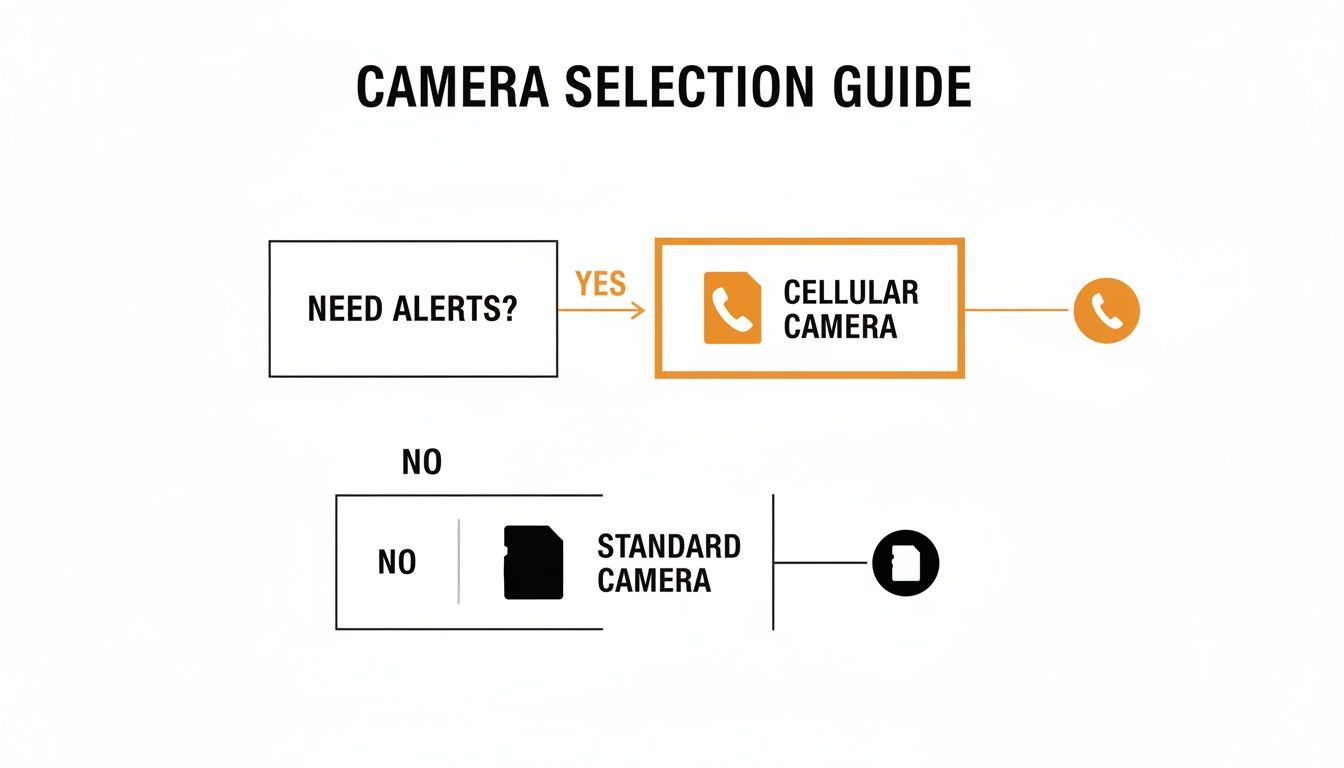
The takeaway is simple: if real-time information is critical to your success, a cellular camera is the only logical choice. While our focus here is on wildlife, the core principle of matching the tool to the task applies everywhere, even in specialized fields like choosing the best RV backup camera systems for safety and navigation.
Ultimately, the "best" camera is the one that directly supports your objective. Don't pay for features you don't need, but don't compromise on the capabilities that will make or break your mission in the field.
To tie it all together, the table below helps you match your specific goal to the right camera and the features that truly matter for that task.
Matching Your Goal to the Right Camera
| Your Goal | Recommended Camera Type | Must-Have Features | Magic Eagle Solution |
|---|---|---|---|
| Gallery-Quality Art | DSLR or Mirrorless | Interchangeable Lenses, Manual Controls | N/A (Requires you to be there) |
| Basic Monitoring | Standard Trail Camera | Long Battery Life, Affordability | N/A (No real-time data) |
| Real-Time Scouting | Cellular Trail Camera | 4G Connectivity, Live-Stream, App Control | EagleCam 5 |
By nailing down your primary objective first, the rest of the decision becomes easy. You can cut through the noise and pick the perfect tool to help you succeed.
So, How Do You Make the Final Call?
When it comes down to it, picking the best camera for wildlife photography boils down to one simple question: What are you actually trying to accomplish out there? We’ve covered a lot of ground, but the "best" gear is always just the right tool for the job. Your mission should drive your equipment choice, not the other way around.
A DSLR or mirrorless camera is an artist’s toolkit. It gives you incredible image quality and total creative control, but it always requires you to be there. You’re the one behind the lens, waiting patiently for that perfect, fleeting moment to unfold.
A standard trail camera is more like a silent, diligent field notebook. It’s the most budget-friendly option for long-term monitoring when you don’t need instant updates. You set it, forget it, and come back later to see what visual data it’s dutifully collected for you.
The Modern Choice for Real-Time Intelligence
Then you have the cellular trail camera, which has completely changed the game for anyone needing timely information. This device is your scout in the field, sending instant alerts and actionable intel straight to your phone. It closes the gap between an animal showing up and you knowing about it, turning passive monitoring into a proactive strategy.
For serious hunters, wildlife researchers, and property managers who need that immediate insight, the Magic Eagle EagleCam 5 is the clear choice. It’s more than just a camera that takes pictures; it's a full-blown remote monitoring system.
The real value of a camera isn’t in its spec sheet—it’s in its ability to help you achieve your goal. For anyone who needs reliable, immediate data from the wild, a cellular camera is no longer a luxury. It’s essential equipment.
The EagleCam 5 was built to handle the harshest conditions, giving you dependable performance right when you need it most. Features like AI species recognition, live-streaming, and a simple, no-SIM-required setup take all the friction out of remote scouting.
If your success depends on knowing what’s happening in the field right now, the EagleCam 5 is your answer. Take a look at the features of the Magic Eagle EagleCam 5 to see how it can become your ultimate partner for wildlife management and scouting.
Frequently Asked Questions
Jumping into the world of wildlife cameras can bring up a lot of questions, especially with all the new tech hitting the market. To help you feel confident in your choice, we’ve put together answers to some of the most common things people ask when searching for the right camera.
Is a 4K Trail Camera Really Necessary?
It’s easy to get drawn in by the promise of 4K, but for a trail camera, it's often overkill. Think of it this way: 4K video files are absolutely massive. Recording them, and especially transmitting them over a cellular network, eats up a ton of battery life and mobile data—two resources you can't afford to waste in the field.
For most scouting and monitoring, a crisp 1080p or even a 2K video gives you all the detail you need. You'll be able to identify species, check an animal's health, and watch its behavior without any issues.
Choosing a lower resolution like 1080p usually gives you a much smarter balance of clear video, longer battery life, and lower data costs. You get the intel you need without burning through your resources on files that are bigger than necessary.
How Can a Cellular Camera Work Without a SIM Card?
You might have noticed that many modern cellular cameras, including the Magic Eagle EagleCam 5, no longer need you to buy and install a physical SIM card. They’ve moved on to something better: integrated eSIM or multi-carrier technology built right into the camera.
This is a game-changer for simplicity and reliability. When you turn the camera on, it automatically scans for all available cellular networks in the area and locks onto the one with the strongest signal. This means you don't have to guess which carrier is best for your spot or fumble with tiny SIM cards and activation codes. It just works, keeping you connected even in remote places where service can be unpredictable.
What’s the Biggest Mistake When Setting Up a Trail Camera?
Hands down, the most common mistake is bad placement and aiming. It’s natural to point the camera straight at the spot you want to watch, like a feeder or a game trail. The problem is, this head-on angle is a magnet for false triggers from things like branches swaying in the wind or the sun moving across the sky.
A much better way to do it is to set your camera at a 45-degree angle to your target area. This simple shift in strategy pays off big time:
- Fewer false triggers: Angling the camera helps you avoid direct sun glare and moving shadows that can trick the motion sensor.
- Better animal shots: This angle captures the animal’s whole body as it moves through the frame, not just a quick shot of its head or tail.
- Maximizes sensor range: The motion sensor is far better at detecting movement across its field of view than it is at picking up something walking straight toward it.
Taking a couple of extra minutes to find that perfect angle and clear a few stray branches will make a world of difference in the quality of your captures.
For a cellular trail camera that makes setup a breeze and delivers reliable performance in the field, check out the Magic Eagle EagleCam 5. See its smart features and tough design for yourself at https://magiceagle.com.