

Figuring out the best camera for filming hunts all comes down to what you’re trying to accomplish. There’s no single right answer. If you’re running remote recon for pre-hunt intel, a cellular trail camera like the Magic Eagle EagleCam 5 is purpose-built for the job. But if you want to capture the action from your point of view, you'll need an action cam. For true cinematic quality, nothing beats a DSLR or mirrorless camera.
Your hunting style and what you want to walk away with on film will point you to the right tool.
Comparing Camera Types for Filming Hunts
Picking the right camera isn’t about finding one perfect device; it's about matching the gear to the mission. The three main players—cellular trail cameras, action cameras, and DSLR/mirrorless cameras—are designed for completely different tasks out in the field. Getting a handle on what each does best (and where it falls short) is the first step to building a setup you can count on.
A hunter’s needs shift dramatically from pre-season scouting to the actual moment of the shot. The camera that silently watches a food plot for weeks on end is the wrong tool for capturing the explosive action of a flushing bird. And that rugged little camera strapped to your bow just doesn't have the chops for producing professional-grade footage.
Matching the Camera to Your Goal
The whole decision really boils down to one of three goals: gathering intel, capturing your personal experience, or producing a high-quality film.
- Scouting and Intelligence: Here, the objective is to pattern animal movement 24/7 without ever setting foot in the woods. This demands stealth, serious battery life, and remote access. Cellular trail cameras were made for this, sending photos and videos straight to your phone so you can stay out of the area.
- First-Person Action: If you want to relive the hunt from your own perspective, you need something small, tough, and totally hands-free. Action cameras own this space. They mount easily to your bow, firearm, or a head strap to pull viewers right into the moment.
- Cinematic Production: For anyone serious about creating hunting films with sharp details, beautiful colors, and that professional look, a DSLR or mirrorless camera is a must. These cameras give you top-tier image sensors, the flexibility of interchangeable lenses, and full manual control.
This decision tree gives you a quick visual for how your main goal—whether it's scouting, action, or cinematic quality—points directly to the ideal type of camera.
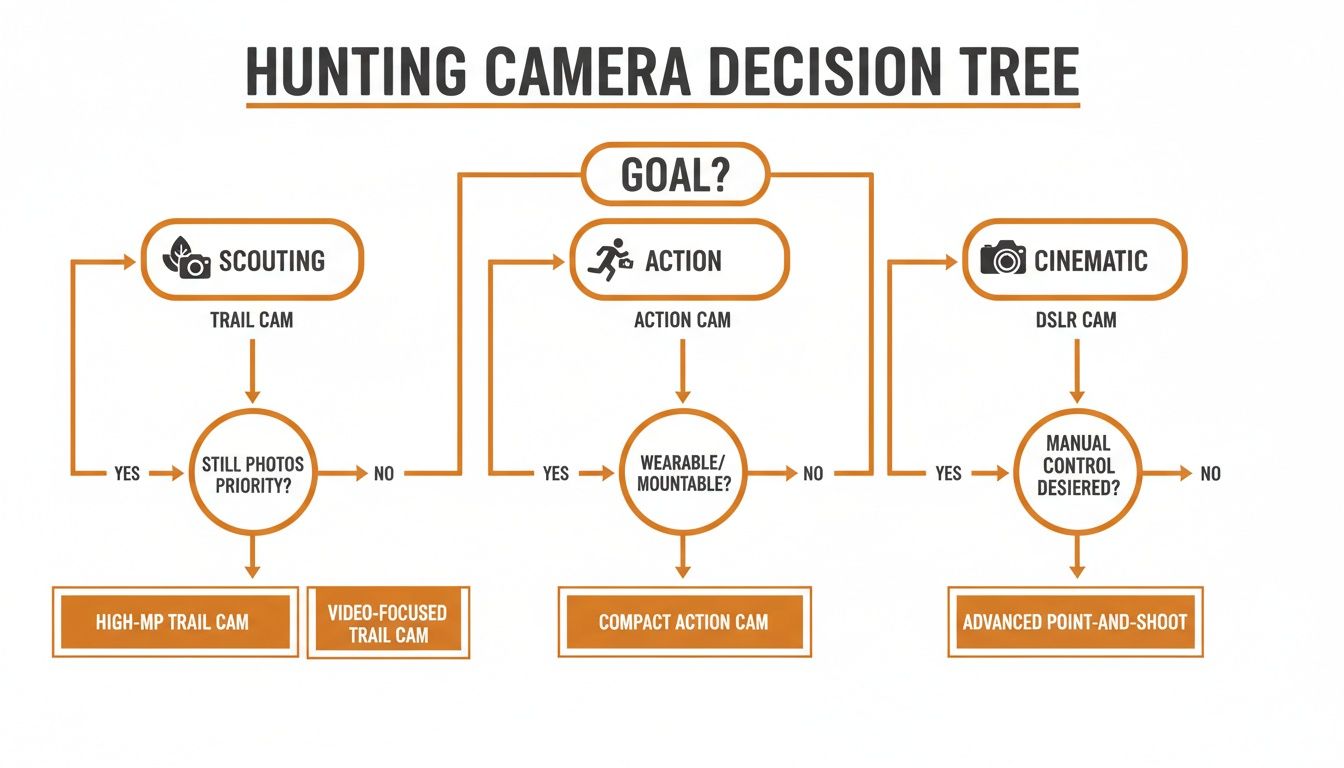
As you can see, your objective is the most important piece of the puzzle. It immediately filters your options down to the most effective tool, with each path leading to a camera category built for a specific hunting scenario.
Quick Comparison of Hunting Camera Types
To put it all in perspective, here's a high-level look at each camera type, highlighting its core function and the trade-offs you'll have to make.
| Camera Type | Primary Use Case | Key Advantage | Main Limitation |
|---|---|---|---|
| Cellular Trail Camera | Remote scouting and wildlife monitoring | Real-time intel without disturbing the area | Lower video quality than dedicated video cameras |
| Action Camera | Capturing first-person, hands-free footage | Extreme durability, portability, and wide field of view | Limited zoom and poor low-light performance |
| DSLR/Mirrorless | Producing cinematic, professional-grade video | Superior image quality, lens versatility, and low-light capability | Bulk, complexity, and lack of ruggedness |
Each camera type has a clear role. A cellular camera gives you the intel, an action camera puts you in the hunt, and a DSLR/mirrorless setup turns that hunt into a film. Many serious hunters end up using a combination of all three to cover every angle.
The Strategic Advantage of Cellular Trail Cameras
Cellular trail cameras are a game-changer, plain and simple. They’re far more than just motion-activated cameras; they represent a fundamental shift in how we hunt. Instead of reacting to old sign and stale intel, this technology lets you operate proactively, making sharp decisions based on what’s happening right now. The advantage is simple but powerful: you get a constant, remote presence in your hunting area without ever leaving a boot print.
This completely transforms how you scout before the season and make adjustments once it starts. You're no longer guessing when a target buck is on his feet. You’re not contaminating a core area by checking a standard trail camera every few weeks. With a cellular model, your phone buzzes the moment a deer walks by, giving you immediate, actionable information that dictates your next move.
From Reactive to Proactive Hunting
Traditional hunting has always involved a lot of guesswork. You find rubs, scrapes, and tracks, then make an educated guess about where to set up. A cellular camera cuts through a huge amount of that uncertainty by delivering a live feed of animal activity, turning assumptions into confirmed patterns.
This shift is everything. Imagine knowing a specific buck hit a scrape three mornings in a row, all within a tight 15-minute window. That’s not just data; that's your game plan for tomorrow morning. You can map out exactly how deer are moving, identify specific animals, and pinpoint their core areas without ever bumping them.
The real value of a cellular camera isn't just the photos it takes—it’s the hunts it prevents. By showing you when and where the action isn't happening, it saves you from burning out your best spots and wasting time in unproductive stands.
This is what strategic patience is all about, and it's what separates consistently successful hunters from everyone else. You learn to strike only when the conditions and animal patterns are perfectly aligned, which maximizes your chances and minimizes your impact.
The Power of Scent-Free Scouting
Every time you step into the woods, you leave a trail of scent, sound, and visual disturbances. Those intrusions can alter deer behavior for days, often pushing mature bucks to go nocturnal or abandon an area altogether. Cellular trail cameras are the ultimate answer to this problem—they act as your silent, scent-free scouts.
- Zero Pressure Monitoring: Check your cameras from home, the office, or your truck. The wildlife remains totally undisturbed and acts naturally.
- Long-Term Patterning: By staying out of the woods, you can gather weeks or even months of pure, unbiased data. This reveals subtle shifts in movement tied to weather, food sources, and the rut.
- Instant Verification: Did a cold front just roll in? You can see instantly if it got the deer moving without having to hike in and check.
The explosive growth of this technology proves how effective it is. The global trail camera market is booming, set to jump from USD 852.97 million in 2024 to an expected USD 1,420.95 million by 2032. North America is the heart of this trend, with surveys showing that around 62% of hunters now rely on trail cameras to build their strategies. You can learn more about the market's rapid expansion on 360iResearch.com.
The Magic Eagle EagleCam 5 Edge
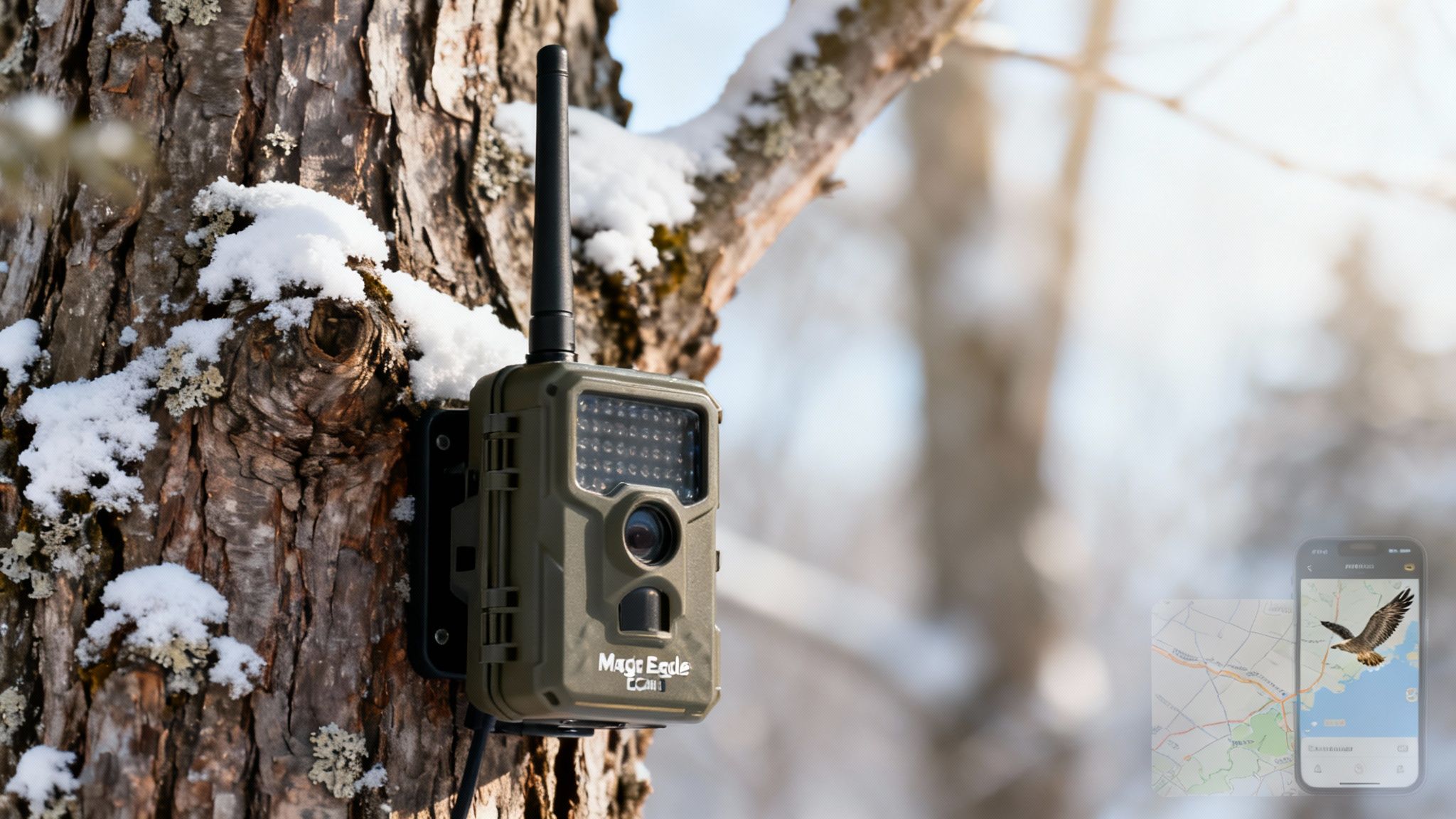
The Magic Eagle EagleCam 5 is a perfect example of this advanced scouting technology in action. It was built from the ground up to address what serious hunters actually need: reliability, smart features, and no-fuss operation. Its integrated 4G connectivity gives you a constant link to your hunting grounds, while its AI species recognition automatically filters out annoying false triggers from squirrels or windblown branches.
The EagleCam 5 isn’t just sending you pictures; it’s delivering organized intel. This is precisely why it’s one of the best tools you can have during the scouting phase of a filmed hunt. The tough, weatherproof design ensures it keeps working through brutal weather, from scorching late-summer heat to freezing winter storms. It combines real-time alerts with smart data, giving you a decisive strategic edge.
For a deeper dive into the mechanics, check out our guide on how cellular trail cameras work. Understanding the tech helps clarify why it’s become such an indispensable tool for modern hunting.
Action Cams vs DSLRs for In-The-Field Filming
Once you've got your remote scouting dialed in with cellular cameras, the next step is capturing the hunt itself. This brings you to a classic crossroads: do you go with a tough, compact action camera or a powerful, cinematic DSLR or mirrorless camera?
There’s no single right answer here. The best choice comes down to your hunting style, whether you have someone else running the camera, and ultimately, the kind of story you want to tell.
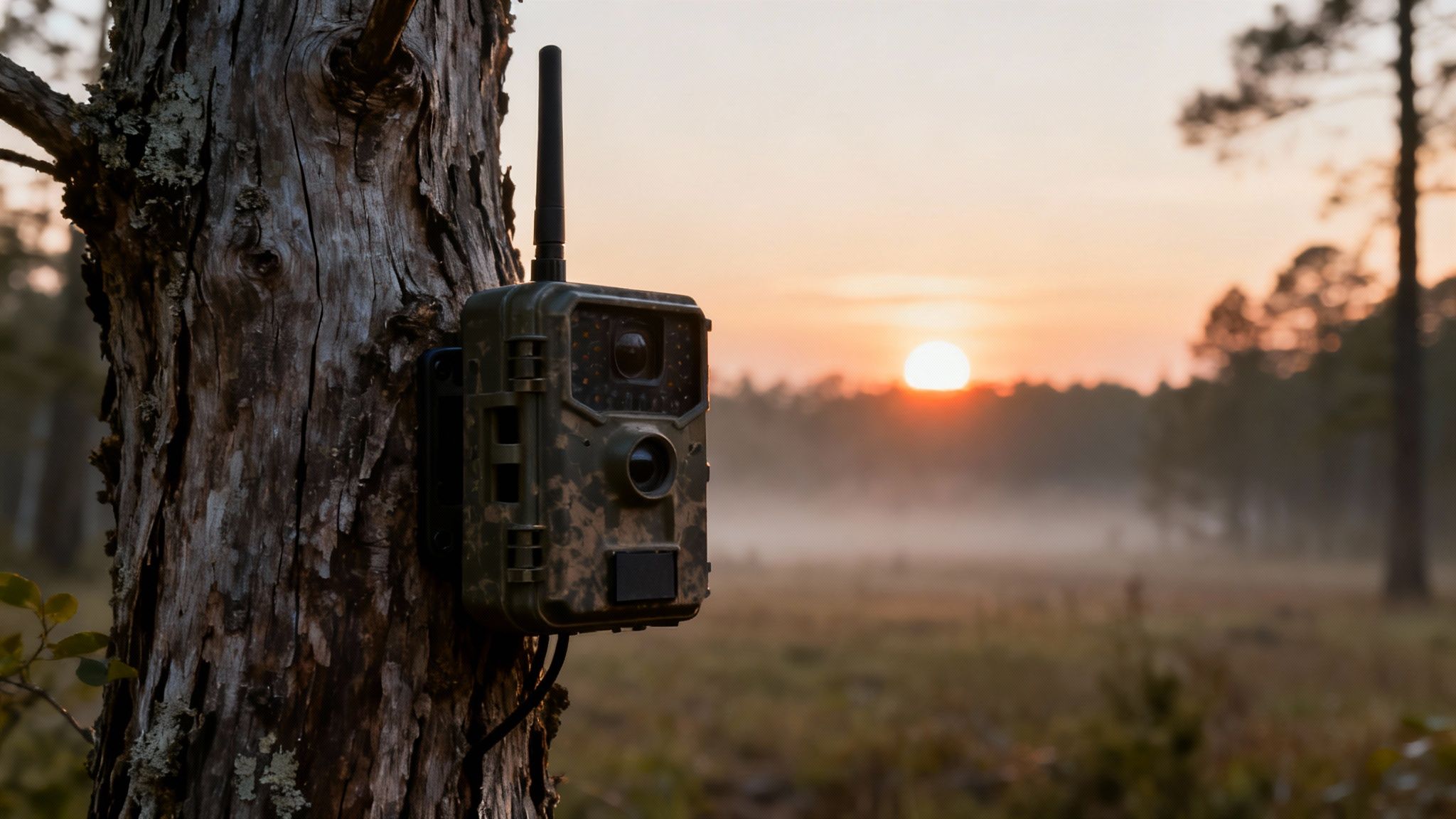
An action camera is your go-to for raw, first-person footage that drops the viewer right into your boots. A DSLR or mirrorless camera, on the other hand, is a production powerhouse. It’s built to create beautiful, professional-quality films that feel like they belong on a bigger screen.
The Case for Action Cameras: Immersive and Rugged
Action cameras were born for harsh environments and hands-free use, making them a perfect match for hunting. They’re small and light enough to mount just about anywhere—a head strap, a bow stabilizer, the brim of your cap—and then you can just forget about it until the action kicks off.
That "set it and forget it" simplicity is their biggest advantage. If you're a solo bowhunter perched in a treestand, you don’t have the freedom to mess with a complicated camera. With an action cam, one press of a button gets you rolling, so you never miss the moment of truth because you were fumbling with settings.
The signature wide-angle perspective of an action camera is what makes it so immersive. It might distort the scene a little, but it pulls in the entire environment, giving the viewer a real sense of the landscape and the intensity of the encounter.
This wide field of view is ideal for tight situations, like calling in a tom in thick timber or a black bear encounter in dense brush. It keeps the animal in the frame, even when things happen fast.
But that strength can also be a weakness. Action cameras don't have optical zoom, so they’re a poor choice for filming animals at a distance. Their small sensors also tend to struggle in the low light of dawn and dusk, often producing grainy footage right when game is most active. For a deeper dive into camera options, our guide on cameras for hunting is a great resource.
The Power of DSLRs: Cinematic and Versatile
If your goal is to produce a polished, cinematic hunting film, a DSLR or mirrorless camera is the undisputed king. Their large sensors pull in far more light, which translates to crisp, clean footage with rich color and incredible detail, especially during those golden hours.
The game-changer with a DSLR is lens interchangeability. Being able to swap lenses gives you total creative control. A wide-angle lens can show off a vast mountain landscape, while a big telephoto zoom can bring a distant elk into tight focus, showing every detail.
This makes them the perfect tool when you have a dedicated cameraman along for the hunt. Imagine a guided mule deer hunt in open country—a second person with a DSLR on a tripod can capture those steady, zoomed-in shots of the stalk and the animal, adding a professional layer an action cam just can't touch.
Of course, all that performance comes at a price. DSLRs are bulky, heavy, and need to be babied. They aren't waterproof or shockproof, so you have to protect them from the elements. Juggling batteries, lenses, and settings adds a layer of complexity that can be a real distraction when you should be focused on the hunt.
Making the Right Choice: A Situational Comparison
This isn't about which camera is "better," but which one is better for the job at hand.
- Solo Treestand Bowhunter: The action camera is the clear winner. It's lightweight, hands-free, and perfectly captures that intense, up-close point of view.
- Guided Open-Country Rifle Hunt: Here, a DSLR/mirrorless camera is a must. The ability to zoom in from afar and capture high-quality footage is what will tell the whole story.
- Waterfowl Hunt in a Blind: This is a perfect scenario for a dual-camera setup. An action cam mounted nearby can grab the in-your-face action, while a DSLR on a small tripod films the decoy spread and birds working the pattern.
Hunters are demanding better video quality, and the market is responding. The hunting camera sector, valued at USD 224.08 million in 2024, is expected to climb to USD 375.16 million by 2034. Models with 12MP+ sensors and 4K video are driving that growth, pushed by content creators who know great visuals are everything. You can find more on these trends at MarketGrowthReports.com.
The most successful hunting filmmakers have learned to use both. They blend immersive action shots with beautiful, cinematic scenes to create a film that's dynamic, compelling, and keeps people watching.
Essential Features for Any Hunting Camera
Picking the right camera for filming hunts is about more than just megapixels and video resolution. Out in the field, where conditions are tough and wildlife is unpredictable, the specs on a sheet don't tell the whole story. A camera that looks great online can become a brick when faced with freezing temps, a sudden downpour, or the critical low-light minutes at dawn and dusk.
To make a smart choice, you need to think about a checklist of practical, non-negotiable features. These are the things that decide whether your gear will actually work when it matters most or fail you at the moment of truth. It's about building a system you can count on, season after season.
Unwavering Durability and Weatherproofing
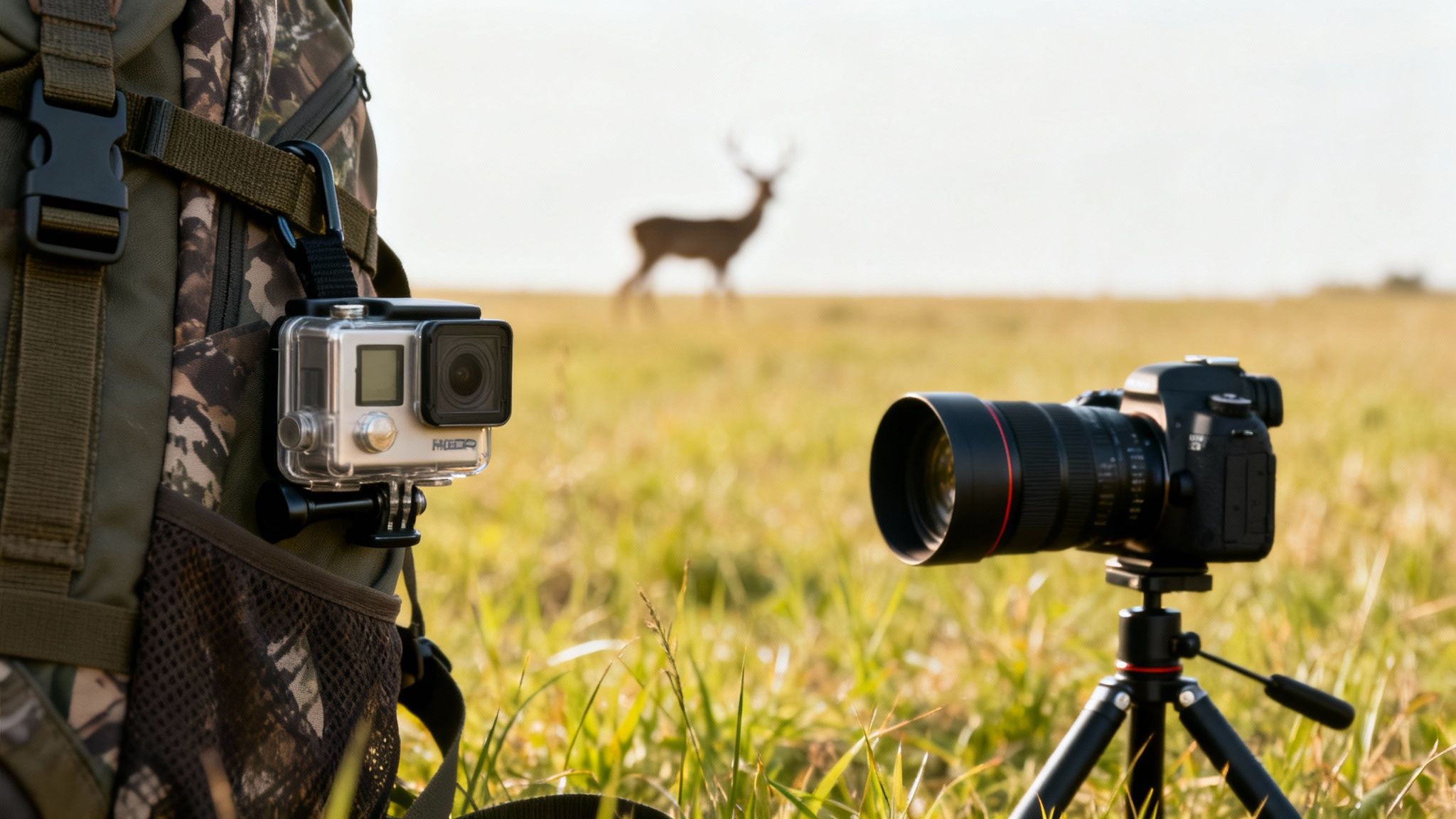
Your hunting camera is going to get hit with rain, snow, mud, and whatever else the backcountry throws at it. Without solid protection, it won't last a single season. That's why durability is the absolute foundation of a good hunting camera.
Always look for an official IP (Ingress Protection) rating, like IP66 or higher. The first number rates its defense against solids like dust, while the second measures its resistance to water. A camera rated at IP66 is completely dust-tight and can handle powerful jets of water, meaning it will keep running through a heavy rainstorm.
A camera's ability to endure the elements is non-negotiable. It's the difference between capturing a once-in-a-lifetime moment and finding your expensive gear waterlogged and useless after an unexpected storm.
Reliable Cold-Weather Battery Performance
Standard alkaline batteries can lose over 50% of their juice in freezing temperatures—a common reality for much of the hunting season. A camera that dies in the cold is a huge liability, especially when it gives out right before that peak morning activity.
This is where your power source really matters.
- Lithium Battery Compatibility: Make sure any camera you buy works with lithium AA batteries. They perform miles better in cold weather than standard alkalines.
- External Power Options: For trail cams left out for weeks or months, an external power jack is a must. It lets you hook up a solar panel or a bigger 12V battery, giving you a steady power source through the toughest parts of winter.
Superior Low-Light and Night Vision Capability
Deer, elk, and other big game are most active during the "golden hours" of dawn and dusk, and they're often on the move all night. A camera that gives you grainy, worthless footage in low light is missing the most important chapters of the story.
High-quality sensors and fast lenses (look for a low f-stop number) are crucial for capturing clean video when light is fading. For scouting with a trail cam, the type of night vision is just as important. You want No-Glow (or Black Flash) infrared (IR), which uses a 940nm wavelength that's totally invisible to animals. That way, you get your intel without spooking the game.
Intelligent and Efficient Operation
Modern features aren't just gimmicks; they're tools that save you time and deliver better results. For cellular trail cameras, AI-driven species recognition is a game-changer. It automatically filters out false triggers from swaying branches or squirrels, so you only get alerts when your target species shows up.
Likewise, reliable connectivity is key. Technologies like SignalSync automatically scan for and connect to the strongest cell network available, keeping your camera online even in remote areas with spotty service. This means no more missed updates and always having current scouting data.
Finally, don't forget about audio. Filming hunts outdoors means battling the elements, and wind can ruin your footage. Knowing some proven techniques to remove wind noise from video is a huge help, but it all starts with a camera that has an input for an external microphone.
Why the EagleCam 5 Excels for Remote Scouting
While many cameras are built to film the hunt itself, the Magic Eagle EagleCam 5 is purpose-built to make sure you're in the right place to begin with. Think of it as a specialized tool for remote scouting, engineered to solve the exact problems hunters and land managers face when monitoring properties from miles away.
This isn’t just another trail camera; it's a strategic system. Its entire ecosystem is designed for one goal: delivering reliable, actionable intelligence. Where standard cameras often fail due to weak signals or tedious photo management, the EagleCam 5 offers a seamless solution.
Overcoming Remote Connectivity Hurdles
The single biggest failure point for any cellular camera is a weak or inconsistent signal. A camera that can’t transmit photos is just an expensive, battery-powered paperweight. Magic Eagle tackles this problem head-on with its SignalSync technology, an integrated system that actively scans for and connects to the strongest available network from major carriers.
This means you can stop worrying about matching a specific SIM card to your hunting location. The camera automatically locks onto the best signal, ensuring your intel keeps flowing even from deep woods or remote mountain valleys where service is notoriously spotty. The all-in-one 4G connection simplifies setup, getting you up and running without any technical headaches.
The true advantage of the EagleCam 5 is its reliability in the margins. It’s designed to stay connected in those fringe areas where other cameras go dark, giving you a consistent eye on your property when it matters most.
This dependable connectivity is what transforms scouting from a frustrating chore into a powerful advantage, letting you build a complete picture of animal movement without interruption.
Turning Raw Data into Actionable Intelligence
A memory card jammed with thousands of photos isn't intelligence—it's just raw data. The EagleCam 5 ecosystem is designed to process this data for you, delivering clear insights through the MAGIC EAGLE app. This is a crucial differentiator, as solid pre-hunt prep is what separates a lucky hunt from a successful one.
The app's AI-powered species recognition is a massive time-saver. It automatically sorts and tags photos, filtering out false triggers from blowing leaves or small critters so you can focus exclusively on your target species. No more scrolling through hundreds of pictures of squirrels.
Even better, the app’s interactive mapping features let you build a strategic overview of your hunting area. You can drop pins for your camera locations, feeders, rubs, scrapes, and bedding areas. This creates a visual database of animal activity, helping you connect the dots and predict where a buck will be next. You can get a closer look at the full capabilities of the Magic Eagle® EagleCam 5 here.
Magic Eagle EagleCam 5 Feature Breakdown
The EagleCam 5 isn't just a collection of specs; it's a system where each feature provides a tangible benefit in the field. Here's a look at how its key technologies translate into a real-world advantage for hunters.
| Feature | Technical Specification | Benefit for Hunters |
|---|---|---|
| SignalSync™ Technology | Multi-carrier 4G LTE connectivity | Automatically finds the strongest signal, ensuring reliable photo transmission from remote areas without needing specific SIM cards. |
| AI Species Recognition | Onboard image processing | Filters out false triggers (e.g., squirrels, wind) and tags target species, saving hours of manual sorting. |
| Interactive Mapping | In-app GPS & custom waypoints | Lets you map out camera locations, scrapes, and bedding areas to visualize animal movement patterns across your property. |
| Flash Range | 35m (115 ft) No-Glow IR | Captures clear, detailed images of game at a distance without spooking them, crucial for monitoring open fields or long shooting lanes. |
| Weatherproofing | IP66 Certified Housing | Built to withstand harsh conditions like rain, snow, and extreme temperatures, ensuring your camera works when you need it most. |
| Anti-Theft GPS | Real-time location tracking | Protects your investment by sending alerts and tracking the camera's location if it's moved or stolen. |
This combination of reliable hardware and intelligent software is what makes the EagleCam 5 a powerful tool for anyone serious about scouting.
A Purpose-Built System for Serious Hunters
The demand for reliable, connected scouting tools is reshaping the market. Cellular trail cameras are at the forefront of this shift, enabling the kind of real-time intel that leads to success. The global hunting camera market is projected to hit USD 0.26 billion in 2025 and is expected to grow to USD 0.45 billion by 2035. This growth is heavily driven by the 11.5 million active hunters in the U.S. who require dependable gear for remote locations.
While affordable, shorter-range cameras have their place, models with a 20-40m flash range are surging in popularity for serious hunts where seeing game at a distance is critical. To see the full picture of these industry trends, discover more insights about hunting camera market growth.
The EagleCam 5 is built for this demanding user. Every feature is practical and field-tested, from its rugged IP66 weatherproof housing to the anti-theft GPS tracking that protects your investment. It’s a complete system designed not just to take pictures, but to help you hunt smarter and more effectively.
Frequently Asked Questions About Filming Hunts
Choosing the right camera for filming hunts means sorting through a lot of variables, from legal fine print to the technical headaches you'll face in the field. This section tackles the most common questions hunters ask, giving you practical answers to build a reliable and effective filming setup.
Think of these answers as a way to reinforce the core idea of this guide: match your gear to your hunting style and always be prepared for whatever the outdoors throws at you.
What Is the Best Camera Setup for a Self-Filming Solo Hunter?
For a solo hunter managing every part of the hunt, a dual-camera setup is easily the most effective approach. The strategy really starts long before you head out, using a cellular trail camera like the Magic Eagle EagleCam 5 for pre-hunt scouting. This ensures you're setting up in a spot with proven activity.
Once it's time to hunt, an action camera becomes your primary tool. You can mount it with a head strap or attach it directly to your bow or firearm for some incredible, hands-free POV footage. Its tough, lightweight design means you can just set it and forget it, letting you focus completely on the hunt.
To really elevate your film, bring a second, smaller camera on a tripod or tree arm. This secondary angle is perfect for capturing wider "B-roll" shots that add context and a more professional finish to your video. This combo gives you both the scouting intelligence you need and compelling, immersive footage—all without a dedicated camera operator.
How Do I Manage Battery Life for Cameras in Cold Weather?
Cold weather is the arch-enemy of batteries, draining their power at an alarming rate. Your first line of defense is choosing the right battery type. Always go for high-quality lithium batteries, as they perform dramatically better in freezing temperatures compared to their alkaline counterparts.
For trail cameras like the EagleCam 5 that you'll leave out in the field for weeks or months, an external solar panel power pack is a complete game-changer. An accessory like this can keep the camera running indefinitely, even through the harshest winter.
For your in-the-field action cameras and DSLRs, the strategy is much simpler. Keep all your spare batteries in an insulated pocket close to your body to keep them warm until you need them. You can also save a ton of power by turning off non-essential features like Wi-Fi and GPS and dropping the video resolution from 4K to 1080p when every minute of battery life counts.
Are There Legal Restrictions on Using Cellular Trail Cameras?
Yes, absolutely. Regulations for trail cameras—especially cellular models that transmit images in real time—vary significantly by state and sometimes even by specific wildlife management zones. Some states prohibit their use during hunting seasons, arguing that they violate the principles of "fair chase" by giving hunters live updates on an animal's location.
On the other hand, some states have no restrictions at all. It is absolutely essential to check your local and state wildlife agency regulations before you put any camera out for hunting purposes.
Never assume the rules are the same from one year to the next. Wildlife regulations can and do change annually, so always consult the most current hunting guidebook or the official agency website for the specific area you plan to hunt.
How Can I Get the Best Audio Quality When Filming My Hunt?
Let's be honest, onboard camera microphones are usually terrible. They are highly susceptible to wind noise, which can completely ruin an otherwise great video clip. If you're serious about quality, using an external microphone is non-negotiable.
For action cameras, a "media mod" accessory usually provides a port to connect a small external shotgun microphone. For DSLRs, a high-quality shotgun mic mounted right on the camera is the standard for capturing rich environmental sounds.
If you want to record your own commentary, the sound of drawing a bow, or even your quiet breathing for an immersive feel, a wireless lavalier microphone clipped to your collar is the best tool for the job. Always cover any mic with a foam windscreen or a "dead cat" muffler to drastically cut down on wind noise. While mastering background noise removal from video is a key skill for post-production, getting clean audio in the field is the most important first step.
At Magic Eagle, we build scouting tools designed for the real-world challenges hunters face. The EagleCam 5 provides the reliable, remote intelligence you need to make every hunt more strategic and successful.