

If you’re out in elk country, one of the most reliable signs you’re on the right track is finding fresh scat. While tracks and rubs are great clues, droppings are undeniable physical evidence that an elk was recently in the area. Learning to identify it is a core skill for any hunter or wildlife watcher.
Your Quick Guide To Identifying Elk Scat
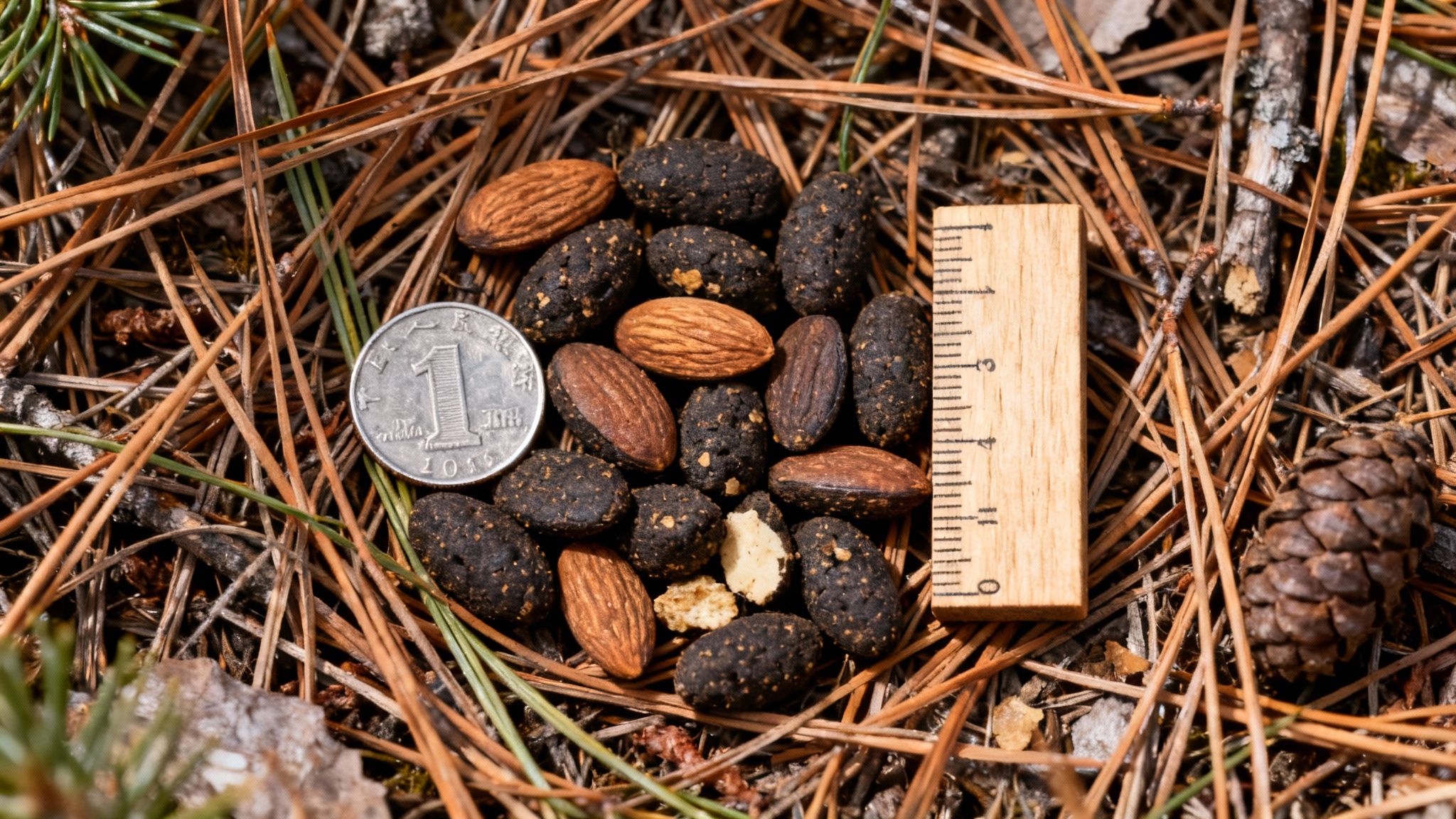
The most common form you’ll find is a pile of distinct, dark, oval-shaped pellets. Think large almonds—that’s the classic description for a reason.
What To Look For
When you stumble upon a fresh pile, here’s what you should notice:
- Size: The pellets are typically 0.5 to 1.0 inch long, making them noticeably bigger than deer pellets. This size difference is often the first and most obvious giveaway.
- Shape: Look for an oblong, almond-like shape. Many pellets will have a small dimple or concave area on one end and a slight point on the other.
- Arrangement: Elk usually deposit their droppings in a single clump or a tight pile, not scattered around like a deer might.
Of course, nature is rarely that simple. An elk’s diet dramatically changes the appearance of its scat, and this is where a sharp eye really pays off.
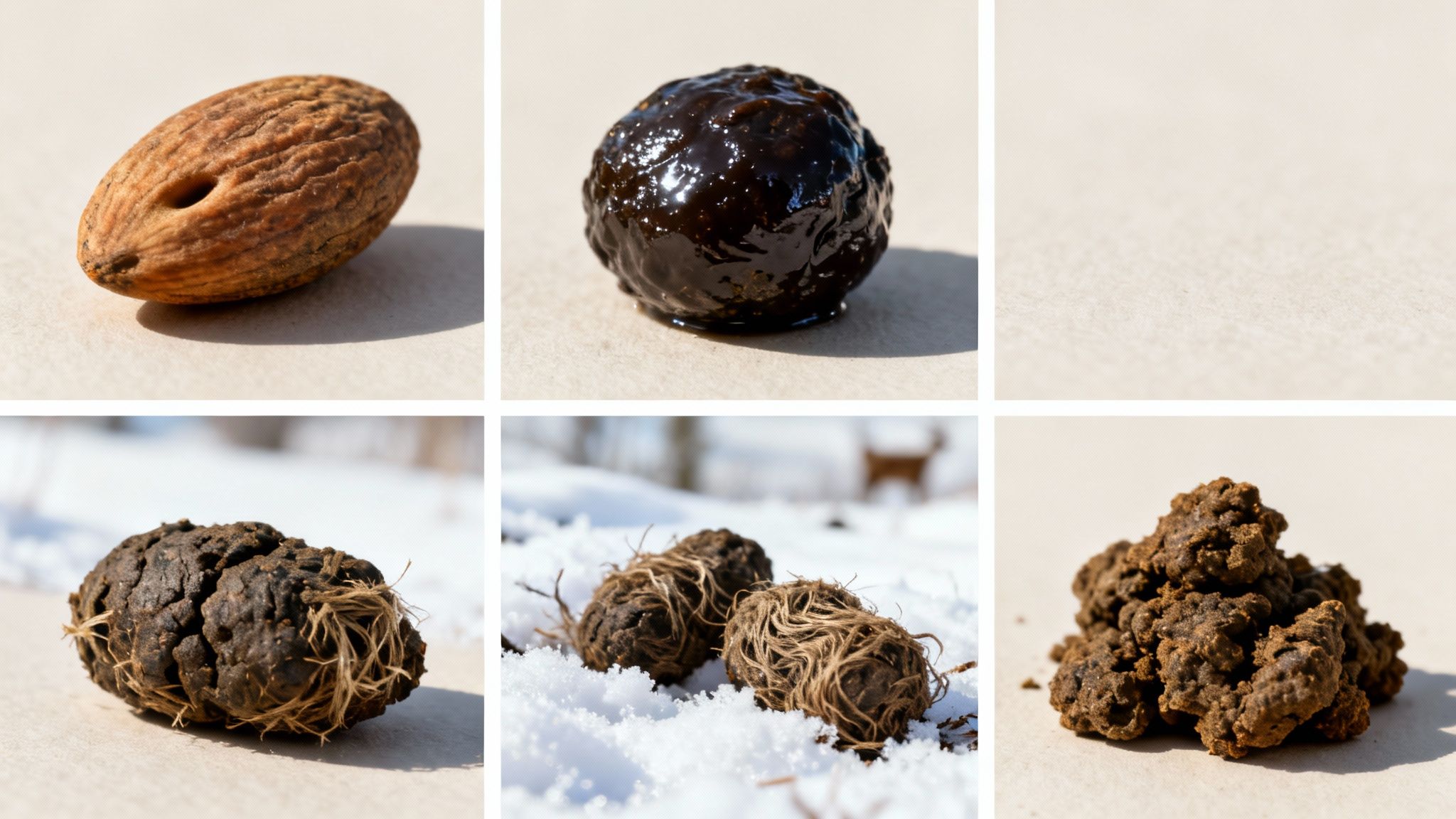
The classic hard pellets you see are usually from a winter diet of dry woody browse, like twigs, bark, and tough grasses. But in the spring and summer, when elk are feeding on lush green grass and forbs, their scat becomes much softer. It can form a clumpy, less-defined mass or even a "plop" that looks a bit like a small cow pie.
Key Takeaway: Don't just look for hard pellets. The consistency of the scat is a major clue to the season and what the elk have been eating, giving you a more complete picture of their behavior.
Elk Scat At-A-Glance Identification
To make field identification even easier, keep this quick reference in mind.
| Characteristic | Typical Appearance |
|---|---|
| Shape | Oval or oblong, often almond-like with a slight dimple. |
| Size | Approximately 0.5 to 1.0 inch long and 0.5 inch wide. |
| Color | Fresh scat is dark brown to black; ages to a lighter tan. |
| Arrangement | Typically found in piles or large clumps, not scattered. |
Mastering these basics is a great first step toward becoming a better woodsman. This core knowledge allows you to make a quick, confident assessment on the trail.
Of course, having the right knowledge is only half the battle. Having the right tools for the job is just as important, which is why you might be interested in our guide to hunter essentials for every outdoorsman.
The Four Core Characteristics Of Elk Scat
To get good at reading elk sign, you have to look past a quick glance and really analyze what the scat is telling you. Think of it like a detective piecing together clues. By examining four distinct features—size, shape, color, and contents—you can build a complete picture of the animal that left it behind.
Each characteristic tells a part of the story, from how long ago an elk was in the area to exactly what it was eating.
Mastering these details is what separates a novice from an expert tracker. It’s the difference between just seeing scat and truly understanding the valuable intel it holds.
Size And Shape
The most obvious identifiers are the size and shape of the pellets. Elk scat is consistently larger than what you’ll find from deer, with individual pellets usually measuring between 0.5 to 1.0 inch in length. People often compare them to oversized almonds, and for good reason—it’s a great visual.
Their shape is distinctly oblong, often a bit flattened. A key detail that experienced woodsmen look for is a small dimple or concave indentation on one end, while the other end tapers to a gentle point. This unique form is a dead giveaway of an elk's digestive system. While deer pellets are smaller and more rounded, elk pellets have a robust, stretched-out profile that’s hard to mistake once you’ve seen it a few times.
Color And Age
The color of elk scat is your best clue for figuring out its age, which tells you how recently an elk passed through. Fresh droppings, maybe just a few hours old, have a dark, rich look—anywhere from deep brown to almost black. They’ll also have a noticeable sheen or glossy finish from the moisture.
But that changes quickly. As the scat is exposed to sun and air, it starts to dry out, losing its shine and fading. Within a couple of days, it will turn a dull, lighter brown. After a week or more, it can become a pale tan or even grayish, looking almost bleached by the elements. Reading the color is like using a clock to tell if you’re hot on the trail or just looking at old sign.
By learning to read the color, you can determine if an elk was in the area this morning or last week. A dark, shiny pile means your target could still be nearby. A pale, crumbly one means you’re looking at history.
Consistency And Contents
If you break a pellet apart (with a stick, of course!), you’ll uncover the last two clues: its consistency and contents. These are tied directly to the elk's recent diet. Scat from an elk that’s been eating dry winter forage—like bark, twigs, and cured grasses—will be very firm and packed with fiber. When you open it up, you’ll see a tight mass of coarse, undigested plant material.
On the other hand, scat from a summer diet of lush, green vegetation is much softer. It might even be mushy and clumped together, sometimes forming a single mass that looks like a small cow pie. The contents will be less distinct, more like a uniform paste. Examining what’s inside gives you a snapshot of what the elk are eating, which in turn tells you where they’re likely feeding.
How Seasons And Diet Change Elk Scat Appearance
Thinking all elk scat looks the same is a rookie mistake. The truth is, it’s a dynamic clue that changes dramatically with the seasons, acting like a field guide to an elk's recent meals. The appearance of their droppings is directly tied to what they’re eating, and knowing how to read the signs is key to accurate tracking.
So, what does elk scat look like in the dead of winter versus the peak of summer? The difference is night and day. A winter diet—full of dry, tough stuff like twigs, bark, and cured grasses—produces the classic sign most people picture.
- Winter Scat: You'll find hard, distinct, individual pellets. They're firm to the touch and packed with coarse plant fibers.
- Analogy: Think of these winter pellets like hard, fibrous marbles or big almonds. Each one is separate and well-defined.
This hard, pelleted form is a direct result of the low moisture in their winter forage. An elk's digestive system squeezes out every last drop of water, leaving behind tightly compacted waste.
The Summer Transformation
Once the snow melts and green shoots appear, an elk’s menu completely changes. They start feasting on lush, water-rich vegetation like new grasses, forbs, and tender leaves. This diet swap totally alters the consistency of their droppings, which is where many novice trackers get thrown off.
Instead of individual pellets, the high moisture content in their food leads to much softer waste. The pellets often lose their distinct shape, clumping together into a single, less-defined mass.
Key Insight: In summer, elk scat often looks more like a small, lumpy cow pie or a soft pile of dough. This softer form is a clear indicator the animal is gorging on fresh, green vegetation.
Recognizing this shift is crucial. It stops you from misidentifying summer elk sign as belonging to a different animal, like a bear or cow. It’s a normal, predictable change that tells a story about what’s on the menu.
To make it even clearer, let's break down the seasonal differences side-by-side.
Seasonal Elk Scat Comparison
This table highlights the key visual and textural differences between elk scat found in winter and summer, driven entirely by their diet.
| Feature | Winter Scat (Dry Diet) | Summer Scat (Lush Diet) |
|---|---|---|
| Shape | Distinct, individual oval or acorn-shaped pellets | Soft, amorphous clumps; often fused into a single pile |
| Color | Dark brown to nearly black | Lighter brown, often with a greenish tint |
| Texture | Hard, dry, and fibrous | Soft, moist, and pasty; lacks visible fiber |
| Contents | Clearly visible coarse plant matter, twigs, and bark | Finely digested green material; uniform consistency |
Understanding this table helps you quickly assess the season and the elk's feeding patterns just by looking at what they left behind.
Reading The Seasonal Clues
The transition between these two forms offers powerful insights for hunters and wildlife watchers. Finding soft, clumpy scat in early fall means elk are still on green feed, likely hanging out in meadows or near water. On the other hand, discovering hard pellets tells you they’ve switched to their tougher winter diet and are probably browsing in wooded or brushy areas.
This seasonal variation isn't just an observation; it's a consistent pattern backed by science. Field studies show that pellet clumps, where multiple droppings fuse together, increase significantly during summer months. This shift is a reliable indicator of dietary changes, as confirmed by wildlife biologists. You can learn more about these ecological findings on PMC NCBI.
By learning to read these seasonal signs, you move beyond just identifying elk and start interpreting their behavior like a seasoned pro.
Distinguishing Elk Scat From Other Wildlife
Out in the wild, you're rarely dealing with just one species. An elk’s territory often overlaps with that of deer, moose, and even bears, making accurate sign identification a critical skill. Misreading the clues can send you on a wild goose chase, so learning to tell elk scat apart from similar-looking droppings is essential for any serious tracker.
At first glance, droppings from different hoofed animals can look pretty similar. But once you know the subtle yet consistent differences, you can make the right call with confidence. It all comes down to a few key comparisons.
Elk Scat Versus Deer Scat
This is by far the most common point of confusion in the field. Both elk and deer are part of the cervid family and leave behind pelleted droppings. The most reliable way to tell them apart is size.
Think of it this way: elk are significantly larger animals than deer, and their scat reflects that.
- Elk Pellets: These are robust, measuring about 0.5 to 1.0 inch long. They have a distinct, oblong almond shape, often with a slight dimple on one end.
- Deer Pellets: These are much smaller, typically only 0.25 to 0.5 inches long. They tend to be more rounded or acorn-shaped, lacking the pronounced oblong form of elk pellets.
Simply put, an elk pellet is roughly twice the size of a deer pellet. If you’re unsure, look at the overall pile. Elk droppings often form a larger, more concentrated mound, whereas deer scat can be more scattered. Recognizing these differences is also key if you are trying to understand animal movements, which is a big part of learning how to find deer bedding areas.
Elk Scat Versus Moose Scat
If you’re in moose country, another comparison becomes important. Moose are the largest members of the deer family, and their scat is proportionally massive, making it relatively easy to tell apart from an elk's.
The key differences are both size and shape. While elk pellets are oblong, moose pellets are noticeably larger and more spherical.
Field Tip: Moose pellets look like large, fibrous marbles or even small balls, often measuring over an inch long and being very round. Elk pellets are consistently smaller and more almond-shaped.
Imagine a pile of large, dark marbles—that’s a classic sign of a moose. The roundness is the biggest giveaway, a stark contrast to the more flattened, oblong profile of elk scat.
The infographic below helps visualize how an elk's diet impacts what its scat looks like through the seasons.

This visual guide shows that the consistency of the scat—hard pellets versus a soft clump—is a direct reflection of whether the elk is eating dry winter browse or lush summer greens.
Elk Scat Versus Bear Scat
Finally, let's compare elk droppings to bear scat, which is fundamentally different. Elk are herbivores, meaning they only eat plants. Bears are omnivores, eating both plants and animals. This dietary difference creates a completely different type of waste.
Instead of pellets, bear scat is typically tubular, resembling a large dog's droppings but often found in a single, sizable pile. The most telling feature is its contents.
You can almost always see what the bear has been eating. Look for:
- Undigested berries and seeds
- Pieces of nuts or acorns
- Insect parts
- Animal hair or bone fragments
Because elk scat is composed entirely of digested plant fiber, it will never contain these elements. The sight of berries or hair is a definitive sign you’re looking at bear scat, not elk.
What Elk Scat Reveals About Their Presence And Health
Finding scat is proof an elk was in the area, but learning to read what it's telling you is what separates a good tracker from a great one. Those droppings are a physical record, a story about how recently an elk passed through, what it was up to, and even how it’s feeling.
Going beyond simple identification is a game-changer for anyone serious about the outdoors, especially those practicing effective primitive hunting techniques.
The first question you should always ask is: how old is this? Fresh droppings give you a timeline, letting you know if you’re hours or days behind an animal.
- Fresh (Hours Old): The scat will be dark, damp, and have a noticeable glossy shine. Give it a gentle poke with a stick—it’ll be soft and smear easily.
- Recent (1-2 Days Old): The surface starts to dull and dry out, but the inside will still be moist. It becomes firmer and won't smear as readily.
- Old (Days to Weeks): By now, the pellets are totally dry, lightweight, and often crumbly. The color has faded to a much lighter brown or tan after being bleached by the elements.
Reading The Landscape For Elk Behavior
Where you find the droppings—and how much you find—offers powerful clues into elk behavior. A single, scattered pile along a game trail suggests an animal on the move, probably feeding as it traveled. It’s just a sign of a passing presence.
But when you find a large concentration of droppings in a sheltered spot, like under a thicket of pines or on a protected ledge, that’s a huge indicator of a bedding area. Elk often defecate right after standing up, so multiple piles in one place means they're spending a lot of time there.
This allows you to start mapping out an elk's daily routine. You can pinpoint where they feed, where they rest, and the travel corridors they use in between. It’s like finding a blueprint of their life on the landscape. This kind of intel is invaluable for deciding where to set up an observation post or place some of the best trail cameras for hunting.
Advanced Clues From Scat Condition
Experienced trackers can pull even more detail from a pile of droppings. For instance, in dry conditions, fresh elk piles will stay visibly moist and smear for at least a few hours.
In colder climates, though, the rules change. A fresh pile might freeze overnight, showing tiny ice crystals under the pellets. This is a slick trick that seasoned guides use to age scat during winter surveys. You can learn more about reading these subtle signs from the experts at RMEF.
Key Takeaway: Elk scat isn't just a sign of presence; it’s a detailed field report. By analyzing its age, location, and concentration, you can decipher an elk’s movements and daily patterns, giving you a serious strategic advantage.
Frequently Asked Questions About Elk Scat
Even with a detailed guide, a few questions always seem to pop up once you're out in the field. Here are the quick, clear answers to the most common queries we hear about elk droppings.
How Can You Tell The Age Of Elk Scat?
Figuring out how old elk scat is comes down to two things: moisture and color. Think of it as a natural clock telling you how recently an elk passed through.
Fresh droppings—we're talking just a few hours old—will be dark, shiny, and moist. If you poke a pellet with a stick, it should smear easily. This is your sign that an elk is very, very close.
As the hours pass, the scat starts losing that moisture and glossy finish, turning dull. Within a day or two, the outside will be firm, but you'll still find some softness on the inside. After several days or weeks, it becomes completely dry, hard, and often fades to a much lighter brown or tan as the sun bleaches it out. A great pro tip for cold weather: if you see frost or ice crystals on the scat, you know it was dropped very recently.
Is There A Difference Between Bull And Cow Elk Scat?
This is a classic campfire debate, but the truth is, there's no foolproof way to tell a bull's scat from a cow's just by looking. While some seasoned trackers claim they can spot subtle differences, the evidence is more anecdotal than scientific.
Here’s what you might hear:
- Bull elk pellets are sometimes larger and have a noticeable dimple or concave shape on one end.
- Cow pellets are often described as being slightly more pointed.
Important Note: These traits are all over the place and really depend on the individual animal’s size, age, and what it's been eating. Trying to determine an elk's sex from pellet shape alone is not a reliable method.
What Does It Mean If I Find Elk Scat In A Large Mushy Pile?
If you come across a large, soft pile of droppings that looks more like a small cow pie than distinct pellets, you’ve found a classic sign of an elk's summer diet. Don't worry, it's completely normal and tells you a lot about what the animal has been eating.
This mushy consistency happens when elk are feeding on lush, moist vegetation. You'll see it most often in the spring and early summer when new grasses and forbs are full of water. The elk's digestive system processes all that moisture differently, causing the droppings to lose their shape and clump together. It’s a great field clue that tells you exactly what the local herd is feeding on right now.
Can Elk Scat Carry Diseases?
Yes, just like any wild animal feces, elk scat can carry bacteria or parasites that might be harmful to people and pets. While the risk of getting sick is generally low, it's always smart to be cautious.
A big concern in many parts of the country is Chronic Wasting Disease (CWD), a fatal neurological illness that affects deer, elk, and moose. Although there has never been a documented case of CWD transmission to humans, experts still recommend avoiding contact with any animal material that could be contaminated.
Here’s how to stay safe in the field:
- Never handle scat with your bare hands.
- If you want a closer look, use a stick or wear gloves.
- Always wash your hands thoroughly when you get back from your trip.
By following these simple hygiene rules, you can safely learn from the signs elk leave behind without putting yourself at risk.
At Magic Eagle, we believe that understanding animal behavior is the key to a successful hunt. Our smart cellular trail cameras are designed to give you an edge, providing real-time insights so you can turn clues like fresh scat into a successful scouting strategy. Learn more about how our technology can help you get closer to the action at https://magiceagle.com.