

To find deer bedding areas, you have to start thinking like a deer. Their lives are governed by a few non-negotiable needs: security, comfort, and strategic advantage. The places they lay up for the day aren't just random thickets; they are carefully chosen sanctuaries.
These spots offer protection from predators (including us), shelter from the elements, and a perfect vantage point to monitor their world. Understanding these core needs is the first step to pinpointing where a mature buck spends his daylight hours.
What Deer Look for in a Bedding Area
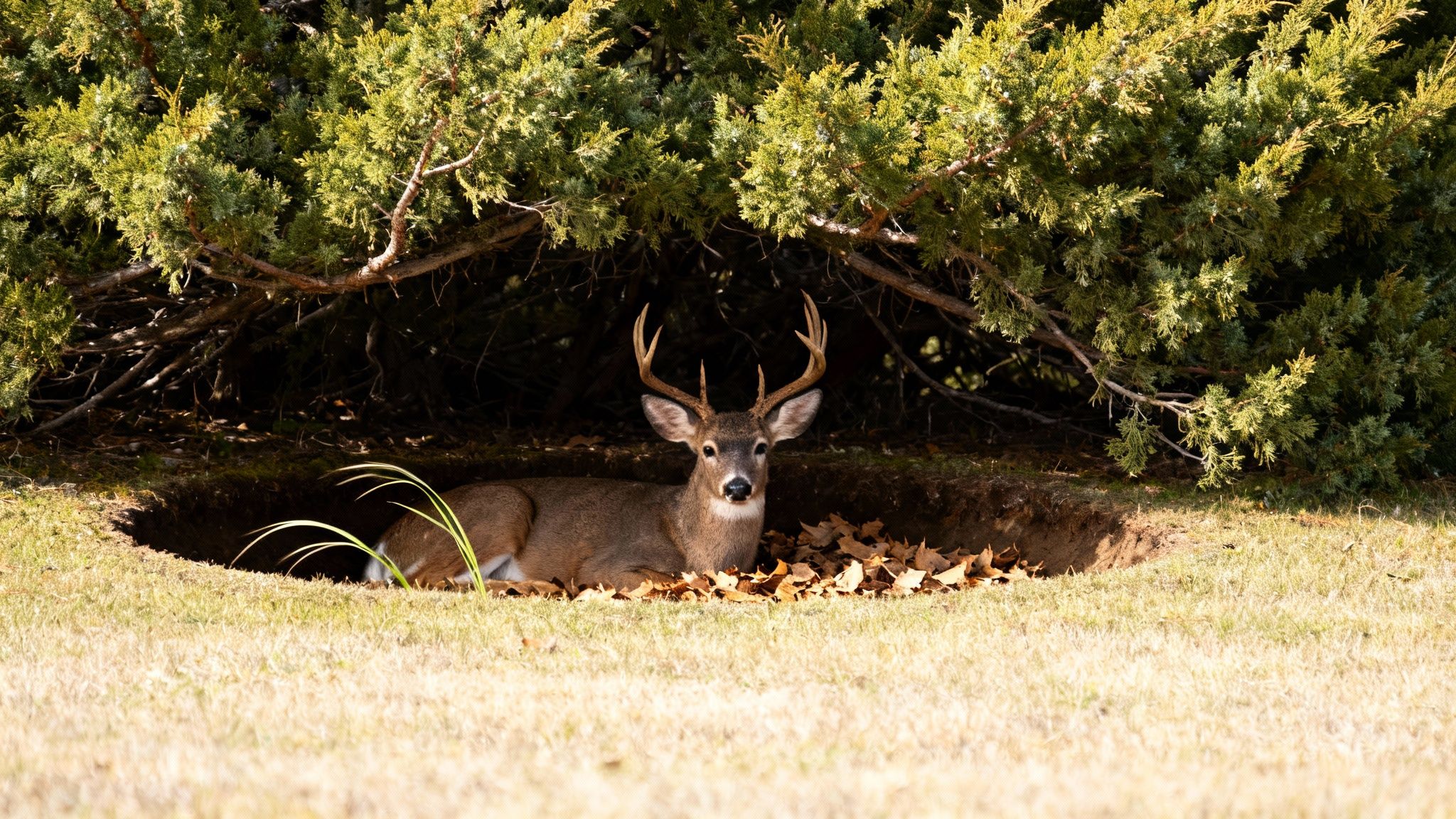 A deer's entire existence revolves around survival, and their choice of bed is the most critical survival decision they make each day. This is where they're most vulnerable, spending the bulk of their time resting and digesting. Getting inside their head and understanding the "why" behind their selection is far more valuable than just memorizing a list of typical spots.
At its core, it's a simple cost-benefit analysis of energy and safety. Deer won't burn unnecessary calories traveling to a bed, and they absolutely won't settle down somewhere that feels insecure.
The Core Pillars of a Prime Bedding Location
A prime bedding area has to check several boxes. Think of it as a mental checklist every deer runs through before it commits to a spot.
- Security: This is everything—the absolute number one priority. A deer needs to feel safe. This usually means thick, nasty cover, an elevated position, or some other feature that prevents a surprise approach.
- Comfort: Staying warm or cool is critical for survival. An ideal bed offers a break from the elements, whether that's shade from the blazing summer sun or a solid block from a biting north wind.
- Strategy: Mature bucks are master strategists. They pick beds that give them a tactical edge, using the wind and their eyes to detect danger long before it gets close.
These three pillars work together. A spot might have incredible cover, but if the wind is constantly swirling and unpredictable, a wise old buck will avoid it. Likewise, an open ridge offers a great view but provides zero thermal protection on a freezing day. It has to be the total package.
How Deer Use Wind and Terrain to Their Advantage
A whitetail’s nose is its greatest defense, and they wield it with incredible precision. A mature buck will almost always bed with the wind at his back, allowing his nose to cover his six.
At the same time, he'll face downwind, using his eyes to scan everything in front of him. This classic "watch my front, smell my back" strategy is a textbook survival tactic that makes him incredibly difficult to approach.
It's a classic setup: a buck beds on the leeward side of a ridge, just below the crest. He can smell anything coming over the top behind him while visually scanning the entire hillside below. It's a nearly impenetrable fortress.
This strategic positioning allows a deer to detect threats from multiple directions with minimal effort. It's all about conserving precious energy while staying on high alert. This is exactly why features like ridge points, benches on steep hillsides, and isolated knobs are such legendary buck bedding hotspots—they provide a natural surveillance advantage.
Energy Conservation and Proximity to Resources
While security is king, energy conservation is a very close second. Deer have to balance that need for safety with easy access to food and water. They typically won't bed right in a food plot or on a creek bank, as those are high-traffic areas that leave them exposed.
Instead, they'll bed in a secure spot near those resources. Picture a dense cedar thicket just 150 yards off a soybean field. This lets a buck rest securely all day, then move a short, protected distance to feed in the evening. He'll often use a staging area to check for danger before stepping out into the open. Understanding this simple relationship between bedding, food, and water is the foundation for predicting daily movement and setting up a successful ambush.
Buck vs. Doe Bedding
Not all deer beds are created equal. The sanctuaries chosen by a reclusive, mature buck are often worlds apart from the communal bedding areas used by doe family groups. Learning to spot the subtle differences is a huge advantage. Bucks are loners who prioritize security above all else, while does need to accommodate fawns and often bed closer to primary food sources.
Here’s a quick breakdown to help you tell the difference when you're in the woods.
Buck vs Doe Bedding Area Quick Guide
| Feature | Mature Buck Bedding Area | Doe & Fawn Bedding Area |
|---|---|---|
| Location | Isolated, hard-to-reach spots (ridge points, benches, swamp islands) | Closer to primary food sources (ag fields, food plots) |
| Topography | Often has a distinct terrain advantage for wind/sight | Typically on flatter, more gentle terrain |
| Cover | Extremely thick, often with overhead cover and multiple escape routes | Good cover, but generally less dense and fortified |
| Number of Beds | Usually a single, large bed, sometimes with a few alternates | Multiple beds of various sizes clustered together |
| Sign | Large-diameter rubs on approach trails, bigger droppings | A mix of tracks and pellets; smaller, less-defined beds |
| Proximity | Strategic distance from food/water to maximize security | Closer, more direct access to food and water |
Recognizing these patterns helps you filter out the high-traffic doe areas and focus your efforts on the specific, hard-to-find lairs where a mature buck is likely hiding. It's about reading the landscape and knowing what kind of sign points you toward your target animal.
Using Terrain and Topography to Pinpoint Hotspots
Deer are absolute masters of the landscape, using every hill, ridge, and ditch to their advantage. If you want to consistently find their core bedding areas, you have to start seeing the world through their eyes—a world dictated by wind, sightlines, and escape routes. Honestly, learning to read a topographic map is like getting a cheat sheet to a buck's daily game plan.
Before you even put boots on the ground, digital mapping tools can light up the high-percentage spots where a mature buck feels secure. These terrain features create natural funnels and vantage points that deer have used for generations. Once you understand why they pick these spots, you can predict where they'll be with startling accuracy.
Decoding the High Ground
Mature bucks, especially, gravitate toward elevated terrain that gives them a serious strategic edge. They rarely bed right on top of a hill, since that would silhouette them against the sky. Instead, they choose very specific spots just below the crest that let them maximize their senses.
Keep an eye out for these classic buck sanctuaries:
- Ridge Points: The very tip of a ridge is a prime location. A buck can bed here with the wind currents at his back, smelling anything creeping up the ridgeline, while visually scanning the entire valley or basin below. It's the best of both worlds.
- Military Crests: This is simply the highest point on a slope where you can still see the bottom. By bedding just below this crest, a deer stays hidden from anything on the ridgetop but still maintains a commanding view of everything downhill.
- Leeward Slopes: Bedding on the side of a hill opposite the wind (the leeward side) is a textbook buck strategy. This setup allows rising morning thermals and prevailing afternoon winds to carry scent from below, warning him of danger he can't even see.
I once found a cluster of beds on a steep, north-facing hillside where the prevailing wind was from the northwest. From those beds, the buck could smell a huge swath of timber behind him while watching a food plot in the creek bottom below. He had three distinct escape routes already planned. This wasn't a random spot; it was a fortress.
Finding Hidden Benches and Bumps
Not all bedding spots are on obvious high points. In fact, some of the most subtle features on a map hold the biggest bucks. You need to train your eyes to find small, flat spots on otherwise steep hillsides, often called benches. These offer a comfortable place to bed with a great view.
A buck can lie on a bench and easily see, hear, or smell anything moving below him. His primary escape route is dead simple: just pop over the top of the ridge and vanish. These benches are deer magnets, especially when they're choked with thick cover.
Similarly, even a minor knob or hump in an otherwise flat swamp or clear-cut can become a go-to bedding location. That little bit of elevation is often just enough to give a deer a better view and keep its feet dry. Mule deer often bed about two-thirds up mountain slopes amid vegetation like bitterbrush, allowing them to survey entire basins from a secure spot. Finding these specific terrain features is a game-changer.
My "a-ha" moment came when I stopped looking for massive ridges and started focusing on the small, isolated terrain features. A tiny 10-foot rise in a sprawling marsh became my number one spot after I realized bucks were using it as an island sanctuary, safe from nearly all approaches.
Marking these potential spots on a digital map is your first move. You can then confirm deer movement and map out their core areas without adding pressure by using a trail camera with GPS tracking. This one-two punch of map-scouting and remote surveillance is a powerful way to zero in on bedding hotspots.
The Role of Microhabitats in Terrain
Beyond the major landforms, look for the microhabitats that offer an extra layer of security or comfort. A simple rock outcropping or small escarpment can provide fantastic thermal cover, blocking wind and soaking up sunlight on cold days.
A deep washout or ravine cutting down a hillside can also be a prime bedding location. Deer will tuck right into the sides of that washout, using the steep banks as cover that shields them from view and funnels scent directly to them. These subtle features don't always jump out on a topo map, but they're absolute goldmines when you find them on foot.
Reading the Ground Sign That Leads to Beds
Terrain and topography get you into the right neighborhood, but the ground itself tells you exactly which house a buck calls home. Think of the forest floor as a history book written in tracks, pellets, and broken twigs. Learning to read this language is what separates guessing from knowing. It’s the difference between finding general deer traffic and pinpointing that faint, hooking trail that leads straight into a mature buck's sanctuary.
Here's the thing: not all deer sign is created equal. A heavily beaten path along a field edge just tells you where deer are feeding. But a barely-there trail branching off into a thicket? That tells you where one might be living. Your job is to filter out the noise of high-traffic "community" areas and zero in on the subtle clues that scream seclusion and security.
Decoding Trails and Tracks
Trails are the most obvious sign, but they can be incredibly misleading. A massive, muddy trail is almost always a "doe highway" connecting a major food source to a communal bedding area. It’s good information to have, but it’s not where you’ll find that solitary old buck.
What you're really looking for are what seasoned hunters call "hook trails." These are faint, secondary paths that peel off the main drag and hook back into thick cover, usually heading toward a terrain feature like a ridge point or a bench. These are the private driveways. Pay close attention to the tracks on them; a single set of large, splayed-out tracks on one of these hooks is a neon sign.
What Droppings Tell You
Deer droppings do more than just confirm a deer was there; they reveal its behavior. Pellets scattered along a trail mean the deer was moving and feeding as it went—typical travel corridor sign.
The real giveaway is a cluster of pellets all in one spot. When a deer first stands up from its bed, it often relieves itself right there. Finding a concentrated pile of droppings, especially if they're large and clumped, is one of the strongest indicators that you're standing in or right next to a bed. If you find several piles in a tight area, you've found a spot that deer uses regularly.
A single, large bed with a pile of big, clumped droppings nearby is about as definitive as it gets. It’s a buck leaving his calling card on the doorstep. It tells you a mature buck likely spent hours in that exact spot.
This graphic breaks down a few of the classic, high-percentage spots where bucks love to bed to give themselves a tactical advantage.
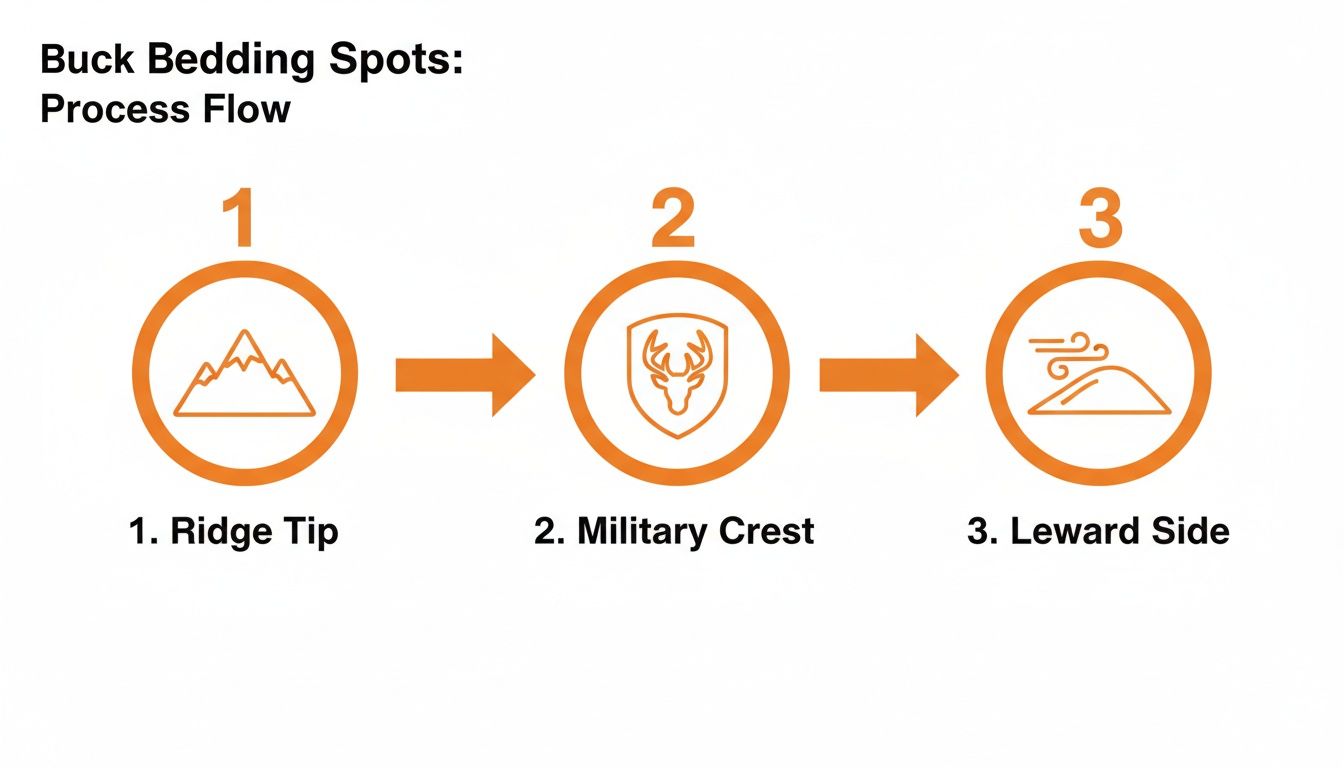
Each of these locations—the ridge tip, military crest, and leeward side—lets a buck use the wind and his line of sight to stay one step ahead of danger.
Confirming the Bed Itself
The ultimate prize is finding the bed—an oval-shaped depression in the leaves, grass, or snow. The size of that depression is the final piece of the puzzle.
- Doe and Fawn Beds: Usually smaller (around 3-4 feet long) and almost always in groups. You'll see multiple beds of different sizes all clustered together.
- Mature Buck Beds: A buck bed is noticeably bigger, often 5-6 feet long. And they are almost always alone. He might have a couple of alternate beds nearby, but you won't find them in a big jumble like a doe family group.
When you find what looks like a buck bed, fight the urge to walk all over it. Your scent can poison that spot for weeks. Instead, observe it from a distance, drop a pin on your GPS, and back out the way you came. You can always monitor it remotely without applying any pressure. For a complete walkthrough on that, check out our guide on how to set up a trail camera.
Rubs and scrapes are the final clues that tie it all together. A line of big, gouged-up rubs leading into a thicket is a buck marking his route home. Finding scrapes near these bedding zones tells you he’s comfortable and staking his claim. When you piece together those faint trails, clustered droppings, a big solitary bed, and nearby rubs, you can be damn sure you’ve found his bedroom.
Why Specific Vegetation Is a Magnet for Deer
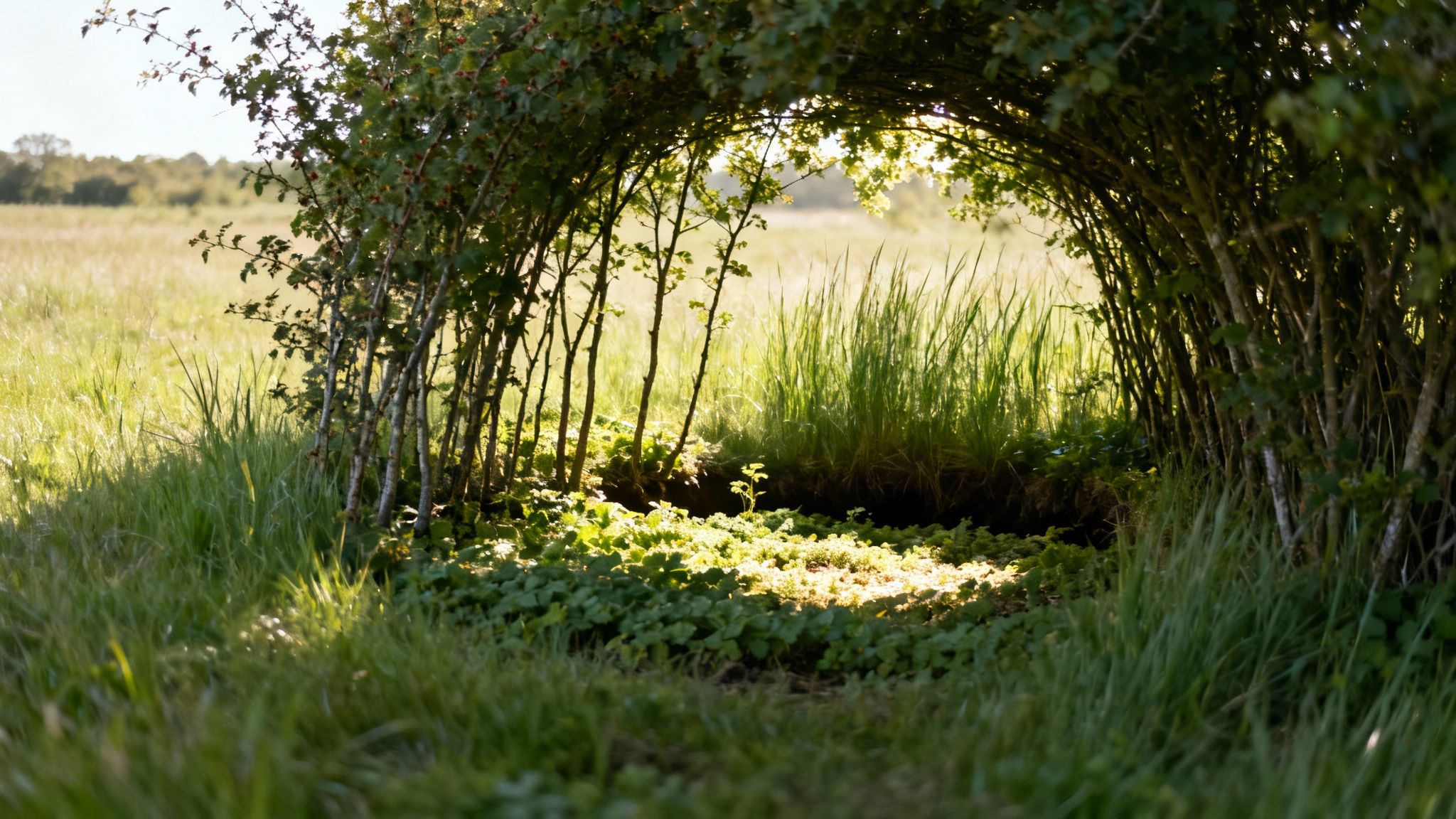
While terrain gives a deer a strategic advantage, it's the actual plants on the ground that provide the life-saving concealment they depend on. You can be on the perfect ridge point, but if it’s just a clean stand of mature hardwoods, it’s not a bedroom. It’s a hallway.
Security is everything when it comes to bedding. That security comes from cover that breaks up their outline and makes them invisible to predators—including you.
A deer’s survival hinges on its ability to disappear. They are absolute masters at finding specific types of growth that offer a two-pronged defense: overhead cover for protection from the elements and horizontal cover for visual concealment. Learning to spot these vegetative sanctuaries is one of the most important skills in deer hunting.
The Power of Layered Cover
The best bedding cover is never just one thing. It’s a messy, tangled-up combination of different growth stages that creates a fortress. Deer need that thick stuff at eye level to hide, but they also get huge benefits from a canopy above them to block out the sun, wind, and snow.
This mix of layers is a powerful magnet. Research backs this up, with one 2012 Swedish study on fallow deer showing that survivors consistently chose bed sites with much higher canopy cover and lower ground visibility than random spots. This proves deer are actively seeking both overhead and horizontal security to stay comfortable and hidden.
Think of it like building a house. The high canopy is the roof, and the dense undergrowth is the thick walls. One without the other just doesn't offer the same level of safety.
Prime Examples of Security Vegetation
As you scout, you need to train your eyes to pick out these high-value cover types. They’re like neon signs in the deer woods, pointing you toward places a whitetail feels safe enough to bed down.
- Cedar and Pine Thickets: These are year-round sanctuaries. The dense, low-hanging boughs provide incredible thermal cover against harsh winter winds and offer cool shade in the summer. More importantly, they create a visual screen that’s almost impossible to see through.
- Early Successional Growth: This is just a fancy term for young, nasty-thick growth. Imagine an old field that’s been let go for five years or a recent clear-cut. It’s a jungle of briars, tangled saplings, and weeds that you can barely crawl through—which is exactly why deer love it.
- Tall Native Grasses (CRP Fields): In farm country, fields of tall switchgrass or other native grasses from the Conservation Reserve Program (CRP) are absolute deer magnets. This grass can get 5-6 feet tall, offering incredible concealment right out in the open.
These spots are often overlooked by other hunters but are prime real estate for both bucks and does trying to escape pressure.
How Deer Use Edges and Pockets
Deer rarely bed right in the middle of a massive thicket. They prefer to use the edges, which lets them stay hidden while still being able to peek out into more open areas. It gives them a huge advantage in spotting danger from a distance.
The most successful hunters I know look for the “cover within the cover.” They don’t just find a big thicket; they find the single, isolated pocket of ultra-dense briars inside that thicket, often tucked right against a strategic terrain feature. That’s the buck’s bedroom.
A mature buck, in particular, will seek out these tiny, isolated pockets of security cover in otherwise open timber. It might just be a single fallen treetop, a small clump of cedars, or a nasty patch of multiflora rose on a hardwood ridge. These are the spots most people walk right past, but they are precisely the kind of secluded, defensible positions an old buck craves.
When you find these little vegetative anomalies, mark them on your map immediately.
Finding Doe Bedding Areas to Predict Rut Behavior
Every hunter dreams of finding that secluded, hard-to-reach sanctuary where a monster buck spends his daylight hours. While that’s a worthy goal, the real key to consistently punching tags during the rut often lies in a completely different spot: the local doe bedding area.
Once November hits, a mature buck’s brain gets rewired for one thing. His survival instincts take a backseat to the biological urge to breed. Suddenly, his carefully chosen security cover is less important than finding the next receptive doe. This shift means the doe family groups are now driving all the action. If you know where they live, you have a front-row seat to the main event.
Unlike a solitary buck who values isolation above all else, does bed in bustling, social communities. They’re less concerned with tactical terrain advantages and more focused on the safety that comes with numbers and being close to food. Because they travel in groups, their sign is much easier to find and interpret.
What to Look for in Doe Sanctuaries
Doe bedding areas just feel different than a buck’s hideout. Forget the single, tucked-away bed. These spots are larger, messier, and located in places that offer good, but not necessarily fortress-like, security. You're looking for a spot that can hold a crowd.
Keep an eye out for these tell-tale signs:
- Proximity to Food: Does, especially those with fawns, almost always bed much closer to primary food sources. Think ag fields, food plots, or a hot oak flat. They need to feed often and won't burn calories traveling far from their bedroom to the kitchen.
- Expansive Cover: Instead of a tiny, isolated pocket, doe groups prefer bigger swaths of consistent cover. This could be an expansive briar thicket, an overgrown pasture, or a grassy drainage that offers enough room for multiple deer to spread out.
- Abundant Sign: This is the dead giveaway. A doe bedding area is hammered with sign. You’ll find countless tracks of all sizes, multiple trails beaten into the dirt, and droppings everywhere. A buck might leave a single pile of pellets; a doe area will have dozens.
With doe groups sometimes numbering 10 or more, the volume of sign is impossible to miss. These communal spots—often found in thickets on a ridgeline right next to a bean field—give the family everything it needs: overhead cover, food just a few steps away, and a nearby water source. You can find more insights on identifying this kind of deer habitat.
Turning Doe Beds into a Rut Strategy
Finding these doe sanctuaries is only half the battle. The real magic happens when you use that intel to predict what the bucks will do next. During the pre-rut and the peak of the chaos, bucks will systematically cruise through these areas, checking for estrous does. And they are remarkably predictable about it.
A mature buck will almost never charge straight into a doe bedding area. That’s a rookie move that would blow the does out and ruin his chances. Instead, he’ll use the wind to his advantage, circling downwind of the bedding area to scent-check for a hot doe without ever showing himself.
This downwind scent-checking route is the single most predictable travel corridor a buck will use during the rut. By setting up on this route, you intercept him while he's distracted, focused entirely on the does ahead. It's the perfect ambush.
This strategy takes some careful planning. First, identify the doe bedding area. Next, figure out the prevailing wind for that day. Then, you need to pinpoint the downwind trail or terrain feature he’ll use to approach. This might be a parallel ridge, a creek bottom, or even a subtle ditch that hides his approach.
Using remote scouting tools is an excellent way to confirm these travel patterns without contaminating the area. Still, many hunters worry, asking "do trail cameras scare deer" when placed near these sensitive zones? With careful placement, the answer is a resounding no, and the intel you gain is priceless for confirming his route.
Got Questions About Finding Deer Beds? We’ve Got Answers.
Even with a perfect scouting plan, questions always crop up once your boots are on the ground. Pinpointing where a buck spends his daylight hours is a subtle art, and the more you learn, the more you realize you don't know. Getting straight answers to these common hang-ups can be the difference between a good trip and a great one.
Let’s break down some of the most frequent questions hunters ask when they’re trying to decode deer bedding. These are the details that help you hunt smarter, not just harder.
When Is the Absolute Best Time of Year to Scout for Beds?
Hands down, the prime time to scout for bedding is in the late winter and early spring. I'm talking about that perfect window right after the snow melts but before everything greens up. The woods are wide open, you can see for a country mile, and all the sign from last fall—rubs, scrapes, trails—is still visible.
This is your chance to dissect a property without the constant worry of bumping a mature buck. Beds from the prior season often stick out like a sore thumb, visible as matted-down depressions in the leaves. You can walk ridges, dive into thickets, and build your entire game plan for the fall without ever pressuring a deer during hunting season.
How Much Does Hunting Pressure Really Affect Bedding Locations?
Hunting pressure is the number one reason a deer's bedding habits will change on a dime. A mature buck might love a scenic hardwood point, but if a hunter stomps through it just once, he could abandon that spot for the rest of the season.
When deer feel pressured, they retreat to the thickest, nastiest, most miserable cover they can find. Think about the places other hunters refuse to go:
- Swampy cattail hellholes
- Impenetrable briar thickets and thorny tangles
- Overgrown clear-cuts that are an absolute nightmare to walk through
They’ll often go almost completely nocturnal, only moving at the fringes of daylight. A spot that was hot last week can go ice-cold if it gets disturbed. This is exactly why low-impact scouting and staying the heck out of known sanctuaries is so critical for long-term success.
Is There a Real Difference Between Morning and Evening Beds?
Yes, but it can be subtle. Deer usually have a primary, fortress-like bedding area where they feel totally secure and spend most of the day. But they also use secondary, temporary beds.
For instance, a deer might bed down for the night much closer to a food source, like the edge of a cornfield, where they feel safe under the cover of darkness. As dawn breaks, they’ll filter back toward their primary bedding area, which is almost always deeper in heavy cover and offers better protection during daylight hours.
A buck’s most secure bed is his daylight bed. He might take a quick nap in a more exposed spot at night, but when the sun comes up, he retreats to his fortress. Understanding this pattern helps you predict his morning travel route from food back to cover.
How Close Can I Get to a Bedding Area Without Blowing It?
This is the million-dollar question, and the honest answer is: not nearly as close as you think. The goal is never to hunt in a bedding area. You hunt the travel corridors leading to and from it. Your scent, sight, and sound are the enemy.
A solid rule of thumb is to stay at least 150-200 yards away from a confirmed bedding area, especially a mature buck’s core sanctuary. That distance changes with the terrain, wind, and cover. On a windy day in rolling hills, you might get away with being a bit closer. In a dead-calm swamp, you need to give them an even wider berth.
The safest play is to identify the bed, drop a pin on your GPS, and back out the exact way you came in. Never, ever push deeper. Your job is to find the bedroom door, not barge into the bedroom. Set your ambush in the "hallway."
The most effective way to monitor these sensitive spots without applying pressure is with modern scouting tools. The Magic Eagle EagleCam 5 lets you watch travel corridors from a distance, confirming a buck's routine without ever leaving your scent behind. Its AI-powered species recognition and GPS mapping help you piece together the puzzle of deer movement, turning your scouting intel into a concrete plan for opening day. Learn more about how to scout smarter at https://magicleagle.com.