

If you want to get serious about hunting coyotes, you have to throw out the playbook you use for deer. It’s a whole different game. Success isn’t about fancy gear; it’s about getting inside a coyote’s head—understanding how they think, where they travel, and why they’re there in the first place. Once you nail that down, everything else starts to click.
Think Like the Predator You're Hunting
Outsmarting a coyote means you have to start thinking like one. These aren’t just instinct-driven animals; they’re incredibly sharp, adaptable, and operate within a complex social structure. While a deer is mostly worried about finding food and avoiding danger, a coyote’s world is a constant balance of hunger, defending territory, and navigating pack politics. If you don't grasp these motivations, you're just guessing.
A common mistake is assuming that hunting pressure simply reduces the coyote population. It’s not that simple. In reality, aggressive hunting can backfire and cause their numbers to explode.
A fascinating study from the University of New Hampshire, which analyzed data from over 4,500 camera traps, revealed something completely counterintuitive. They found that areas with permitted coyote hunting often ended up with more coyotes than protected areas. Why? When dominant pack members are removed, it throws the social order into chaos. This allows younger, subordinate coyotes to breed more freely, often resulting in larger litters. It’s a rebound effect that can quickly overrun an area. You can read the full research about these counterintuitive findings to see just how dramatically pressure can impact their populations.
Pinpoint Their Highways
Coyotes are all about efficiency. They’re not going to waste energy busting through thick brush when an easier path exists. They stick to routes that offer the path of least resistance, giving them cover and a good vantage point to patrol their territory. Learning to spot these "coyote highways" is the key to a good ambush or trail camera setup.
Keep an eye out for these classic travel corridors:
- Creek Beds and Ditches: These natural funnels are perfect for staying out of sight and protected from the wind.
- Field Edges and Fence Lines: They love using these transition zones to scan open fields for prey while staying just feet from escape cover.
- Logging Roads and Game Trails: Just like us, they’ll take the easy road. Established trails are coyote superhighways.
It’s not enough to just find a trail. You need to figure out why they’re using it. A trail connecting a thick bedding area to a farmer’s field is a goldmine. Your job is to intercept them on their daily commute.
Match Your Strategy to the Season
What works for calling in January will get you nothing but crickets in May. A coyote's behavior and priorities shift dramatically throughout the year, and your tactics have to shift right along with them.
Here’s a quick rundown of what to expect and how to adjust your game plan.
Seasonal Coyote Behavior and Hunting Focus
| Season | Primary Coyote Behavior | Strategic Hunting Focus |
|---|---|---|
| Spring (March-May) | Denning and raising pups. Highly territorial and defensive. | Use pup distress calls and territorial challenges. Focus on areas near potential den sites. |
| Summer (June-August) | Teaching pups to hunt. Family groups are active and food needs are high. | Focus on prey distress calls (rabbit, fawn). Stands can be productive as they feed hungry mouths. |
| Fall (September-November) | Young coyotes dispersing to establish their own territories. Increased movement and vocalizations. | This is prime time for howls and challenges to trigger a response from newcomers. |
| Winter (December-February) | Breeding season and scarce food. Coyotes are hungrier and more desperate. | Prey distress calls are highly effective. Snow makes tracking much easier for scouting. |
Understanding these seasonal shifts is fundamental. During the fall dispersal, for example, a young coyote is trying to stake its claim. This is where technology that can help you pattern individual animals becomes a massive advantage. You can learn more about how AI species identification technology helps you track specific coyotes and learn their habits over time, giving you a serious edge.
Build Your Pre-Season Scouting Playbook
A successful coyote hunt is won or lost long before you ever pick up a rifle. It’s the groundwork you lay in the pre-season that separates a lucky shot from a well-executed plan. This is where you stop being reactive and start thinking like a predator yourself. And your best tool for getting inside their heads? The cellular trail camera.
Forget the old days of tromping through the woods, spreading your scent everywhere just to swap an SD card once a month. Cellular cameras give you a quiet, low-impact window into the coyotes' world. You can gather intel for weeks—even months—without ever disturbing the very patterns you’re trying to figure out. That silent observation is your biggest advantage.
Where to Set Your Electronic Eyes
Tossing a camera on a random tree is like fishing in a puddle. Sure, you might get lucky, but you can't build a strategy on it. You have to start thinking like a coyote and pinpoint the natural funnels and terrain features that guide their movement. Your whole goal is to find those high-traffic spots where you can intercept their daily routine.
Start by focusing your camera placements on these key locations:
- Pinch Points and Funnels: Look for those narrow strips of timber between two open fields, a saddle in a ridge, or where a fence line forces them into a thicket. These spots naturally squeeze animal movement down a predictable path.
- Water Sources: A secluded pond, creek, or cattle tank is a mandatory stop for nearly every animal in the area, especially in dry country or late summer. Coyotes will hit these spots regularly, making them perfect for taking inventory.
- Intersections of Game Trails: Find where multiple trails cross. Think of it as a major highway intersection for wildlife. It's a prime location to see not just coyotes, but all the prey they're tailing.
Of course, putting the camera in the right spot is only half the battle. If you're new to this, check out our complete walkthrough on how to set up a trail camera for the best results.
This infographic breaks down how a coyote's brain works, connecting its social needs to its travel habits and what it prioritizes each season.
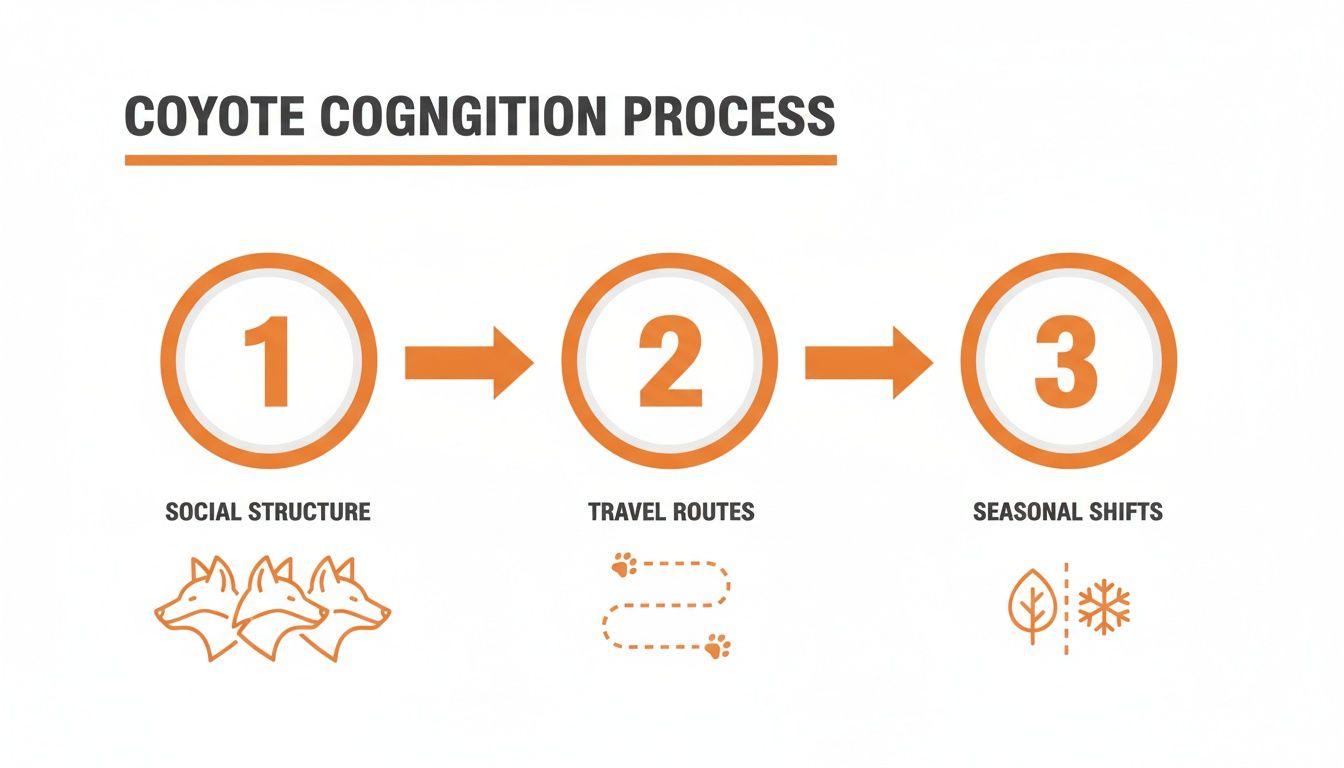
You can see that where a coyote goes is tied directly to its pack status and the time of year. This makes your scouting intel that much more powerful for predicting its next move.
Turning Raw Data into a Hunt Plan
A folder full of coyote pictures is just noise until you learn to read it. This is where modern cameras and apps truly shine. You're not just collecting photos; you’re building a behavioral profile of your local 'yotes.
This is where a feature like Magic Eagle's AI Species Recognition becomes a massive time-saver. Instead of scrolling through hundreds of photos of deer and raccoons, the app automatically filters and tags every single coyote image for you. It lets you cut straight to what matters: finding the pattern.
A single photo tells you a coyote was there once. A hundred photos, timestamped and organized, tell you a story. It’s the story of their daily commute, their favorite times to hunt, and the routes they use to stay hidden.
Once the data starts rolling in, you can begin connecting the dots.
- Pinpoint Peak Activity: Look for clusters in the timestamps. Are they consistently hitting a spot at 5:30 AM and again at 8:00 PM? That’s not random—it’s their schedule. Now you know the best times to be waiting for them.
- Gauge the Pack Size: Are you seeing the same lone coyote over and over, or are there photos of two or three traveling together? This tells you whether you're dealing with a solo transient or an established pack, which completely changes your calling strategy.
- Map Their Travel Corridors: Use the GPS tags on your cameras. If a coyote trips Camera A at dawn and then shows up on Camera C an hour later, you can literally draw a line on your map. You've just uncovered their preferred travel route between bedding and feeding areas.
By the time opening day gets here, you won’t be guessing anymore. You’ll have a playbook built on weeks of hard evidence. You’ll know exactly where to set up, when to be there, and which direction they’ll likely come from. This data-driven approach is what separates the consistently successful hunters from everyone else.
Master Your Stand Setup and Placement
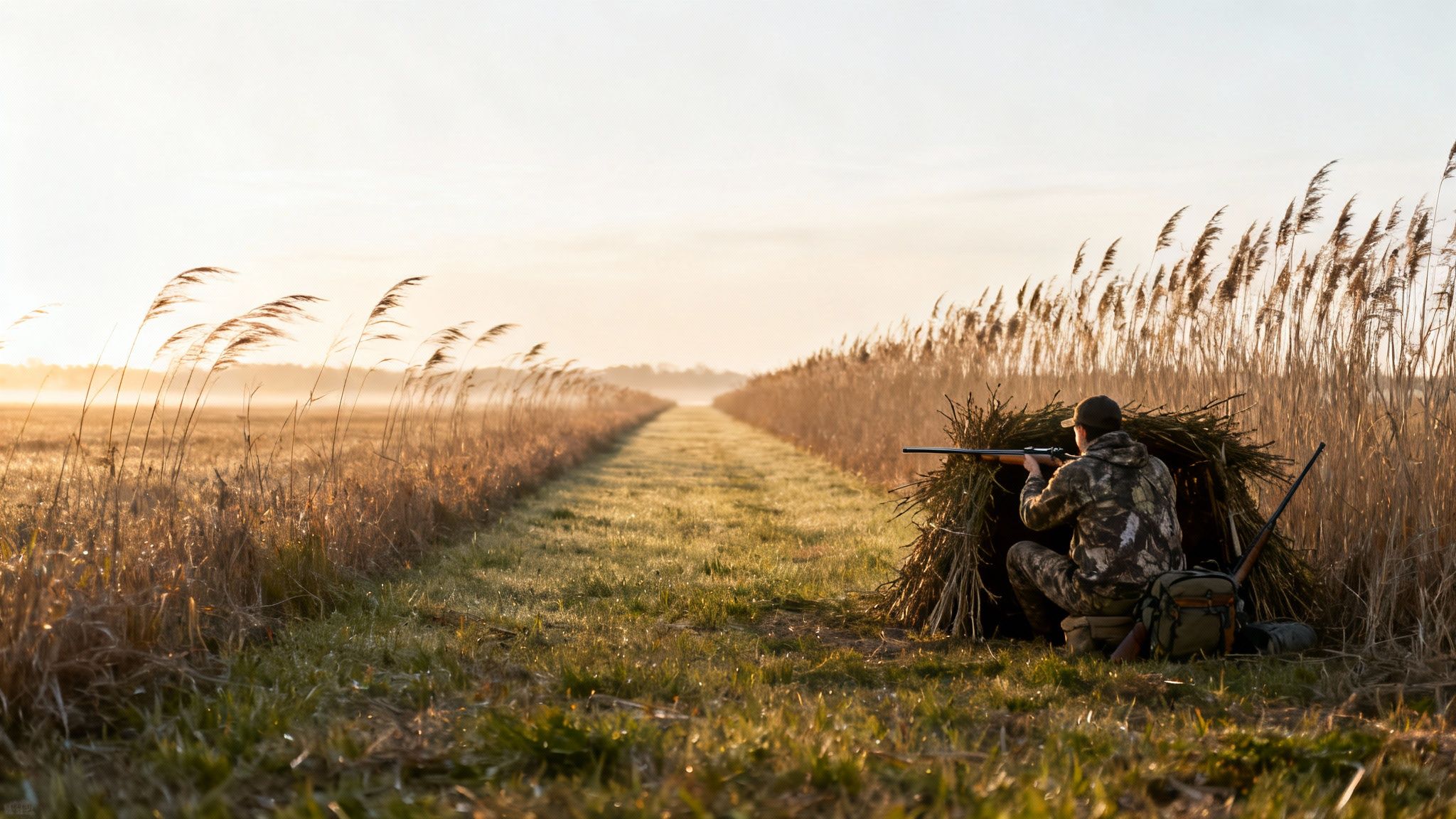
All the scouting data in the world won’t save you from a sloppy setup. This is where your pre-season homework gets put to the test, and the tiniest details decide whether a coyote commits or busts you from 400 yards out. A successful stand boils down to three things: scent, sight, and a clear shot.
The single most critical element is the wind. A coyote lives and dies by its nose. It will almost always try to circle downwind of a call to scent-check the area before showing itself. Get this wrong, and your hunt is over before it even starts.
Using Wind and Terrain to Your Advantage
You never, ever want the wind blowing from your back toward where you expect coyotes to be. The golden rule is to set up for a crosswind, where the wind is blowing across your face, either left-to-right or right-to-left.
A crosswind setup forces a circling coyote to walk out in front of you, giving you a shot. If the wind is blowing from west to east across your position, a coyote coming in from the north has to cross your shooting lane to get downwind. That’s your window of opportunity.
Here are a few tactics I live by:
- Use Elevation (but not too much): Find a slight rise or the side of a hill, but never sit right on the crest. Ducking just below the peak breaks up your silhouette and keeps you from being “skylined.” You get a great view without sticking out.
- Anchor Your Back: Always put something solid behind you—a big rock, a thick cedar, a dense brush pile. It breaks up your human outline and covers your six, letting you focus on what’s in front.
- Anticipate Their Path: Your scouting data, especially GPS-tagged camera locations from your app, tells you where they travel. Position your stand 75-150 yards downwind of these known routes to intercept them as they come to investigate your call.
Blending In Without a Blind
Pop-up blinds have their place, but in open or sparse country, they can look like a spaceship landed in the field. A better approach is often to just melt into the landscape. Coyotes are absolute masters at spotting anything that looks out of place.
Look for natural depressions, clumps of sagebrush, or the base of a gnarly old tree you can tuck into. Your goal is to become part of the scenery, not add a new, suspicious object to it. And once you're set, keep all movement slow and deliberate. A fast, jerky motion to raise your rifle is a dead giveaway.
Your scent is your biggest liability, and the wind is your greatest ally. Master the relationship between the two, and you've solved half the puzzle of coyote hunting.
Before you even think about touching your caller, take a few minutes to plan your shots. Use a rangefinder to zap key landmarks—that lone fence post is 150 yards, that big rock is 250. Knowing these distances beforehand eliminates all the guesswork when a dog finally trots into view.
And please, make sure you have clear, unobstructed shooting lanes. If you need to, discreetly snip a few small branches that could deflect a bullet. Doing this little bit of prep work ensures that when the moment of truth arrives, your only focus is on making a clean, ethical shot.
Learn Advanced Calling and Ambush Techniques
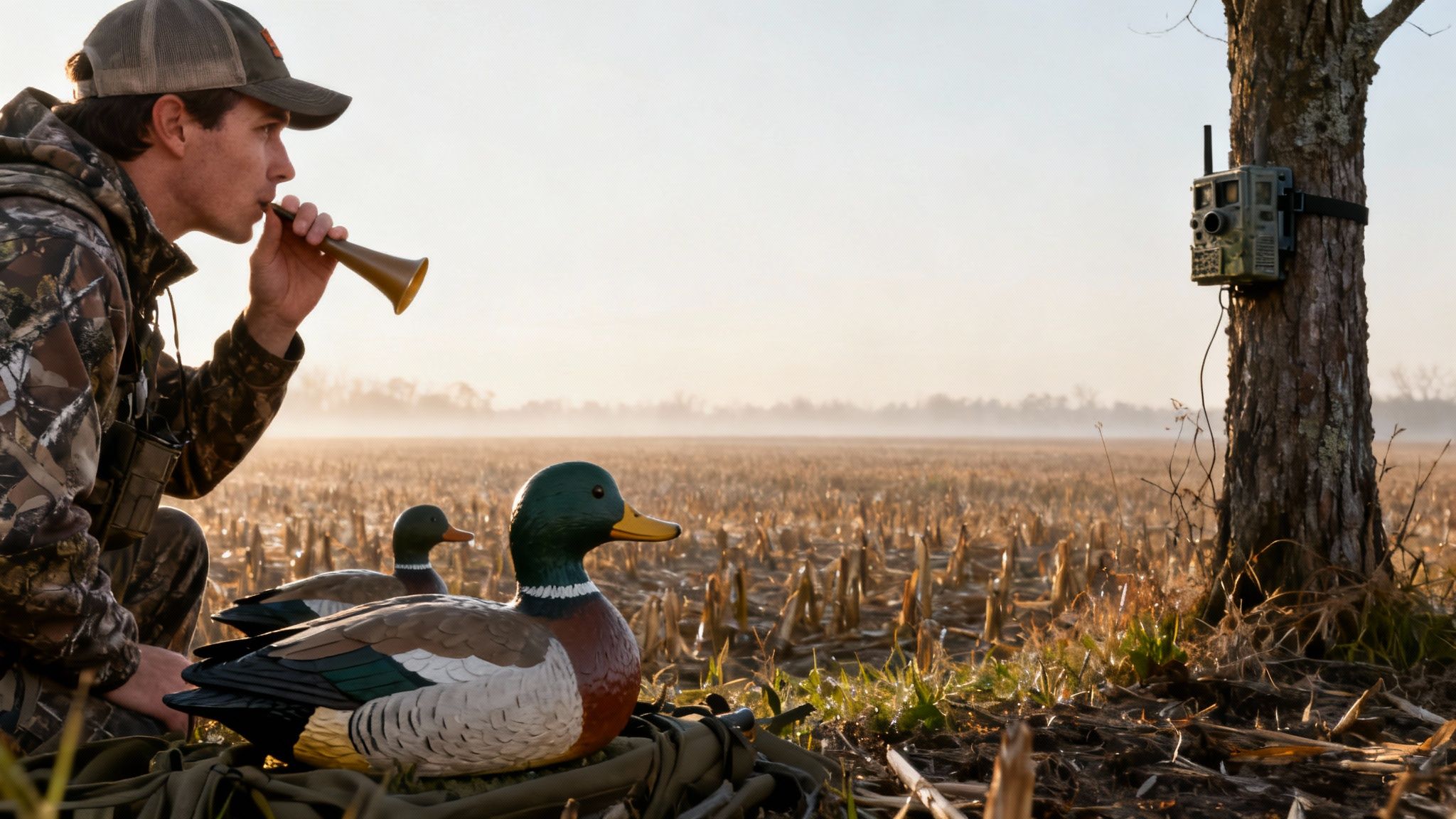
Effective calling is more art than science, and getting it right is what turns a decent setup into a lethal one. Sure, a basic rabbit distress call can pull in a young or desperate coyote. But the educated, wary adults have heard that tune a thousand times. To consistently fool them, you have to tell a convincing story with your calls—one that triggers their territorial, parental, or predatory instincts.
This isn't about just hitting "play" on a single sound and letting it loop. Think of your calling sequence like chapters in a book. I always start quiet, because a coyote could be just over the next rise. From there, I'll slowly crank up the volume to reach any distant ears, then start mixing in different sounds to make the scene feel real.
The Language of Coyotes
Knowing when to use prey sounds versus coyote vocalizations is at the core of any advanced calling strategy. Each type of call sends a completely different message. Using the right one at the right time is everything, and it all comes back to what you learned during your scouting.
- Prey Distress Calls: These are your bread and butter, especially in the dead of winter when food is scarce. A dying rabbit or a fawn in trouble signals an easy meal, appealing to a coyote's most primal instinct: hunger.
- Coyote Vocalizations: This is where you tap into their social structure. A lone howl might get another 'yote to sound off and give away its position. During the spring, pup distress calls can trigger a powerful parental response. In the fall and winter, a territorial challenge can provoke a dominant male into charging in to defend his turf.
One of the biggest mistakes I see hunters make is over-calling. Your goal is to spark their curiosity, not give them a constant beacon to zero in on your exact spot. The second you see a coyote coming in, shut the caller off. Let them search. That little bit of uncertainty makes them cautious but curious, and it often slows them down for a much better shot.
My best stands almost always involve a mix of electronic and hand calls. I’ll start with a rabbit distress on the e-caller to grab their attention. If a coyote hangs up just out of range, a few soft lip squeaks on a hand call is often the magic ticket to make them commit those last crucial yards.
Cadence, Volume, and Patience
The rhythm and intensity of your calling are just as critical as the sound itself. A real animal in distress doesn't scream at full blast for ten minutes straight. Its cries are frantic, then they fade as it weakens, with periods of dead silence in between.
You need to mimic this natural cadence. Call for 30-60 seconds, then sit in absolute silence for several minutes, scanning every inch of the landscape. So many coyotes slip in without making a sound, and you'll blow your chance if you’re busy fiddling with a remote. Patience is your greatest asset here; give every stand at least 20-30 minutes before you even think about packing it in.
Integrating Tech for a Smarter Ambush
This is where modern tools give you an incredible edge. Instead of just calling and hoping for the best, you can now use technology to get real-time feedback and adjust your strategy on the fly. With the Magic Eagle app's 4G live-streaming feature, you can place your camera overlooking a likely approach route and watch the whole thing unfold from a concealed position a hundred yards away.
Picture this: you kick off a calling sequence with a fawn distress sound. Watching the live feed on your phone, you see a coyote pop out at the far end of the field. But its body language is hesitant—it’s not sold on the story you're telling. This is your cue to switch things up.
You kill the fawn sound and switch to a coyote pup in distress. Instantly, you see its ears perk up and its whole posture change through the live feed. It's now coming in on a string. You just used live intelligence to crack the code in that exact moment, turning a maybe into a definite. This active approach is one of the most effective ways to hunt coyotes today, especially when you pair the sounds with a motion decoy to create a scene no predator can resist.
Use Hunting Tech for a Decisive Advantage
Good old-fashioned woodsmanship and calling skills are the bedrock of any successful coyote hunt. No doubt about it. But let's be honest—modern tech gives you an edge that was pure science fiction just a decade ago. It’s not just about getting a few blurry pictures anymore. We’re talking about using live, actionable intelligence to make smarter, faster decisions in the field.
This is about turning your trail camera from a passive scouting tool into an active partner on the hunt. The ability to gather real-time data without stomping all over your hunting area and leaving your scent everywhere is a complete game-changer. Features that once seemed like gimmicks are now essential for outsmarting wary, educated predators.
Predict Movement with Weather Overlays
One of the most powerful tools in a modern hunting app is the integration of real-time weather data, and I'm amazed at how many hunters overlook it. A smart camera from Magic Eagle doesn’t just spit out the temperature; it merges its own sensor readings with detailed, cloud-based weather overlays. This fusion of data lets you see exactly how coyotes react to specific environmental triggers.
For instance, you can pull up a barometric pressure map right over your camera's activity log. You might suddenly realize that big male you're after only shows his face in daylight when the pressure plummets just before a storm front rolls in. That's a pattern you can hunt.
- Temperature Spikes: Track how sudden cold snaps or unseasonable warm-ups trigger feeding frenzies. Coyotes are all about conserving energy, and they'll move when the weather gives them an advantage.
- Wind Direction: Correlate wind data with how coyotes approach a site. You'll quickly confirm their tendency to circle downwind, which helps you fine-tune every future stand setup.
- Moon Phase: Use the built-in solunar and moon phase data to nail down their nighttime travel patterns. This is gold for anyone who hunts after dark.
This isn't just a hunch. You're using hard data to predict when and where a coyote will be, giving you a serious upper hand.
Secure Your Gear and Your Spot
Let’s face it, dropping expensive camera gear in remote spots carries risks. Theft is a real problem, and sometimes you just plain forget exactly where you put one. This is where GPS and geofencing features become absolute necessities for protecting your investment.
A geofence is basically a virtual boundary you draw on a map in your app, right around your camera’s location. If that camera gets picked up and moved outside the line, you get an instant alert on your phone. Paired with live GPS tracking, you can see its exact location, making recovery a whole lot more likely. For anyone running multiple cameras on public land or a big lease, this is non-negotiable.
Today’s tech isn’t just about seeing more coyotes; it's about understanding their world in greater detail. It’s the difference between knowing a coyote exists and knowing its entire weekly schedule.
On top of security, these tools are incredible for dialing in your stand placement. By marking every coyote sighting from your camera on the interactive map, you can literally connect the dots between different locations. You’ll start to see their preferred travel corridors with pinpoint accuracy, turning a simple map into a strategic playbook for your next hunt. The development of modern trail cameras that send photos to your phone has fundamentally changed how we prep for a season.
Stay Connected in Remote Country
There’s nothing worse than having a camera in a killer spot, only for it to go dark because of spotty cell service. It's a common headache in the rugged, remote country that coyotes love to call home. That's a problem that tech like Magic Eagle’s SignalSync was built to solve.
Instead of being locked to one carrier, the camera automatically scans for and connects to the strongest network available—whether that’s AT&T, Verizon, or someone else—without you ever touching a SIM card. This means you get that critical alert when a coyote is coming in, even when you're in a fringe service area.
That kind of reliability is everything. Coyotes are incredibly adaptable, and our hunting strategies have to be, too. Their range has tripled in the U.S. since the Pleistocene, proving they can thrive anywhere. This is where a good cellular camera becomes a precision management tool. AI species ID automatically tags coyote sightings on your app's map, while integrated sensors track the environmental triggers that make them move. Features like no-SIM 4G and GPS anti-theft ensure your camera stays online and secure in those remote pastures and creek bottoms that predators love.
Practice Ethical Shot Placement and Safety
All your hard work—weeks of scouting, hours on stand—boils down to a single moment: the instant before you pull the trigger. That final action is what defines the hunt. It’s a responsibility every hunter carries to ensure a quick, clean, and ethical harvest. It means respecting the animal enough to know exactly where to aim and having the discipline to wait for the right shot.
Coyotes are tough, resilient animals. A poorly placed shot often means a lost animal and an unethical outcome. The goal is always a swift, humane dispatch, and that starts with understanding their anatomy.
Aiming for the Vitals
For a broadside coyote, the vital zone is a roughly fist-sized area tucked right behind the shoulder. This is the “boiler room”—it contains the heart and lungs, and a well-placed shot here will be devastating. It can be tempting to aim for the head, but resist that urge. It’s a much smaller, constantly moving target that carries a high risk of a non-lethal injury.
The aiming point changes with the animal's angle.
- Quartering Away: Aim farther back on the ribcage, visualizing the bullet's path so it exits through the opposite shoulder.
- Quartering-To: The target is the point of the near shoulder, driving the bullet back through the vitals.
The best shot is often the one you don't take. If a coyote is moving fast, facing you head-on, or presenting a bad angle, have the patience to wait. A clean pass is always better than a risky shot.
Choosing the Right Tool for the Job
Your choice of caliber and ammunition plays a huge role in an ethical harvest. While a lot of calibers can get the job done, you want to strike a balance between sufficient stopping power and minimizing pelt damage if you plan on selling or keeping the fur.
Here are a few popular and effective options:
- .223 Remington: This is arguably the go-to choice for a reason. It offers a flat trajectory and a massive variety of effective varmint loads.
- .22-250 Remington: A real speed demon that delivers incredible terminal performance. It's perfect for those longer-range shots in open country.
- .243 Winchester: A versatile caliber that provides a bit more energy, making it a great do-it-all option if you also hunt deer with the same rifle.
Regardless of the caliber, the right bullet is crucial. Polymer-tipped bullets designed for rapid expansion are ideal for coyotes. They transfer energy quickly and effectively without over-penetrating and creating large exit wounds, which is key for preserving the pelt.
The sheer adaptability of coyotes underscores the need for responsible management. A University of Georgia study found coyote densities exceeding one per square mile in some areas, with populations rebounding and even spiking after removal efforts. This highlights their incredible resilience and the impact they can have on local prey, like whitetail fawns. You can explore the full findings of this study to better understand their population dynamics.
Safety Is Not an Option
Finally, firearm safety is paramount. Always be 100% certain of your target and what lies beyond it. Bullets can travel for miles, and you are responsible for every round you fire. Never take a shot at a coyote on a ridgeline or in any situation where you don't have a solid, safe backstop.
Upholding these safety principles and practicing fair chase ethics is what separates a hunter from just a shooter.
Common Coyote Hunting Questions Answered
Even the most seasoned coyote hunters run into questions out in the field. Truth is, consistent success often boils down to making small, smart adjustments based on what the coyotes are doing that day. Here are some quick, no-nonsense answers to a few of the most common dilemmas hunters face.
What Time of Day Are Coyotes Most Active?
Coyotes are primarily crepuscular, which is just a fancy way of saying their activity spikes during the low-light hours of dawn and dusk. These are your money-making hours. They’re usually on the move, transitioning between their bedding and feeding areas, making them more likely to respond to a call.
My best sets, time and again, have been in that first hour of legal light and the last hour before it’s too dark to see.
But don’t pack it in just because the sun is high. During the dead of winter, when every calorie counts, it's not at all unusual to see them hunting midday. The same goes for areas with very little human pressure. Your trail camera data is the ultimate truth-teller here; trust those timestamps to reveal the actual patterns on your specific piece of dirt.
It’s a classic mistake to leave the field as soon as the sun is fully up. I’ve called in some of my biggest, most cautious coyotes mid-morning on brutally cold days when they were just desperate for an easy meal. Stay patient and let your scouting intel be your guide.
How Far Away Can a Coyote Hear a Call?
This one surprises a lot of people. Under the right conditions—think flat, open country with little to no wind—a high-pitched distress call can be heard by a coyote from over a mile away. Their hearing is nothing short of incredible; it’s one of their most finely-tuned survival tools.
That incredible range is exactly why your calling discipline is so critical. Always, always start your calling sequence at a low volume. You never know when a coyote is bedded just over the next rise, and blasting the call at full tilt will only send it into the next county. Start soft, then gradually ramp up the volume to reach any distant ears.
Should I Hunt Coyotes Alone or With a Partner?
While there’s a certain satisfaction that comes from a successful solo hunt, bringing a partner along gives you a massive tactical advantage. Frankly, it’s one of the single most effective coyote hunting strategies you can use to boost your success rate, especially when you're up against call-shy, educated animals.
Hunting with a buddy lets you specialize your roles for a much deadlier setup:
- The Caller: One person can focus 100% on working the call and watching for a reaction, without fumbling to get a rifle in position.
- The Shooter: The other hunter stays completely still, rifle at the ready, covering the most likely approach lanes.
- Extra Eyes: A partner gives you a second set of eyes to spot that coyote doing the classic downwind circle—a move that fools solo hunters all the time. This simple advantage can easily be the difference between a punched tag and a frustrating blank.
Stop guessing and start strategizing with real data. The Magic Eagle EagleCam 5 gives you the live intel you need—from AI species recognition to real-time weather overlays—to truly understand and predict coyote behavior. See the difference for yourself.