

A single whitetail deer track isn't just a dent in the dirt—it's a story waiting to be read. To a seasoned woodsman, that iconic, heart-shaped print reveals a deer's size, its direction of travel, and even what it was doing just moments before. Learning to read this language is one of the most fundamental skills any hunter or wildlife enthusiast can develop.
Why Learning to Read Deer Tracks Matters
Think of a track not as a clue you stumble upon, but as a single word in a much longer sentence. The ability to interpret whitetail tracks changes how you see the woods, turning you from a passive visitor into someone who understands the landscape on a deeper level. It’s a timeless skill that gives you a real edge out in the field.
By understanding what the tracks are telling you, you can start predicting where deer are going and why. It's about connecting the dots to build a full picture of how deer use a property.
- Find Their Highways: You'll start to see the invisible trails deer use to move between food, water, and cover.
- Locate Key Areas: Following a fresh trail can lead you straight to a hot food source or even show you how to find deer bedding areas where they feel safe.
- Time Your Hunt Perfectly: Fresh sign tells you deer are in the area right now, so you know exactly where to focus your efforts.
From Simple Prints to Strategic Advantage
The story told by a set of tracks can be incredibly detailed. Spotting a fresh track—usually about 2.5 to 3 inches long—in the Texas backwoods is a classic moment for any hunter. There's a reason for that: Texas is the undisputed king of whitetail country, home to an estimated 5.3 to 5.5 million deer. That number is staggering, especially when you consider that the entire nationwide population had crashed to just 300,000 back in 1890.
A single track reveals a moment. A full trail reveals a pattern. Mastering this skill is about connecting those moments to understand the daily life of the deer you’re pursuing.
But great woodsmanship goes beyond just reading animal sign. You can take your scouting to the next level by also understanding your surroundings with a topographic map. When you combine that broader environmental context with on-the-ground tracking, you create a powerful strategy.
Pairing these classic skills with modern tools like trail cameras allows you to confirm what the tracks are telling you, turning your observations into hard intelligence and making you a far more effective outdoorsman.
The Anatomy of a Whitetail Deer Track
A single whitetail track is one of the most classic signs you can find in the woods. That tell-tale heart shape is an instant giveaway, but knowing how to read the finer details is what really separates the beginners from seasoned trackers. Think of each print as a fingerprint—it tells a unique story about the deer that left it.
The main shape comes from the deer’s two primary hooves, which are actually its third and fourth toes. When a deer steps on soft ground, these two halves create that split, heart-like impression. The pointed end always shows you which way it was headed. This basic shape is your starting point for any track you find.
From there, the details start to fill in the rest of the story. The first clue you’ll want to look at is the overall size of the track, which can tell you a lot about the deer’s age and maybe even its sex.
Sizing Up Whitetail Deer Tracks
Not all deer tracks are created equal. In fact, the size can vary quite a bit. A big, mature buck is going to leave a much different print than a young, delicate fawn. The easiest way to get a baseline is to measure the track’s length from its pointed tip down to the rounded bottom edge of the hoof. This gives you a solid starting point for an educated guess.
Here's a general guide to what you can expect to find:
- Mature Buck: These tracks are usually 3 inches or longer. They often look wider and a bit more rounded at the tips because of the buck's heavier body weight.
- Mature Doe: A doe's tracks are typically more slender and pointed, generally measuring between 2 and 2.5 inches long.
- Fawn: Fawn tracks are tiny and delicate, almost always measuring less than 2 inches in length.
Keep in mind, these are great rules of thumb, but they aren't foolproof. A very large, old doe can sometimes leave a track that's bigger than a young buck's. Context is always key.
This diagram gives a great visual breakdown of the key elements you can pull from a single track—size, speed, and direction.
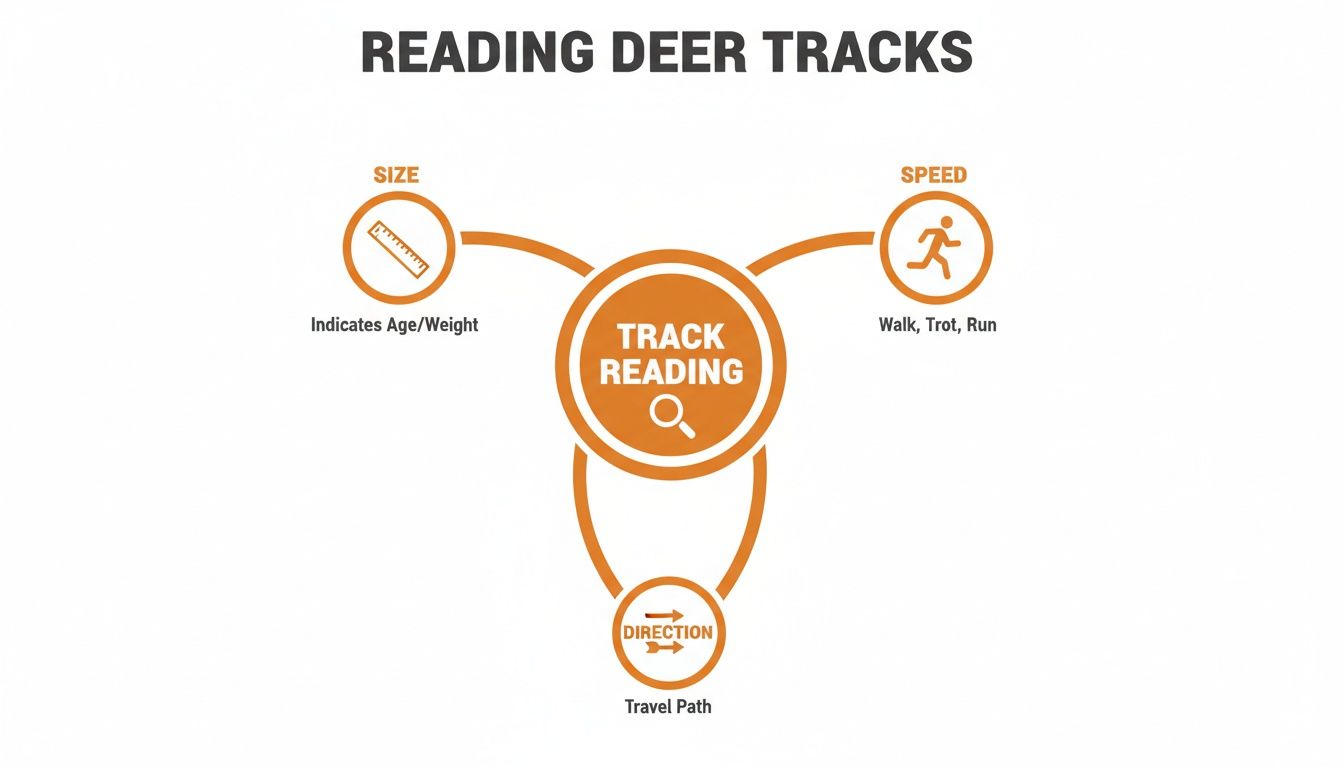
As you can see, one print offers a ton of information. When you start combining these data points, you can build a surprisingly detailed picture of what that deer was doing.
The Role of Dewclaws in Deer Tracks
Behind the main two-toed hoof, deer have two smaller digits called dewclaws. During a normal walk on firm ground, these dewclaws sit high up on the leg and almost never show up in the track. Finding their impressions—two small dots behind the main print—is a huge clue.
The presence of dewclaws in a track is like an exclamation point in the story the deer is writing. It signifies something beyond a casual stroll—either increased speed, soft terrain, or both.
When a deer is running, jumping, or moving fast, its foot sinks deeper, causing the dewclaws to press into the ground. You'll also see them in deep mud or soft snow, where the entire lower leg sinks in. So, if you spot tracks with dewclaw marks on firm ground, it’s a pretty safe bet that deer was in a hurry.
Whitetail Deer Track Identification Quick Guide
To make things easier in the field, it helps to compare the key characteristics side-by-side. While you can't rely on a single feature to be 100% conclusive, looking for a combination of these signs will make your identification far more accurate.
Use this table as a quick reference when you're out scouting and trying to figure out what kind of deer you're looking at.
| Characteristic | Mature Buck | Mature Doe | Fawn |
|---|---|---|---|
| Track Length | Typically 3+ inches | 2 to 2.5 inches | Under 2 inches |
| Track Shape | Wider, more rounded, and blocky | Narrow, slender, and more pointed | Small and delicate |
| Hoof Splay | Often more splayed due to weight | Toes are typically closer together | Minimal splay |
| Dewclaws | More likely to register in soft ground | Less likely to register unless running | Rarely seen unless in deep substrate |
| Trail Pattern | Straighter, more direct lines of travel | More meandering paths when browsing | Follows doe's tracks closely |
By combining your observations of the track's anatomy—its size, shape, and whether dewclaws are present—with the overall trail pattern, you can build a remarkably accurate profile of the deer that passed through. This foundational knowledge is what unlocks the more advanced skill of reading deer behavior from their tracks alone.
How to Distinguish Deer Tracks from Lookalikes
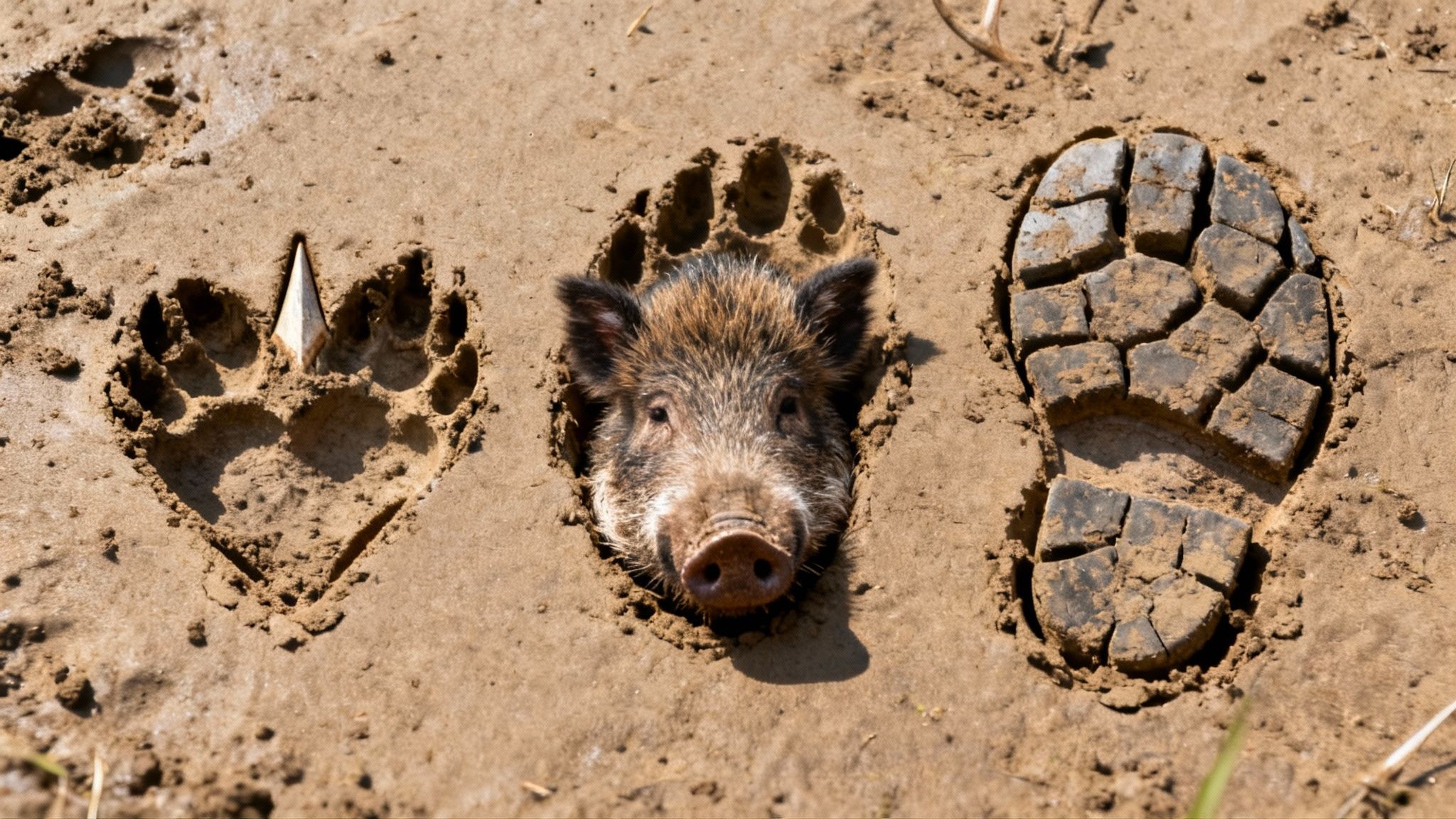
Out in the woods, that classic heart-shaped print in the mud gets your pulse racing. But hold on a second. Excitement can easily lead to a case of mistaken identity, because not every cloven-hoofed animal out there is a whitetail.
Learning to spot the subtle—but critical—differences between a deer track and its common lookalikes is a fundamental skill. It’s what keeps you from wasting hours, or even days, following the wrong trail.
This is more than just a neat party trick for the woods; it’s the bedrock of effective scouting. The sheer number of whitetail tracks across the American landscape tells an incredible story of recovery. After plummeting to a mere 300,000 survivors in 1890, the total U.S. deer population has rebounded to an estimated 36 million today, with whitetails making up about 32 million of that. Their tracks are everywhere, but so are the prints of other animals that call the same woods home. Learn more about the history of the whitetail deer's recovery.
Knowing how to tell these prints apart ensures your energy is always focused on the right animal. Let's break down the most common track impostors.
Whitetail Deer vs. Feral Hog Tracks
Feral hogs are probably the number one cause of track confusion. Their prints are often in the same size range as a deer's, but once you train your eye, the differences are glaring. A whitetail track is distinctly heart-shaped and pointed. A hog track? It’s much more rounded, almost looking square.
Think of it like this: a deer track looks like two long teardrops pressed together at the base. A hog track is more like a blunt, rounded coffee bean that’s been split in two.
Here are the key giveaways:
- Shape: A whitetail track is longer than it is wide, giving it that classic pointed, heart-like silhouette. A hog track is nearly as wide as it is long, creating a more circular or boxy outline.
- Hoof Tips: A deer’s hoof tips are sharp and pointy. In contrast, a hog’s hoof tips are visibly blunt and rounded off.
- Dewclaws: A hog's dewclaws are a dead giveaway. They sit further out to the sides and are much more prominent, often showing up in the print even on firm ground. They’ll be noticeably wider than the main hoof impression.
The single biggest tell is the shape. If the track looks more like a circle than a heart, you're almost certainly looking at sign from a feral hog, not a whitetail.
Whitetail Deer vs. Elk Tracks
Elk are obviously much larger than whitetail, but a young calf can sometimes leave a track that makes you do a double-take. The key difference here is simply size and shape. A mature elk track is a massive 4 to 5 inches long, completely dwarfing even the biggest buck track you'll find.
Even with a younger elk, the shape is all wrong for a deer. Elk tracks are much more rounded and blocky. They look like a big, blunted heart and lack the delicate, sharp points of a whitetail. If the track looks big, heavy, and a little bit "cowy," you’re on an elk.
Whitetail Deer vs. Sheep or Goat Tracks
Depending on your region, domestic sheep or wild goats can also leave misleading prints. Much like hogs, their tracks tend to be more rounded and blunt than a deer’s. A great detail to check is the inner edge of the two hoof halves.
-
Deer: The inner edges of a deer's hooves are concave, curving inward like a set of parentheses
( ). - Sheep/Goat: The inner edges of their hooves are usually straight or even slightly convex, which messes up that clean "heart" shape.
By locking in on these specifics—overall shape, hoof tips, and dewclaw placement—you'll build the confidence to correctly identify whitetail tracks every time. Mastering this skill makes your scouting infinitely more efficient and ensures every minute in the woods counts.
Interpreting Deer Gait and Behavior Patterns
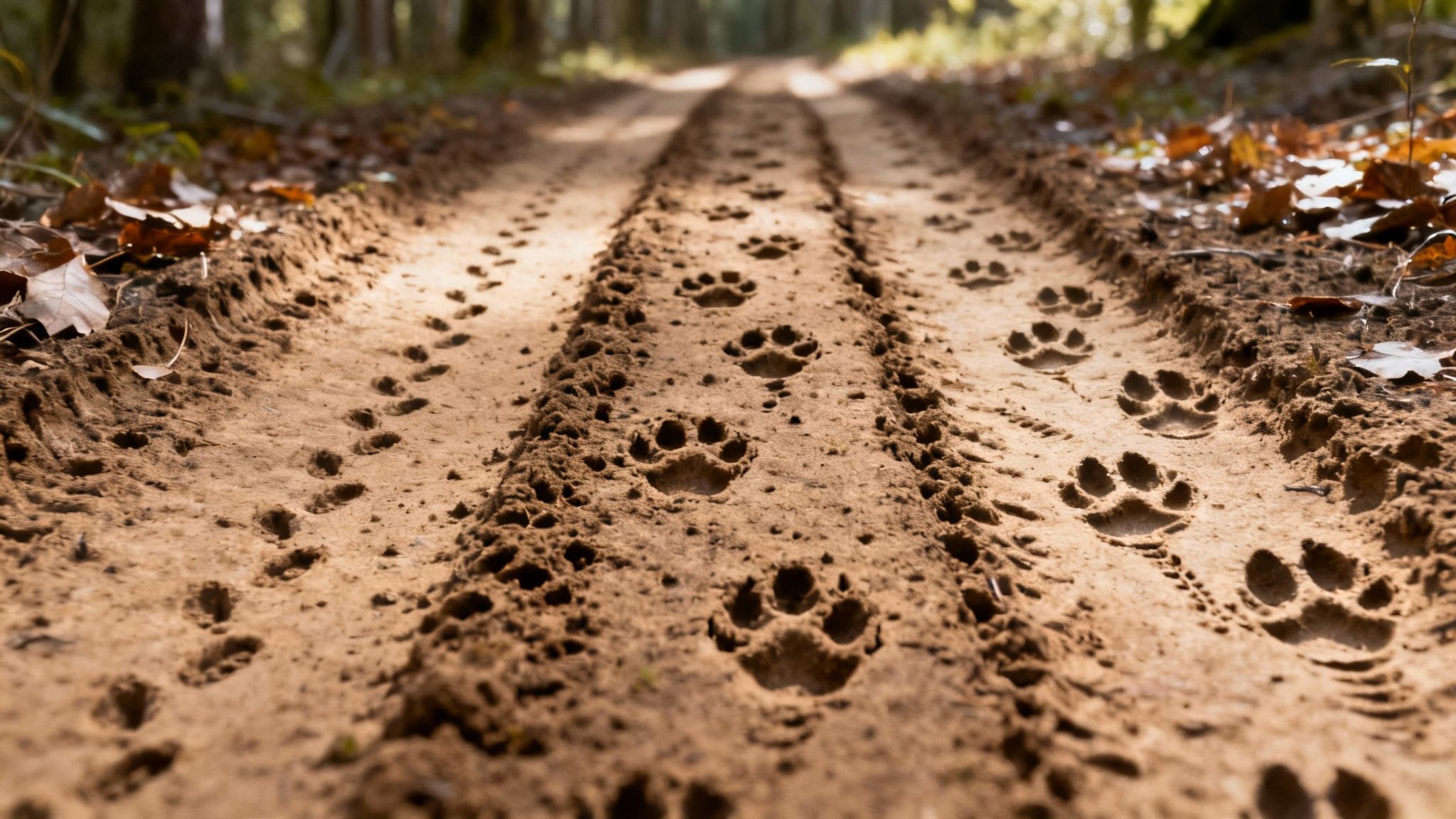
Finding a single whitetail track is just the first step. The real story isn't in one print—it's written in the entire trail. Think of a single track as one word; the pattern of tracks is the full sentence that tells you exactly what that deer was doing, thinking, and feeling. Learning to read these gaits is how you move from just identifying tracks to genuine woodsmanship.
A deer’s tracks don't just point you in a direction. They reveal its state of mind. A calm, relaxed deer moves very differently from one that just caught your wind or is trotting purposefully toward a hidden food plot. By looking at the spacing, depth, and layout of the prints, you can piece together the narrative of that deer's journey.
The Calm Walk: A Deer’s Default Gait
The most common pattern you'll stumble upon is the simple walk. This is the deer's "cruise control" setting. You'll see evenly spaced tracks where the rear hoof lands almost perfectly on top of where the front hoof just lifted off. This is called direct registration.
This efficient, energy-saving movement is the sign of an undisturbed deer. If you find a meandering, zig-zagging trail, it often means a doe was casually browsing. On the other hand, a buck will often leave a straighter, more direct walking trail as he moves with purpose between his bedding and feeding spots.
A walking deer leaves a story of calm and routine. The tracks are deliberate and evenly spaced, painting a picture of an animal that feels secure in its environment and is simply going about its daily business.
The distance from one set of tracks to the next is the stride. For an average whitetail, a walking stride is about 20 inches. A much longer or shorter stride can give you hints about the deer’s size and the terrain it’s navigating.
The Purposeful Trot
When a deer picks up the pace, it shifts from a walk to a trot. You’ll see this gait when a deer is a little wary or is traveling with more intent. The tracks will be spaced farther apart, and you’ll no longer see that neat direct registration.
Instead, the rear foot will land ahead of where the front foot was, creating a more staggered pattern. The stride length will open up significantly, often stretching out to 3-6 feet between prints. In softer ground, you might also start to see dewclaws pressing in as the deer pushes off with more force. This gait tells you the deer was alert and on the move.
The Bounding Leap and Stot
When a deer is truly alarmed, it bounds. This is that classic, graceful leaping motion you see when a deer busts out of cover. The tracks from a bound are impossible to mistake. All four feet will land in a tight cluster, followed by a huge gap of open ground before the next cluster lands.
This explosive gait can cover ground incredibly fast, with leaps sometimes exceeding 20 feet. You will almost always see deep impressions and prominent dewclaw marks, signaling the sheer force of the movement. Finding these tracks means a deer was recently spooked—and badly.
Another interesting pattern comes from the stot, or pronk. This is a stiff-legged bouncing motion where all four feet hit the ground at once. It's often a display of fitness to a predator or a way to get a better view over brush. The track pattern is a very distinct square of four prints.
Reading the Trail’s Story
Putting it all together is where tracking becomes an art. For example, finding whitetail tracks in Wisconsin's northwoods tells a powerful story of opportunity. Those classic 2-3 inch prints, especially with dewclaw marks in soft snow, are clues left by a thriving population. Wisconsin is a whitetail powerhouse, boasting between 1.3-1.6 million deer and holding the record for the most entries in the Boone & Crockett book—over 1,800. That density means that during the October rut, some studies log 10-30 fresh tracks daily per square mile on public land.
By understanding gait patterns, you can interpret the narrative on the ground. See a meandering walk that suddenly explodes into a bounding trail? Something spooked that deer. Find tracks showing a steady trot along a field edge, even during a light drizzle? That tells you about their confidence in the area. It might also make you want to learn more about how deer move in the rain to sharpen your strategy. Reading the gait is like reading body language—it reveals the animal’s behavior long after it has vanished.
How to Age Tracks Based on Environment
A fresh whitetail track is an immediate clue. An old one is just history.
The difference tells you whether you’re on a wild goose chase or hot on the trail of a deer that’s just minutes ahead. Learning to read the age of a track is a skill that separates the pros from the casual observers, and the secret isn’t just in the track itself—it’s in the environment around it.
Think of a fresh track like a photo taken a second ago. It’s sharp, clear, and loaded with detail. An older track is more like a photo left out in the sun and rain: faded, blurry, and worn around the edges. The ground is the canvas, and every different substrate tells a unique story about time.
Reading the Story in Mud and Sand
Mud is one of the best storytellers in the woods. A brand-new track in mud will have razor-sharp edges. You might even see a slick sheen of moisture or a tiny bit of water seeping into the bottom of the print. But as time goes on, that picture changes dramatically.
- Within a Few Hours: Those crisp edges will start to soften up as the mud begins to dry. The wet sheen vanishes, leaving behind a dull, matte finish.
- After 24 Hours: The track will look noticeably drier. You’ll probably see small cracks forming along the edges as the mud shrinks and contracts. Forget about seeing fine details like the subtle texture of the hoof pad; they’re long gone.
- Several Days Old: Now the track is hard, cracked, and its edges are crumbled and rounded. Little bits of leaves, dirt, and other forest debris will have started to settle inside the print.
Sand and dust follow a similar pattern, but they break down a lot faster. A perfect track in fine dust might only hold its shape for an hour or two before the wind begins to erase it. A print in wet sand holds up great at first, but once the sun starts baking it, the edges will quickly start to crumble away.
Snow Tracks: The Ultimate Timestamp
When it comes to aging tracks, snow is the absolute best medium you could ask for. It’s so sensitive to temperature and sunlight that it provides an almost perfect timestamp for when a deer passed through. Fresh snow creates an incredibly detailed print.
A track in snow is like a melting ice cube. The longer it's exposed to the elements, the less definition it has. A sharp, crisp track with clean edges means the deer is close. A melted, rounded-out print is a sign you're hours, or even a day, behind.
Here’s how to read the timeline in the snow:
- Very Fresh (Minutes to an Hour): The track will have sharp, angular edges with zero signs of melting. You might even see loose snow crystals that were kicked up still resting on the surface around it.
- A Few Hours Old: The sun and air temperature have started their work. The sharp edges will begin to round off, making the track look a little wider and less defined as the snow melts.
- A Day Old or More: At this point, the track is just a rounded, hollowed-out depression. It's lost almost all its original shape and detail, looking more like a cup than a hoof print. If there’s been any wind, you’ll see it starting to fill with drifting snow.
By paying close attention to these subtle changes—the sharpness of the edges, the moisture, the debris—you can learn to read the timeline left behind in the dirt. This one skill will transform your scouting from pure guesswork into an informed strategy, making sure you’re always acting on the best intel the woods has to offer.
Using Tracks to Guide Your Hunting Strategy
Everything we've covered—identifying, aging, and interpreting whitetail tracks—comes together right here. This is where you stop being a passive observer and start building a real-world hunting strategy based on what the deer themselves are telling you.
The prints left in the mud are more than just proof a deer passed through. They’re a roadmap to its daily life. By learning to follow that map, you can stop guessing and start knowing. The woods are a puzzle, and tracks are the pieces that let you solve it. This isn't just about finding a deer; it’s about connecting with the environment on a much deeper level and getting real-time intelligence that no satellite image can provide.
Pinpointing High-Traffic Corridors and Funnels
Deer are creatures of habit. Just like us, they prefer the path of least resistance when moving between their core areas—bedding, food, and water. A single set of tracks is a clue, but discovering where multiple trails converge is a game-changer. These intersections are deer highways.
Look for places where the terrain naturally squeezes deer movement into a tight spot. We call these funnels. A classic funnel might be a saddle between two ridges, a thin strip of timber connecting two big woodlots, or the corner of a field where a fence pushes deer through a specific gap.
When you find a spot where multiple sets of tracks—all from different deer—cross through the same small area, you've struck scouting gold. That's a high-confidence location for a stand or blind.
These travel corridors are the arteries of a deer's home range. By finding them, you can position yourself not where you hope deer will be, but where their tracks prove they travel constantly.
Finding the Destination: Food and Water
Tracks don't just show you where a deer is going; they show you why. A trail that marches straight into a cornfield or disappears toward a secluded creek tells a clear story.
It’s a simple but incredibly effective technique. If you find a heavy trail leaving a field edge in the morning, you can often backtrack it right to a primary bedding area. On the flip side, following fresh evening tracks leading away from thick cover will almost always take you to that night's dinner table or water source. This is how you confirm which specific trail they’re using to approach a food plot, instead of just setting up and hoping for the best.
Using Fresh Tracks for Trail Camera Placement
Here’s where classic woodsmanship gets a massive boost from modern tech. A trail camera is an amazing tool, but it's only as good as its location. Nothing will improve your trail cam results more than placing it over fresh, concentrated sign.
When you find a heavily used trail, a fresh scrape, or a cluster of rubs, that’s your cue. A camera set up to watch that spot will confirm which deer are using the area, what time they’re moving through, and which direction they're coming from. This turns your tracking into a data-driven strategy. The tracks help you find the spot, and the camera provides 24/7 surveillance to tell you the rest of the story. Honing your skills at capturing bucks on trail cams can turn a good season into a great one by giving you the photographic proof you need to pattern a specific animal.
By combining these methods, you're no longer just hoping for an encounter. You’re building a complete hunting strategy based on hard evidence, using the story the deer wrote in the dirt to put yourself in the right place at the right time.
Common Questions About Whitetail Deer Tracks
Even after you've got the basics down, some questions always seem to pop up in the field. These are the real-world scenarios that can stump even experienced trackers. Getting clear on them will sharpen your skills and give you the confidence to trust what the tracks are telling you. Let's tackle a few of the most common ones.
Can You Tell a Buck from a Doe by a Single Track?
It’s tempting, but trying to identify a buck from just one print is a fool's errand. Yes, buck tracks are often larger, wider, and a bit more rounded at the tips, but a big, old doe can easily leave a print that dwarfs a young buck's. The real story is never in one track; it’s in the pattern.
You have to build a case with supporting evidence:
- Drag Marks: Mature bucks, especially when they're rut-heavy and tired, often drag their feet. Look for those telltale scuff marks in the dirt or snow between the prints.
- Trail Pattern: Bucks tend to walk with a purpose, often in a straighter, more direct line. A doe's trail might meander more as she browses and keeps an eye on fawns.
- Other Sign: If you find fresh rubs or scrapes nearby, the odds you're on a buck's trail skyrocket. Context is everything.
Think of it like this: a single track is a hint, but the entire trail—combined with other signs—is the confirmation. Never judge a deer by a single print alone.
How Does Rain Affect Reading Deer Tracks?
Rain can be your best friend or your worst enemy, depending on how it falls. A hard, soaking rain is like hitting the reset button on the entire forest floor. It washes away every old track and bit of sign. This is a massive advantage because any whitetail deer tracks you find right after the storm are 100% fresh.
Even a light rain can be a huge help. It can turn dry, dusty soil into the perfect medium for capturing prints, making them much easier to spot and follow. It adds just enough moisture to help the tracks hold their shape long enough for you to find them.
What Are the Best Conditions for Finding Deer Tracks?
Nothing makes a track pop like the right conditions. A fresh dusting of snow is the gold standard, revealing every detail. Soft, damp earth right after a rain is a close second, capturing crisp, clear impressions of whitetail deer tracks.
The toughest conditions? Hard-packed dry dirt, thick matted grass, or a forest floor buried under a deep layer of crunchy leaves. In these situations, your best tool is low-angle light. Head out in the early morning or late evening when the sun is low on the horizon. The long shadows it casts will make even the faintest track stand out in dramatic relief.
Ready to turn your tracking insights into 24/7 intel? The Magic Eagle EagleCam 5 combines rugged reliability with AI-powered species recognition, letting you confirm exactly which deer are using those trails you found. See what you've been missing and build a smarter hunting strategy. Discover the EagleCam 5 today at magiceagle.com.