

Figuring out the best camera for filming your hunts isn't about finding a single "best" device. It's about matching the right piece of gear to the story you want to tell. These days, a good camera to film hunts is way more than just something that records video. It’s a purpose-built tool, mixing field-ready toughness with smart features like cellular updates and even AI that can tell a buck from a doe.
What Makes a Good Camera for Filming Hunts
For a lot of us, capturing the story of the hunt—the raw, unfiltered moments—is just as important as the chase itself. Video lets us relive the stalk, learn from our choices, and share the whole adventure, from preseason scouting to the final pack-out.
But the idea of a "perfect" camera is a moving target. The right camera for scouting a remote food plot is completely different from the one you'd use to film a first-person shot or produce a cinematic hunting film.
Each type of camera has its own strengths and weaknesses. Understanding what they are is the first step to making a smart investment and avoiding frustration down the road.
Defining Your Filming Goals
Before you even look at specs like megapixels or trigger speed, you need to get clear on one thing: what's the main job this camera needs to do? Answering this question will immediately narrow down your options.
Most hunt filming falls into one of three buckets:
- Remote Scouting and Monitoring: The mission here is pure intel. You need to know what animals are in the area, their patterns, and their numbers, all without spooking them. This requires a camera that can run on its own for weeks, or even months, at a time.
- Capturing the Action: This is all about filming the hunt from your perspective—the stalk, the shot, the recovery. You need something lightweight, tough as nails, and dead simple to operate when your heart is pounding.
- Producing High-Quality Films: Now we're talking about storytelling. This requires cameras that give you creative control, fantastic image quality, and crisp audio to create something that looks and feels professional.
And once you have that footage, you'll need the right tools to put it all together. A complete setup often includes various types of video production software to turn raw clips into a story worth watching.
The Four Main Camera Categories
To cover all these bases, hunters usually turn to four main types of cameras. Think of them as different tools in a toolbox. A serious hunter might even use a few different kinds to get the complete picture.
The biggest change in hunting tech lately isn't just better video—it's the shift from passively recording to actively gathering real-time intel. A truly good camera to film hunts today often provides actionable data that can change your whole strategy on the fly.
A cellular trail camera, for example, is the undisputed king of remote scouting, sending updates right to your phone. If you just need to set it and forget it for months on end, you can learn more about https://magiceagle.com/blogs/knowledge/what-is-a-good-trail-camera in our other guide. On the flip side, an action camera is built for that hands-free, point-of-view footage, while a mirrorless or DSLR camera delivers the cinematic look needed for top-tier productions.
In this guide, we’ll break down each of these categories, so you can pick the best tool for your next hunt.
The Main Types of Hunting Cameras Explained
Choosing the right camera to film your hunts is like picking a tool from your workshop—you wouldn't use a hammer when you need a screwdriver. Each type of camera is built for a specific job, and understanding what makes them different is the first step to capturing incredible footage. We'll break down the main categories, from the silent scouts that gather intel to the cinematic storytellers that bring your hunt to life.
This decision is more important than ever. Over the last decade, what we consider a "good camera to film hunts" has evolved from simple SD-card trail cams to smart, cellular-connected systems. Hunters now demand more than just grainy photos of deer passing by at night. This shift is huge—the dedicated hunting camera market hit about USD 100 million in 2023 and is expected to climb to USD 160 million by 2032. The cellular camera niche alone was worth over USD 500 million in 2023, proving just how massive the demand for remote intel has become. You can dig into more data on the hunting camera market to see these trends for yourself.
This flowchart boils it down, connecting your main goal—whether it's scouting, capturing the action, or creating a film—to the right type of camera.
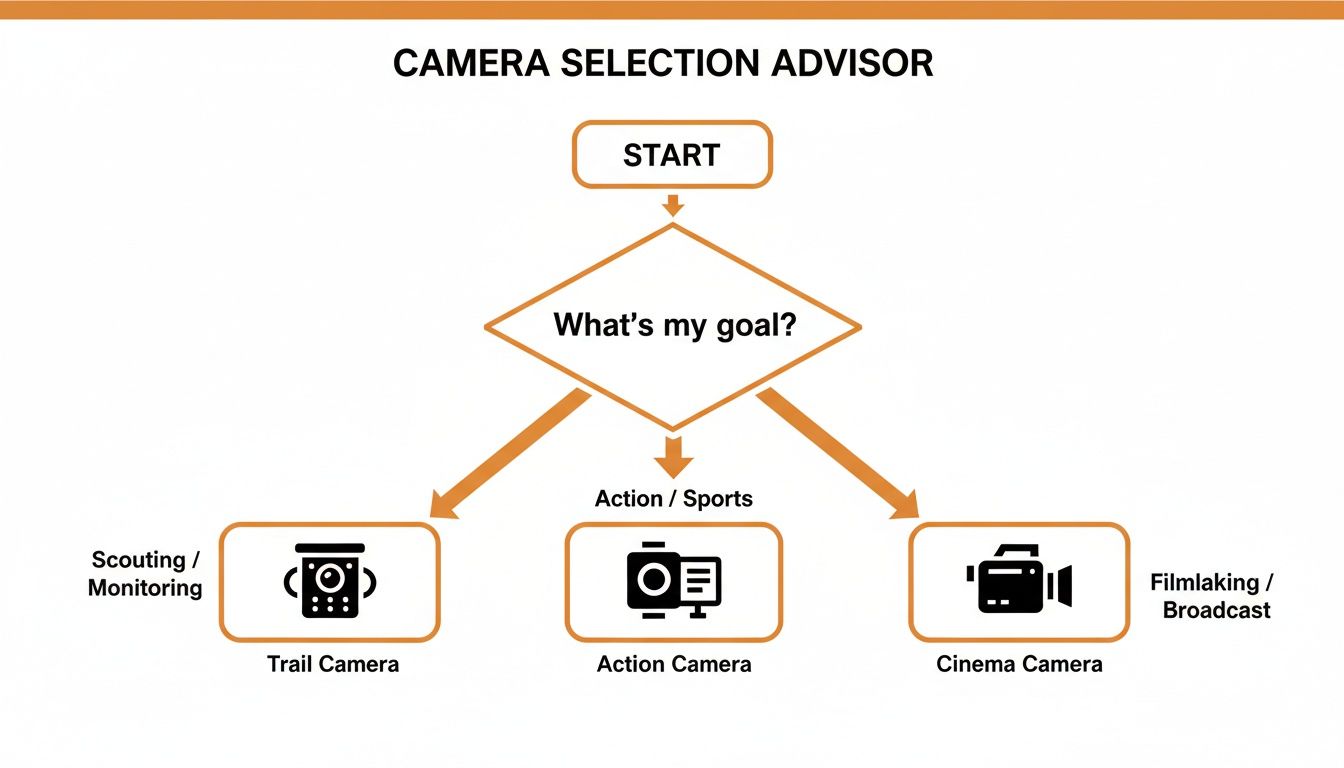
As you can see, what you want to accomplish dictates the gear you need. It’s all about matching the tool to the task at hand.
Hunting Camera Types at a Glance
To make it even simpler, here’s a quick breakdown of the main camera categories, their best uses, and what they can (and can’t) do for you in the field.
| Camera Type | Primary Use Case | Key Advantages | Key Limitations |
|---|---|---|---|
| Cellular Trail Camera | Remote scouting and real-time monitoring | Instant photo/video delivery, remote access | Requires a data plan, shorter battery life |
| Traditional Trail Camera | Long-term, set-and-forget scouting | Excellent battery life, lower cost | Requires manual SD card retrieval |
| Action Camera | Capturing first-person (POV) action | Small, rugged, wide-angle view | Poor zoom, limited creative controls |
| Mirrorless/DSLR | Producing high-quality, cinematic films | Superb image quality, interchangeable lenses | Bulky, expensive, requires more skill to operate |
This table should give you a solid starting point. Now, let’s dive a little deeper into what each of these camera types brings to the table.
Cellular and Traditional Trail Cameras
Think of a trail camera as your silent, 24/7 scout. These are the workhorses of pre-season recon and property management. You strap one to a tree, and its motion sensors trigger photos or videos whenever an animal walks by. Simple, effective, and absolutely essential for modern hunting.
They come in two main flavors:
- Traditional Trail Cameras: These are your classic set-it-and-forget-it models. They save everything to an SD card that you have to physically pull to see what you’ve captured. They’re generally cheaper and have fantastic battery life because they aren't constantly sending data.
- Cellular Trail Cameras: This is where the game changes. These cameras send photos and videos straight to your phone over a cellular network. You get near-real-time updates from anywhere, allowing you to monitor activity without ever setting foot in the woods and spooking game.
Their main job is gathering intel, not creating a feature film. But the footage they capture is often the critical opening chapter to the story of a successful hunt.
A hunter's journal used to be handwritten notes in a spiral notebook. Today, it’s a cloud-based library of time-stamped videos from a cellular trail cam, delivering hard data that can make or break a season.
Action Cameras for POV Footage
Action cameras, like the ones from GoPro or DJI, are built for one thing: putting the viewer right in the middle of the action. They're tiny, tough as nails, and designed to be mounted anywhere—on your bow, scope, hat, or chest.
This is the camera you want for capturing that heart-pounding, first-person view of a buck stepping into your lane or a gobbler strutting into decoy range. Their wide-angle lenses grab the entire scene, making anyone who watches it feel like they were right there with you. While they’re brilliant for capturing dynamic, in-the-moment footage, they don't offer the zoom or creative settings you’d get from a bigger camera.
Mirrorless and DSLR Cameras for Cinematic Quality
When your goal is to produce a hunting film that looks like it belongs on the big screen, you step up to a mirrorless or DSLR camera. These are the same cameras the pros use for photography and videography, and they offer unbeatable image quality and creative freedom.
Here’s why they stand out:
- Interchangeable Lenses: This is a huge deal. You can swap from a wide lens for capturing breathtaking landscapes to a powerful telephoto zoom to get tight shots of animals hundreds of yards away.
- Manual Controls: You get full command over settings like aperture, ISO, and shutter speed. This is how you create that blurry background, nail the perfect exposure, and achieve a truly cinematic look.
- Superior Low-Light Performance: This might be their biggest advantage for hunters. They can capture clean, crisp footage in those critical dawn and dusk hours when most cameras would just see darkness.
Filming with a mirrorless or DSLR is definitely more involved. It often means having a dedicated camera operator, using a tripod for stable shots, and really knowing your way around the settings. But the trade-off is footage that can rival a professional production, making it the only real choice for serious content creators.
Decoding the Specs That Matter in the Field
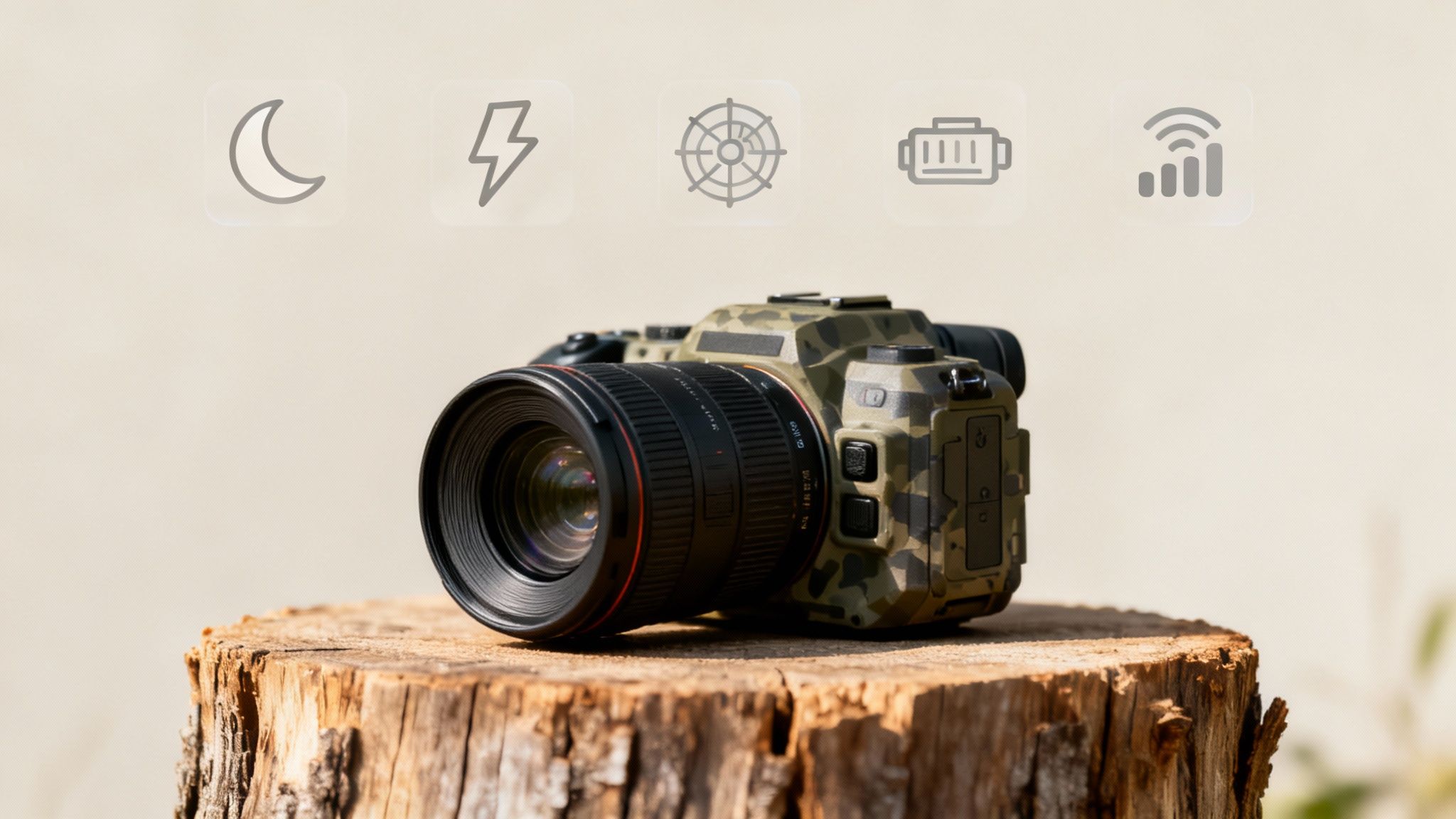
Choosing a good camera to film hunts can feel like learning a new language. The box is plastered with numbers and jargon that don't always mean better footage in the woods. To pick the right gear, you need to know which specs actually make a difference when you’re freezing in a tree stand at dawn.
Let's cut through the marketing hype and focus on the features that truly deliver. Think of it this way: a spec sheet is just a list of ingredients. What really matters is the meal you can cook with them. We'll show you how to read the recipe for success.
Low-Light and Night Capability
This is, without a doubt, the most critical spec for any hunting camera. Whitetail, elk, and most other game animals are most active during the first and last slivers of daylight—what photographers call the "golden hours" but what often feels like the "gray hours" for a camera sensor. A camera that can’t see in the dark is practically useless for hunting.
Look for cameras with large sensors and wide aperture lenses, shown by a low f-stop number like f/2.8 or lower. These features let the camera suck in more light, giving you a bright, clean image without the grainy static that plagues cheap cameras. For trail cams, the infrared (IR) flash range is key. It tells you how far the camera can light things up in total darkness without a visible flash that would send a buck running for the next county.
Trigger Speed and Recovery Time
When it comes to trail cameras and even some action cams, trigger speed is everything. This is the measurement of how fast the camera wakes up and snaps a picture after it senses movement. A slow trigger is the difference between a perfect shot of a monster buck and a blurry photo of its tail disappearing from the frame.
Top-tier trail cameras have trigger speeds of 0.2 seconds or less. This speed ensures you capture the animal as it walks into the frame, not after it's already passed by. Equally important is recovery time—how quickly the camera can get ready for a second picture. A fast recovery is what you need to capture a whole group of does or get multiple shots of a single animal's behavior.
Resolution and Frame Rate
These two specs work as a team to define how sharp and smooth your video looks.
- Resolution: This is all about clarity, measured in pixels. While 1080p (Full HD) is a decent baseline, 4K resolution has become the new standard for anyone serious about filming. It offers four times the detail, which means incredible clarity and the freedom to crop or zoom in on your footage later without it getting fuzzy.
- Frame Rate (fps): This is how many individual pictures (frames) the camera captures every second. Standard video is filmed at 24 or 30 fps. But shooting at a higher frame rate, like 60 or 120 fps, is what lets you create those buttery-smooth, slow-motion replays of an arrow in flight or a turkey in full strut. It adds a dramatic, professional touch to your films.
So, should you prioritize 4K or a high frame rate? It depends on your goal. For cinematic landscapes and detailed close-ups, go for 4K. For capturing the fluid motion of an animal on the move, a higher frame rate is your best friend.
Durability and Ruggedness
Your hunting camera is going to face rain, snow, dust, and brutal temperatures. A camera that isn't built to handle the elements is a liability, plain and simple. Look for an official IP (Ingress Protection) rating, like IP66, which tells you the camera is sealed against dust and powerful jets of water.
But it’s about more than just being weatherproof. A good camera for filming hunts needs a tough housing that can survive getting dropped or knocked against a tree. For gear left in the field, like trail cameras, things like a lockable case or built-in anti-theft measures are vital for protecting your investment.
Battery Life and Connectivity
A camera with a dead battery is just dead weight. Solid battery performance is non-negotiable, especially on multi-day backcountry hunts or for trail cameras you plan to leave out for months. Look for cameras that support external battery packs or solar panels to keep them running longer.
Connectivity has also become a game-changer. These days, a camera’s ability to communicate is a huge part of what makes it "good." Global market data shows that wireless and cellular trail cameras are now the biggest chunk of the market, driven by hunters who want remote access. The trail camera industry, valued at around USD 7.7 billion, is expected to grow even more, largely because of this demand for connected gear. You can learn more about the trail camera market trends that are driving this shift.
This connectivity lets you check footage from your phone, which means fewer trips into the woods and less human pressure on your hunting spot.
Effective Field Placement and Camera Settings
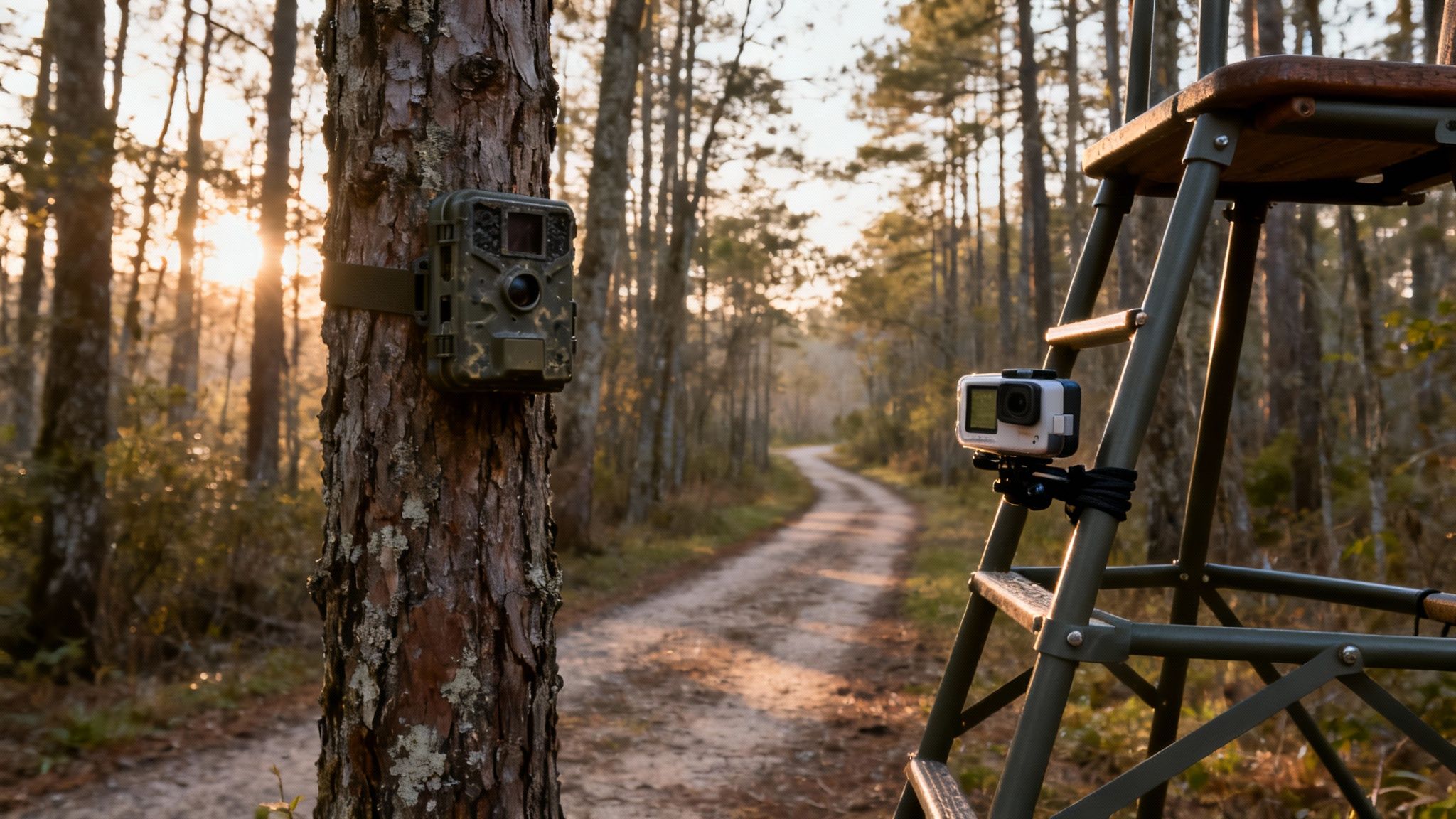
Owning the right camera is just the start. Knowing exactly where to put it and how to configure the settings is what turns a decent camera into a powerful storytelling tool. This is where strategy and stealth come together, ensuring you capture that perfect shot without ever spooking the game you’re after.
It all boils down to thinking like an animal. Where are the travel corridors, pinch points, and feeding areas? Placing your camera in these high-traffic zones is the first step to getting consistent, valuable footage.
Mastering Camera Placement and Angles
The height and angle of your camera can make or break the shot. A poorly placed trail cam might only get you photos of deer butts, while a well-positioned action camera can make the viewer feel like they’re right there in the stand with you.
A common mistake with trail cameras is mounting them at human eye level. This is right in a mature buck’s line of sight, and it’s a surefire way to get your camera spotted. Instead, try these placements:
- Higher Mounting Angle: Place the camera 8-10 feet up a tree and angle it downward. This gets it out of a deer's direct field of view and gives you a much better perspective of the area.
- Concealment is Key: Use natural cover like branches or brush to break up the camera's silhouette. Just make sure the lens and sensors are completely clear.
- Mind the Sun: Point your cameras north or south whenever you can. Facing them east or west often results in washed-out, unusable footage during sunrise and sunset—which just so happens to be prime time for animal movement.
The best camera placement isn't just about seeing an animal; it's about capturing its behavior naturally. An unseen camera tells a more honest story because the subject is completely unaware it's being filmed.
If you really want to capture the full story of a hunt, you need to understand visual composition. Learning about mastering camera shot angles for powerful storytelling can elevate your footage from simple clips to compelling narratives. These principles are universal, whether you're setting a hidden trail cam or framing a cinematic shot with your mirrorless camera.
Dialing in Your Camera Settings
Once your camera is in the perfect spot, you need to fine-tune the settings. Default settings are rarely ideal for the dynamic, ever-changing environment of the woods.
Trail Camera Settings:
- Trigger Sensitivity: Set this to high for open fields where you need to catch distant movement. In dense woods, lower it to avoid tons of false triggers from windblown leaves.
- Video Length: A 15-30 second video clip is usually the sweet spot. It’s long enough to capture meaningful behavior without draining your battery or maxing out your SD card in a day.
- Photo Burst: A 3-shot burst is a great way to make sure you get at least one clear image of a moving animal.
For a full walkthrough on getting your camera positioned and configured just right, check out our detailed guide on how to set up a trail camera. It covers everything from initial testing to long-term deployment.
Stealth and Scent Control
Your final consideration is stealth. Even the best-placed, perfectly configured camera is useless if your scent spooks every animal in the county.
Always wear gloves when handling and mounting your cameras to avoid leaving human scent behind. A pro move is to spray down the camera body and mounting strap with a good scent eliminator. The goal is to leave the area as undisturbed as you found it, turning your camera into a silent, invisible observer.
How the Magic Eagle Blends Scouting and Filming
Knowing the right specs and where to place your gear is half the battle. But what if you could combine the best parts of a scouting camera and a filming camera into one powerhouse tool? That’s where modern tech is headed.
The old lines between scouting and filming are disappearing. The best cameras for filming hunts today don’t just give you a highlight reel of what already happened; they feed you live intel that helps you make the right move, right now.
The Magic Eagle EagleCam 5 was built from the ground up on this idea. It’s not just a passive recorder waiting for you to check an SD card. It’s an active partner designed to connect the dots between what your camera sees and what you do next. This directly tackles the headache hunters have dealt with for years: using separate gear for scouting and filming that never talks to each other.
Fusing Live Intel with High-Quality Capture
The biggest game-changer in hunting cameras is the move to real-time information. Between 2018 and 2024, the trail camera market went from a simple photo-gathering tool to a data-driven machine. The market itself was valued at around USD 89.95 billion in 2024 and is expected to blow past USD 153.16 billion by 2031.
What's driving that explosion? Cellular cameras. The demand for instant video alerts has made the old routine of pulling SD cards feel like something from the stone age. You can read more about the growth of the trail camera market to see just how fast things are changing.
The EagleCam 5 is right at the front of this wave. Here’s how its features give you a real edge in the field:
- 4G Connectivity: Get instant video and photo alerts sent straight to the MAGIC EAGLE app. Your phone basically becomes a live command center for your hunting spot.
- SignalSync Technology: This isn't your average cell cam. The system automatically scans for and locks onto the strongest network signal it can find, keeping you connected in remote spots where other cameras just give up.
- Live-Streaming Capability: This feature is a total game-changer. The second you get a motion alert, you can tap in and watch a live feed of what’s happening. Is that buck just passing through, or is he settling in? Now you’ll know.
With this setup, you’re not just looking at old pictures. You’re actively monitoring your property from anywhere, giving you the intel you need to decide exactly when and where to make your move.
Smarter Scouting Through AI and Security
Beyond just staying connected, the EagleCam 5 brings smart features to the table that cut down on busywork and protect your gear. Let's be honest, nobody wants to scroll through hundreds of pictures of a branch swaying in the wind.
The most valuable resource a hunter has is time. Modern cameras give that time back by filtering out the noise and delivering only the actionable intelligence that leads to success.
AI-powered species recognition is a perfect example. The camera’s software automatically identifies what it sees—buck, doe, turkey, you name it—and tags your footage accordingly. This saves you hours of manual sorting and helps you build a crystal-clear picture of the game patterns on your land. You can dive deeper into how AI species identification technology works to see just how powerful it is.
On top of that, security is baked right in. We all know the sinking feeling of a camera going missing. The EagleCam 5 comes with a full GPS anti-theft suite that includes:
- Real-time GPS tracking to pinpoint your camera's exact location.
- Geofence alerts that send a notification if the camera moves outside a zone you set.
- Motion-triggered photos of anyone who messes with your camera.
This gives you some serious peace of mind when you’re leaving expensive gear out in the woods. By combining high-quality capture with intelligent, real-time data, the EagleCam 5 is a purpose-built tool for the hunter who demands more.
Got Questions About Hunting Cameras? We've Got Answers.
Even after you've sorted through camera types and specs, a few key questions always seem to pop up when you're zeroing in on the right camera for filming hunts. We've pulled together the most common ones we hear to give you straight-up, practical answers. Let's clear things up so you can make your final choice with confidence.
Can a Cellular Trail Camera Really Do It All?
This is a big one, and the honest answer is a mix of yes and no. A top-tier cellular trail camera, especially one with live-streaming like the EagleCam 5, is a phenomenal tool for a very specific job: capturing undisturbed wildlife from a fixed spot.
It’s the perfect solution for filming over a food plot, a hot scrape, or a classic pinch point without you ever having to be there. You can get that incredible footage of a buck methodically working a scrape or a gobbler strutting for his hens, sent right to your phone. That footage is pure gold—it's both scouting intel and the perfect opening scene for your hunt film.
But let's be real: a cellular trail camera isn't going to replace an action cam for your first-person view or a mirrorless camera for those artistic, cinematic shots. It’s a storyteller, but it tells the story from one angle. To build a complete hunt film, you’ll want to weave that remote footage from your trail cam with the up-close, personal action you capture from your stand or blind.
Think of a cellular trail cam as your embedded field reporter. It’s out there 24/7, getting the raw, on-the-ground footage that sets the stage for the main event—the part you film from your own perspective.
What's the Single Most Important Spec for Low-Light?
Hands down, it's low-light performance. The huge majority of deer and other game movement happens right at dawn and dusk, when the light is fading fast. A camera that gives you grainy, dark, or totally useless footage during those golden hours is a deal-breaker.
So what makes a camera great in low light? It's not just one thing, but a team effort:
- Sensor Size: A bigger sensor can physically gulp in more light, which results in a cleaner, brighter image. This is where mirrorless and DSLR cameras really shine.
- Lens Aperture: Look for a wider aperture, shown by a lower f-stop number (like f/2.0). It's like opening the blinds wider to let more light into the room and onto the sensor.
- Infrared (IR) Flash: For trail cameras filming in pitch-black conditions, the quality and reach of the IR flash are everything. A powerful but well-diffused flash lights up the scene without creating harsh "hot spots" or a spooky red glow that spooks game.
While 4K resolution gets all the hype, a camera that captures a clean, bright 1080p image at last light is infinitely more valuable than one that shoots a noisy, dark 4K video. Always, always put a camera's ability to see in the dark first.
How Do I Keep Cellular Data Plans from Getting Complicated?
Cellular data plans can look intimidating, but they're much easier to manage than most people think. The secret is simply matching the plan to your actual needs. If you’re just checking a couple of cameras on a small property, you won't need nearly as much data as someone running a dozen cams across a huge ranch.
Thankfully, modern cellular trail cameras usually come with their own built-in SIM cards and flexible plans, so you're not trying to add another line to your personal cell phone bill.
Here are a few tips to keep your data usage in check:
- Start on the Lower End: Pick a smaller data plan to start. You can almost always bump it up later if you find yourself running out.
- Tweak Your Transmission Settings: Set your camera to send photos right away but only upload video clips once or twice a day. "Batching" them like this is way more data-efficient than sending every single video file the second it's recorded.
- Use Smart Filters: Take advantage of features like AI species recognition. This will stop the camera from sending you endless videos of squirrels and windblown branches, which saves a surprising amount of data over a season.
By being a little strategic with your settings, you can get all the intel you need without getting hit with a massive data bill.
4K Resolution or High Frame Rate: Which One Matters More?
Deciding between 4K resolution and a high frame rate (like 60 or 120 fps) comes down to one thing: what do you want the final shot to feel like? There’s no single "best" choice here; they each serve a totally different creative purpose.
Go with 4K Resolution When:
- You're All About the Details: You want to capture every tine on a buck's antlers, the texture of a turkey's feathers, or the epic scale of a mountain landscape.
- You Need Cropping Power: 4K gives you four times the pixels of 1080p. This means you can "punch in" on a shot during editing to get a closer view of an animal without the image turning into a blurry mess.
Go with a High Frame Rate When:
- You Want That Epic Slow-Motion: This is the only way to get those stunning, buttery-smooth slow-motion shots of an arrow hitting its mark, a tom spitting and drumming, or an elk letting out a bugle.
- You're Filming Fast Action: A higher frame rate makes motion look incredibly crisp and smooth. It cuts down on motion blur, making fast-moving action sequences look sharp and professional.
Ideally, the best camera for filming hunts gives you both options. But if you have to prioritize, think about your style. If you love telling a story with beautiful, cinematic shots, lean toward 4K. If you're an action junkie who lives for dramatic replays, a high frame rate is your new best friend.
The Magic Eagle EagleCam 5 delivers the scouting intelligence and high-quality capture you need to tell the complete story of your hunt. Discover how our smart cellular trail cameras can elevate your season.