

Outdoor wildlife cameras are tough, weatherproof devices built to automatically snap photos and videos of animals in the wild. But today's models have come a long way from the simple trail cams of the past. They now pack in features like 4G cellular connectivity, AI-powered species recognition, and even live-streaming straight to your phone.
This guide will break down all this new tech, helping you pick the right camera for your mission and master it in the field.
From Trail Cams to Intelligent Eyes in the Field
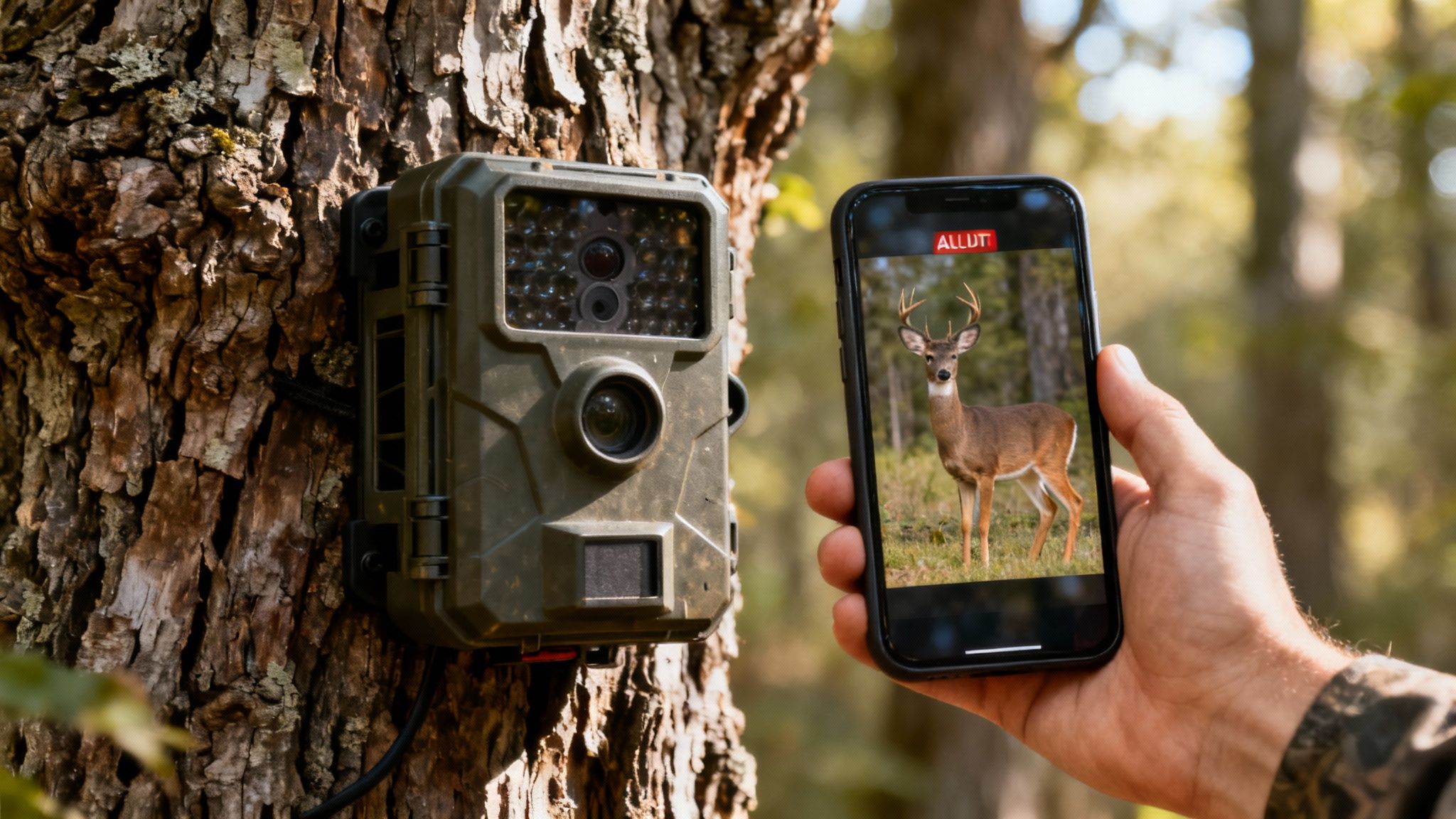
Imagine going from trekking out to your stand just to swap an SD card to getting an instant alert on your phone the moment a monster buck wanders by. That’s the leap outdoor wildlife cameras have made. They’ve gone from passive picture-takers to powerful, connected tools that feed you real intelligence from miles away.
This evolution is why they’ve moved from being a niche gadget for hunters to a mainstream technology. The global market for these cameras was valued at USD 224.08 million in 2024 and is expected to hit USD 375.16 million by 2034. It’s clear that hunters, researchers, and landowners are all catching on to these smarter devices.
What Makes Modern Cameras Different
The real change isn’t just about sharper pictures—it's about smarter information and getting it instantly. Old cameras could tell you what was there last week. New cameras tell you what’s happening right now.
This immediate feedback is possible thanks to a few key technologies working together:
- Integrated Cellular Connectivity: Forget the headache of buying your own SIM card or worrying if it's compatible. The best models come with a built-in 4G SIM that automatically hops on the strongest network, ensuring your pictures actually get sent. Our guide to the benefits of a 4G trail camera dives deeper into why this is such a game-changer.
- AI-Powered Species Recognition: This is like having a digital assistant that filters your photos. Instead of sifting through hundreds of shots triggered by a swaying branch or a curious squirrel, the AI identifies and tags the animal for you. It saves you hours of pointless scrolling.
- Real-Time Alerts and Live Streaming: Modern cameras can ping your phone with a photo or video clip the second they detect motion. Some even let you tap into a live video feed, giving you a real-time window into what's happening on your property.
The true power of today’s outdoor wildlife cameras is how they combine rugged, all-weather hardware with the brains of cloud-based software. This partnership gives you more than just images—it gives you insights you can act on immediately.
This guide will walk you through everything you need to know about these advanced tools, from understanding the must-have features to mastering setup and placement. By the end, you'll see a clear path from old-school monitoring to a smarter, more effective way of watching wildlife.
What Really Matters in a High-Performance Outdoor Camera
Picking the right outdoor wildlife camera can feel like navigating a minefield of tech specs. Manufacturers love to throw around big numbers for megapixels and detection ranges, but honestly, that's only half the story. The real magic happens when all the core features work together seamlessly to give you reliable, useful intel from the field—saving you time, hassle, and frustration.
Let's cut through the jargon and talk about the technology that actually makes a difference. Once you understand these pieces, you'll see why a modern, connected camera is so much more than a simple picture-taker. It's a powerful scouting and monitoring partner.
The Freedom of Cellular Connectivity
One of the biggest leaps forward for outdoor cameras has been the move to integrated cellular technology. If you remember the early cellular models, you probably remember the headaches. You had to buy a separate SIM card, get a data plan from one specific carrier, and then cross your fingers that they had service where you wanted to put your camera. It was clunky and often unreliable.
Today’s top-tier cameras, like the Magic Eagle EagleCam 5, have completely solved that problem. They come with a built-in, all-in-one 4G SIM that automatically scans for and connects to the strongest network in the area—whether that’s AT&T, Verizon, or T-Mobile. You don't have to play guessing games about which carrier works best at your remote food plot. The camera just figures it out for you, making sure your photos and videos always get through.
Think of it like a smartphone that can hop between cell towers from different carriers to find the best signal. This multi-carrier capability is a total game-changer for remote spots with sketchy service, giving you a level of reliability that just wasn't possible before.
This kind of user-friendly tech is a huge reason the market is booming. The global trail camera market is expected to jump from USD 109.84 billion in 2024 to USD 203.3 billion by 2032, and cellular models are leading that growth. People are demanding the convenience and dependability that smart, connected cameras deliver.
To show how far things have come, let's compare the old way with the new.
Comparing Traditional vs Modern Outdoor Wildlife Cameras
The jump from a basic SD card camera to a modern cellular model isn't just an upgrade; it's a completely different experience. Here’s a quick breakdown of what you gain.
| Feature | Traditional Camera | Modern Smart Camera |
|---|---|---|
| Data Retrieval | Manual trips to pull the SD card | Instant transmission to your phone via a mobile app |
| Setup | Simple but requires physical access for changes | Remote configuration and firmware updates from anywhere |
| Image Sorting | Manually sift through hundreds of false triggers | AI automatically identifies species and filters out "noise" |
| Power Management | Relies on disposable AA batteries | Integrated solar panel and rechargeable lithium battery |
| Security | Minimal; easily stolen with no way to track | GPS tracking, geofencing alerts, and cloud-based storage |
| Real-Time Intel | Data is days or weeks old by the time you see it | Immediate notifications when activity happens |
Simply put, a modern smart camera gives you back your most valuable resource: time.
AI Detection: Your Personal Photo Sorter
A sensitive motion detector is a double-edged sword. Sure, it catches everything, but that "everything" often includes hundreds of photos of wind-blown branches, falling leaves, or that same squirrel running past for the tenth time. Sifting through all that digital junk is a massive time-waster.
This is where Artificial Intelligence (AI) species recognition completely changes the game. Modern cameras use smart algorithms to actually look at each image and figure out what's in it.
Think of it as having a little assistant living inside your camera. When a buck walks by, the assistant recognizes it, tags the photo as "Deer," and pings your phone. When the wind rustles some leaves, the assistant knows it's nothing important and leaves you alone. This automated filtering saves you hours of tedious work.
- No More False Alarms: AI drastically cuts down on notifications for things you don't care about. When your phone buzzes, you know it's something worth checking.
- Instant Organization: Your photo gallery is automatically sorted by species. Want to see every turkey that visited your food plot last week? Just tap the "Turkey" filter.
- Smarter Scouting: By tracking specific animals, you can build an incredibly accurate picture of their patterns, feeding times, and travel routes—all without touching a spreadsheet.
For a deeper dive into how this tech evolved, check out our guide on what trail cameras are and how they work.
Power Solutions for Long-Term Deployment
An outdoor camera is completely useless if the batteries are dead. Making constant trips to a remote location just to swap AAs isn't just annoying; it disturbs the very area you're trying to monitor. That’s why a reliable, long-term power solution is a must-have.
High-performance cameras tackle this problem in two smart ways:
- Low-Power Standby Modes: They’re engineered to sip energy when they’re inactive, only waking up when motion is detected.
- Integrated Solar Panels: A small, built-in solar panel paired with a rechargeable lithium battery creates a self-powering loop. A few hours of decent sunlight each day is usually enough to keep the battery topped off, letting the camera run for months—or even forever—without you ever touching it.
This setup gives you true "set it and forget it" confidence, knowing your camera will be on duty and ready to capture that critical moment, season after season.
Optics and Sensors: The Eyes in the Dark
A clear, crisp image is everything, especially at night when most critters are on the move. While many brands brag about high megapixel counts, the real secret to great nighttime photos is the image sensor and the infrared (IR) flash.
A quality image sensor acts like the retina of the camera's eye. It’s more sensitive to light, which means you get brighter, cleaner images with less of that grainy digital noise. This sensor is paired with a powerful IR flash that lights up the scene without a visible flash that could spook an animal.
The best cameras use what's called "no-glow" infrared technology. This is absolutely critical for capturing natural behavior. Unlike "low-glow" flashes that emit a faint red light animals can see, a no-glow flash is completely invisible to both animals and people. Your target never even knows it's there.
| Feature | What It Does | Why It Matters |
|---|---|---|
| High-Quality Sensor | Captures more light with less digital "noise." | Gives you clearer, brighter, and more detailed night photos. |
| No-Glow IR Flash | Illuminates the scene with invisible infrared light. | Prevents spooking wildlife, so you can capture natural behavior. |
| Fast Trigger Speed | Wakes the camera up the instant motion is detected. | Ensures you get a photo of the animal, not just its back end. |
Anti-Theft and Security Features
Let’s be real: leaving a valuable piece of tech out in the woods comes with risk. That’s why modern cameras have security features built right in to protect your investment.
GPS tracking is probably the most important of these. If someone grabs your camera and moves it, its new location is sent directly to your app, letting you track it down. Some models, including the EagleCam 5, even offer geofencing—if the camera moves outside a boundary you set on a map, you get an instant alert. That kind of peace of mind is priceless.
How to Choose the Right Camera for Your Mission
Picking the right outdoor wildlife camera isn't about grabbing the one with the longest spec sheet. It's about matching the right tool to the job. The perfect camera for a hunter patterning deer on a remote food plot is a world away from what a biologist needs to monitor a sensitive habitat, or what a landowner wants to keep an eye on a back fence line.
The trick is to start with your end goal and work backward. This way, you invest in features that actually make a difference for you, instead of paying for bells and whistles you'll never touch. Once you know what you need to accomplish, it's easy to see which camera capabilities will get you there.
This simple decision tree shows how your main goal—whether it's wildlife monitoring or property security—points you toward the right kind of camera.
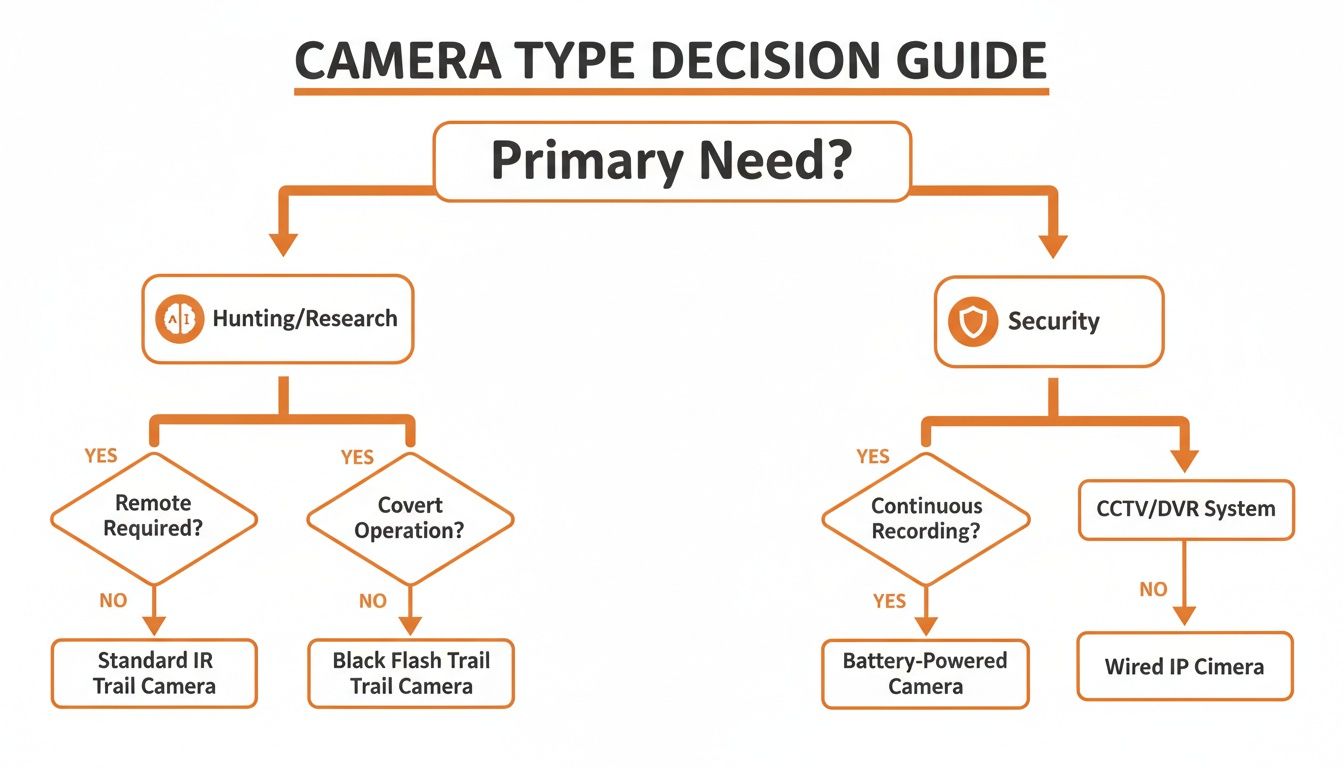
As you can see, both paths demand solid hardware. But the fork in the road is clear: wildlife analysis relies heavily on smart AI, while security is all about getting instant alerts.
For the Dedicated Hunter
As a hunter, your mission is to pattern animal movement without leaving your scent all over the woods. You need to know which bucks are showing up, what time they arrive, and the trails they're using. That makes a few key features non-negotiable.
AI species recognition is your biggest ally here. It's a massive time-saver, automatically filtering out the endless photos of squirrels and swaying branches so you can focus only on your target game, like deer or turkey. When you combine that with real-time cellular alerts, your camera transforms from a passive picture-taker into an active scouting partner that texts you the moment a shooter buck walks by.
A self-sustaining power source is also a must-have. An integrated solar panel and a rechargeable battery mean you can set your camera up once before the season and trust it to run for months. No more trudging in to swap batteries and disturbing the very spot you’re trying to scout. For a deeper dive, check out our guide to the best trail cameras for hunting.
For the Wildlife Researcher or Biologist
When your work is research, data integrity and leaving zero impact are everything. You're not just looking for one animal; you’re monitoring an entire ecosystem. This calls for a camera that's both invisible to wildlife and rock-solid reliable for long-term deployments.
A no-glow infrared flash is absolutely essential. Unlike low-glow flashes that emit a faint red light some animals can see, a no-glow flash is completely invisible. This guarantees you're capturing authentic animal behavior without spooking your subjects—a critical detail for accurate population counts or behavioral studies.
Cloud-based data management is another game-changer. Having photos and videos automatically beamed to a secure online gallery, all neatly time-stamped and organized, simplifies data collection immensely. This remote access means far fewer trips into the field, reducing your footprint on sensitive habitats and the animals you're there to study.
For the Landowner Securing Property
If your main goal is security, your focus shifts entirely. You're less concerned with deer patterns and more about getting immediate alerts for people or vehicles on your property. Your camera becomes a 24/7 sentry, watching over gates, driveways, equipment sheds, or remote fence lines.
For property security, instant, motion-triggered notifications are the most important feature. You need to know the second someone sets foot where they shouldn't be. A camera that sends a photo or a quick video clip straight to your phone gives you immediate awareness, letting you react in the moment.
For property managers, a camera's value is measured in peace of mind. Features like geofencing and GPS tracking are not just conveniences—they are essential security layers that protect your investment and deter theft.
Anti-theft geofencing adds a vital layer of protection for the camera itself. You can set a virtual boundary, and if the camera is moved outside of it, you get an instant alert. Paired with GPS tracking, you can pinpoint its location if it ever gets stolen. These are indispensable features for protecting both your land and your gear.
Mastering Camera Setup and Placement for Optimal Results
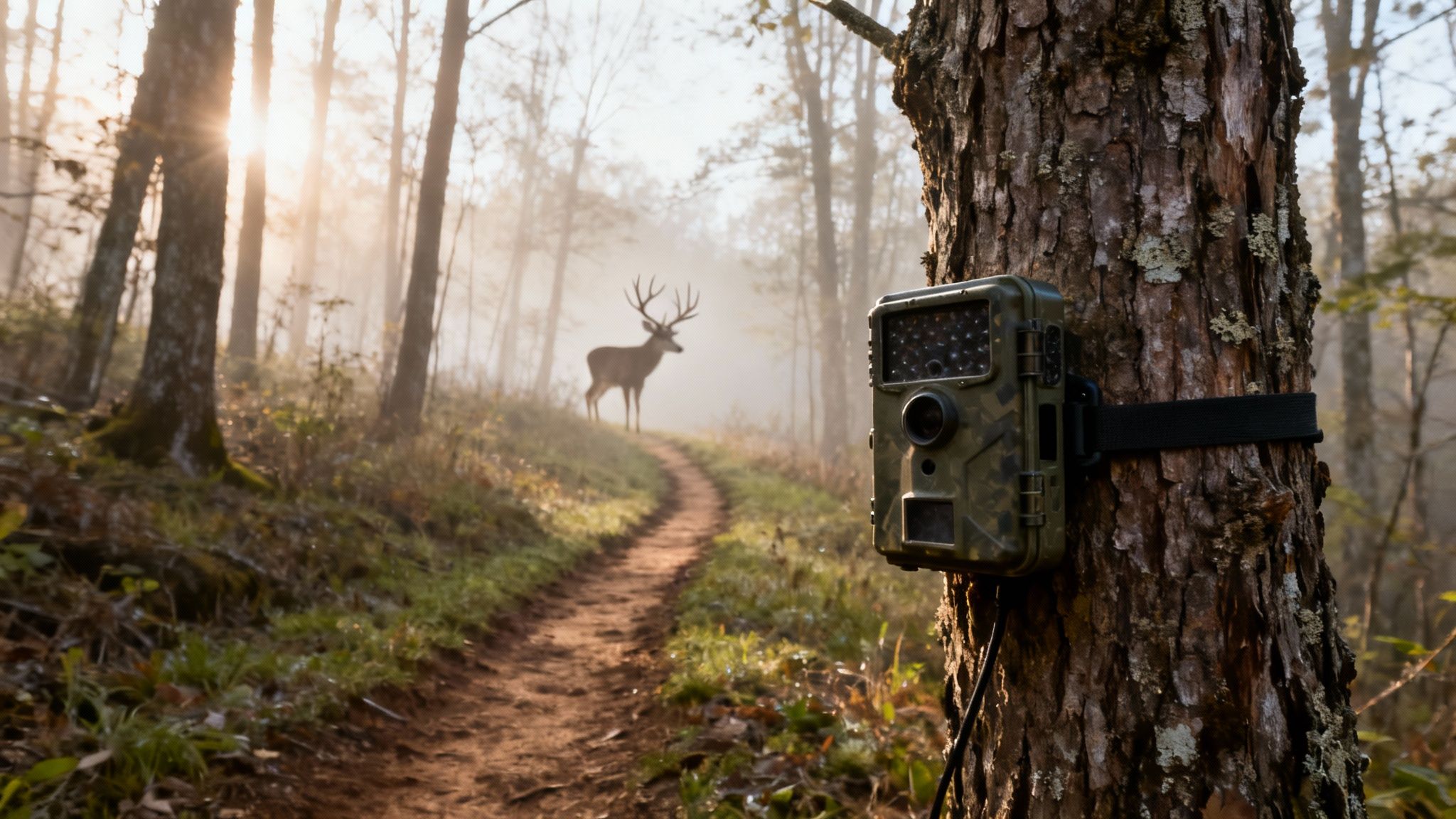
You can have the most advanced outdoor wildlife camera on the market, but if you place it poorly, it will fail you. Every single time. Think of your camera as a highly skilled scout—its effectiveness is all about positioning. A great camera in a bad spot is just an expensive piece of plastic strapped to a tree.
The real goal is simple: capture clear, useful images without spooking animals or getting thousands of pictures of a swaying branch. This takes a little bit of strategy, blending what you know about wildlife with a few technical ground rules. Get this right from the start, and your first batch of images will be insightful, not frustrating.
Finding the Perfect Location
Before you even think about strapping the camera up, you need to scout your area. The best placement isn't random; it’s a calculated move based on animal activity. You're looking for natural funnels and high-traffic zones where wildlife is likely to walk, feed, or hang out.
Here are the gold mines for camera placement:
- Game Trails: These are the highways of the animal world. Find a well-worn path and set your camera up to monitor the traffic.
- Water Sources: Creeks, ponds, and even big puddles are natural magnets, especially when it’s dry. Every animal needs a drink.
- Food Sources: Set up your camera overlooking a food plot, the edge of an agricultural field, or a cluster of fruit trees.
- Mineral Licks or Scrapes: These are basically communication hubs for deer and other animals, guaranteeing they'll be back again and again.
Once you’ve zeroed in on a promising spot, the next step is getting the camera oriented just right for that perfect shot.
Ideal Height and Angle for Flawless Shots
How you position your camera directly impacts your results. The wrong height or angle leads to half-pictures of animals, sun glare, or missed triggers altogether.
For most game like deer, bear, or elk, mounting the camera three to four feet off the ground is the sweet spot. This is roughly chest-level on the animal, giving you a full-body perspective that's perfect for identification. From there, angle the camera slightly downward to focus on the trail or bait site. This small adjustment also helps reduce false triggers from the sky or swaying treetops.
The cardinal rule of camera placement? Avoid facing directly east or west. Pointing the lens into the rising or setting sun will completely wash out your images with glare, making them useless for a few hours every day.
Always aim your outdoor wildlife cameras north or south whenever you can. It’s a simple trick that prevents the sun from shining straight into the lens, ensuring you get clear, evenly lit photos all day long.
A Checklist of Common Mistakes to Avoid
Even experienced users make simple mistakes that tank their camera’s performance. Before you walk away from your setup, run through this quick mental checklist.
- Clear the View: Trim away branches, tall weeds, or leaves right in front of the camera. The wind moving these things is the number one cause of false triggers, which drains your battery and clogs your memory card with nothing.
- Check Your Aim: Take a test photo or use the live view in your app to confirm the camera is pointed exactly where you want it. Make sure the main detection zone covers the trail you're watching.
- Secure the Mount: Is the camera strapped tightly to the tree? A loose camera can get knocked around by the wind, ruining its aim and causing blurry photos.
- Confirm Signal Strength: If you're using a cellular model, check the app to make sure you have a stable connection before you leave. A weak signal means you won't get the real-time alerts you’re counting on.
Putting Advanced Camera Technology into Action

Tech specs on a box are one thing. What really matters is how a camera performs out in the mud, rain, and woods. The real magic happens when all those advanced features—cellular, AI, and solar power—come together to give you insights that completely change how you approach your land.
It’s the difference between just collecting pictures and gaining real, actionable intelligence.
Think of these modern cameras less as simple gadgets and more as your eyes in the field, 24/7. When cellular connectivity meets AI analysis and live-streaming, you get a dynamic source of information fed right to your phone.
Let's look at a few real-world examples to show you what this technology actually lets you do.
The Hunter Planning the Perfect Ambush
Imagine a hunter named Alex. He’s spent weeks scouting a new lease and has a Magic Eagle EagleCam 5 watching a key funnel between bedding and a food plot. For days, he’s gotten AI-filtered alerts showing a mature buck moving through like clockwork right after sunrise.
One morning, his phone buzzes with a live notification. This isn't just another picture. He taps into the camera’s live stream and watches the buck work a scrape in real time, completely calm and unaware. Seeing that live confirmation gives Alex the confidence to plan his approach, knowing exactly where that buck is and what it's doing right now. Scouting goes from a guessing game to a precise, strategic operation.
This isn’t a niche tactic anymore. In North America, roughly 62% of hunters now rely on trail cameras to pattern game, making advanced app features critical for making the right call.
The Researcher Monitoring a Protected Species
Now, let's picture Maria, a wildlife biologist studying an elusive bobcat population in a remote, rugged wilderness. Her main goal is to collect data without disturbing the animals. So, she deploys a handful of solar-powered cameras across the territory.
Thanks to AI species recognition, Maria doesn't have to waste her week scrolling through thousands of photos of squirrels and raccoons. The camera’s software automatically sorts and tags every bobcat sighting, building a clean, organized database for her. Knowing how object recognition technology works is key here, as it allows her to focus only on the data that moves her study forward.
For researchers, the biggest win is efficiency with minimal impact. AI-sorted data and remote access mean fewer trips into sensitive habitats. This preserves the natural behavior of the animals being studied while gathering far more accurate information.
The Landowner Securing a Remote Gate
Finally, think about Tom, a landowner worried about trespassers using an old access road on the back corner of his property. He mounts a cellular camera, tucked away and watching the entrance.
One afternoon, his phone buzzes. It's not a deer—the AI has identified a vehicle. Tom instantly gets a clear picture of the truck, license plate and all. He can immediately decide what to do, whether that’s calling a neighbor or the local authorities, all while holding photographic evidence in his hand.
The camera turns a passive security measure into an active, responsive system, giving him peace of mind from miles away.
Field Maintenance and Troubleshooting Your Camera
Out in the wild, your camera is exposed to everything from blistering sun to freezing rain. Even the toughest gear needs a little TLC to keep performing year after year. A few simple checks can mean the difference between capturing that once-in-a-lifetime shot and finding a dead camera.
Think of it as a quick tune-up for your most reliable field scout. By keeping the lens clean, the power flowing, and the connection strong, you guarantee the intel you receive is always crystal clear and right on time.
Essential Maintenance Checklist
Before you walk away from a fresh setup, or when you swing by for a check-in, run through these quick steps. It’ll keep your gear in prime condition.
- Lens and Sensor Cleaning: Grab a microfiber cloth and gently wipe away any dust, mud, or water spots from the camera lens and the PIR motion sensor. A clean lens is non-negotiable for sharp images, and an unobstructed sensor ensures accurate motion detection.
- Battery and Solar Panel Check: Make sure your solar panel is clear of leaves, bird droppings, or dirt that could be blocking the sun. Pop open your app and check the battery level to confirm it’s charging properly, which is especially important during those gray, overcast winter months.
- Weatherproofing Inspection: Take a second to inspect the rubber seals and gaskets on the camera housing. You want to make sure they are snug and free of cracks. This simple step is what stops moisture from seeping in during a downpour and frying the electronics inside.
Keeping your camera's hardware in top shape is your first line of defense against failure in the field. A clean lens, a charged battery, and a watertight seal will solve over 90% of potential issues before they even start.
Quick Troubleshooting for Common Issues
Even with perfect maintenance, you'll eventually run into a hiccup or two. It happens. Here’s how to quickly diagnose and fix the most common problems you'll face with your outdoor wildlife cameras.
If you’re getting bombarded with false triggers, take a look at the camera's field of view. You’ll want to trim any moving branches, tall grass, or weeds that could be waving in the wind and tricking the sensor.
For cellular cameras, a weak signal can be a real headache. If your camera suddenly has connectivity problems, it's worth reading this guide on troubleshooting mobile signal issues for cellular-enabled cameras.
And what if your camera just stops sending pictures? Before you panic and plan a trip out to the site, try a simple remote restart through the app. This often forces the cellular modem to reset and re-establish its connection to the network, fixing the problem without you ever leaving your couch.
Answering Your Top Questions About Outdoor Wildlife Cameras
Jumping into the world of modern trail cameras can bring up a lot of questions. Getting straight answers is the key to picking the right gear and actually using it the way you want to. Here, we'll tackle the most common questions we get from hunters, researchers, and landowners alike.
We're going to clear the air on everything from cellular plans and AI to what really matters for getting those crisp, clear night shots you need to see what's out there.
Do I Need to Go Buy a Separate SIM Card for a Cellular Camera?
Not anymore, thankfully. The best modern cameras have completely done away with that headache. Top-tier models now come with an all-in-one 4G SIM already built in, which you activate right from the companion app on your phone.
This smart tech automatically scans for and connects to the strongest local cell network, whether that’s Verizon, AT&T, or someone else. It means you don’t have to waste time researching carriers, buying a separate SIM card, or juggling another data plan. The result is far more reliable connectivity, especially in remote spots where service can be spotty at best.
How Does AI Species Recognition Actually Help Me?
Think of AI recognition as a massive time-saver. It uses machine learning to identify the animal in each photo or video, so you don't have to. Instead of manually sifting through hundreds of pictures of swaying branches or squirrels, the camera’s software does all the heavy lifting for you.
You can think of AI as your personal photo editor. It automatically filters out all the "noise" and instantly organizes your gallery by species. That way, you can focus only on the animals that matter to your scouting or research.
In practice, this means you can filter your gallery to see only deer, turkey, or whatever you're tracking. It turns scouting from a tedious chore into a precise, data-driven strategy.
What’s Most Important for Clear Night Vision Photos?
While megapixel counts get all the attention in ads, the real secret to great night photos comes down to two things: the image sensor quality and the infrared (IR) flash. A high-quality sensor is simply more sensitive to light, which allows it to produce brighter, less grainy images when it's pitch-black outside.
For wildlife, a "no-glow" IR flash is non-negotiable. This type of flash lights up the scene with infrared light that is completely invisible to animals. Unlike "low-glow" flashes that emit a faint red light that can spook game, a no-glow flash lets you capture perfectly natural behavior in total darkness without ever tipping off your target.
Ready to see how these features come together in the real world? The Magic Eagle EagleCam 5 combines an all-in-one 4G SIM, powerful AI species recognition, and true no-glow night vision to deliver performance you can count on. Check out the EagleCam 5 today and see what you've been missing.