

Ever seen a crystal-clear photo of a buck in the pitch-black of night and wondered how it was possible without a blinding camera flash? The secret is a slick piece of tech that operates just beyond what our own eyes can see. Modern infrared hunting cameras give us a secret window into the nocturnal world, gathering priceless intel for hunters and researchers without ever tipping off the wildlife.
This technology is the key to scouting and monitoring what happens after the sun goes down, completely undisturbed.
How Infrared Cameras See in Total Darkness
The magic behind these nighttime shots comes from an array of specialized Light Emitting Diodes, or LEDs. Unlike the startling white flash on a normal camera, these LEDs blast out light in the infrared spectrum. Think of it this way: visible light is just one small slice of a much bigger pie. Infrared light sits just outside the red light we can perceive, making it invisible to us and most animals.
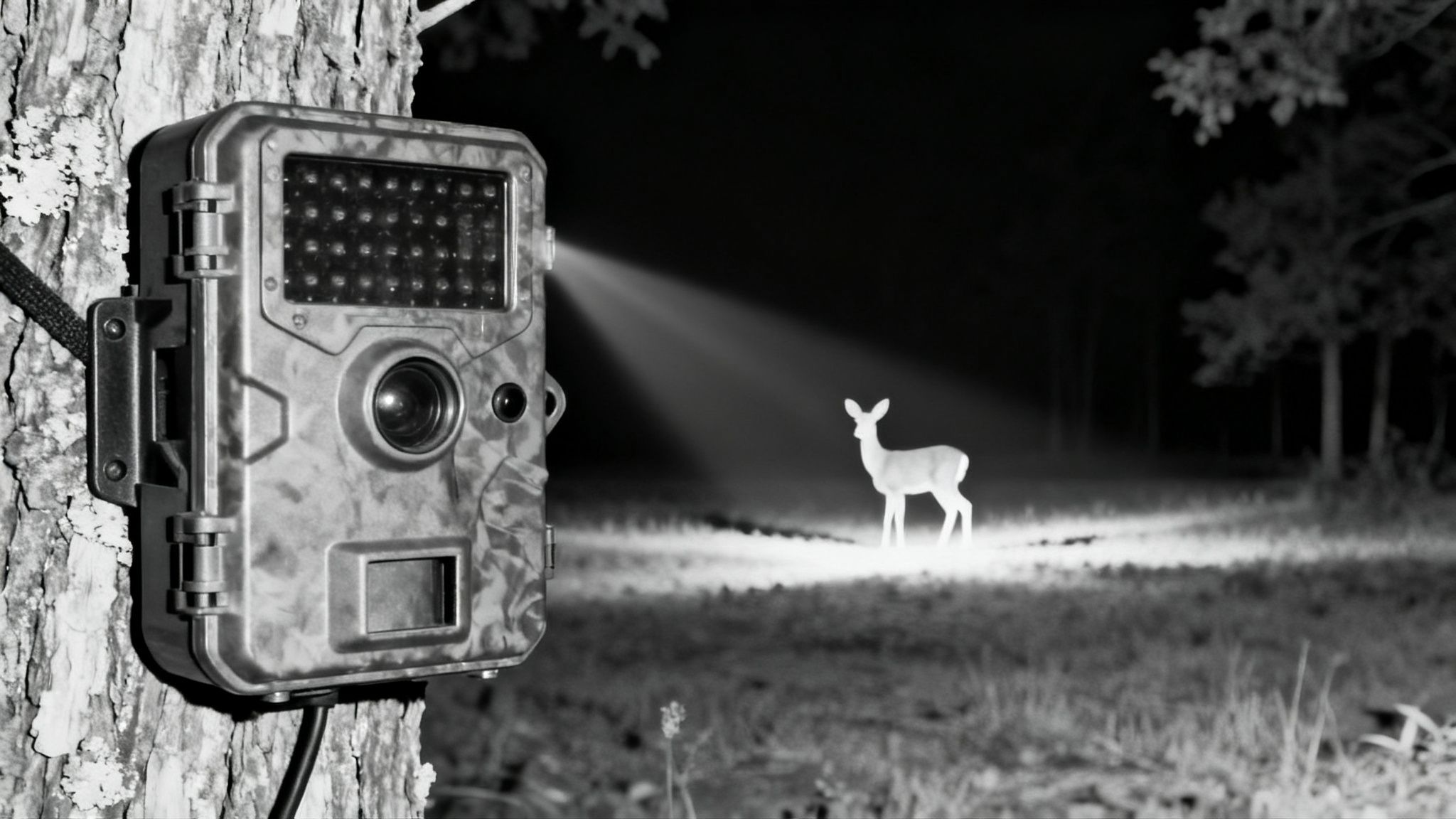
When the camera's motion sensor gets tripped at night, it flips on this IR flash, bathing the scene in a flood of invisible light. While you and the critters won't see a thing, the camera's sensor is built specifically to pick up this wavelength. It captures the reflected infrared light and uses it to build a sharp, detailed black-and-white image.
The Power of Stealthy Observation
This stealthy approach is exactly what makes infrared hunting cameras so incredibly effective. A traditional, bright camera flash would send game running, potentially pushing a mature buck out of the area for good. But infrared illumination allows for round-the-clock, non-intrusive monitoring.
This tech is the backbone of the entire night vision surveillance industry, a massive market projected to grow from USD 199.49 billion in 2025 to over USD 1,417.85 billion by 2035. Hunting cameras are a critical slice of that pie, with their market share expected to hit USD 0.45 billion by 2035 as demand for 24/7 wildlife intelligence continues to climb.
The core advantage of an infrared flash is its ability to gather crucial data without altering animal behavior. You get an authentic look at what happens when you aren't there, which is the ultimate goal of any scouting effort.
Two Paths to Invisibility
Now, not all infrared flashes are built the same. They generally fall into two different categories, each offering a different level of stealth in the field.
- Low-Glow Infrared: This type of flash produces a faint red glow from the LEDs when the camera fires. It’s pretty subtle, but it can occasionally be spotted by sharp-eyed animals that happen to be looking right at the camera.
- No-Glow Infrared: Just like the name says, this technology is completely invisible. It emits light at a higher wavelength (940nm) that is undetectable to both human and animal eyes, giving you the ultimate level of concealment.
Understanding the difference between these two is vital for effective scouting. To really dig into why total invisibility is often the best choice, check out our guide on trail camera no-glow technology. Getting this foundational knowledge right is the first step in picking a camera that won’t blow your cover.
Understanding the Science Behind Infrared Technology
To really get a grip on how infrared hunting cameras work, we have to look just beyond what our own eyes can see. The world is bathed in a huge spectrum of light, but humans can only perceive a tiny slice of it—the familiar rainbow of colors. Infrared (IR) light sits on this spectrum, just past the red light we can see.
Think of it like a dog whistle. The sound is real, but our ears just aren't built to pick it up. In the same way, infrared light is all around us, but our eyes aren't equipped to detect it. This is the secret language your camera uses to see in total darkness.
The Two-Part System: Motion and Illumination
An infrared hunting camera relies on a brilliant two-part system. It’s not just a single piece of tech but two distinct components working together perfectly. The first is the detector, and the second is the illuminator.
-
The Detector (PIR Sensor): A camera's first job is to know when to snap a picture. It does this with a Passive Infrared (PIR) sensor. This sensor doesn't see images; it detects changes in heat. Every warm-blooded animal, from a tiny field mouse to a massive bull moose, gives off thermal energy. The PIR sensor constantly monitors the ambient temperature of its surroundings. When an animal wanders into its view, its body heat creates a sudden temperature spike, which triggers the sensor.
-
The Illuminator (IR LED Array): As soon as the PIR sensor signals that something is moving, the camera fires up its illuminator—an array of infrared LEDs. This is the camera's invisible flash. It floods the area with infrared light, bathing the scene in a glow that the camera's specialized CMOS sensor can see perfectly, even though we can't see a thing.
This whole sequence happens in a split second. It’s like having a silent, invisible motion-activated spotlight that only your camera can perceive, ensuring the animal is never spooked. To get deeper into how this works, learn more about what PIR sensitivity is on a trail camera and how to fine-tune it for the best results.
Low-Glow Versus No-Glow: The Critical Difference
Not all infrared flashes are the same. The specific wavelength of the light determines its visibility, which leads to the two main types of technology you'll find out in the field. Nailing this distinction is one of the most important parts of choosing the right infrared hunting cameras for your needs.
A key thing to remember is that wavelength is measured in nanometers (nm). Lower numbers are closer to the visible light spectrum, while higher numbers are further away.
The core difference lies in the nanometer (nm) measurement of the light emitted by the LEDs. A lower number means the light is closer to the visible spectrum, while a higher number pushes it further into true invisibility.
Low-Glow Infrared (850nm)
Low-glow cameras operate at a wavelength of 850nm. Because this is closer to the red light our eyes can process, the LEDs produce a faint red glow when the camera triggers. While it's subtle, this dim red dot can be spotted by wary animals, especially mature bucks that are already on edge. It’s a bit of a trade-off: 850nm flashes are often brighter and can light up a larger area, but you sacrifice complete stealth.
No-Glow Infrared (940nm)
No-glow cameras use a higher wavelength of 940nm. This pushes the light far enough away from the visible spectrum to be completely invisible to both human and animal eyes. When a no-glow camera takes a picture, there is absolutely no visible sign that anything happened. This makes it the hands-down winner for serious scouting where the goal is to observe natural behavior without any outside influence. You get an unfiltered look at what the animals are really doing, which is the ultimate prize for any hunter or researcher.
Decoding Camera Specs That Actually Matter
Stepping away from the science and into the field, a trail camera's spec sheet can be pretty overwhelming. Brands love to flash big numbers for megapixels and flash range, but those figures don't always tell the whole story. To really compare cameras with confidence, you have to know which features actually impact performance and which are just marketing noise.
Think of it like buying a truck. A high horsepower number is impressive, but if the torque and suspension can't handle the terrain, that power is useless. The same logic applies here; a balanced mix of key specs is what makes a reliable scouting tool.
This flowchart breaks down how a camera's core sensor technology leads to the two primary types of infrared flash available.
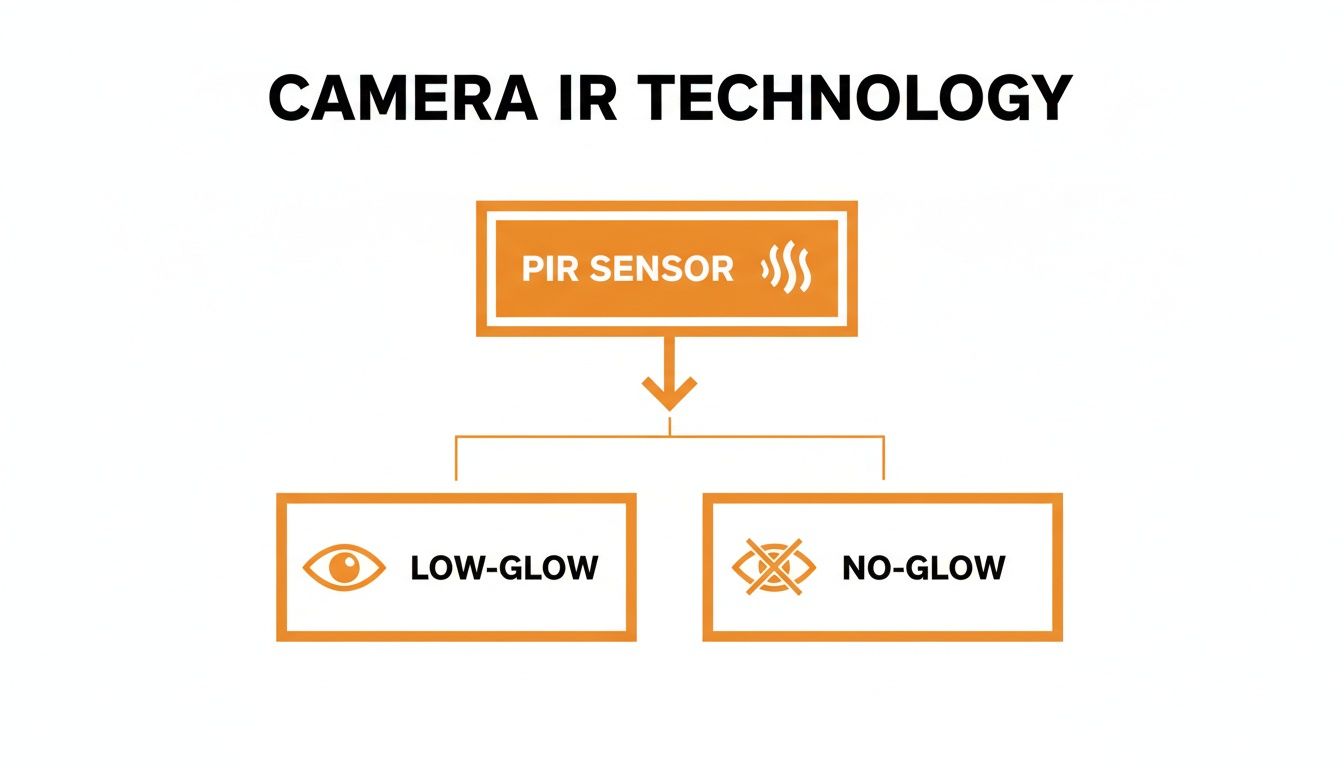
As you can see, the PIR sensor is the starting point for every capture. But the real fork in the road is choosing between a low-glow or no-glow flash—a decision that completely changes how stealthy your camera is.
Range Detection and Trigger Speed
Two of the most critical specs are detection range and trigger speed. The detection range is the maximum distance at which the camera’s PIR sensor can pick up a heat signature and wake up. This is not the same as the flash range, which is how far the infrared LEDs can light up the scene for a clear photo.
If a camera has an 80-foot flash range but only a 50-foot detection range, it will never capture that buck standing 70 feet away. It's a simple but crucial distinction.
Equally important is trigger speed—the time it takes for the camera to snap a picture after the sensor is tripped. A fast trigger (under 0.5 seconds) is non-negotiable for capturing animals moving quickly down a game trail. Anything slower, and you'll end up with a gallery full of deer tail ends.
A camera’s effectiveness often boils down to a simple formula: can it detect an animal far enough away and react fast enough to capture a useful image? If the answer to either is no, all other features become irrelevant.
Image Quality and Flash Type
While high megapixel counts look great on the box, they don't guarantee a great photo. True image quality has more to do with the quality of the lens and the image sensor itself. A camera with an excellent 8-megapixel sensor can easily outperform a cheap 24-megapixel one, especially at night when the infrared flash is doing all the work. Always look at real-world sample images from a camera, not just its megapixel rating.
The same goes for video. A camera shooting in crisp 1080p or 4K gives you far more detail for identifying specific bucks or watching their behavior than a grainy 720p clip ever could.
The type of infrared flash also plays a huge role in both image quality and stealth. There are two main options:
- Low-Glow (850nm) gives you a brighter, longer-range flash but produces a faint red glow from the LEDs that can spook wary, mature animals.
- No-Glow (940nm) is completely invisible to the naked eye, making it the top choice for scouting cautious game or for security purposes.
To make the choice clearer, here’s a direct comparison of the two technologies.
Infrared Flash Type Comparison
| Feature | Low-Glow Infrared (850nm) | No-Glow Infrared (940nm) |
|---|---|---|
| Visibility | Faint red glow visible at night | Completely invisible |
| Flash Range | Longer and brighter illumination | Shorter range (about 20-30% less) |
| Image Quality | Generally produces brighter, clearer night photos | Can result in slightly grainier night photos |
| Best For | Food plots, open fields, less-pressured animals | High-traffic trails, bait sites, security, easily spooked game |
| Power Consumption | Slightly more efficient | Can use slightly more battery to achieve its range |
Ultimately, the best choice depends on your specific needs. If maximum night range is your priority, low-glow is a solid option. But if total stealth is the goal, nothing beats a no-glow camera.
Cellular Connectivity and Battery Life
Modern cellular connectivity has completely changed the scouting game, sending images and videos straight to your phone. This gives you real-time intel without having to tramp into your hunting spot and contaminate it with scent just to pull an SD card.
This convenience is a major reason the global trail camera market is booming. Valued at USD 905.94 million in 2025, it's projected to hit USD 1,420.95 million by 2032, with North America leading the charge.
Of course, sending all that data takes power. Battery life is a constant trade-off. Features like video recording, cellular transmission, and frequent image bursts drain batteries faster. For longer deployments, look for cameras that are compatible with lithium AA batteries or have options for an external solar panel. For a deeper dive into top-performing models, check out our guide on the best trail cameras for hunting.
Durability and Security Features
Finally, a trail camera is only useful if it can survive months in the woods. Look for an IP rating (like IP66), which tells you how resistant it is to dust and water. A rugged, weatherproof housing is a must to protect your investment from rain, snow, and extreme temperatures.
Theft is also a real concern, so security features are more important than ever. Make sure the camera is compatible with a steel security box and a python-style cable lock. Some of the more advanced models now include GPS anti-theft tracking, which can pinpoint the camera's location if it gets stolen and send an alert right to your phone. It’s a great feature for peace of mind.
Choosing the Right Camera for Your Hunting Style
There’s no such thing as a one-size-fits-all infrared hunting camera. The best tool for a landowner worried about security is probably a poor choice for a biologist studying shy wildlife. To get the results you want, you have to match the camera's features to your specific mission.
Your personal "why"—the whole reason you're setting up a camera—should drive every single decision. Are you trying to pattern a wary, mature buck, or are you just taking a quick inventory of the game on a new property? Each of those goals requires a totally different set of tools.
By breaking down your needs into a few common roles, you can cut through the marketing noise and zero in on the features that will actually make a difference for you out in the field. Let's look at three typical users and the camera specs that matter most to them.
The Whitetail Strategist
For the hunter laser-focused on patterning a mature, high-pressure whitetail, one word defines the game: stealth. These bucks are notoriously skittish. One wrong move—one faint red glow or a whiff of human scent—and he’s gone for the season. Your camera has to be a ghost.
The mission here is simple: gather intelligence without ever letting that deer know you exist. That means your presence, both physical and electronic, must be completely invisible.
- No-Glow Infrared (940nm): This is non-negotiable. A low-glow flash, with its faint red signature, is a dead giveaway to a cautious old buck. A true no-glow camera is completely invisible to the naked eye, ensuring you never spook the animal you're after.
- Fast Trigger Speed: A buck working a scrape line or cruising a trail rarely stops to pose for the camera. A trigger speed of 0.5 seconds or less is what you need to capture a clear, centered image instead of just his tail end leaving the frame.
- Cellular Connectivity: Every single trip you make to pull an SD card leaves scent and creates disturbance. A cellular model sends photos straight to your phone, letting you monitor activity from miles away while your hunting spot stays untouched and pressure-free.
The Wildlife Researcher
Researchers studying animal behavior are playing a different game. While stealth is still a factor, the main goal is capturing high-quality, reliable data over long stretches, often in extremely remote locations.
Here, reliability and data integrity are king. The camera absolutely must function flawlessly for months at a time and capture video that’s clear enough for scientific analysis. More and more, thermal and infrared cameras have become mission-critical for researchers studying elusive species, helping them gather data that was once impossible to get.
"Instead of walking fields hoping to stumble across snipe, I can quickly scan with the thermal camera and key in on where the birds are. Feathers may hide them from view, but their heat signatures stand out against the cold background of water and soil."
This shows just how much advanced imaging is changing fieldwork. For a researcher using infrared hunting cameras, these are the specs that really matter:
- Exceptional Battery Life: Deployments can last an entire season, so you can't be running out to swap batteries. Look for cameras with large battery trays (8-12 AA lithium batteries) and, more importantly, compatibility with an external solar panel for truly uninterrupted operation.
- High-Quality Video with Audio: Still photos are good, but high-definition video (1080p or higher) with clear audio is what captures the invaluable stuff—behaviors, vocalizations, and social interactions.
- Advanced Data Stamping: A researcher needs more than just a picture. A robust data strip that imprints temperature, moon phase, time, and date on every single file is essential for building accurate behavioral models.
The Property Manager
For a landowner or property manager, an infrared camera often pulls double duty: monitoring wildlife and keeping an eye on security. The goal is to get a wide, reliable view of the property to track both game animals and any two-legged intruders.
Durability and a broad field of vision are the top priorities. The camera needs to be tough enough to survive year-round weather and cover as much ground as possible from one spot.
- Wide Detection Angle: A camera with a wide detection angle (60 degrees or more) is perfect for watching over large food plots, field edges, or access gates. It ensures you miss less of the action happening across the scene.
- Rugged, Weatherproof Build: Look for a high IP rating (IP66 or better). This certification guarantees the camera will keep running through driving rain, snow, and extreme temperatures. A tough outer casing also protects it from curious bears and harsh conditions.
- Anti-Theft Features: When your camera is also your security guard, you have to protect the camera itself. Features like a lockable housing, password protection, and GPS tracking are vital for securing your investment and can even help identify trespassers if the camera gets stolen.
Mastering Field Setup for Flawless Night Shots
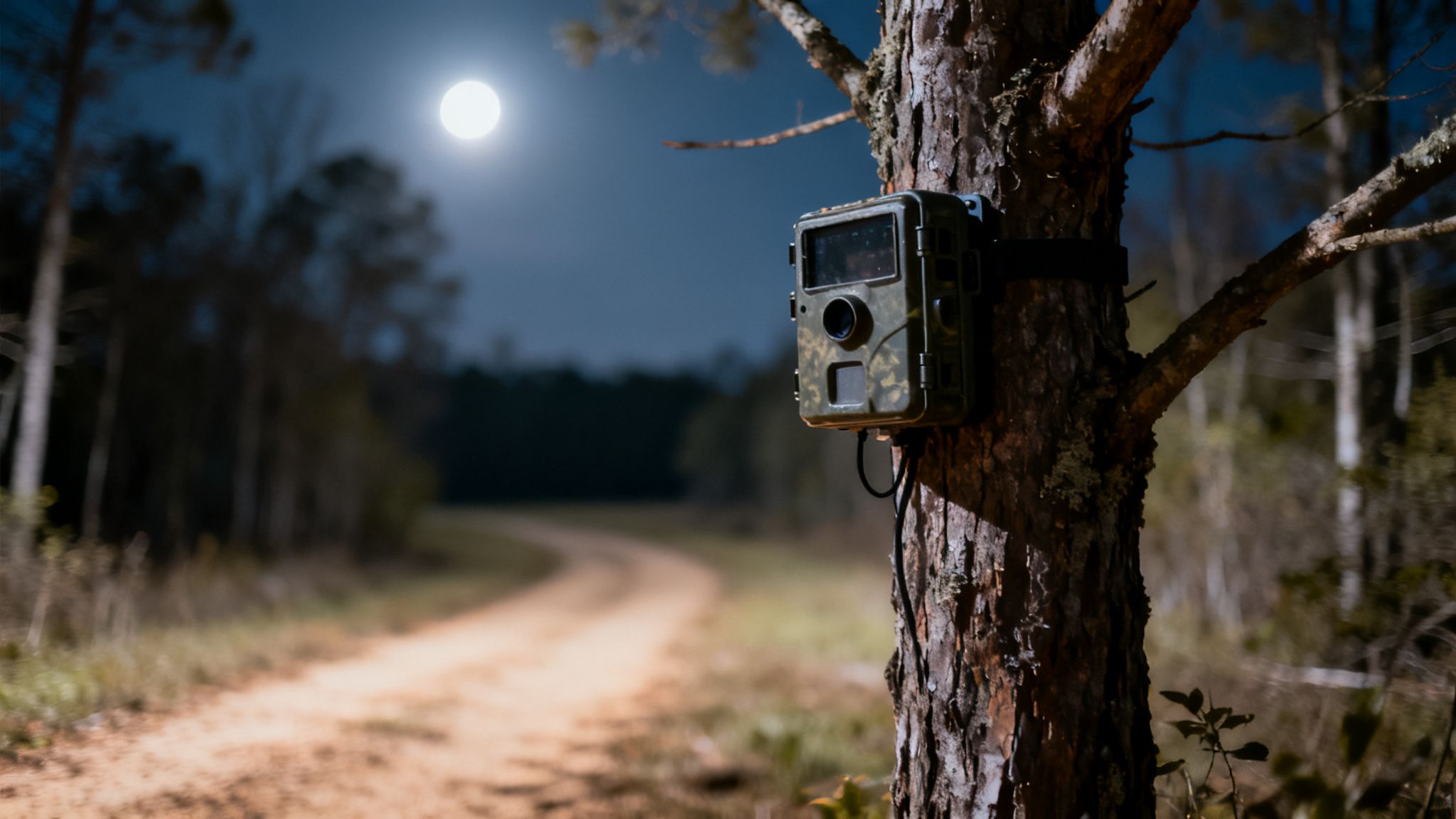
Owning a top-tier infrared hunting camera is only half the battle. Its real power is unlocked by how and where you put it in the field. Even the most advanced camera on the market will send you garbage images if it’s aimed at the wrong spot or set up without a little thought.
Getting this part right is what turns a simple gadget into a round-the-clock scouting machine that delivers priceless intel. The first step is to start thinking like the animals you’re after. Pinpoint those high-traffic areas like game trails, food plot edges, creek crossings, and water sources. These are the highways and rest stops of the woods.
Strategic Camera Placement and Orientation
Once you’ve found the perfect spot, you can't just strap the camera to the first tree you see. The height, angle, and direction are all critical for getting great shots and avoiding the common headaches like blurry images or a memory card full of nothing.
- Ideal Height: Aim for about 3 to 4 feet off the ground. This chest-level view gives you a natural perspective on animals like deer and keeps the lens clear of weeds and brush.
- Subtle Angling: Don’t point your camera straight across a trail. Instead, angle it down the trail at roughly 45 degrees. This gives the sensor a much longer window to detect an approaching animal, so you get a perfect center-frame shot instead of just a picture of a tail.
- Mind the Sun: This one’s a rookie mistake. Never face your camera directly east or west. The rising and setting sun will blast the lens, causing glare and triggering the sensor with the changing light. A north or south-facing setup is always your best bet.
Smart placement isn't just about capturing animals; it's about avoiding what you don't want to capture. Every false trigger from a sunbeam or swaying branch is a wasted image and a drain on your battery life.
Before walking away, take five minutes to clear the area in front of the lens. Snip any small branches, tall weeds, or leaves that could blow in the wind and set off your camera. This simple step will save you from sorting through hundreds of empty photos and make your batteries last way longer.
Fine-Tuning Your Camera Settings
With the camera mounted, the last step is to dial in the settings. Getting these right ensures your infrared hunting cameras capture exactly what you need without burning through batteries or filling up your SD card.
- Sensitivity Level: Adjust the PIR sensor's sensitivity based on the season. In the summer heat, a lower sensitivity helps avoid false triggers from shimmering leaves. In the cold of winter, crank it up to reliably detect animal body heat.
- Burst Mode: For game trails, a 2-3 photo burst is perfect. It dramatically increases your odds of getting a clear, identifiable shot of an animal on the move.
- Photo vs. Video: When scouting a new spot, photos are your best friend—they’re quick and efficient. Once you’ve confirmed you’ve got regular visitors, switch to video mode to study their behavior and patterns.
- Quiet Period: Set a delay of 30-60 seconds between triggers. This is crucial for preventing the camera from snapping hundreds of photos of the same doe milling around, saving you battery life and memory card space.
Your Top Questions About Infrared Cameras, Answered
As you get into the world of infrared hunting cameras, there are always a few questions that pop up. Getting clear, straight-up answers is the last step before you can choose, place, and run your camera like you’ve been doing it for years.
Let's break down the most common questions hunters and land managers have about this game-changing scouting tech.
Can Animals See the Infrared Flash?
This is the big one, and the honest answer is: it depends on the camera's technology.
A low-glow (850nm) camera has LEDs that give off a faint, visible red dot when the flash fires. It’s pretty subtle, but a wary old buck looking right at the camera might just spot it and decide to leave the area for good.
On the other hand, a no-glow (940nm) camera is completely invisible to the naked eye. It works on a higher wavelength of the infrared spectrum that's undetectable to both humans and animals. If you're after total stealth, no-glow is the only way to go.
How Far Can an Infrared Camera See at Night?
This question actually involves two different specs that often get mixed up: detection range and flash range. Knowing the difference is critical for setting your camera up in the right spot.
- Detection Range: This is how far out the camera’s Passive Infrared (PIR) sensor can pick up a heat signature to trigger a picture. A solid camera will have a detection range of 60 to 100 feet.
- Flash Range: This is the distance the infrared LEDs can light up the scene for a clear night shot. It can be anywhere from 50 to over 100 feet, though no-glow flashes usually have a slightly shorter reach than low-glow models.
For the best results, you want a camera where the detection and flash ranges are a close match.
A camera's true night-time range is only as good as its weakest link. A powerful 120-foot flash range is useless if the sensor can only detect a deer at 60 feet.
Do Cellular Cameras Use a Lot of Data?
How much data a cellular camera burns through depends entirely on your settings and how much action it sees. Sending high-resolution photos and long video clips will obviously use more data than sending small thumbnails. A camera watching a busy food plot will transmit way more than one set up on a quiet trail.
But here's the good news: modern cellular trail cam plans are built for this. Most hunters find that the standard data packages are plenty for a full month of scouting, especially if they tweak the settings to only send pictures during certain hours or at a lower resolution.
How Can I Protect My Camera from Theft?
Protecting your gear is a real concern out in the woods. The best way to do it is with a multi-layered defense that makes your camera a pain for any would-be thief to mess with.
Start with the basics: a heavy-duty steel security box and a python-style cable lock wrapped around a big tree. For an extra layer of security, many modern infrared cameras now come with anti-theft features like password protection and even GPS tracking, which can help you find your camera if it ever gets stolen.
For a truly secure and reliable scouting tool, Magic Eagle combines AI-powered species recognition with an advanced anti-theft suite, including GPS tracking and geofence alerts. Discover the next generation of smart cellular trail cameras and get peace of mind in the field at https://magiceagle.com.