

A no glow trail camera is the ghost in the woods. It uses a totally invisible infrared flash to capture photos and videos in pitch-black darkness, all without producing a single speck of visible light. This makes it completely undetectable to both wary animals and unwanted visitors, letting you see what’s really happening without ever giving your position away.
Understanding the Invisible Flash Advantage
Ever used your TV remote in a dark room? You press a button, and an invisible beam of light talks to your television. You can’t see it, but the TV’s sensor can. A no glow trail camera works on the same principle, just on a much bigger and more powerful scale. It floods the area with infrared light that is completely invisible to the human eye—and to most wildlife.
This invisible flash is what gives a no glow trail camera its edge. It operates at a specific wavelength of light—940 nanometers (nm)—which is outside the visible spectrum for most mammals, including that cagey old buck you've been after. The camera can light up a whole scene for a crisp nighttime photo, and the animal will never have a clue it was there.
The Stealth Spectrum
To really get why no glow is a big deal, it helps to see how it stacks up against other flash types. Think of it as a spectrum of visibility, from loud and obvious to completely silent.
- White Flash: This is your standard, blinding camera flash. It creates beautiful, full-color night photos, but it's also like setting off a flare. It's guaranteed to spook wildlife and will immediately tell any person where your camera is.
- Low Glow (850nm IR): This is a step up in stealth. It uses an infrared flash that’s mostly invisible, but the LED bulbs themselves give off a faint, dull red glow when the camera triggers. It’s far less obvious than a white flash, but a sharp-eyed deer or a suspicious trespasser might still spot that subtle red dot.
- No Glow (940nm IR): This is the pinnacle of stealth. The 940nm infrared flash is totally, completely invisible. No red dot, no faint shimmer—nothing. For serious hunters, wildlife researchers, or anyone needing covert security, this level of invisibility isn't just a feature; it's a requirement.
The single biggest benefit of a no glow camera is its ability to remain completely clandestine. For high-stakes situations where detection would mean failure—whether that’s spooking a trophy animal or alerting a trespasser—total invisibility is the only reliable option.
At the end of the day, choosing a no glow camera means you’re prioritizing stealth above all else. While other flash types might offer slightly brighter night images, they all come with the risk of being seen. Understanding this fundamental concept of the invisible flash is the first step toward picking the right tool for the job. To learn more about the basics, check out our guide on what are trail cameras and how they work.
Understanding Trail Camera Flash Technologies
Picking the right trail camera isn't just about megapixels or trigger speed; the flash technology you choose is one of the most critical decisions you'll make. It’s a constant balancing act between getting the brightest, clearest night photos and staying completely invisible.
Each flash type—no glow, low glow, and white flash—works differently, and the best one for you depends entirely on what you're trying to accomplish. Think of it like choosing the right tool for a job. You wouldn't use a sledgehammer on a finishing nail, right? The same logic applies here. The flash you pick has to match the sensitivity of your target and how critical it is to remain undetected.
The Spectrum of Stealth: From Brightest to Invisible
The core difference between these flash types comes down to a simple question: how much light, if any, is visible when the camera snaps a picture at night? The answer creates a clear spectrum, ranging from a blindingly obvious flash to a completely invisible burst of infrared light.
This is where the trade-offs come in. One flash type will give you stunning, full-color night photos but announces its presence to every creature in the woods. Another offers total stealth but captures images in black-and-white. Let's break down how each one really performs out in the field.
The diagram below shows the basic differences between the bright white flash, the subtle low glow, and the totally covert trail camera no glow technology.
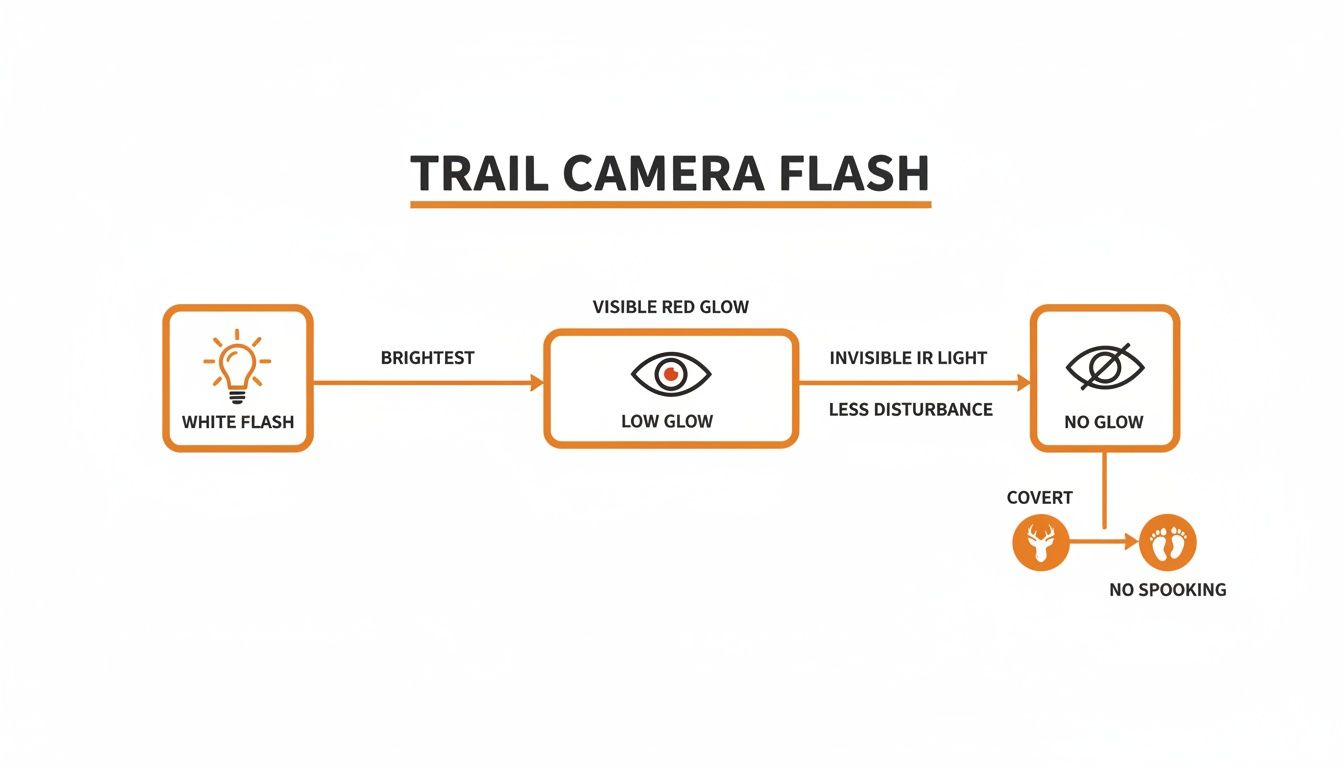
This visual makes it easy to see the progression from the highly visible white flash to the completely undetectable no glow option, highlighting the huge advantage in stealth.
No Glow vs. Low Glow vs. White Flash
Before you can decide, you need to weigh the pros and cons of each technology. The "best" camera is simply the one that aligns with your top priorities, whether that's capturing magazine-worthy color shots or ensuring a wise old buck never knows your camera is there.
To simplify the choice, here's a side-by-side look at how these three flash technologies stack up against each other.
Trail Camera Flash Technology Comparison
| Feature | No Glow (Invisible IR) | Low Glow (Red IR) | White Flash (Visible Light) |
|---|---|---|---|
| Visibility | Completely invisible; zero visible light. | Faint, dull red glow from LEDs. | Bright, obvious white flash. |
| Wavelength | 940nm | 850nm | Visible light spectrum |
| Stealth Level | Highest. Ideal for security & wary game. | Good. Less spooky than white flash. | Lowest. Will spook most wildlife. |
| Image Quality | Good black-and-white photos. | Brighter, sharper black-and-white photos. | Best possible night quality; full color. |
| Flash Range | Shorter range (typically 60-80 ft). | Longer range (often 80-100+ ft). | Longest range, often 100+ ft. |
| Best For | High-pressure hunting, security, research. | General scouting, low-pressure areas. | Food plots, surveys where color is needed. |
This table clearly shows the trade-offs: what you gain in image quality with a white flash, you sacrifice in stealth. And what you gain in total invisibility with no glow, you give up in raw flash power.
White Flash: The Loudest Option
A white flash camera is the old-school bruiser of the group. It works just like a regular point-and-shoot camera, firing a powerful, visible xenon flash to light up the night. The result? The absolute best nighttime image quality you can get: sharp, detailed, full-color photos and videos.
But that quality comes at a very steep price. The brilliant flash is incredibly disruptive and will almost certainly spook wary animals like mature bucks or coyotes. It also screams "camera here!" to any human trespasser, making it a poor choice for security or serious hunting.
Low Glow: A Solid Middle Ground
Low glow cameras, sometimes called red glow or standard IR cameras, are probably the most common type on the market. They use an infrared flash that operates at an 850nm wavelength. While this frequency is mostly invisible, the camera's LED bulbs emit a faint, dull red glow for a split second when they fire.
This technology offers a great compromise. The 850nm flash is more powerful than a no glow flash, which means you get a longer flash range (often 80-100 feet) and brighter, more detailed black-and-white night photos. While the faint red glow can be spotted if an animal or person is looking right at the camera, it’s far less startling than a white flash.
A key thing to remember is animal conditioning. Some deer might ignore a low glow flash, but mature, pressure-sensitive bucks can become "camera shy" after spotting that red glow. It might be enough to alter their patterns or make them avoid the area completely.
No Glow: The Ultimate in Stealth
A trail camera no glow model is the ghost in the woods. It uses a 940nm infrared flash, which is completely outside the visible light spectrum for humans and nearly all game animals. When it takes a photo, there is absolutely no visible sign—no light, no glow, nothing.
This total invisibility is its biggest strength. It’s the perfect choice for security surveillance and for hunting highly pressured or wise old animals that would be spooked by any hint of human activity. The trade-off is a slightly shorter flash range and a bit less brightness compared to low glow models, since the 940nm wavelength is inherently less powerful. However, modern high-end no glow cameras are closing that gap with advanced sensors that still deliver excellent images.
If total stealth is your priority, it's worth learning more about whether trail cameras can spook wildlife to help you decide.
When to Choose a No Glow Camera
Understanding the tech behind a trail camera no glow model is one thing, but knowing exactly when to use it is what separates a good scouting strategy from a great one. These cameras aren't just a minor upgrade. In certain high-stakes situations, their total invisibility is the secret to success.
Opting for this technology means you're putting stealth above all else—a decision that can make or break your hunting season or security plan.
Think of it like this: a low-glow camera is like whispering in a quiet library, while a no-glow camera is like thinking the words without making a sound. Most of the time, a whisper goes unnoticed. But when the target is exceptionally wary, even the slightest disturbance gives you away. In those critical moments, silent, invisible observation is the only way to get genuine, unaltered intelligence.
Hunting High-Pressure Animals
If you're targeting a mature, pressured animal, a no-glow camera is practically a necessity. A wise old buck that has survived multiple hunting seasons has learned to associate anything out of the ordinary with danger. He didn't get that old by being careless.
That faint red dot from a low-glow camera might not spook a young, curious deer. To a seasoned buck, however, it's an immediate red flag. He might not bolt right away, but he'll notice it, log it as a potential threat, and start changing his patterns to avoid that spot, especially during daylight. This is exactly how a hunting area can "go cold" without you ever figuring out why. The buck has been educated, and your camera was the teacher.
A no-glow camera ensures you get an honest look at a mature animal's behavior. You're observing him in his natural state, completely unaware of your presence, which is the only way to effectively pattern him for a successful hunt.
Wildlife Research and Observation
Wildlife biologists and researchers face a similar problem. Their primary goal is to observe animals without influencing their behavior, and the presence of any human-made object can introduce bias into a study. This is especially true for sensitive or elusive species.
Imagine trying to study the nesting habits of a shy predator or the social dynamics of a reclusive animal family. A visible flash or even a subtle red glow could:
- Cause the animals to abandon their territory completely.
- Create unnatural stress, leading to skewed behavioral data.
- Attract unwanted attention from other, more curious species.
A no-glow trail camera is essential for ethical and accurate research. It allows for pure observation, capturing authentic data that shows how animals truly live when they think no one is watching. This non-invasive monitoring is critical for conservation and understanding delicate ecosystems. For a deeper dive, our guide on different cameras for hunting covers various technologies suited for these sensitive tasks.
Uncompromised Property Security
When your goal is securing property, alerting an intruder to your camera's location defeats the entire purpose. A trespasser or thief who spots the red glow of a low-glow camera has several options, and none of them are good for you. They can simply avoid the camera's view, disable it, or steal it—leaving you with no evidence and one less camera.
A trail camera no glow model is the obvious choice for security. Its complete invisibility means it can capture clear images without ever tipping off the subject.
This covert advantage is what makes it such a powerful security tool. When paired with cellular technology, it can silently snap a picture of an intruder and send it directly to your phone in real-time. This provides crucial evidence for law enforcement without the perpetrator ever knowing they've been caught. In security, what the other person doesn't know is your greatest advantage.
Essential Features of a Modern No Glow Camera
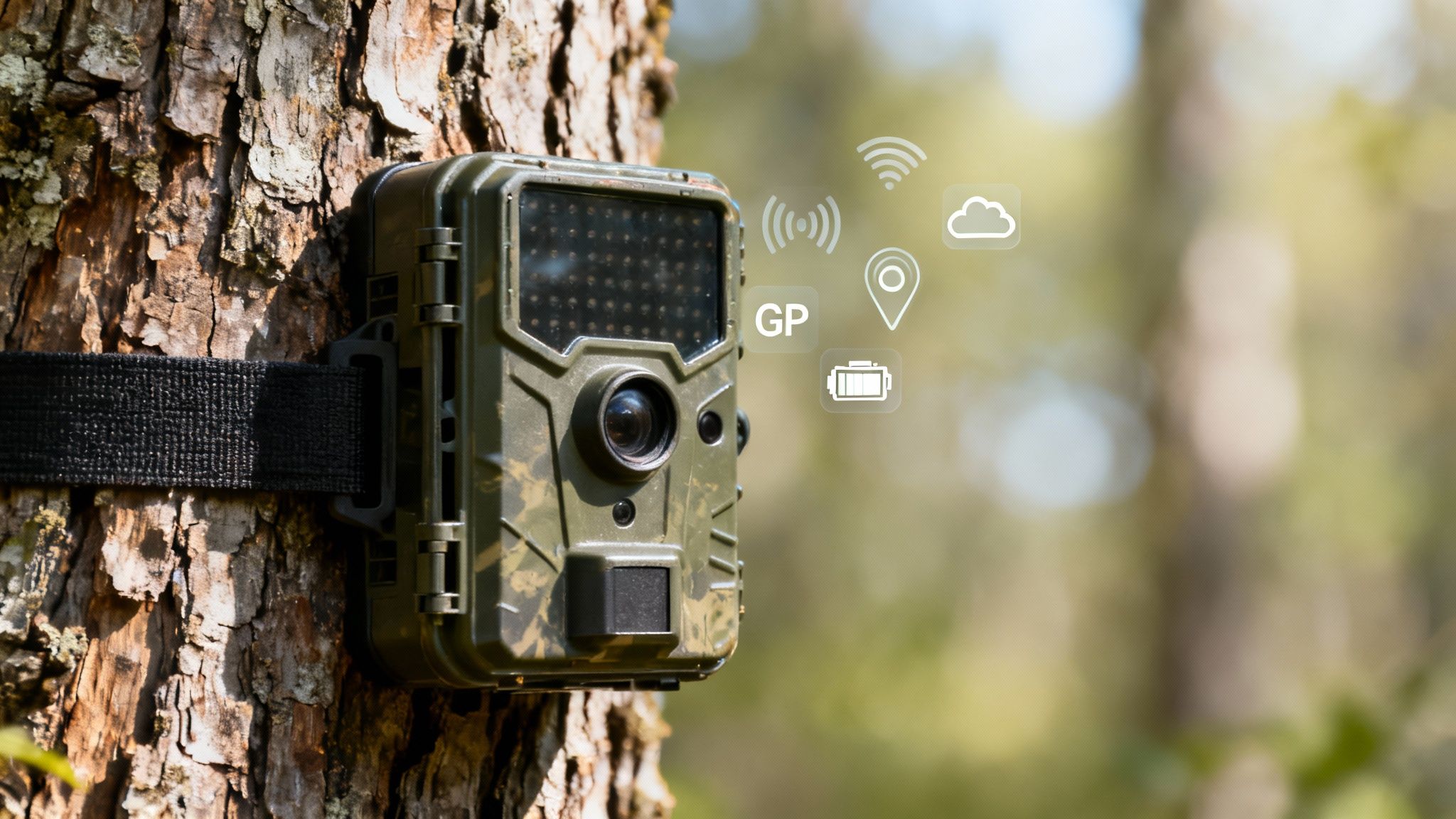
Choosing a trail camera no glow model gets you total stealth, but the flash is just the starting point. Today’s top cameras are more like intelligent scouting partners, packed with tech that saves you time, keeps you out of the woods, and delivers more useful intel than ever before.
These features all work together, transforming a simple camera into a remote data-gathering system. You get a hub that lets you monitor activity, pattern wildlife, and protect your land in real time—all from your phone.
Let's break down the must-have capabilities that define a modern, high-performance no-glow camera.
Cellular Connectivity for Real-Time Scouting
Cellular connectivity is the single biggest game-changer in the trail camera world. It completely frees you from the old routine of walking in to pull an SD card, a process that leaves your scent and alerts every deer in the area that you were there.
A cellular trail camera no glow model sends photos and videos straight to your smartphone or computer the moment they're taken. This instant feedback is huge. You know the second a target buck shows up, letting you make immediate moves on your hunting strategy without ever setting foot on the property. It’s no surprise that searches for cellular cameras have climbed steadily for the last five years, a trend driven by hunters who need those immediate alerts for everything from patterning deer to managing predators. You can dig into more on this trend in market research on trail camera growth.
The real magic of cellular is reduced pressure. By cutting out those disruptive trips to check cameras, you keep your hunting spot undisturbed. This lets animals stick to their natural patterns without human interference.
AI Filtering for Smarter Image Management
A camera on a hot food plot can easily snap thousands of photos, but most of them are junk—a swaying branch, a nosy squirrel, or the same raccoon raiding your corn pile for the tenth time. Sifting through all that digital clutter is a massive time-sink. This is where Artificial Intelligence (AI) filtering becomes your best friend.
AI species recognition automatically identifies and sorts images based on what’s in them. The camera's software can tell the difference between a deer, a turkey, a person, or a vehicle, which lets you create custom alerts for only the species you actually care about.
- Deer-Only Alerts: Get a ping only when a buck or doe walks by.
- Ignore Small Game: Tell the app to ignore raccoons, squirrels, and birds to keep your phone quiet.
- Security Focus: Set up instant alerts for people or vehicles, turning your trail cam into a security device.
This smart sorting saves you countless hours you’d otherwise spend swiping through useless photos.
Advanced Location and Security Tools
Losing an expensive camera to a thief is a gut-wrenching feeling. Modern no-glow cameras are fighting back with a suite of anti-theft and location tools that give you peace of mind and help you manage your camera network more effectively.
Gps and Geofencing
Built-in GPS is a non-negotiable security feature. If your camera gets stolen, you can track its location in real-time through the companion app, which massively boosts your chances of getting it back. Geofencing takes it a step further by letting you draw a virtual perimeter around your property. If the camera moves outside that zone, you get an instant alert.
Smart Anti-Theft Protection
Top-tier cameras like the Magic Eagle EagleCam 5 offer even more advanced protection. They have features like motion-triggered capture during a theft and the ability to keep tracking even when powered off, making the device a nightmare for thieves to deal with.
Built for the Real World
At the end of the day, all the high-tech bells and whistles are useless if the camera can't survive a downpour or a deep freeze. Core features like durability and power efficiency are the foundation of a reliable device that has to live outdoors 24/7.
- Rugged Weatherproofing: Look for an IP66 rating or higher. This ensures the camera is sealed tight against heavy rain, dust, and brutal temperatures. A durable housing is critical for year-round operation.
- Extended Battery Life: Power efficiency is key, especially for cellular models that are constantly transmitting data. The best cameras are optimized to run for months on a single set of batteries or can be hooked up to an external solar panel for nearly endless power.
When you put all these features together, a modern trail camera no glow model becomes a powerful tool for both scouting and security.
Expert Tips for Setting Up Your Camera
Owning a feature-packed trail camera no glow model is a great start, but its real potential comes alive in the field. Proper deployment is an art form, one that turns a good camera into an incredible scouting tool. It’s about more than just strapping it to a tree—it’s about thinking like your target to stay invisible and capture priceless intel.
The goal is to make your camera melt into the woods, a silent observer that’s just another part of the environment. Every little detail matters, from the angle and height to the scent you leave behind. A few field-tested principles will make the difference between spooked deer and high-quality images.
Mastering Placement and Positioning
The single most common mistake I see is placing a camera at eye level, whether it’s for a human or a deer. This puts the device squarely in an animal's line of sight, practically begging to be noticed. Even with a no-glow flash, the camera's body or the faint click of its shutter can send a mature buck into the next county.
To beat this, you have to change your perspective. Try mounting the camera 8-10 feet up and angling it down. This gives you a wider field of view and keeps the camera out of an animal's immediate awareness. As a bonus, it helps cut down on false triggers from squirrels and raccoons. A low mount hidden in a brush pile can be just as deadly, offering a unique angle that animals almost never expect.
Pro Tip: Always know where the sun is. Pointing your camera north or south keeps direct sunlight from blasting the lens at sunrise and sunset. This simple trick dramatically reduces washed-out photos and false triggers from moving shadows.
The Art of Natural Concealment
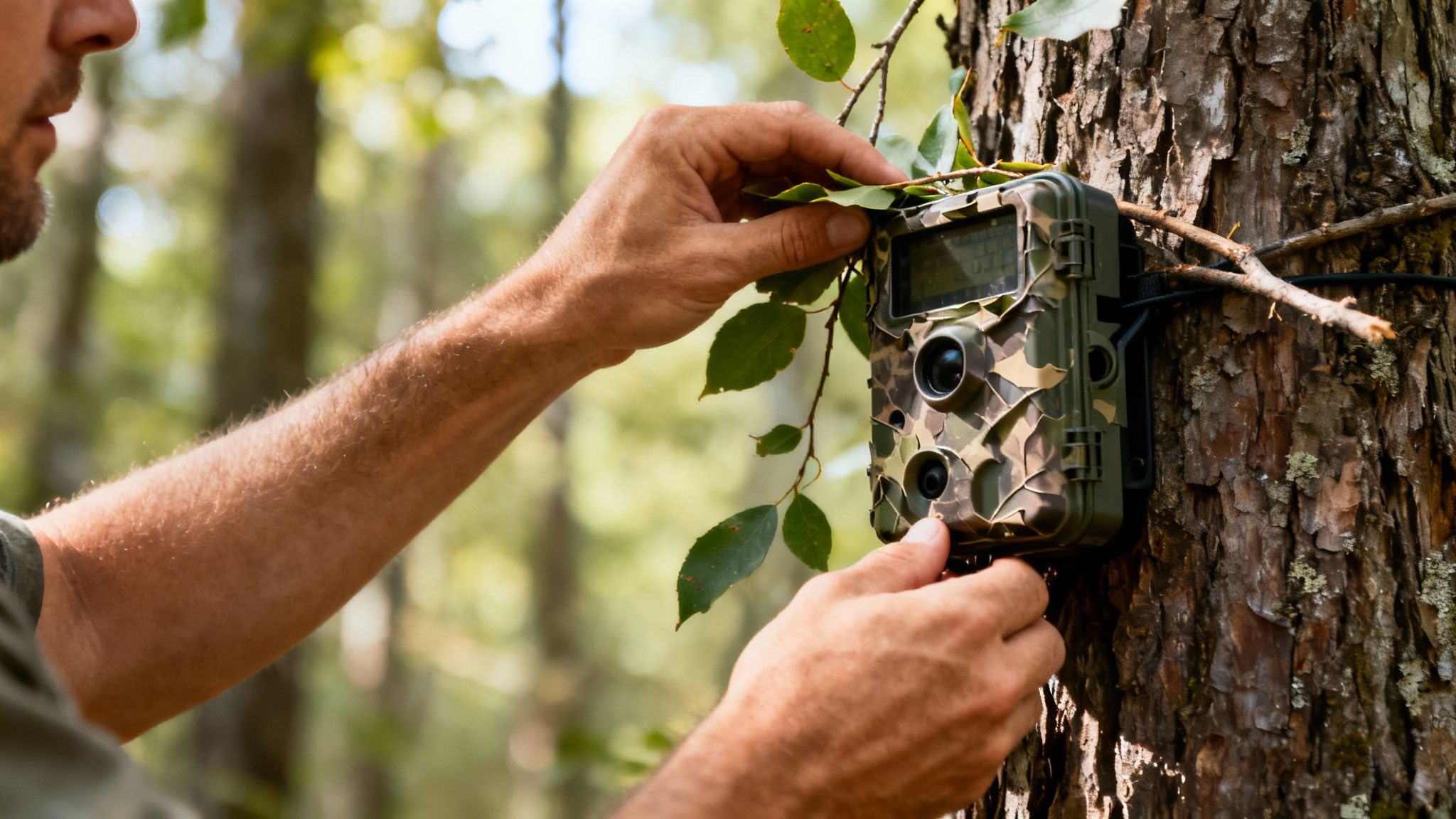
Your camera needs to blend in, not stick out like a sore thumb. The camo pattern helps, sure, but nothing beats using the natural environment to your advantage. You’re looking for ways to break up the camera’s hard, rectangular outline—a shape that just doesn’t exist in the woods.
- Utilize Surrounding Vegetation: Tuck the camera behind a few leaves or snug it up against a thick branch. The idea is to obscure its shape without blocking the lens or IR sensors.
- Find Irregular Trees: Mount it on a multi-trunked tree or one with gnarly, rough bark. A perfectly smooth, straight tree is like a billboard advertising your camera’s location.
- Create a Backstop: Position the camera so a dense thicket, hillside, or fallen log is in the background. This keeps the IR flash from lighting up a big, empty space, which can draw unwanted attention.
This kind of strategic hiding makes your trail camera no glow setup practically invisible, day or night.
Minimizing Human Impact
Every time you walk to your camera, you’re leaving a trace. Your scent, a snapped twig, a footprint—it’s all a flashing neon sign to wildlife that an intruder was there. Reducing this pressure is absolutely critical for capturing natural behavior, especially near sensitive spots like bedding areas or primary scrapes.
Scent Control Discipline:
- Always wear rubber boots and scent-free gloves when you handle or check your camera. No exceptions.
- Avoid grabbing branches or bushes with your bare hands on the way in or out.
- Plan your route. Use creek beds or windy days to help carry your scent away from where you expect deer to be.
Check Your Camera Sparingly: This is where cellular cameras really shine. They eliminate the need to constantly stomp through the woods. Fight the urge to pull the SD card "just to see what's on it." Let the tech do the work. Only go in when you absolutely have to, like when a battery needs changing. By staying out, you let animal patterns develop naturally, which is exactly what you want to see.
The Future of Stealth Scouting Technology
The world of stealth scouting is blowing up, expanding far beyond its traditional roots in the hunting community. What was once a specialized tool for patterning a whitetail buck is now a go-to for conservation projects, wildlife research, and even advanced property security. This boom is pushing manufacturers to cook up smarter, more connected tech, and it's completely changing how we gather intel in the wild.
A huge part of this push comes from right here in North America. The U.S. and Canadian markets made up over 30% of all wildlife camera use globally in early 2025. That’s no surprise, given our deep-rooted hunting culture and serious conservation efforts in national parks and private lands. This isn't just about numbers; it's about demand for sophisticated features like cloud storage, GPS tagging, and AI that can tell a raccoon from a coyote. For a deeper dive into these market trends, you can explore the full trail camera research from 360iResearch.
The Rise of Predictive Intelligence
So, what’s next? The real game-changer is moving from just seeing what was there to predicting what will be there. The future of the trail camera no glow industry isn't just about clearer pictures; it's about smarter AI that can help you anticipate an animal's next move.
Think about a system that crunches months of your camera's data—timestamps, weather, moon phase, wind direction—and tells you the exact window your target buck is most likely to show up. That’s not just a camera anymore; it's a proactive scouting partner. We're already seeing hints of this in the world of intelligent security camera systems, where advanced recognition tech is becoming the norm. It won’t be long before that same power is standard in the woods.
The goal is shifting from "what was here" to "what will be here." Future trail cameras will leverage big data and machine learning to give users a significant strategic advantage, interpreting patterns humans might miss.
Smarter Power and Seamless Connectivity
Of course, as cameras get smarter, they need to be able to power themselves and stay connected in the middle of nowhere. This is where we'll see some of the most practical improvements.
- Integrated Power Systems: Forget swapping out dozens of AA batteries. Expect to see more cameras with built-in solar panels and beefy internal batteries, which means fewer trips into the field and less disturbance.
- Smarter Network Roaming: Getting a signal can be a nightmare in remote spots. New tech will allow cameras to automatically jump between cellular carriers to lock onto the strongest signal, keeping you connected where you couldn't be before.
This push toward smarter, self-sufficient hardware means you can spend less time tinkering and more time planning your next move. Investing in a solid, forward-thinking camera today means you'll be ready to take full advantage of these exciting changes as they roll out.
Common Questions About No Glow Cameras
Even after you get the tech, a few practical questions always pop up. Let's tackle the most common ones to clear up any confusion and make sure you get the most out of your camera.
Is Nighttime Image Quality Really Worse?
This is a big concern, but the trade-off is often smaller than you’d think. A no glow camera uses 940nm infrared LEDs, which just aren't as powerful as the 850nm LEDs you find in low glow models. That can mean a slightly shorter flash range and pictures that look a bit dimmer.
But here’s the thing: the best manufacturers know this. They compensate with better sensors, premium lenses, and smarter image processing software. For most scouting and security jobs, the image quality from a modern no glow camera is more than good enough. The massive advantage of being totally invisible almost always beats a minor dip in nighttime brightness.
Can Any Animals See the No Glow Flash?
For the game animals most of us are after—deer, elk, bears—the 940nm infrared flash is completely invisible. The light's wavelength is just outside what their eyes can pick up. That's the whole point: capturing animals acting naturally, without a clue you're there.
While some studies hint that certain predators or birds might have a wider visual range, the flash is effectively invisible to common North American and European mammals. This means you can scout without ever spooking the game you’re trying to pattern.
The core benefit remains: a no glow trail camera allows you to be a ghost in the woods. It captures authentic behavior without alerting animals to your presence, which is essential for patterning mature bucks or conducting accurate wildlife studies.
Are No Glow Cameras Better for Security?
Absolutely, yes. For watching over your property, a trail camera no glow model is the only real choice. A low glow camera gives off a faint red light when it triggers, which any person can easily spot from a distance. Once they see it, they can dodge it, break it, or steal it, leaving you with zero evidence.
A no glow camera is completely covert, grabbing the footage you need without ever tipping its hand. Pair that total stealth with cellular tech that sends instant alerts and photos right to your phone, and you’ve got an incredibly effective—and discreet—security system. You get the proof without the intruder ever knowing they were caught.
Ready to gain the ultimate stealth advantage for your scouting and security? The Magic Eagle EagleCam 5 delivers true no glow invisibility paired with advanced AI, GPS, and cellular technology. Explore the EagleCam 5 today and see what you've been missing.