

Navigating the world of spotter scope reviews can be a real headache, but picking the right one boils down to a simple idea: match the scope to what you'll actually be doing. The best spotting scope for a backcountry hunter glassing a distant ridgeline is a totally different beast from one a birdwatcher uses from a stationary hide. This guide is built to cut through the marketing noise and give you a solid framework for making a choice you won't regret.
How to Choose the Right Spotting Scope
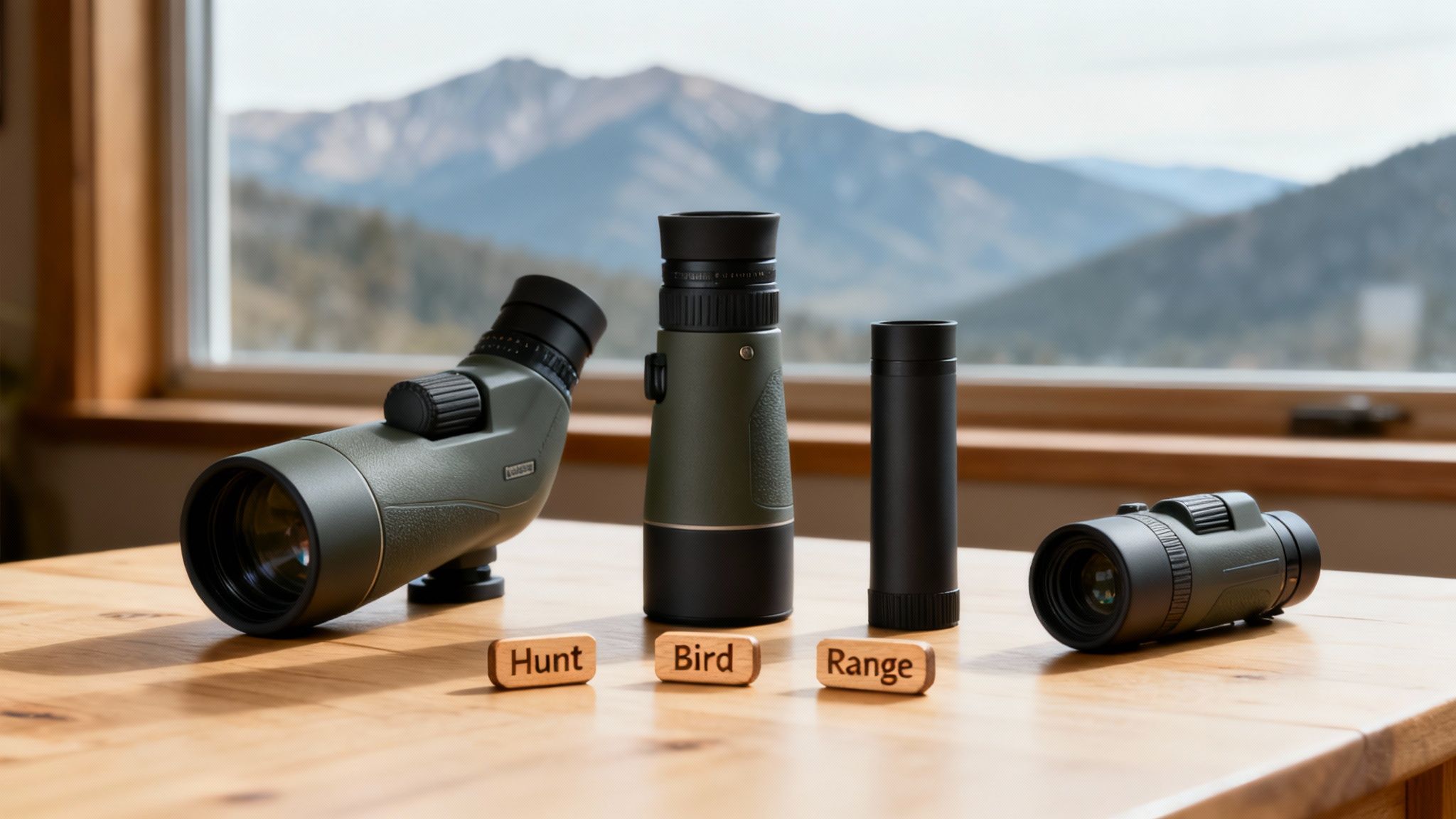
Before we get into specific models, you need to understand how different features serve specific needs. A scope’s body style, magnification range, and objective lens size aren't just numbers on a spec sheet—they're practical tools designed for particular environments. Get the combination wrong, and you're in for a frustrating and expensive experience.
Take body style, for instance. A hunter trying to get on a moving animal will almost always find a straight-body scope faster to use. On the other hand, a birdwatcher spending hours observing a nest will find an angled-body scope far more comfortable for long glassing sessions.
Connecting Features to Your Activity
The core of your decision should be rooted in how you'll use the scope 90% of the time. It’s easy to get suckered into chasing the highest magnification or the biggest objective lens, but those specs come with trade-offs. You're often looking at more weight, a tighter field of view, and more distortion from heat mirage.
To make things easier, we put together a quick-reference table that connects key scope features to common activities. Use this as your starting point to figure out which specs truly matter for your passion, whether that's spotting impacts at 1,000 yards or identifying a rare warbler.
Key Insight: Don’t shop for the "best" scope in a vacuum. Your goal is to find the best scope for you. A mid-range optic that perfectly fits your needs will always outperform a premium one that doesn't.
This framework will help you read our in-depth spotter scope reviews with a clear purpose. You'll know exactly what to look for and can weigh the pros and cons of each model against a solid understanding of what you actually need in the field.
Quick Guide to Spotting Scope Features by Activity
This table matches critical scope features to common uses, helping you quickly identify the most important specifications for your needs.
| Activity | Recommended Body Style | Ideal Magnification | Key Feature Focus |
|---|---|---|---|
| Backcountry Hunting | Straight (for quick target acquisition) | 20-60x | Lightweight design, durability, and low-light performance. |
| Birdwatching | Angled (for comfortable, prolonged viewing) | 15-45x or 20-60x | Exceptional color fidelity, smooth focus, and wide field of view. |
| Long-Range Shooting | Angled (for comfort from a bench) | 25-75x or higher | High-end glass for mirage, maximum magnification, stability. |
| Wildlife Observation | Angled (versatile and comfortable) | 20-60x | Balance of optical clarity, durability, and ease of use. |
By starting here, you can narrow your search and focus only on the scopes that are genuinely suited for your specific use case.
Making Sense of Spotting Scope Specs
To pick the right spotter, you first have to speak the language of optics. The numbers and acronyms on a spec sheet aren't just jargon; they're the DNA of the scope, defining exactly how it will perform in the field. Getting a handle on these features is the first step to making a smart buy.
You’ll almost always see a set of numbers like 20-60x85mm. This isn’t a model number—it describes the two most critical components: magnification and the objective lens size. These two specs work hand-in-hand to shape your viewing experience, directly impacting everything from image brightness to how much country you can scan at once. Let's break down what those numbers really mean.
Magnification and Objective Lens Size
The first set of numbers, like 20-60x, is your magnification range. This tells you how much closer an object will appear. At 20x power, a buck standing 1,000 yards out will look like it's just 50 yards away. Having that variable power is key—you can scan a whole hillside on low power, then crank up the zoom to count antler points.
The second number, like 85mm, is the diameter of the objective lens—the big one at the front of the scope. Think of this as the light-gathering engine. A larger objective lens pulls in more light, which is absolutely critical for keeping the image bright and clear, especially when you're maxing out the magnification at dawn or dusk.
- Real-World Gut Check: Picture this: you're glassing for elk as the sun dips below the ridge. A spotter with an 85mm objective lens will deliver a much brighter, more detailed image at 60x than one with a smaller 65mm lens. That difference is what lets you distinguish a shadow from a bedded bull in fading light.
Why Glass Quality and Coatings Matter Most
Here’s a hard truth: not all glass is created equal. The quality of the glass and the coatings applied to it are arguably the most important factors dictating image sharpness, color accuracy, and overall clarity. Cheaper scopes often use standard glass, and you'll pay the price with a frustrating optical flaw.
That flaw is called chromatic aberration, which you’ll see as ugly purple or yellow fringing around high-contrast edges, like the outline of an animal against the sky. To fight this, premium scopes use specialized glass:
- ED (Extra-Low Dispersion) Glass: This is the good stuff. It’s engineered to correct for that color fringing, giving you a much sharper image with true-to-life colors.
- HD (High Density) or Fluorite Glass: This is the top tier. It offers the absolute best color fidelity and image resolution money can buy, pushing clarity to its limits.
Lens coatings are just as crucial. These are microscopic layers applied to lens surfaces to cut down on glare and reflection. By doing so, they maximize the light that actually makes it through the scope to your eye. Lenses that are "fully multi-coated"—meaning every single air-to-glass surface has been treated—can boost light transmission by over 15% compared to uncoated glass.
Expert Insight: The real difference between a good scope and a great one often boils down to the glass. A budget scope might seem fine in bright daylight, but premium ED or HD glass proves its worth in the tough, low-light conditions where it pulls out hidden details and delivers a crisp, vibrant view.
Field of View and Eye Relief
Field of View (FOV) is simply the width of the area you can see, usually measured in feet at 1,000 yards. A wider FOV makes it far easier to scan broad landscapes and find what you're looking for. Just remember, as you increase magnification, your field of view will shrink—it's a fundamental trade-off.
Eye relief is the sweet spot—the ideal distance between your eye and the eyepiece to see the entire, clear picture. This spec is a make-or-break feature for anyone who wears glasses. If the eye relief is too short (say, 14mm), a glasses-wearer won't be able to get their eye close enough. The result is a frustrating, tunnel-like view where you only see the center of the image.
For comfortable viewing with glasses, look for scopes with at least 17-20mm of eye relief.
Comparative Spotter Scope Reviews
Specs on a sheet are one thing, but how a scope performs in the field is what really counts. This is where we move beyond the numbers and dive into real-world analysis of today’s top models. We’ve put these scopes through the wringer, judging them on the metrics that actually matter when you’re miles from civilization.
Our focus is purely on practical performance. How does the image hold up at max zoom on a hazy afternoon? Is the focus knob precise enough for those tiny adjustments? Does it feel like a brick in your pack after a full day? We’ve structured our reviews to answer exactly these kinds of questions.
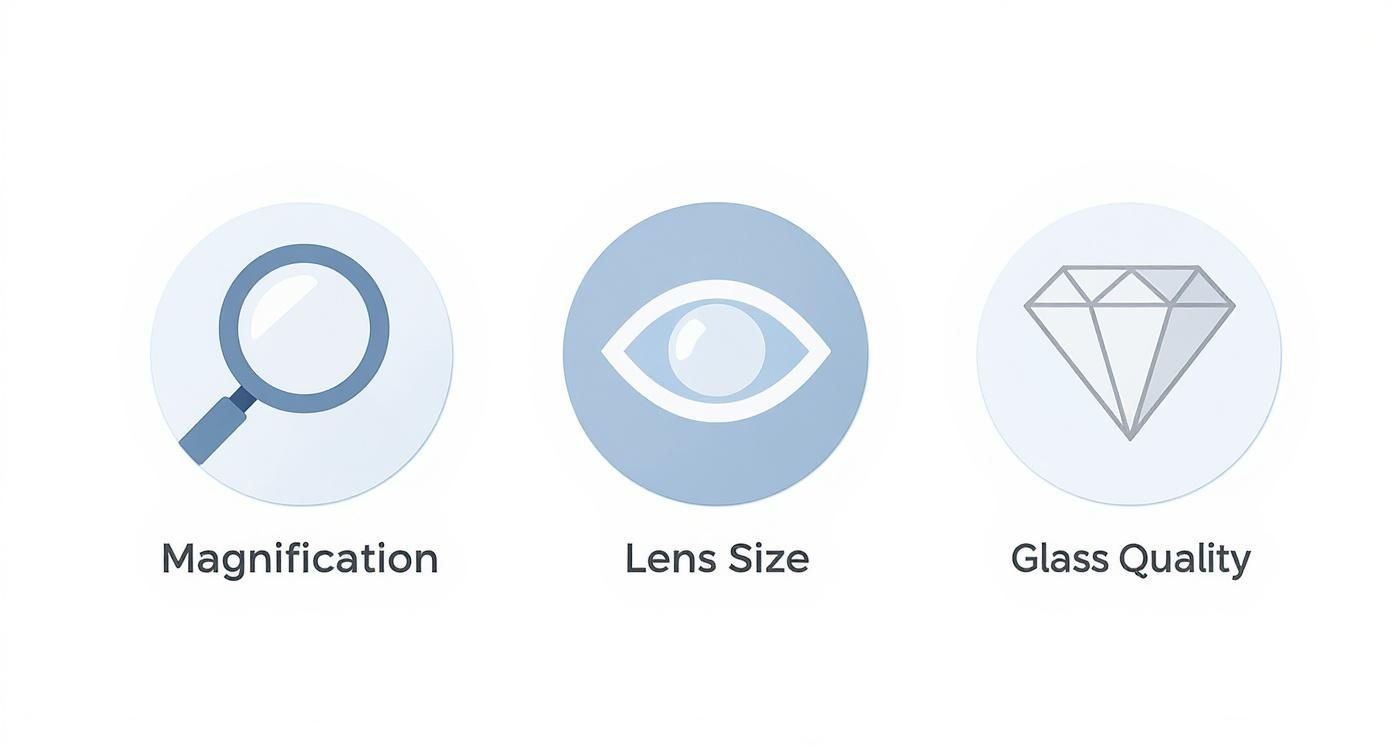
As the image shows, magnification, lens size, and glass quality are the big three. They all work together to create the final image you see, and a weakness in one can't be overcome by the others.
Premium Performer: Vortex Razor HD
The Vortex Razor HD line is the gold standard for a reason. We put the 27-60x85mm model to the test, and its bright, tack-sharp image quality was immediately obvious. Its APO triplet optical system and HD glass deliver stunning color and edge-to-edge sharpness.
In the real world, this lets you pick out the subtle feather patterns on a distant bird or count every tine on a mule deer buck. During our low-light tests at dawn, that massive 85mm objective lens just drank in the light, giving us usable glassing time long after lesser scopes had gone dark. The helical focus dial is another win—it's buttery smooth, making fine-tuning your view feel natural and precise.
Key Differentiator: The Razor HD’s advanced XR Plus multi-coatings give it a serious leg up in tough lighting. While other scopes wash out, the Razor maintains vibrant contrast, which is a game-changer in those critical first and last minutes of legal light.
Of course, this level of performance doesn’t come cheap, and it’s one of the heavier scopes in its class. For a backcountry hunter counting every ounce, the weight might be a dealbreaker. But if optical perfection is your top priority, the Razor HD is tough to beat. The global spotting scope market is valued at around USD 600 million in 2024 and is expected to hit USD 800 million by 2033, driven by this exact demand for high-performance glass.
Mid-Tier Contender: Tract Toric UHD
The Tract Toric UHD 22-45x65mm hits a sweet spot, offering near-premium performance without the sticker shock. Tract’s direct-to-consumer model lets them pack in high-end components like SCHOTT HT glass while keeping the price reasonable. In our testing, the Toric produced an impressively bright and clear image that punched well above its weight class.
The color contrast is excellent. That SCHOTT glass renders a vivid, true-to-life picture that makes spotting game against a busy background much easier. The build is solid, too, with rugged rubber armor and a smooth focus wheel. At 52 ounces, it strikes a nice balance between portability and a durable, substantial feel.
Where the Toric shows its mid-tier roots is at the very edges of the view. The center 80% is perfectly sharp, but we noticed a little softness creeping in on the periphery, especially at lower magnifications. The zoom mechanism is also a bit stiff. These are minor gripes for a scope that over-delivers everywhere else.
A great optic is just one piece of the puzzle. Many hunters pair their spotting scope with other scouting tools to get the full picture. For more on that, check out our guide on the best trail cameras for hunting.
Compact Powerhouse: Vortex Razor HD 13-39x56
For the minimalist hunter or birder who refuses to compromise on optical quality, the Vortex Razor HD 13-39x56mm is an absolute gem. Weighing a mere 28.6 ounces, this little scope is a dream to pack and carry on long treks. But don't let its size fool you—it packs a serious punch.
The HD glass system provides a crisp, clear view with fantastic color. We found the helical focus to be quick and responsive, which is perfect for tracking moving animals. The build quality is pure Razor line—a tough magnesium body that’s fully waterproof and fog-proof, ready for whatever the weather throws at it.
The trade-off is obvious: light gathering. The 56mm objective lens simply can’t pull in light like its bigger 65mm or 85mm siblings. While the performance is incredible for its size, it won't buy you those extra few minutes of viewing at sunrise and sunset. Its close focus of 9.2 feet might also be a limitation for some specific uses, like digiscoping insects.
This scope isn't for everyone, but for the user who puts a premium on mobility without sacrificing core optical quality, it’s in a class of its own.
Comparative Analysis of Top Spotting Scopes
To make things easier, we've broken down how these top models stack up against each other. This table scores them on key metrics to help you find the right fit for your budget and how you plan to use it.
| Model | Magnification | Objective Lens (mm) | Glass Quality | Optical Performance Score (1-10) | Durability Score (1-10) | Best For |
|---|---|---|---|---|---|---|
| Vortex Razor HD 27-60x | 27-60x | 85mm | HD APO System | 9.5 | 9.0 | Demanding hunters and wildlife observers. |
| Tract Toric UHD 22-45x | 22-45x | 65mm | SCHOTT HT | 8.5 | 8.5 | Value-conscious users seeking high performance. |
| Vortex Razor HD 13-39x | 13-39x | 56mm | HD Glass | 8.0 | 9.0 | Backcountry hunters prioritizing portability. |
| Swarovski ATX 25-60x | 25-60x | 85mm | SWAROVISION Fluorite | 10.0 | 9.5 | Users demanding the absolute best optics. |
| Celestron Ultima 20-60x | 20-60x | 80mm | Standard BaK-4 | 6.5 | 7.0 | Entry-level users and budget-conscious buyers. |
As our spotter scope reviews show, each of these scopes fills a specific role. There’s no single "best" option for everyone. The right choice comes down to your personal priorities—balancing optical performance with weight, durability, and cost to find the perfect match for your adventures.
Finding the Best Scope for Your Activity
Specs and feature lists only tell you half the story. The best spotting scope isn't the one with the biggest numbers; it's the one that feels like a natural extension of what you're doing in the field. A scope's real worth is measured by how well its design solves the unique problems you face.
Generic advice is useless because the needs of a hunter in the high alpine, a birder on the coast, and a shooter at the range couldn't be more different. Getting a handle on these nuances is how you make a choice you won't regret. This is where we connect the dots between the spec sheet and the real world.
The Backcountry Hunter’s Dilemma
For the backcountry hunter, every single ounce is scrutinized. You need an optic that can take a beating from rough weather and even rougher handling, all while being light enough to earn its spot in an already-heavy pack. It's all about balancing optical power with packability.
A great scope for this job, like the Vortex Razor HD 13-39x56mm, is built around a compact design without sacrificing optical quality. Its magnesium body keeps the weight down to a very reasonable 28.6 ounces, but the HD glass still delivers the clarity needed to size up game from a mile away. Many hunters prefer a straight-body design here for its speed, making it faster to get on an animal moving across a distant ridge.
A hunter's scope has to be a tool of efficiency. It needs to be tough enough to survive the climb, light enough not to be a burden, and optically sharp enough to make a clear 'go or no-go' call on an animal across the canyon.
The Dedicated Birder and Wildlife Photographer
Birdwatchers and wildlife photographers are playing a totally different game. Their goal isn’t just to find a subject but to see the finest details—the subtle color shift in plumage, the texture of a feather, or the nesting behavior of a distant pair. For them, optical perfection is everything.
Models with superior glass, like those with SCHOTT HT or fluorite elements, really shine here by delivering stunning color fidelity and contrast. A buttery-smooth, precise focus wheel is non-negotiable when you’re trying to track a flitting warbler through thick brush. An angled body is almost always the right call, giving you a much more comfortable viewing angle for long hours of glassing from a blind or vehicle mount. These activities also often lead to digiscoping, and you can learn more in our handy guide with wildlife photography tips for beginners.
The Precision Long-Range Shooter
Out on the shooting range, stability and raw magnification are king. Unlike a hunter, a long-range shooter is usually stationary and couldn't care less about weight. Their challenge is resolving tiny targets or spotting bullet impacts at extreme distances, often through the wavy distortion of heat mirage.
For this discipline, you need a scope built for pure optical horsepower. An angled body is a must to reduce neck strain when you're glassing from a prone or benched position. The most critical features are:
- Maximum Magnification: Power ranges like 25-75x are common for spotting impacts at 1,000 yards and beyond.
- Premium Glass: High-end glass with advanced coatings is essential for cutting through mirage and keeping the image sharp at full zoom.
- Rock-Solid Stability: This scope will live on a heavy, beefy tripod to kill every last hint of vibration.
This growing passion for specialized outdoor pursuits is fueling some serious market growth. The global spotting scopes market is expected to climb from roughly USD 597.4 million in 2023 to about USD 1,025 million by 2032, driven by a surge in outdoor recreation and new optical tech. You can discover more insights about spotting scope market trends. By matching your choice to your main activity, you ensure your investment actually delivers the performance you need.
Essential Gear to Support Your Scope
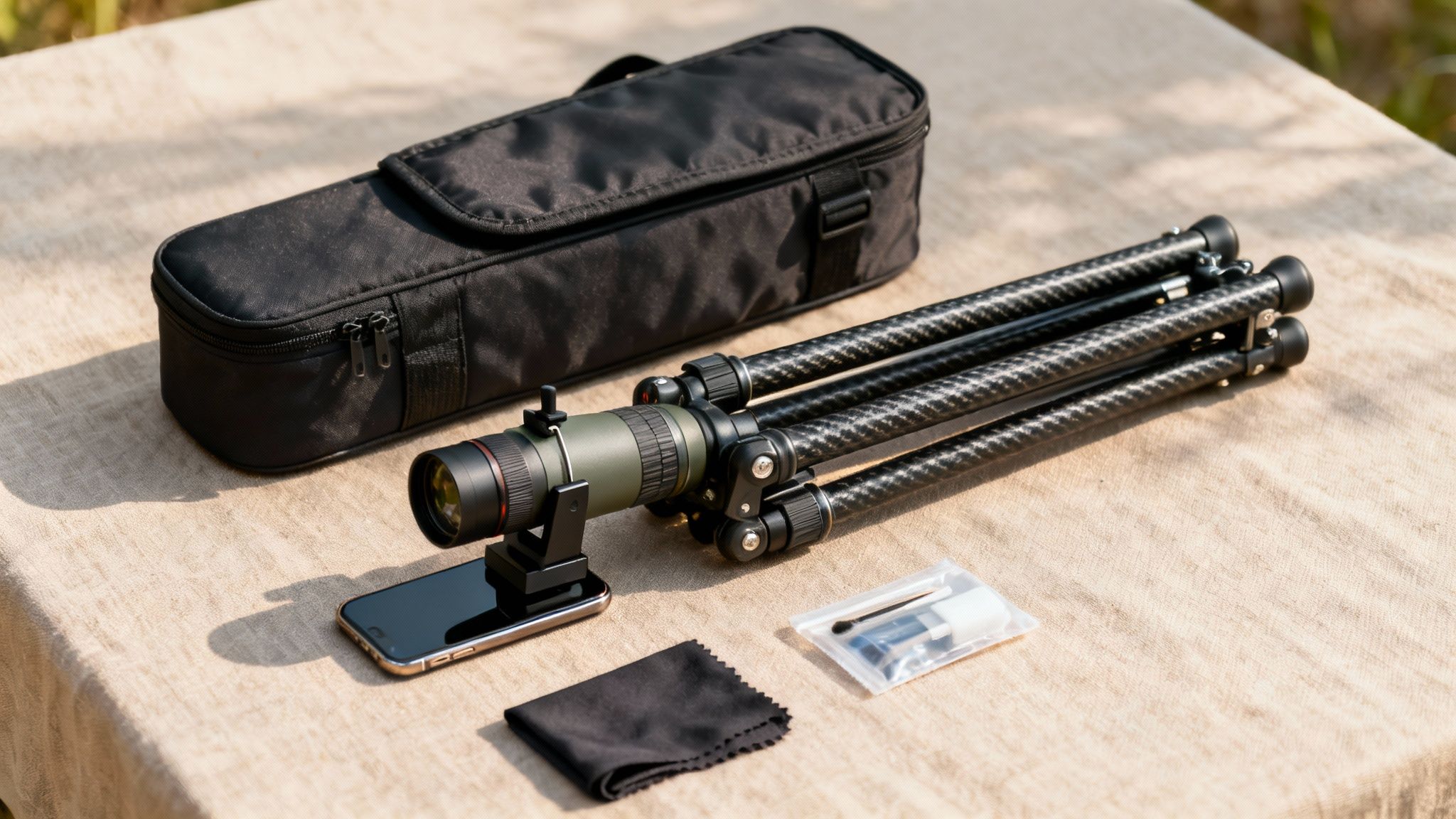
A top-tier spotting scope is an incredible tool, but it's only as good as the gear holding it up. Without the right support system, its potential is wasted. The same high magnification that lets you count points on a buck a mile away also magnifies every tiny shake and vibration, turning a clear image into an unusable blur.
This is why a solid foundation isn't just a suggestion—it's an absolute necessity. Investing in quality accessories protects your scope and unlocks its true performance. From the tripod to the cleaning kit, this gear is what makes a great optic a reliable partner in the field.
Why a Quality Tripod Is Non-Negotiable
A sturdy tripod is the single most important accessory you’ll buy. Period. Trying to hand-hold a spotter is impossible, and even propping it on a backpack introduces too much movement for detailed glassing. The stability of your tripod directly translates to the clarity of your view.
When you're picking one out, the main choice boils down to two materials: aluminum and carbon fiber. Each has its place, depending on where and how you’ll be using your scope.
- Aluminum Tripods: These are the workhorses—affordable, tough, and reliable. While they're heavier, that extra weight can be a good thing, providing a rock-solid platform. They're an excellent choice for stationary use, like at the shooting range or glassing from the truck.
- Carbon Fiber Tripods: This is the premium option for anyone hauling gear deep into the backcountry. Carbon fiber is significantly lighter and better at dampening vibrations, but it'll cost you more. For a hunter on a multi-day trek, shedding those extra pounds is almost always worth the price.
The real test of a tripod isn't how it performs on a calm day. It's how it handles a stiff crosswind on uneven ground. A cheap, flimsy model will make even a $3,000 scope useless when the wind picks up.
Essential Accessories for Protection and Performance
Beyond the tripod, a few other key items will make or break your experience. These tools don't just improve your glassing sessions; they ensure your scope survives years of hard use out in the elements.
A protective case is non-negotiable for transport. Many scopes come with a soft neoprene cover, which is great for preventing scratches in the field. But for travel, especially in a packed truck or on a plane, you need a padded, semi-rigid case to protect against impacts.
Digiscoping adapters have also become a game-changer. These simple gadgets connect your smartphone to the scope's eyepiece, letting you capture incredible high-magnification photos and videos. It's a fantastic way to document a trophy animal, share intel with your hunting buddies, or just save a memory. Getting your gear dialed in is part of the adventure, and you can find more tips on our list of hunter essentials every outdoorsman needs.
Finally, get a dedicated lens cleaning kit. Wiping a dusty lens with your shirttail is a surefire way to scratch the delicate coatings and ruin your glass. A proper kit with an air blower, a soft brush, and microfiber cloths will safely remove grit and keep your view crystal clear. Regular, proper maintenance is the best way to guarantee peak performance season after season.
Answering Your Spotting Scope Questions
After digging into the specs and field tests, a few practical questions always seem to pop up. This section is all about clearing up those common debates you see online, giving you direct answers from our experience. Let's tackle the lingering uncertainties so you can make your final choice with confidence.
Angled vs. Straight Scopes
What's the real difference between an angled and a straight spotting scope? This is probably the most common question we get, and the answer comes down to what you'll be doing with it.
An angled scope has its eyepiece set at a 45-degree angle from the main body. This design is way more comfortable for long glassing sessions, especially if you're stationary or sharing the view with people of different heights. It’s the go-to choice for most birdwatchers and competitive shooters at the range.
A straight scope, where the eyepiece is in line with the barrel, is more intuitive. It’s much faster to get on a target, which is a massive advantage for hunters trying to spot and track game across open country. Your decision should boil down to what you do most.
Are Expensive Scopes Worth The Price?
Is a high-end spotting scope really worth the extra money? For most people who are serious about their optics, the answer is a hard yes. That price jump buys you a significant, visible upgrade in optical quality.
Premium scopes use superior glass, like ED (Extra-Low Dispersion) or Fluorite, and pair it with advanced multi-layer lens coatings. Put them all together, and you get an image that is undeniably brighter, sharper, and shows truer colors.
That performance gap isn't subtle, either. It becomes glaringly obvious in tough conditions—the low light of dawn and dusk, or when you're trying to pick out fine details at max zoom. This is where the investment in top-tier glass pays for itself.
How Much Magnification Do I Really Need?
It's tempting to go for the biggest magnification numbers you can find, but how much do you actually need? There's a reason the versatile 20-60x range has become the industry standard—it hits the sweet spot for most hunting, birding, and general wildlife observation.
Here's how that plays out in the field:
- Low Power (20-30x): You get a wider field of view, making it perfect for scanning big areas to find what you're looking for.
- High Power (40-60x): Once you've spotted your target, you can punch in to see the details, like counting antler points on a buck or identifying the subtle feather patterns on a bird.
Pushing magnification beyond 60x often creates more problems than it solves. The image gets dimmer and becomes highly susceptible to atmospheric distortion like heat shimmer, making it less practical for most real-world use.
Can I Use A Scope Without A Tripod?
We get this one a lot, and our advice is simple: don't. The same powerful magnification that brings distant objects closer also amplifies every tiny shake and twitch from your hands.
Even if you think you have the steadiest hands in the world, the image will be a blurry, unusable mess. A solid tripod is non-negotiable; it’s what eliminates those vibrations and gives you the crystal-clear, steady view needed to resolve fine details. Think of a quality tripod not as an accessory, but as a mandatory part of the system.
At Magic Eagle, we're committed to building tools that deliver in the field, every time. Our smart cellular trail cameras are designed to give you the clear, actionable intel you need to scout smarter. Learn more about how Magic Eagle can elevate your scouting game.