

Finding the "best game camera for the money" isn't about grabbing the cheapest one off the shelf. It's about finding that sweet spot where long-term performance, must-have features, and rugged reliability meet a price that makes sense. A smart investment is a camera that delivers season after season, without nickel-and-diming you to death with hidden costs.
What "Best for the Money" Really Means for a Game Camera
When you start shopping, it’s easy to get buried in specs and marketing jargon. One camera screams about its massive megapixel count, while another claims a trigger speed faster than a blink. The real trick to finding the best value is to cut through that noise and focus on what actually helps you scout more effectively.
True value isn't about the cheapest initial price—it’s about the smartest long-term investment. A budget camera that eats batteries for breakfast or gives you grainy, worthless night photos is no bargain. On the flip side, a top-dollar model loaded with features you'll never touch is just wasted money.
The Three Pillars of Real Value
I look at value as a simple three-part formula: the initial price, the ongoing costs, and how long the camera will last out in the woods. A camera might seem like a steal at checkout, but those initial savings can vanish fast.
- Initial Purchase Price: This is the obvious one, but it has to be weighed against what you're actually getting.
- Operational Costs: This is the big one. We're talking batteries, SD cards, and especially data subscriptions for cellular models. An inefficient camera can chew through eight AA batteries in just a few weeks, which adds up fast.
- Durability and Lifespan: A camera built with a tough, weatherproof housing is going to survive brutal winters and blistering summers for years. That’s a much better return on your money than a flimsy unit that dies after one rough season.
The Cellular Camera Value Equation
For cellular trail cameras, the math gets a little more involved. The hardware usually costs more upfront, but the payoff is huge. You save an incredible amount of time, fuel, and—most importantly—you avoid spooking game by constantly walking in to pull SD cards.
The real cost of a cellular camera isn't just the price on the box. It's the total package. A cheap camera tied to an expensive, rigid data plan is a financial trap waiting to happen.
This is where the quality of the data plan becomes critical. Some plans are pricey and lock you in, while others are flexible and let you pause them in the off-season. Before you set a budget, it’s a good idea to research the best cellular trail camera plans to see how those recurring costs will impact the total price. A camera with an efficient transmission protocol can send you more photos for less money, boosting its long-term value right away.
Breaking Down the Features That Give You the Best Bang for Your Buck
Every feature on a game camera adds to its price tag, but only a handful actually deliver a real return on your investment. Figuring out the best game camera for the money means learning to see past the flashy marketing specs and focusing on what drives performance in the field.
A smart place to start is with the heart of the camera: its image sensor. It's easy to get drawn in by massive megapixel counts, but that's often a red herring. The actual quality of the sensor and the lens it’s paired with are far more important for getting clear, usable photos, especially in the low-light conditions common at dawn and dusk.
A camera with a high-quality 10 MP sensor will almost always give you a sharper, more detailed image than a budget camera that uses software to blow up a low-quality image to 30 MP. That process, called interpolation, usually just gives you grainy, pixelated photos that are useless for identifying specific animals or judging antler size.
Trigger Speed and Detection Range
Next up, you have to consider the camera's reaction time. Trigger speed—the time it takes for the camera to snap a photo after it senses motion—is a make-or-break feature. A fast trigger speed of 0.3 seconds or less is what you need to capture crisp images of animals moving quickly down a game trail. Anything slower, and you'll just end up with a picture of a deer's back end.
But the fastest trigger isn't always the best value. If you're setting up a camera over a bait site or a mineral lick where animals tend to hang around, a more moderate trigger speed is perfectly fine and a smart way to save some cash. The trick is to match the camera's performance to where you plan to put it. For a deeper dive into how these systems work, our guide on the motion-activated game camera breaks it all down.
Detection range is the other side of that coin. A camera has to be able to sense motion far enough out to get ready for the shot. You're looking for a good balance between trigger speed and a detection range that realistically covers the spot you're watching.
Cellular Connectivity and Smart AI
For a lot of us, cellular connectivity is the ultimate value-add. Getting photos and videos sent straight to your phone saves a massive amount of time, gas, and—most importantly—human pressure in your hunting area. Instead of tromping in every week to pull SD cards, you get real-time intel delivered right to you.
The real value of a cellular camera isn't just convenience; it's a huge strategic advantage. It lets you monitor your property with minimal disturbance, keeping animal patterns natural right up until opening day.
This is where smart AI detection becomes a game-changer. A basic motion sensor goes off on anything that moves—a swaying branch, a squirrel, falling leaves—and will burn through your data plan with hundreds of junk photos. Good AI, on the other hand, can tell the difference between deer, turkeys, people, and vehicles. This filtering cuts down on false alerts and makes sure your data plan is only used for the images you actually care about. It's a feature that directly lowers your running costs and makes your scouting way more efficient.
Practical Features That Ensure Reliability
Beyond the core tech, a few practical features really determine a camera’s long-term value. These are the things people often forget to check, but they're absolutely critical for reliable performance season after season.
- Night Vision Technology: Cameras generally use either Low-Glow or No-Glow infrared (IR) flash. Low-Glow gives off a faint red glow that some game can see, while No-Glow is completely invisible. For wary, mature bucks, a No-Glow flash is an investment that pays off.
- Weather Resistance: A camera is a tool that has to survive nasty weather. Look for an IP rating (like IP66) that certifies its resistance to dust and water. A tough, well-sealed housing is non-negotiable for a camera that's going to live outside for months.
- App Usability: The companion app is your command center for a cellular camera. A clunky, poorly designed app can make even the best hardware a nightmare to use. A clean, intuitive interface for changing settings, viewing photos, and checking battery life is a huge part of the camera's overall value.
When you're looking at the tech specs that make a game camera a good investment, it helps to think about the broader principles of camera selection. For more on general camera features and how to evaluate them, you can read more about how to choose the best camera for photography. At the end of the day, a camera that combines a quality sensor, the right trigger speed, and smart, reliable features will always be the better investment.
Comparing The Top Value Game Cameras Head-to-Head
You can’t find the best game camera for the money just by reading a spec sheet. A camera that looks perfect on paper often falls short out in the woods, which is why a practical, head-to-head comparison is so important. We're going to break down three completely different types of cameras to show you the real-world trade-offs you'll be making.
This comparison puts a popular budget-friendly standard camera, a solid mid-range cellular model, and the premium-value Magic Eagle EagleCam 5 in the ring together. Each one is a winner in a specific situation, and seeing where they shine will make it clear which one gives you the most bang for your buck.
Scenario 1: The Dense Hardwood Forest
Picture a thick patch of hardwoods where deer trails are tight and any shot you get will be up close. In a spot like this, a camera’s ability to stay completely invisible is everything. Its trigger speed also has to be lightning-fast to catch a buck slipping through a tiny opening.
This is a job for a non-cellular, no-glow camera like the Browning Dark Ops Pro DCL Nano. Its biggest selling point is pure stealth. The dual-lens system delivers sharp daylight photos and clear, totally covert night images without any visible flash that would send a wary old buck into the next county.
But there’s a big trade-off: you have to physically go to the camera to pull the SD card. That makes it a poor choice for remote properties where driving in constantly is a pain or just plain disruptive. Think of it as a specialized tool for high-pressure spots where staying hidden is the number one priority.
Scenario 2: The Remote Food Plot
Now, let's switch gears to a food plot miles from your house. The goal here is simple: consistent, long-term monitoring with the least amount of human disturbance. Battery life and reliable cell service are king, because they save you countless hours behind the wheel and a ton of money on gas.
This is the sweet spot for a mid-range cellular model like the Tactacam Reveal Pro 3.0 X. It hits a great balance between good image quality, dependable cell transmission, and a price that doesn't make you wince. You get the huge advantage of remote scouting without paying a premium for top-tier features you might not even use.
The compromise with many mid-range cameras often shows up in their AI and data plans. You'll likely get more false triggers from squirrels and swaying branches, which slowly chews through your monthly data and forces you to spend more time sorting through useless pictures.
The real value of any camera comes from the mix of its sensor quality, capture speed, and smart features.
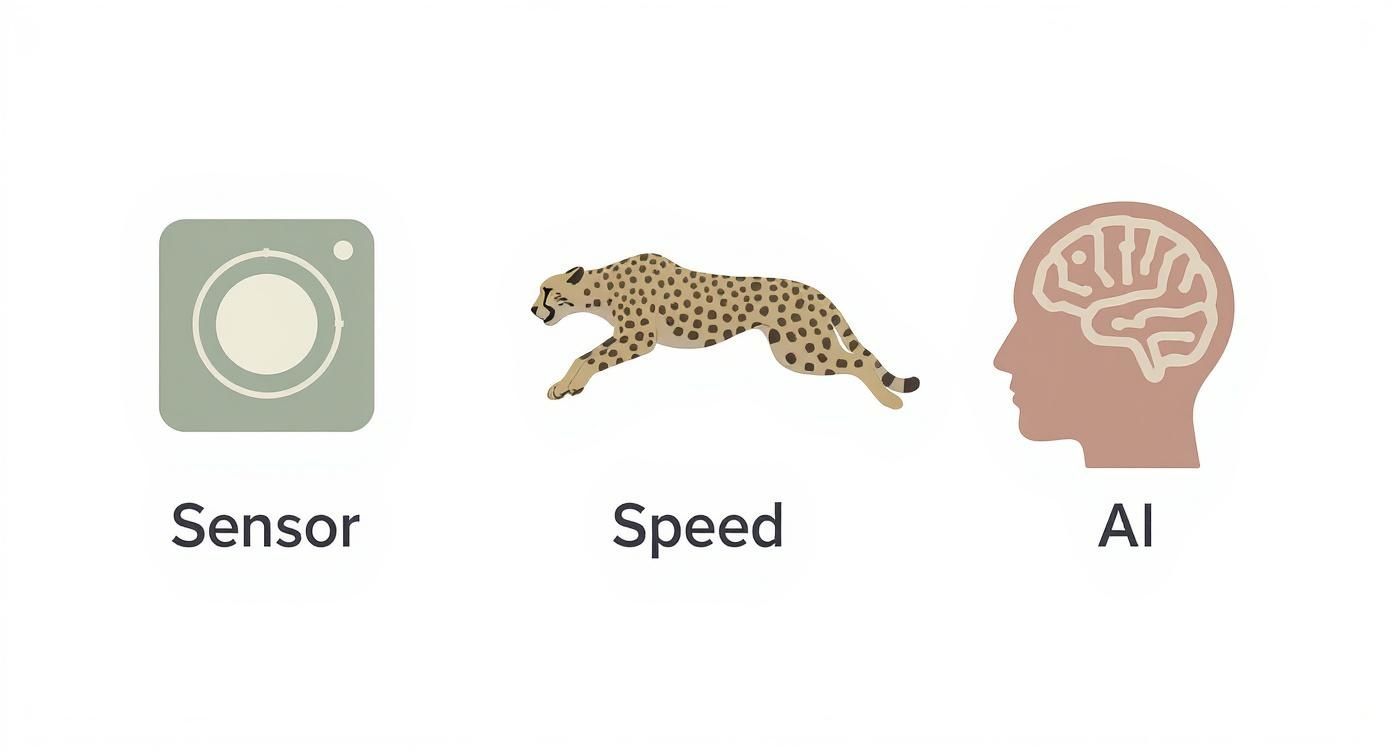
This trio—a high-quality sensor, a fast trigger, and smart AI—is what separates a simple camera from a truly effective field intelligence tool.
Scenario 3: The Multi-Purpose Property
If you're a serious hunter or landowner managing a larger property with different kinds of terrain, your needs get a lot more complicated. You need a camera that’s versatile enough for a food plot, tough enough for a creek bottom, and smart enough to filter out raccoons across multiple locations.
This is exactly where the Magic Eagle EagleCam 5 proves its premium-value status. Yes, the upfront cost is higher, but its advanced features are built to give you a lower total cost of ownership and far better performance over the long haul.
The EagleCam 5's strength isn't just one feature, but how its systems work together. Advanced AI species recognition drastically reduces false alerts, which directly saves battery life and data costs, while its SignalSync technology ensures it stays connected in fringe coverage areas where other cameras fail.
That integration of smart tech with tough hardware is what defines its value. It’s not just a camera; it's a complete remote scouting system that also gives you GPS anti-theft protection, live-streaming on demand, and detailed environmental data right in the app.
A Clear Look at Value
To really figure out which camera is the best for the money, you have to weigh its price against how it will perform for you. Resolution is a perfect example of this balancing act. Market analysis from 2023 showed that the 8–12 MP segment held the biggest share of the global game camera market. This tells us that most people find this range delivers excellent image quality without the high price of bigger megapixel counts. You can explore more about these market trends and what they mean for buyers.
To make it even clearer, here’s a direct comparison of the trade-offs.
Head-to-Head Value Comparison of Leading Game Cameras
This side-by-side analysis cuts through the marketing to focus on what matters: which camera delivers the most value for your specific hunting or wildlife monitoring goals.
| Model | Type | Price Range | Key Value Proposition | Best Use Case |
|---|---|---|---|---|
| Browning Dark Ops Pro | Standard (Non-Cellular) | $ | Ultimate stealth with no-glow flash and dual lenses for crisp day/night images. | High-pressure hunting spots on easily accessible land where silence is golden. |
| Tactacam Reveal Pro | Cellular (Mid-Range) | $$ | Reliable cellular performance and good image quality at an accessible price point. | Monitoring remote food plots or travel corridors where regular access is difficult. |
| Magic Eagle EagleCam 5 | Cellular (Premium-Value) | $$$ | Advanced AI, superior connectivity, and a robust app for a lower long-term cost. | Serious hunters and land managers who need maximum reliability and efficiency. |
At the end of the day, the best game camera for the money is the one that fits your scouting strategy and your property. The budget-friendly Browning gives you unmatched stealth for close-quarters hunting. The Tactacam offers a dependable cellular link for remote spots without emptying your wallet. And the Magic Eagle EagleCam 5 delivers a fully integrated, intelligent system for those who demand the highest level of performance and long-term efficiency.
A Deep Dive Into the Magic Eagle EagleCam 5
Mid-range cellular cameras are a great way to get into remote scouting, but serious hunters and land managers eventually hit a wall. For anyone who needs peak performance and can't afford gear failure, the conversation around the best game camera for the money isn't about the initial price tag. It's about the total cost of ownership.
This is exactly where the Magic Eagle EagleCam 5 carves out its niche. It justifies a higher upfront cost with smart features designed to save you money, time, and headaches over the long haul.
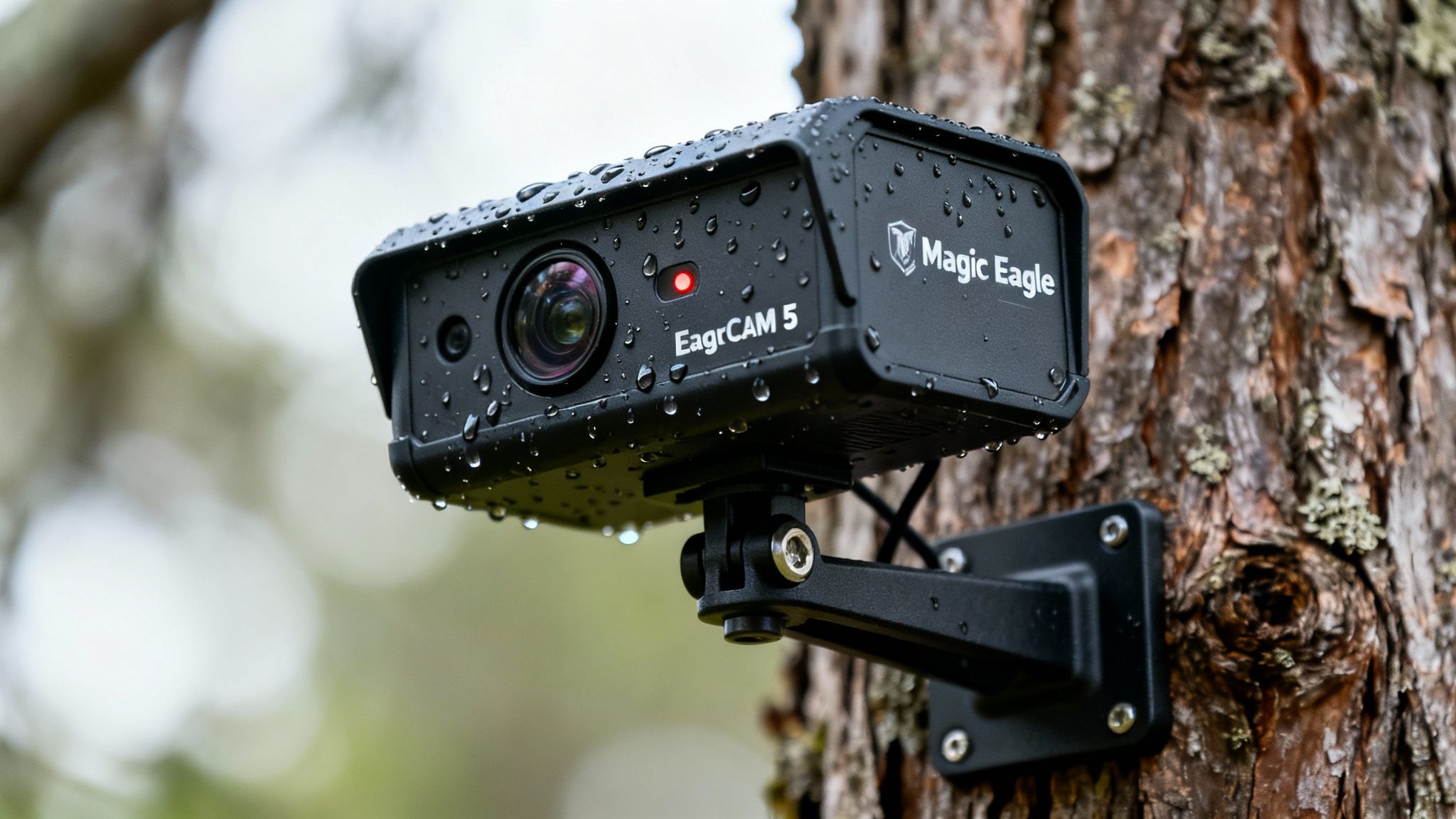
Let's look past the spec sheet and see how its integrated systems deliver a real return on investment. The EagleCam 5 isn't just a box of parts; it's a scouting tool where every feature makes the others work better.
Intelligence That Pays for Itself
The real value of the EagleCam 5 starts with its AI-powered species recognition. Cheaper cameras with basic motion sensors are famous for blowing up your phone with hundreds of false alerts from swaying branches or squirrels. Every one of those false triggers drains your battery and chews through your data plan, creating hidden costs that add up fast.
The EagleCam 5’s AI is the gatekeeper. It accurately filters out non-target species and environmental "noise," so you only get notifications that actually matter. This has a huge ripple effect on its long-term cost:
- Reduced Data Waste: Your data plan is spent sending you pictures of deer or turkey, not the tenth photo of a raccoon at your feeder.
- Extended Battery Life: Fewer transmissions mean less power consumption, stretching the time between battery swaps or recharges by weeks or even months.
- Saved Scouting Time: You're not wasting hours sifting through junk photos. You're analyzing real animal behavior.
This kind of intelligent filtering is the perfect example of a premium feature that directly cuts your running costs and makes your scouting far more efficient.
Built for the Realities of the Field
Durability is another place where spending more upfront saves you money later. A camera that dies mid-season is worse than useless—it's a liability. The EagleCam 5 is built with a tough, weatherproof housing meant to handle everything from sub-zero cold to blistering summer heat. That rugged construction means it'll be a reliable tool for years, saving you the cost of replacing cheaper, flimsy units season after season.
The EagleCam 5’s design philosophy is clear: solve the most common points of failure for serious users. Its efficient power management, intelligent AI, and rugged construction work in concert to deliver a lower total cost of ownership, making it a smarter long-term investment.
Its connectivity is another huge differentiator. The camera's SignalSync technology automatically finds and locks onto the strongest cell network available. That’s a game-changer in remote spots with spotty coverage. This reliability means you get intel from locations where other cameras would just give up, letting you place your cameras exactly where they need to be.
A Superior User Experience
Finally, the EagleCam 5’s value is locked in by its mobile app and advanced mapping features. The app is a seamless command center for changing settings, viewing a live stream, and organizing your photos. The integrated mapping tools let you drop pins for camera locations, feeders, and key sightings, building a powerful visual database of your entire property.
This slick user experience isn't just a nice-to-have; it turns the camera from a simple picture-taker into a full-blown property management tool. The combination of hardware and software makes a strong case for the Magic Eagle® EagleCam 5 as a smart, long-term asset. When you're thinking about the best game camera for the money, it helps to know where the market stands. In 2025, the global trail cameras market hit USD 134.5 million, with North America accounting for over 40% of global revenue. That market dominance, driven by a massive hunting community and fierce retail competition, helps keep high-value options like the EagleCam 5 priced competitively.
Getting the Most Out of Your Game Camera
Buying the right game camera is a solid first step, but its true potential is only unlocked out in the field. Effective setup, smart placement, and a bit of routine maintenance are what turn a good camera into a great scouting tool. These practices are the difference between getting clear, actionable intel and sifting through thousands of useless photos.
Small tweaks in how you deploy your camera can make a massive difference. Getting these details right from the start saves you the headache of wasted battery life and frustrating return trips.
Strategic Camera Placement and Positioning
The single biggest factor for capturing great images is where you put the camera. It’s a mix of art and science—you have to think like a deer, but also like a photographer. The goal is simple: get a clear shot while cutting down on false triggers from sun, wind, and whatever else nature throws at you.
A classic mistake is facing the camera directly east or west. That alignment guarantees intense sun glare at sunrise and sunset, which washes out your images and triggers the sensor over and over. Whenever you can, aim for a north or south-facing orientation to keep the sun out of your lens.
Think about height and angle, too. Setting it at waist level (roughly three feet) is pretty standard for getting solid body shots of deer. I like to angle it down just a bit. This keeps the bright sky out of the frame and helps focus the detection zone right on the trail you're watching.
Pro Tip: Don't just set it and forget it. Before you walk away, trigger the camera yourself by walking past the detection zone. Pull up the photo on your phone to confirm the angle, height, and field of view are exactly what you want. That five-minute check can save you a whole trip back.
Fine-Tuning Settings for Your Goals
Your camera’s settings need to match your scouting goals. A one-size-fits-all approach is just plain inefficient and burns through batteries and data. Tailor your configurations to squeeze the best performance out of every situation.
- For High-Traffic Trails: You'll want a fast trigger speed (less than 0.5 seconds) and a short delay between pictures (15-30 seconds). This setup ensures you catch every animal that zips by.
- For Food Plots or Bait Sites: A longer delay (1-3 minutes) works much better here. It keeps you from getting hundreds of photos of the same doe group feeding for an hour, which saves a ton of battery and data.
- For Pre-Season Scouting: Set the image resolution to medium. It saves SD card space and cuts down on data transmission costs but still gives you enough detail to identify bucks.
- For The Rut: This is the time to switch to high-resolution video mode. Capturing buck behavior during this critical window provides intel that a static photo just can't match.
Extending Lifespan with Routine Maintenance
Let's be real—these cameras live a tough life outdoors. Proper maintenance isn't optional if you want your gear to last. A few simple routines can dramatically extend your camera’s lifespan and make sure it’s reliable when it counts.
Before you deploy it, give the camera a quick once-over. Gently wipe the lens, PIR sensor, and flash cover with a microfiber cloth to get rid of dust and water spots. Check the rubber gasket on the housing to make sure it's clean and creating a solid weatherproof seal. And here’s a big one: always format your SD card in the camera, not on a computer, to prevent file corruption.
For cellular models, managing your data plan is part of the maintenance. The real value of these cameras is tied to long-term savings on time and fuel. With the cellular game camera market projected to grow from $250 million in 2025 to $1 billion by 2033, using data efficiently is key. These devices are meant to save you trips, so optimizing your settings ensures your plan is spent on valuable intel, not pictures of swaying branches. You can read more about the growth of the cellular camera market to see just how big this is getting.
Frequently Asked Questions About Game Cameras
Even with all the details laid out, pulling the trigger on a new camera can be a tough call. Let's tackle some of the most common questions that come up when you're trying to lock down the best game camera for your money. These real-world answers should help clear up any final hesitation.
Are Cellular Data Plans A Worthwhile Expense?
It really boils down to your specific situation. This is a classic case of cost versus convenience, and there's no single right answer for every hunter.
If your cameras are on a remote lease or a piece of property that’s a pain to get to, the monthly fee is almost always worth it. Just think about what you save in gas, time, and wear and tear on your truck by not having to drive out there every few weeks. More importantly, those real-time notifications give you immediate intel—something you can’t put a price on when a target buck shows up or you need to keep an eye on things.
On the other hand, if your camera is just out in the back forty or on a local spot you visit all the time anyway, that recurring cost might be overkill. The real game-changer is finding a provider with flexible plans you can pause or scale down in the off-season. That feature alone makes a cellular camera a much smarter long-term investment.
How Many Megapixels Do I Actually Need?
It’s incredibly easy to get sucked into the megapixel marketing hype, where bigger numbers are pushed as the ultimate sign of a great camera. The truth? For most of us, the 8-12 MP range is the sweet spot, offering a perfect balance of image quality and practical value.
Real-world image clarity has far more to do with the quality of the lens and the image sensor than with raw megapixels. A camera with a top-notch 10 MP sensor will give you a sharper, more useful photo every time compared to a budget camera claiming 30 MP through digital interpolation—a process that often just blows up the image and makes it grainy. For identifying bucks and monitoring wildlife, 8-12 MP is all you need.
The most overlooked part of image quality is the sensor itself. A high-quality sensor paired with a good lens is the engine that drives clear, detailed photos, especially during those critical low-light hours at dawn and dusk when most game is on the move.
What Is The Most Overlooked Feature In A Cellular Camera?
Hands down, it's the mobile app. The quality of the companion app is the most critical—and most frequently ignored—feature of any cellular game camera. A clunky, slow, or unreliable app can turn a technologically advanced camera into a constant source of frustration.
When you're comparing your options, don't just get fixated on the camera's hardware specs. You need to prioritize an app that’s intuitive, delivers your photos and videos quickly, and gives you useful tools to manage your cameras.
Here are a few app features that provide real, tangible value:
- AI Species Tagging: Having the app automatically sort your pictures by animal type is a massive time-saver.
- Remote Settings Adjustment: The ability to tweak camera settings from your phone without going into the field is a huge plus.
- Clear Status Reporting: You need to see battery life, signal strength, and data usage at a glance.
The user experience inside the app directly shapes the camera's day-to-day usefulness. It's the command center for your entire scouting operation, so it absolutely has to be solid.
How Important Is Battery Life, Really?
Battery life is one of those practical things that directly hits your wallet and affects the camera's reliability. A camera that chews through batteries not only gets expensive to run but also forces you to increase your scent pressure in sensitive areas.
Efficient power management is the mark of a well-designed camera. Models that can run for months on a single set of batteries—or better yet, work with a solar panel—give you a serious advantage. That "set it and forget it" capability is crucial for minimizing disturbances and ensuring your camera is always ready when that once-in-a-season buck walks by. Look for cameras that run on 6 or 8 AA batteries, as this is a common and highly efficient setup.
Ready to see how an integrated scouting system can elevate your strategy? The Magic Eagle EagleCam 5 combines advanced AI, rugged durability, and a seamless app experience to deliver unmatched performance and long-term value. Explore the EagleCam 5 and transform your remote scouting today.