

Think of a trail camera that connects to your phone like a scout who never sleeps and texts you updates the second something happens. It’s a simple concept with a huge impact: you get real-time scouting intel from anywhere in the world, turning your phone into a remote command center for your hunting spot or property.
How a Trail Camera That Connects to Your Phone Works
The idea is a lot like your smartphone. When you take a picture and text it to a friend, you're using a cellular network. A trail camera that connects to phone does the exact same thing, but it’s triggered by motion out in the woods. It's your self-sufficient set of eyes that reports back instantly.
The process is surprisingly straightforward. When a deer, trespasser, or other animal moves past the camera's sensor, it wakes up and snaps a picture or records a video. But instead of just saving that file to a tiny SD card, the camera’s internal cellular modem—just like the one in your phone—compresses the file and sends it over a 4G network.
From the Field to Your Fingertips
Once sent, the image zips through the cellular network to a secure cloud server. That server immediately pushes a notification to your phone through a dedicated app, like the one for the Magic Eagle EagleCam 5. Open that notification, and the app pulls the image right from the cloud. Just moments after the trigger, you're seeing what's happening.
This instant communication is what makes these cameras such a game-changer. You no longer have to physically hike into your camera's location, which saves a ton of time, cuts down on human scent you leave behind, and gives you immediate alerts for security. To get into the nitty-gritty, check out our guide on how cellular trail cameras work.
This instant feedback loop has completely changed modern scouting. It’s no longer about checking cameras once a week; it’s about getting a live stream of information that helps you make smarter, faster decisions out in the field.
It's no surprise that the demand for this technology is exploding. The global trail camera market hit USD 125.7 million in 2023 and is on track to reach USD 211.3 million by 2033. A huge part of that growth comes from big-game hunters in the U.S. and Canada who rely on these cameras to pattern whitetail deer across vast properties without constantly disturbing the area. You can dive deeper into these market trends on Grand View Research.
Choosing Between Cellular and Wi-Fi Connectivity
When you’re looking at a trail camera that connects to your phone, the biggest decision you'll make is how it sends you those images. Your choice really boils down to two technologies: cellular and Wi-Fi. Each is built for a different job, and picking the right one is the key to getting the results you need.
Think of it this way: a cellular camera is like its own independent smartphone. It has a built-in modem and works anywhere you can get a cell signal, making it the perfect tool for scouting deep in the woods or keeping an eye on a large, sprawling property. It doesn’t need any outside network to do its job.
On the other hand, a Wi-Fi camera is more like a laptop that needs a home internet connection. It has to be within range of a router to send photos and videos, which makes it a great choice for watching wildlife in your backyard or monitoring a shed just a stone's throw from your house.
This simple flowchart shows exactly how a cellular camera captures an image, sends it out, and delivers it right to your device.
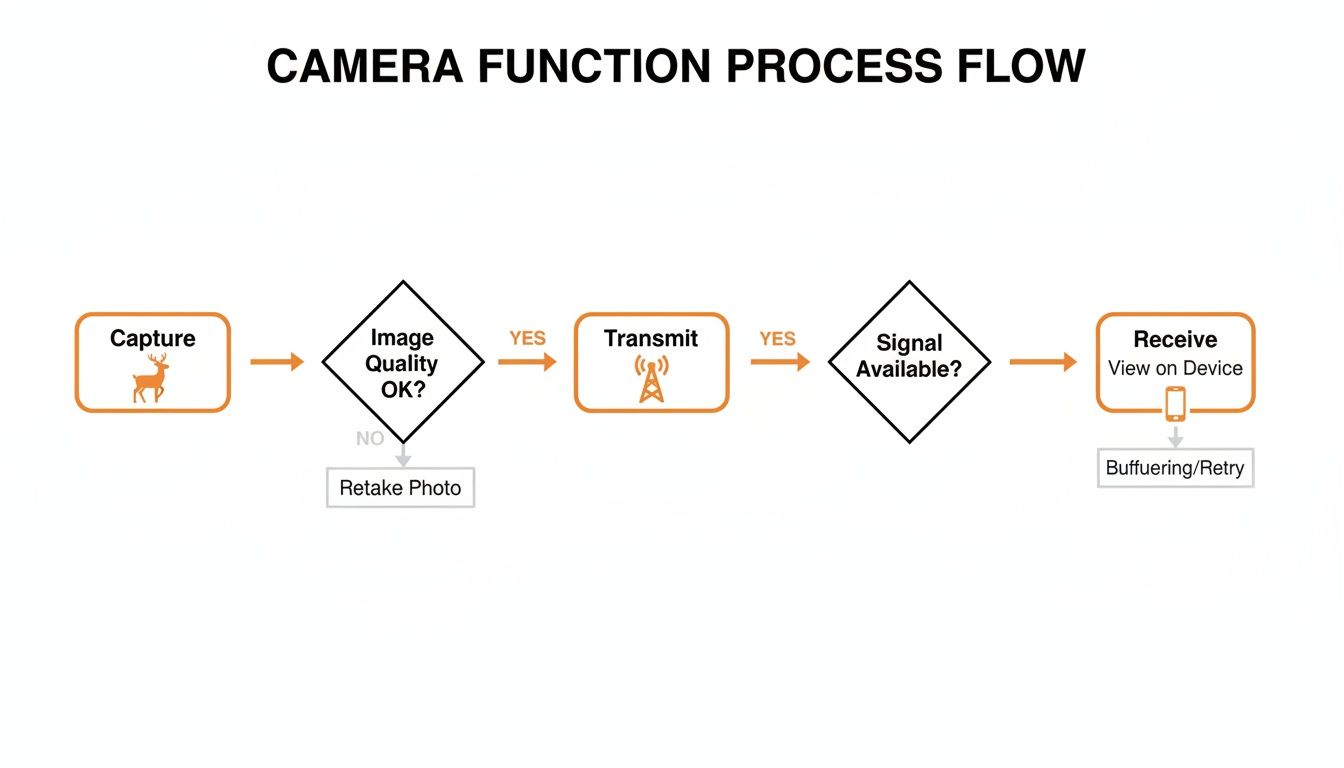
As you can see, the camera is a self-contained unit. It relies only on a cellular network to bridge the gap between the field and your phone.
Comparing Key Differences
To make the best call, it helps to put the two technologies side-by-side. The right camera for a hunter tracking deer a mile from the nearest road is going to be completely different from what someone watching a bird feeder needs.
Here's a direct comparison of the core features to help you decide.
Connectivity Comparison: Cellular vs. Wi-Fi Trail Cameras
| Feature | Cellular Trail Camera | Wi-Fi Trail Camera |
|---|---|---|
| Operational Range | Virtually unlimited, anywhere with a cell signal. | Limited to the range of a Wi-Fi router (typically 50-200 feet). |
| Ideal Use Case | Remote hunting properties, large farms, off-grid security. | Backyard monitoring, home security, areas near a cabin or house. |
| Ongoing Costs | Requires a monthly or annual data plan. | No data plan fees; uses your existing internet service. |
| Setup Complexity | Simple in-app activation, no router pairing needed. | Requires connecting to a Wi-Fi network and password entry. |
For any kind of serious remote scouting, cellular connectivity is the clear winner. The Magic Eagle EagleCam 5, for example, was built for exactly this purpose, giving you reliable image transmission from places where Wi-Fi isn’t even a distant possibility.
Making The Right Decision For Your Needs
Ultimately, the choice comes down to one thing: distance. If your camera will be set up beyond the reach of your home or cabin’s Wi-Fi signal, a cellular model isn’t just your best option—it’s your only one.
For these situations, getting a handle on data usage is essential. Our comprehensive guide on trail camera cellular plans breaks down how to pick the right package for your activity level.
The core advantage of a cellular camera is freedom. You are not tied to any physical infrastructure like a router, giving you the power to place your eyes exactly where you need them most, no matter how remote.
This lines up with bigger shifts in mobile technology. For instance, emerging eSIM adoption trends point toward more integrated and flexible connectivity for all kinds of devices. For hunters and landowners, this means even easier and more powerful remote camera management is on the horizon.
So, if your needs are strictly close-range, Wi-Fi is a solid, cost-effective solution without recurring data fees. But for true remote intelligence, cellular is the undisputed standard.
Essential Features for Remote Scouting Success
A modern trail camera that connects to phone is a whole lot more than just a camera that takes pictures in the woods. The features packed inside are what really separate a simple gadget from a powerful, reliable scouting tool that gets you real results. Understanding this tech is the key to picking a camera that won’t let you down when you’re miles away from your hunting spot.
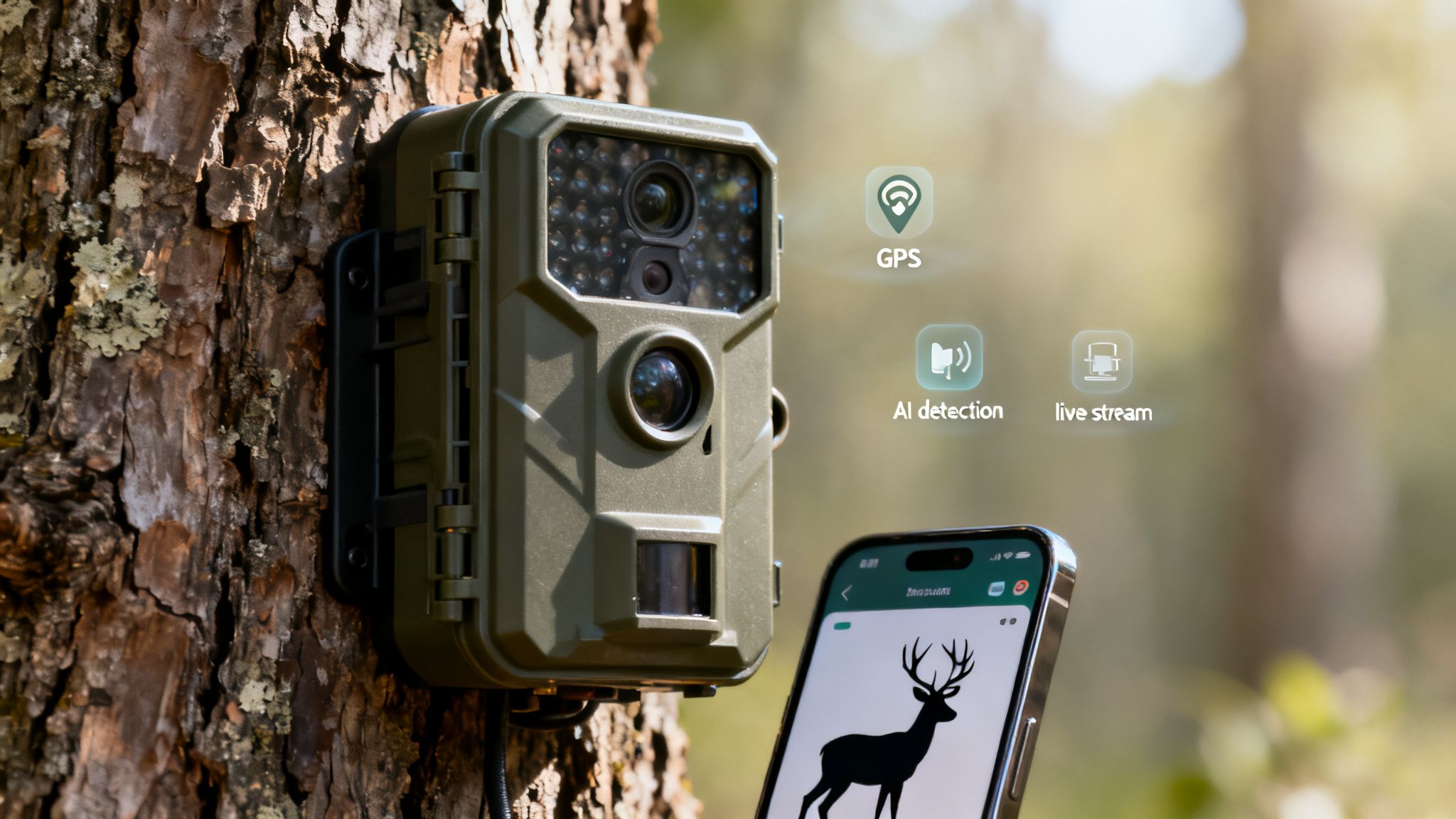
True remote success is built on smart, practical features that save you time and give you deeper insights into what's happening on your property. Without them, you're just getting snapshots; with them, you’re gathering intel you can actually act on.
Smart Technology That Works for You
The best connected cameras use advanced software to solve the most common frustrations out in the field. Instead of spending hours sorting through hundreds of photos of swaying branches or squirrels, you can lean on AI-powered species recognition. This tech acts like a digital gatekeeper, automatically identifying animals and filtering out the junk. For example, the Magic Eagle EagleCam 5 uses its AI to slash these useless notifications by up to 80%, making sure your phone only buzzes when something important is happening.
On top of that, the top-tier cameras give you on-demand control and information right from your phone:
- Live-Streaming Video: This is a game-changer. It lets you tap into a live feed from your camera at any moment, perfect for confirming if that big buck is still hanging around or just checking feeder levels without spooking everything on your way in.
- Integrated GPS Tracking: A built-in GPS is your ultimate anti-theft tool. It maps your camera's exact location, making it a breeze to manage multiple units and absolutely crucial for getting it back if it's ever moved or stolen.
The whole point of these modern features isn’t to add complexity; it’s to deliver simplicity and confidence. Smart tech should make scouting easier and more effective, automating the boring stuff so you can focus on your strategy.
Reliability Where It Counts Most
Even the fanciest features are worthless if your camera can't get a signal. In remote areas, cell service can be spotty and unpredictable, to say the least. This is where a feature like the SignalSync technology in the EagleCam 5 becomes so valuable. It automatically scans for and locks onto the strongest available network, dramatically improving the odds that your camera stays online and keeps sending you updates.
This demand for reliability and smart functionality is driving huge growth in the market. Projections show the trail camera market is expected to jump from USD 122.54 million in 2025 to USD 243.32 million by 2035. This surge is being pushed by wildlife professionals and serious hunters who need tools they can depend on. In fact, field biologists using cameras with GPS and anti-theft features have recovered 90% of stolen units and logged 45% more unique animal sightings. You can dig into more of these industry trends at Fundamental Business Insights.
At the end of the day, a truly effective trail camera combines intelligent software with rugged, dependable hardware to give you a complete remote scouting solution you can trust.
Real-World Strategies for Connected Cameras
The true power of a trail camera that connects to your phone isn't on a spec sheet—it's what happens out in the field. These aren't just remote cameras; they're strategic tools that deliver real intelligence, completely changing the game for hunters, researchers, and landowners.
When you move past simple photo collection, you start building a dynamic, living picture of what’s happening on your property. Let's look at how these smart features translate into better outcomes.
For the Whitetail Hunter
A seasoned whitetail hunter doesn't just check cameras anymore; they build a living strategy map right on their phone. Using an app, they can drop a pin for every camera location. When a mature buck finally shows up, it's not just a photo—it's a critical data point.
They can tag that specific buck, note the exact time, and see its location on their map. Over a few weeks, a clear story emerges, showing the buck’s travel patterns between his bedding area and his favorite food source. Scouting transforms from a guessing game into a precise, data-driven plan for opening day.
For the Wildlife Biologist
Imagine a wildlife biologist tracking an elusive wolf pack in a remote wilderness. Physically checking cameras is disruptive and, frankly, can be dangerous. Instead, they deploy a fleet of cellular cameras across the pack's territory.
These cameras do more than just snap static images. A biologist can use live-streaming to watch critical pack behaviors—like interactions at a den site—in real time, without ever leaving the research station. This delivers priceless, undisturbed behavioral data that is absolutely crucial for conservation.
For the Rancher and Landowner
For a rancher, a connected camera is the ultimate security guard. They can set up virtual geofences around property lines, gates, or fuel tanks. The second a vehicle or person crosses that line, an instant motion alert hits their phone.
This allows for immediate action, whether it's calling the authorities or just heading out to see what's going on. This kind of proactive security is making a real difference.
Industry reports show that landowners using motion-triggered alerts sent to their phones have cut trespassing incidents by as much as 28%. And it’s not just about security—hunting outfitters using live-stream cameras for pre-scouting report a 35% increase in client success rates because they can pinpoint game activity right before a hunt.
These aren't just neat features; they're investments in efficiency and success. To see how this technology is reshaping the industry, you can dig into the full findings from 360iResearch on the trail camera market.
Field Guide to Setting Up Your Connected Camera
Getting your new trail camera that connects to phone from the box to the field should be a quick, painless process. Forget the old days of spending hours fumbling with settings. Modern cameras like the Magic Eagle EagleCam 5 are built for speed, letting you start scouting in minutes.
The secret is a simple, app-driven approach that cuts out all the old headaches.
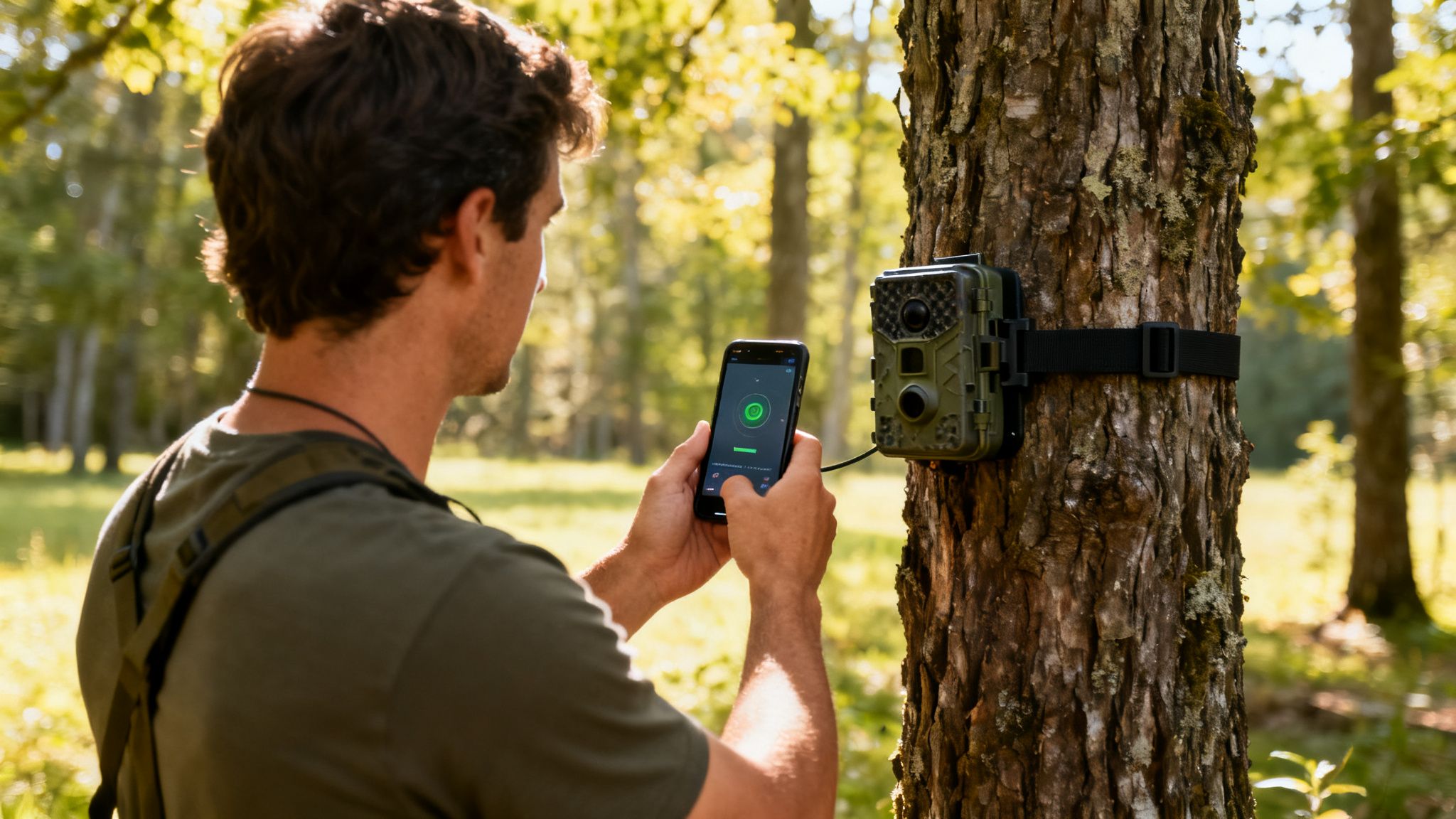
No more buying a separate SIM card and fighting with a cell provider to get it activated. The best systems have it all built-in. You just download the app, create an account, and scan a QR code on the camera to link it straight to your phone. The whole thing usually takes less than five minutes.
Optimizing Camera Placement
Where you hang your camera is just as critical as which one you buy. A little extra thought here will save you from sorting through thousands of photos of swaying branches and get you the intel you actually need.
Follow these simple rules for the best results:
- Find the Right Height: For deer-sized game, mount the camera three to four feet off the ground. This gives you a natural, broadside view. If you're using it for security, waist-height is usually your best bet.
- Angle it Correctly: Never point the camera straight down a trail. You'll miss most of the action. Instead, angle it at about a 45-degree angle to the path. This gives the sensor a wider field to detect movement and trigger a photo as the animal walks by.
- Face North or South: This is a big one. Whenever possible, point your camera north or south. Aiming it east or west means you'll get blasted with sun glare at sunrise and sunset, leading to washed-out images and false triggers.
A well-placed camera is the foundation of effective remote scouting. Taking a few extra minutes to get the height, angle, and direction right will save you countless hours of sorting through unusable photos later.
Fine-Tuning Your Settings
Once the camera is up, the last step is to open the app and dial in your settings. This is where you turn it from a simple motion detector into a truly smart scouting tool. For instance, with the EagleCam 5, you can switch on the AI-powered species recognition to tell it you only care about deer, turkey, or hogs.
This means your phone will only buzz when a target animal shows up—no more alerts for every squirrel and raccoon that wanders by. By customizing your alerts, you turn that constant stream of data into actionable intelligence you can actually use to plan your next move.
Why the Magic Eagle EagleCam 5 Excels in the Field
When your success in the woods or on your property hangs on the gear you use, you quickly learn that not every trail camera that connects to phone is created equal. The Magic Eagle EagleCam 5 really stands apart because it’s a complete solution designed and tested for the field, not just a gadget in a box. It’s built for the harsh realities of being left alone in the wild.
The difference is obvious the moment you unbox it. There are no finicky SIM cards to activate or third-party carrier plans to juggle. You activate it in minutes right from the MAGIC EAGLE app, which means you get from the house to the field in record time.
Built for Unwavering Reliability
Out in remote country, a weak signal creates a blind spot. This is exactly where the EagleCam 5’s SignalSync technology proves its worth. It automatically scans for and locks onto the strongest 4G network it can find, keeping your camera online and sending updates when other cameras would have gone silent.
That tech is wrapped in a rugged, weatherproof housing made to shrug off extreme temperatures, driving rain, and heavy snow.
This obsession with reliability carries over to security. The built-in anti-theft suite isn’t just for peace of mind; it’s a real-world defense system for your investment.
- Integrated GPS Tracking: See your camera’s exact location on a map. This is a game-changer for managing multiple units and absolutely critical if one gets stolen.
- Geofence Alerts: You set a virtual boundary. If the camera ever moves outside of it, you get an instant notification on your phone.
- Power-Off Protection: Even if a thief powers the camera down, it keeps tracking its location, which massively increases the odds of getting it back.
The EagleCam 5 was purpose-built with a simple truth in mind: a camera is only as good as its connection, its durability, and its security. Every feature is there to work when you can't be.
At the end of the day, the EagleCam 5 delivers on the promise of modern remote scouting. It brings together powerful tools like AI species recognition and on-demand live streaming, all built on a foundation of toughness and connectivity you can actually depend on. Backed by U.S.-based support, it’s a partner you can trust, whether you’re a serious hunter, a biologist, or a property manager.
Learn more about the complete feature set of the Magic Eagle EagleCam 5 and see how it’s built to excel where it matters most.
Got Questions? We’ve Got Answers.
Alright, so you’ve got the basics down on how these cameras work. But I know what it’s like—the practical, day-to-day questions are probably bubbling up. Let's tackle the most common ones head-on so you know exactly what to expect in the field.
Think of this as the stuff you'd ask a buddy who's been using these for years.
Do Cellular Trail Cameras Require a Subscription?
Yes, they all do. Just like your cell phone needs a data plan to send a text, a cellular trail camera needs one to send you photos. It’s transmitting data over a mobile network, after all.
The good news? You don't have to go stand in line at a carrier store. Brands like Magic Eagle have made this painless. They offer their own flexible, no-contract plans that you manage right from their app. You can fire it up for hunting season, pause it in the off-season, or change your plan whenever you want. No hassle, no phone calls.
How Much Data Does a Trail Camera Actually Use?
This one's simple: it depends entirely on you. How many pictures and videos are you having it send? Are they standard-res thumbnails or full-blown HD clips?
Sending a few hundred standard-quality photos uses very little data. Requesting a bunch of high-definition videos will naturally use more.
But here’s the key: most modern cellular plans aren't based on confusing gigabytes. Instead, they're structured around the number of photos you transmit. This makes it super easy to pick a plan that fits how aggressively you scout, without ever worrying about surprise bills for going over some arbitrary data limit.
Will a Camera Work if My Phone Has No Service?
Absolutely. This is a big one people worry about. Your camera's connection is 100% independent of your phone's.
Think of it this way: the camera is talking to the cell tower, and the cell tower sends the image to the cloud. Your phone just needs to connect to the internet (via its own cell signal or your home Wi-Fi) to pull that image down from the cloud.
So, as long as your camera has a signal where you placed it, it'll keep sending images. You'll get all the alerts and see the photos the second your phone gets back online.
What Is the Typical Battery Life?
Battery life is all over the map, from a few weeks to several months. It's not a simple answer because it’s heavily influenced by a few critical factors:
- Trigger Frequency: A camera on a hot scrape sending 50 pictures a day will drain batteries much faster than one on a quiet trail sending 5.
- Signal Strength: This is a silent killer. If your camera is in a fringe service area, it has to work much harder (and use more power) to send each picture.
- Temperature: Brutal cold is the enemy of all batteries. Performance can drop significantly when the temperature plummets.
My advice? Don't cheap out on batteries. Always use high-quality lithium AAs. Or, even better, hook up an external solar panel. It's a game-changer for extending your camera's time in the woods and minimizing trips out to the field.
Ready to see what you've been missing? The Magic Eagle EagleCam 5 delivers that real-time intel straight from the field to your phone. Check it out and upgrade your scouting game.