

When you hear the term "long range" trail camera, what comes to mind? For most, it's a big number on the box—a promise of seeing game from way out in a field. But in reality, a true long range camera is much more than that. It’s a specialized surveillance tool designed to detect motion, fire off a shot, and capture crystal-clear images or videos from distances of 80 feet all the way out to 120 feet and beyond.
Unlike standard models you might find on a shelf, its performance hinges on a perfect balance of three key specs: its detection range, its flash range, and its trigger speed. Get one of these wrong, and the whole system falls apart.
What Long Range Really Means for Trail Cameras
"Long range" is one of the most overused marketing terms out there. A genuinely effective camera isn’t about one standout feature; it’s about a finely tuned system where every part does its job flawlessly.
Think of it like a three-person sniper team. If the spotter, the shooter, or the person handling the night vision fails, the mission is a bust. A top-tier long range trail camera has to nail all three jobs to give you reliable intel from a distance.
This synergy is what separates professional-grade gear from the budget models that promise the world but can't deliver. And the demand for this kind of reliable, remote monitoring is booming. The global trail camera market is projected to hit over USD 211.3 million by 2032, driven by serious hunters and land managers who need high-performance, cellular-capable systems. This trend shows a clear shift away from basic cameras toward systems that actually work when it counts. You can discover more market insights from Grand View Research to see where the industry is headed.
The Three Pillars of Long Range Performance
So, how do you properly judge a camera? You have to understand its three core functions: detection, reaction, and illumination. Let's stick with our sniper team analogy.
-
Detection Range: This is the camera's ability to sense motion. Think of this as the team's spotter, whose only job is to pick up movement way across a food plot. A great detection range, often hitting 100+ feet, lets the camera "hear" that buck stepping out of the woods long before it gets close.
-
Trigger Speed: This is how fast the camera snaps a picture after it detects that motion. This is your shooter, who has to pull the trigger the instant the spotter gives the signal. A slow trigger is why you get so many photos of an empty trail where a deer just was.
-
Flash Range: This is how far the camera’s infrared flash can light up the scene for a sharp nighttime photo. This is the team's night vision operator. A powerful flash ensures that an animal spotted at 100 feet shows up as a clear, identifiable buck—not just a pair of ghostly eyes in the dark.
A camera with a 120-foot detection range but only a 60-foot flash range is a classic bait-and-switch. It can sense an animal way out there but is completely powerless to capture a usable image, leaving you with nothing but frustratingly empty pictures.
To help you remember how these specs work together, here’s a quick rundown.
The Three Pillars of Long Range Performance
| Specification | What It Measures | Why It's Critical for Long Range |
|---|---|---|
| Detection Range | The maximum distance at which the PIR sensor can detect motion. | The camera must first sense the animal to begin the capture sequence. If it can't see far, nothing else matters. |
| Trigger Speed | The time elapsed between motion detection and image capture. | A fast trigger ensures the animal is centered in the frame, not just leaving it. Crucial for moving targets. |
| Flash Range | The maximum distance the IR or white flash can illuminate for a clear night photo. | Without enough light, a long-range detection is useless. The flash must match or exceed the detection range. |
As you can see, a successful capture is a chain reaction. If one link is weak, the whole thing breaks.
The diagram below shows exactly how these three elements have to fire in sequence for you to get the shot.
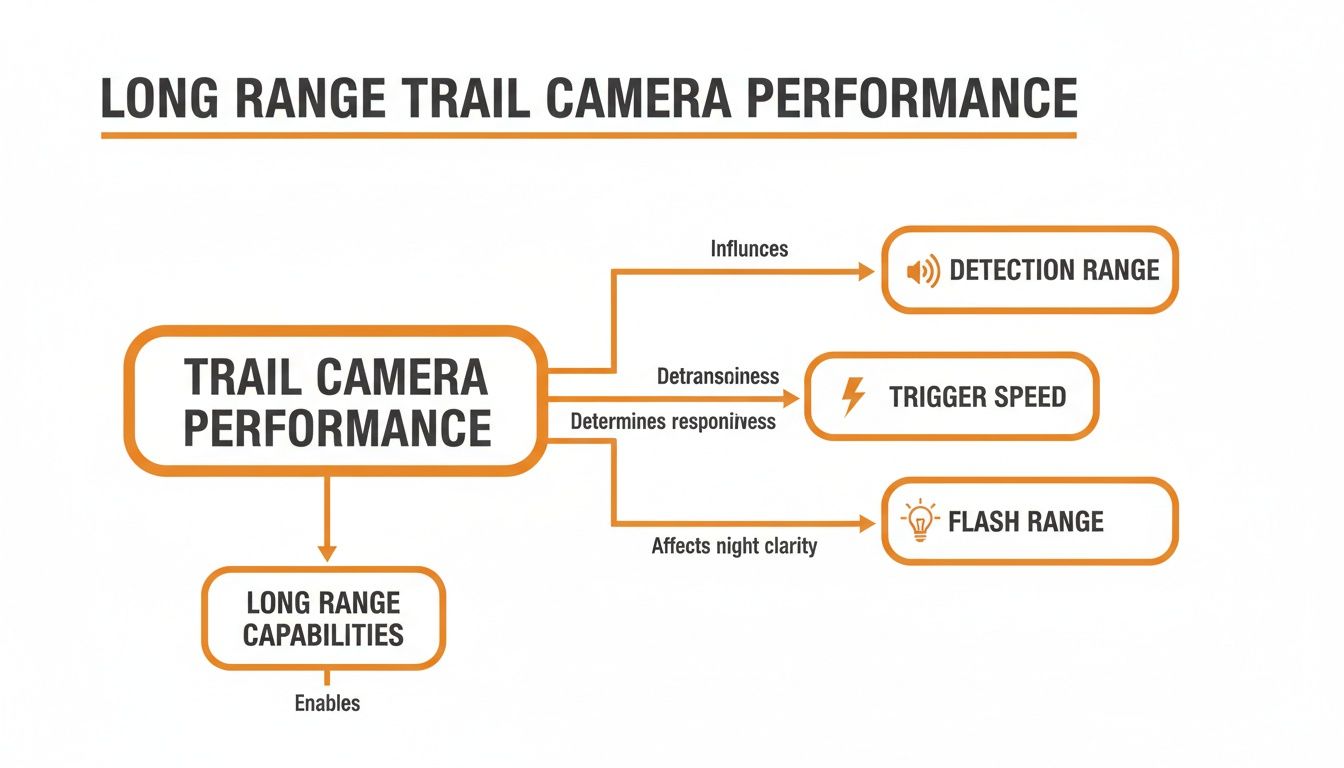
When you're shopping around, remember this: true performance isn’t defined by the biggest number on the box. It’s defined by the weakest link in this critical chain.
Unpacking the Tech Behind Long Range Performance
A true long range trail camera isn’t just a lens in a plastic box; it’s a finely tuned system where every single component has to pull its weight. Getting a grip on what’s going on "under the hood" is the only way to tell high-performance gear from slick marketing hype. Let's break down the core tech that makes these cameras tick.
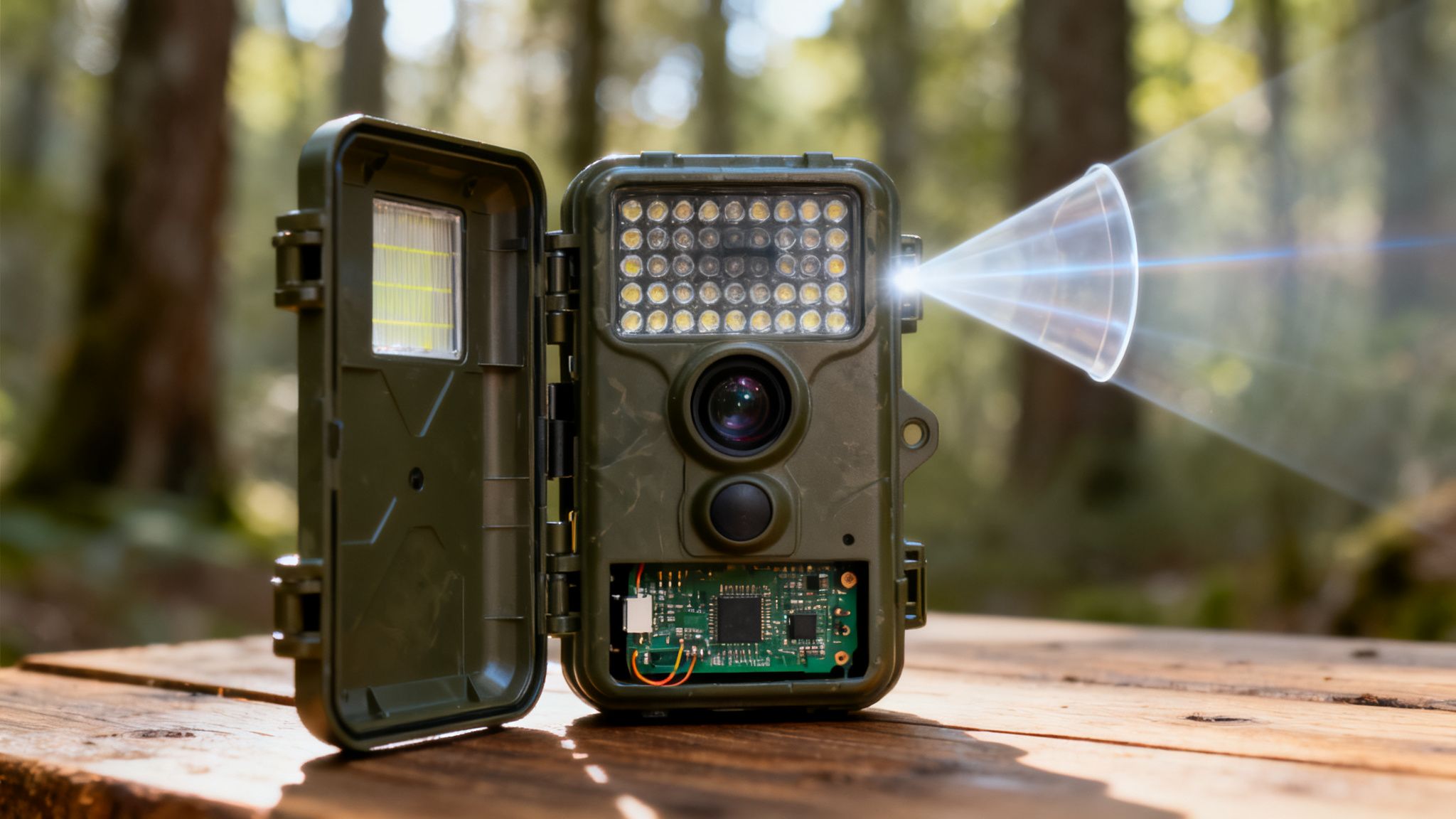
It all starts with the PIR (Passive Infrared) sensor—the camera’s silent watchman. This sensor doesn't see movement the way we do. Instead, it detects the heat signature of an animal moving against the cooler background temperature. Think of it as a motion-activated thermal scope, constantly scanning for a sudden temperature spike in its line of sight.
The Sensor: The Unseen Watcher
A PIR sensor’s reach is defined by its detection angle, which creates a cone of surveillance. The width of that cone dramatically changes how the camera performs in different settings.
- Wide Angle (approx. 50-55 degrees): This is your go-to for covering open areas like food plots or sprawling fields. It scans a broad horizontal zone, making sure nothing slips past on the edges.
- Narrow Angle (approx. 35-40 degrees): Perfect for watching a tight trail, a mineral lick, or a natural funnel. This focused beam cuts down on false triggers from windblown branches and is hyper-sensitive to movement directly in front of the camera.
For a long-range camera, a narrower detection angle is almost always better. It concentrates the sensor's power straight ahead, right where you need it most.
Illumination: No-Glow vs. Low-Glow IR Flash
Once the PIR sensor trips, the flash has to light up the scene for a clear nighttime shot. Infrared (IR) is the standard, but not all IR is created equal. The choice between No-Glow and Low-Glow is a strategic one.
No-Glow (940nm): This flash is completely invisible to both animal and human eyes. It’s the ultimate choice for pure stealth, whether you're after a wise old buck or using the camera for security. The trade-off? You’ll usually see a slight dip in flash range and overall image brightness.
Low-Glow (850nm): This version emits a faint, dull red glow when it fires. It’s a bit more noticeable, but it typically throws more light, resulting in brighter, clearer, and longer-reaching night photos. For general wildlife scouting, it's a fantastic all-around performer.
The decision is simple: if your target animal is notoriously camera-shy or you're using it for security, No-Glow is non-negotiable. For just about everything else, Low-Glow delivers a serious performance boost.
Debunking the Megapixel Myth
Hunters and camera buyers get hung up on megapixels all the time, but it’s one of the most overhyped specs out there. A high megapixel count without a quality sensor and lens is like putting budget tires on a muscle car—you’ll never actually get the power to the pavement.
What really matters are the camera's image sensor and lens quality. A top-tier sensor gathers more light and detail, while a high-quality glass lens keeps things sharp and clear. A camera with 8-12 megapixels and a great sensor will consistently smoke a 30-megapixel camera that has a cheap plastic lens, especially when the sun goes down.
If you want to dive deeper into getting the most from your gear, check out our guide on choosing the best 4G trail camera for your needs.
Trigger and Recovery Speed
At the end of the day, none of this matters if the camera is too slow to react.
- Trigger Speed: This is how fast the camera snaps a picture after the PIR sensor detects motion. Imagine a buck walking across a trail at 100 feet. Anything slower than 0.5 seconds and you might just get an empty frame. The best models are lightning-fast, with trigger speeds down to 0.2 seconds.
- Recovery Time: This measures how quickly the camera can take a second photo. A fast recovery (under 1-2 seconds) is absolutely essential for getting follow-up shots of a buck chasing a doe or capturing multiple animals in a group.
A blazing-fast trigger and recovery mean that when your sensor does its job, you get the shot—not just the tail end of it.
Choosing Your Connection: Cellular vs. SD Card Models
So you've found the perfect remote spot for your long range trail camera. Now for the biggest decision you'll make: how will you get the intel it captures? This is where you choose between a classic SD card model and a modern cellular camera.
This isn't just about convenience. It fundamentally changes how you scout, protect your land, and react to animal behavior in real time.
Imagine you're managing a food plot a two-hour drive away. With a standard SD card camera, you're flying blind for days, maybe even weeks. A monster buck could be hitting that plot every morning, but you won't have a clue until you hike in, spread your scent everywhere, and finally pull the card. By then, the information is old news.
A cellular camera flips that script entirely. It's your scout in the field, sending photos and videos straight to your phone moments after they happen. That same buck shows up at dawn, and your phone buzzes before you've finished your first cup of coffee. This isn't historical data; it's real-time, actionable intelligence.
The Value of Immediate Information
The real game-changer with a cellular trail camera is timeliness. That immediate feedback loop lets you make smarter, faster decisions.
- Patterning Animals: You can lock onto a buck's patterns the day they start, not two weeks later. This lets you plan your hunt with surgical precision, moving in only when the wind is perfect and he's on a predictable schedule.
- Property Security: Get instant alerts if a truck or a trespasser shows up on your land. Now you have a chance to react immediately, not after the damage is done.
- Feeder and Bait Management: Know the minute your feeders are running low or when a new bear has found your bait site—all without making extra trips that contaminate the area with human scent.
This instant access is why cellular models have become non-negotiable for serious hunters and land managers. The market shows it, too. While there's still a place for entry-level cameras, the premium end is dominated by cellular units built for people who demand dependable results in the field.
The real power of a cellular long range trail camera isn't just seeing what was there. It's knowing what's happening right now, giving you a massive strategic advantage.
Balancing Cost and Performance
Of course, this kind of power comes with a few things to consider. An SD card camera is a one-and-done purchase. Cellular cameras, on the other hand, require an ongoing data plan subscription to send you anything. The good news is these plans are usually flexible, letting you pay monthly or annually based on how many photos and videos you expect to get.
Another key factor is battery life. Pushing images and videos over a cellular network definitely uses more juice than just saving them to a card. But top-tier models have this figured out. They use hyper-efficient electronics and are almost always compatible with external solar panels or battery boxes, letting you deploy them for months without a single maintenance trip.
Finally, there's the signal issue. Early cellular cameras were basically useless if you didn't have great service. Today's best cameras feature multi-carrier technology. These brilliant systems automatically scan for the strongest signal from major carriers like Verizon or AT&T and lock onto it, making them far more reliable in those remote, spotty-service locations we all hunt.
And no matter what, always pair your camera with a high-quality memory card. It's your foolproof backup. Choosing the right one is critical, and you can see our top picks in this guide on the best SD card for your trail camera to make sure you never miss a shot.
Mastering Field Placement and Concealment
Even the most advanced long range trail camera is just a piece of plastic and circuitry until you put it in the right spot. Mastering placement is the real art of remote scouting—it’s where your technology meets true woodsmanship. It’s all about thinking like the animals you’re after and using the terrain to your advantage to get consistent, high-quality intel.
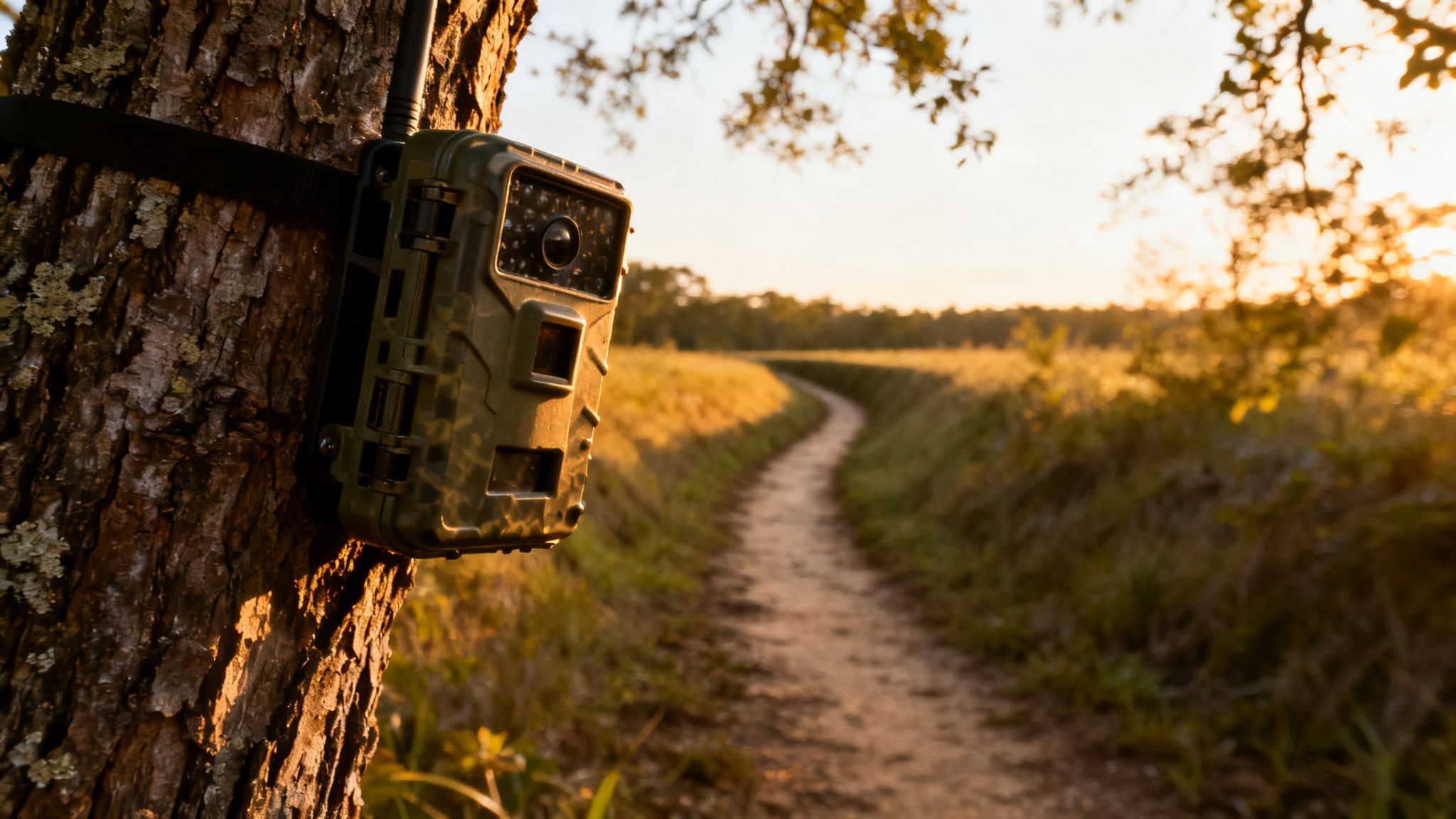
The first move is to pinpoint natural funnels where wildlife is forced to travel. These are the high-traffic intersections of the woods, and they are absolute goldmines for camera placement. Don't just look for a single trail; you need to see the bigger picture.
Identifying High-Probability Locations
To really stretch your camera's long-range legs, you need to find spots where animals feel comfortable and move predictably. Start by scouting for these key landscape features:
- Saddles and Benches: Deer and other game almost always take the path of least resistance when moving between ridges. A saddle or a flat bench halfway up a steep hill creates a natural superhighway.
- Inside Corners of Fields: Animals love using the inside corners of fields as entry and exit points. It gives them a concealed route into open areas. Set your camera watching these corners from a distance to catch them staging before they step out.
- Water Crossings: Creek and river crossings are fantastic because they concentrate movement, forcing animals through a very specific, narrow spot. These are exceptional locations, especially when it gets dry.
Once you’ve found a promising area, the real work begins. Now you have to position the camera to avoid the thousands of "empty" photos that will drain your batteries and fill your SD card.
The goal of smart camera placement is simple: capture more target animals and fewer pictures of swaying branches and the rising sun. Every false trigger is a drain on your battery and a distraction from the real intel.
This means you have to be strategic about where that lens is pointing. A few simple tweaks can make a world of difference in what you capture.
Optimal Camera Height and Angle
The height and angle of your camera are just as critical as its location. Nail these two things, and you’ll capitalize on the entire detection zone while avoiding spooking wary animals.
For whitetail deer and similar-sized game, a mounting height of 3 to 4 feet is the go-to standard. This puts the camera around the animal’s eye level, giving you a natural perspective and making it less likely to be noticed. But if you find that deer are still picking it off, try raising it to 6 or 7 feet and angling it down slightly. This gets it completely out of their direct line of sight.
Angle is everything for maximizing detection. Always aim the camera at a 45-degree angle to the trail you’re watching. This gives the PIR sensor more time to "see" the animal as it moves across the detection zone, making sure the trigger fires when the animal is perfectly centered in the frame. Pointing a camera straight down a trail is a classic rookie mistake that usually gets you nothing but the tail end of a fast-moving deer.
Common Placement Mistakes to Avoid
Even seasoned hunters make simple mistakes that can torpedo their scouting efforts. Sidestep these common pitfalls, and you'll see a massive improvement in your camera’s performance.
- Facing East or West: Never, ever point your camera directly into the rising or setting sun. That direct sunlight will cause nasty glare and "sun spots," triggering countless false photos and washing out any real images you manage to get. Always face your camera north or south.
- Ignoring "Shooting Lanes": Small branches, tall weeds, and leaves blowing in the wind are the #1 cause of false triggers. Before you walk away, take a minute to clear any moving vegetation from the camera's immediate field of view.
- Choosing the Wrong Tree: Don't just slap your camera on any old tree. Pick one that is large and sturdy enough that it won't sway in the wind, which can trigger the motion sensor. Also, make sure it provides some natural cover to help blend the camera in. Mounting options can greatly expand your choices, and you can explore different setups in our guide on trail camera stands and mounts.
- Forgetting Scent Control: Treat every trip to your camera like you're heading to your stand for a hunt. Wear gloves, don't touch the camera with your bare hands, and be mindful of the scent you leave behind. A mature buck can easily connect human odor with that camera and start avoiding the area completely.
Exploring Advanced Trail Camera Features
Today's top-tier cameras aren't just taking pictures anymore; they're powerful intelligence-gathering tools, loaded with features that would have sounded like science fiction just a few years back. These are the capabilities that separate a professional-grade long range trail camera from the rest of the pack, turning it into a scout that works for you 24/7.
They do more than just snap a photo. They analyze data, protect your investment, and give you a level of situational awareness that used to be impossible.
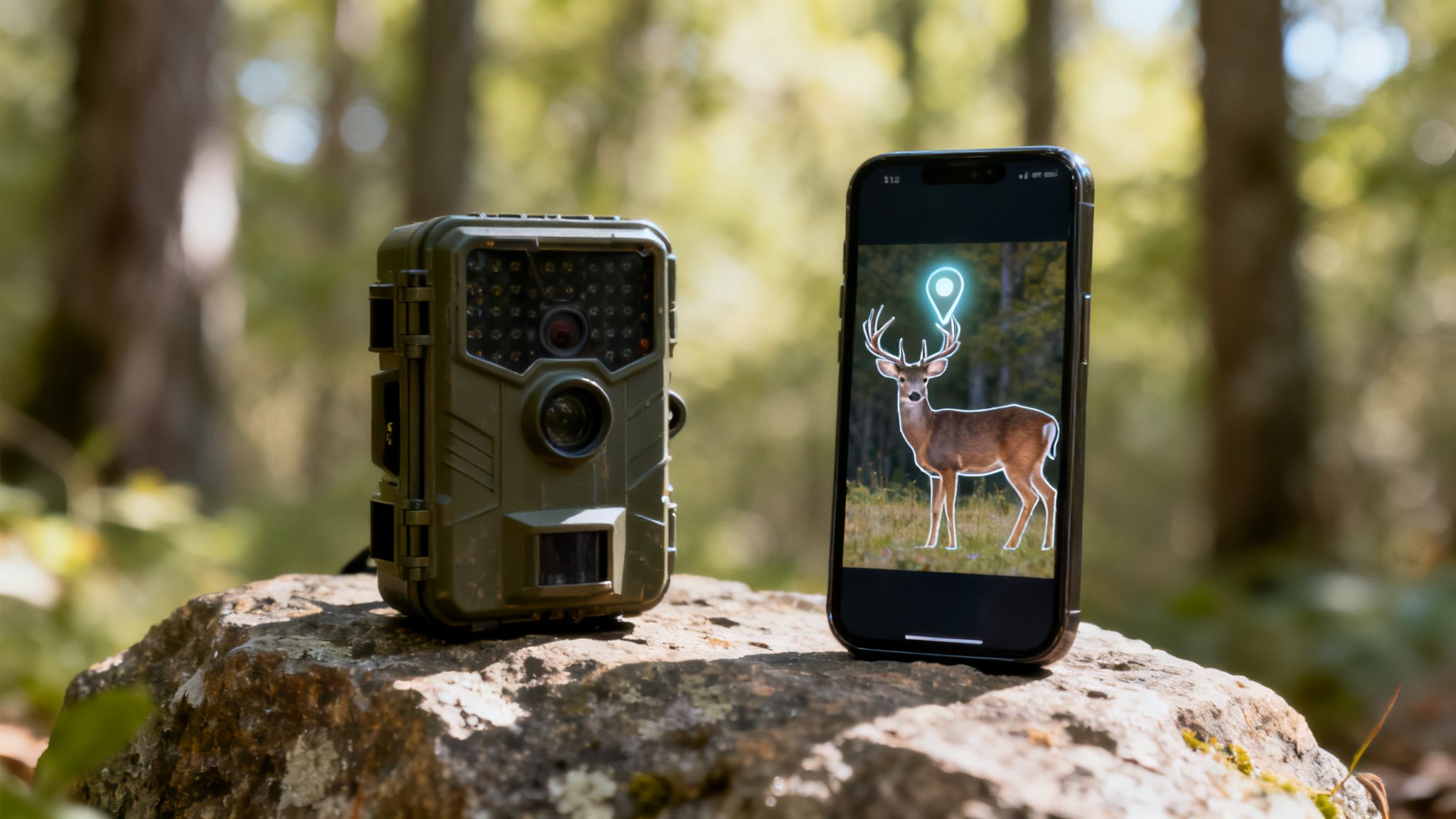
Let's dive into the technologies that are genuinely changing the game.
AI Species Recognition and Smart Filtering
One of the biggest headaches with any trail cam is the sheer volume of photos you have to deal with. For every shot of that target buck, you might get a hundred pictures of a nosy squirrel, a passing raccoon, or just a branch blowing in the wind. This is where Artificial Intelligence completely changes things.
Modern cameras with AI species recognition act like a digital assistant, automatically identifying and tagging what’s in your photos. Instead of manually sifting through hundreds of images, you can instantly filter your gallery to show you only "deer" or "turkey," saving you countless hours. You get to spend your energy on strategy, not sorting through junk photos.
Even with these smart features, sometimes a great photo just needs a little touch-up. Tools like an AI Photo Enhancer can help sharpen details and bring out the best in your captures.
GPS Anti-Theft and Geofencing
A high-quality cellular trail camera is a serious investment, and leaving it out in the woods always comes with a bit of risk. That’s why advanced security features are non-negotiable for anyone who takes this seriously. The most powerful of these is GPS tracking.
- GPS Tracking: This feature embeds a GPS chip inside the camera, letting you see its exact location on a map in your app. If a thief decides to grab your gear, you can track its movement in real time.
- Geofencing: Think of this as an invisible fence around your camera. If the camera moves outside this pre-set area, you get an instant alert on your phone, letting you know something's wrong.
- Power-Off Protection: The best systems keep reporting their location—and can even snap a photo of the thief—even if the device is turned off. This makes it a much less appealing target from the start.
These security measures do more than just help you get your gear back. Their very existence is a powerful deterrent, making thieves think twice before messing with your camera.
Live Streaming and Integrated Data
Beyond just passively sending you photos, the latest cameras offer active, on-demand intelligence that can completely change how you hunt or manage a property.
On-Demand Live Video Streaming is a groundbreaking feature. With just a tap in your app, you can pull up a live video feed from your camera's location. It’s perfect for watching a food plot as the sun sets or checking on a feeder without ever leaving your truck and disturbing the area.
But it gets even better. Premium cameras now integrate with powerful mapping and weather data. Your app can overlay wind direction, barometric pressure, and weather forecasts right onto your property map. When you combine this info with your AI-tagged animal sightings, you can start to predict animal movement with incredible accuracy. This gives you a massive advantage when planning your next move.
Your Essential Long Range Trail Camera Buyer's Checklist
You've got the theory down and you know the tech. Now comes the hard part: making a decision. Sifting through all the different specs and features to pick the right long range trail camera can feel like a chore, but it doesn't have to be.
This checklist cuts straight to the point. It’s designed to help you slice through the marketing hype and judge any camera on what actually matters out in the field. Think of it as your final sanity check before you pull the trigger, making sure the camera you buy will deliver the goods for seasons to come.
Core Performance Specs
These are the fundamentals, the absolute non-negotiables. If a camera can't get these right, no fancy bells and whistles will save it. This is the engine—it has to be strong and reliable.
- Detection Range: Can it sense movement out to at least 80 feet? The best models will push that to 100-120 feet. A "long range" camera that can't detect a deer at distance is just a fancy paperweight.
- Flash Range: Does the flash have the muscle to match or even beat the detection range? A sensitive sensor is useless if the flash can't light up what it sees for a clear nighttime photo.
- Trigger Speed: Is it 0.5 seconds or faster? Any slower and you’ll be looking at a lot of empty pictures, especially on a trail or field edge where animals are just passing through.
- Flash Type: Are you looking at No-Glow or Low-Glow infrared? Go with No-Glow for maximum stealth in those high-pressure hunting spots or for security use. Low-Glow, on the other hand, often gives you brighter, sharper images at the farthest distances.
Connectivity and Power
A camera is only as good as its ability to stay online and powered up. If it's dead or offline, it's not giving you any intel.
- Cellular Capability: Does it have solid 4G cellular service? Look for models with multi-carrier technology that automatically picks the strongest signal. This is a game-changer for remote properties where one carrier might be spotty.
- Data Plans: How flexible are the data plans? You want options that don't chain you to a long, expensive contract you can't get out of.
- Battery Life: What’s the real-world battery performance? Even more important, can you hook it up to an external power source like a solar panel or a battery box? For long-term sets, this is a must.
Never underestimate the importance of brand reputation. A solid warranty, responsive U.S.-based customer support, and a deep knowledge base of articles and tutorials are strong indicators that a company stands behind its product and is invested in your success.
Advanced and Usability Features
This is where a good camera becomes a great one. These features are designed to save you time and give you a real strategic edge.
- AI Species Recognition: Does it automatically sort your photos by animal? This is a massive time-saver that lets you ignore the squirrels and focus right on your target species.
- GPS Anti-Theft: Is there GPS tracking and geofencing built-in? This is your insurance policy against theft and a must-have for protecting your investment.
- App Quality: How good is the mobile app? A buggy, confusing app can sour the whole experience. Check for useful extras like interactive maps and weather data overlays that make scouting more efficient.
By running through these key points, you can confidently compare different models and find the long range trail camera that’s a perfect fit for what you need to do.
Common Questions About Long Range Trail Cameras
Diving into high-performance trail cameras can bring up a lot of questions. Whether you're a seasoned hunter dialing in your scouting strategy or just trying to keep an eye on a remote piece of land, getting clear answers is what matters.
This section tackles the most common things we hear from folks trying to get the most out of a long range trail camera. Let's cut through the noise.
How Far Can These Things Really See at Night?
A true long range trail camera should have a night vision, or flash range, of 80 to well over 100 feet. But the usable range—where you get a clear, identifiable image—really comes down to the type of infrared flash it’s using.
No-Glow IR flashes are completely invisible to game and people, but you might give up a bit of distance and brightness at the far end of their range. On the other hand, Low-Glow IR flashes, which give off a faint red glow, often punch out brighter and sharper images at those longer distances.
The Bottom Line: If you need maximum clarity pushing 100+ feet in total darkness, a Low-Glow flash is usually your best bet. For absolute stealth around spooky bucks or for security, No-Glow is the only way to go. Always check the manufacturer's specs and, more importantly, look for real-world photo examples.
Will a Cellular Trail Camera Work Anywhere on My Property?
Not always. Think of a cellular trail camera just like your smartphone—if you don't have bars, you don't get service. Before you commit, it is absolutely critical to check the signal strength for compatible carriers right where you plan to hang your cameras.
The good news is that many of the newer, smarter models come with multi-carrier technology. This lets the camera automatically scan for and connect to the strongest network signal it can find, which is a game-changer for anyone working in remote spots or areas with spotty coverage.
Is AI Species Recognition Actually Good Enough to Trust?
Honestly, it's gotten incredibly good. Modern AI species recognition often hits 90-95% accuracy for common animals like deer, hogs, and turkeys. It's not perfect—a weird angle or bad lighting can still fool it sometimes—but it's a massive time-saver.
For hunters or researchers sifting through thousands of pictures, this feature is a lifesaver. It lets you filter out all the "noise" (like swaying branches or raccoons) and focus only on the animals you care about, turning a pile of raw data into usable intel almost instantly.
How Do I Keep My Expensive Trail Camera from Getting Stolen?
Protecting your gear takes a two-part approach: making it physically hard to steal and using technology to track it.
- Physical Security: The first step is always a heavy-duty steel security box paired with a quality cable lock. Make sure you're attaching it to a big, solid tree that isn't going anywhere.
- Tech Safeguards: Look for a camera with built-in GPS tracking. If it gets moved, you can see exactly where it is on a map. Some models even have geofence alerts that ping your phone the second the camera leaves a specific area you've defined.
At Magic Eagle, we build our cameras to solve these real-world problems. By combining smart AI, GPS anti-theft tech, and multi-carrier connectivity, we make sure you get reliable intel from the field, every time. See how our smart cellular trail cameras can give you a real edge this season.