

A no glow trail cam is a scouting tool that uses a completely invisible infrared (IR) flash to capture photos and videos at night. Unlike other cameras that produce a faint red glow or a bright white flash, its illumination is undetectable to game animals and humans, making it the ultimate choice for total stealth in the field.
The Secret to Undetected Scouting
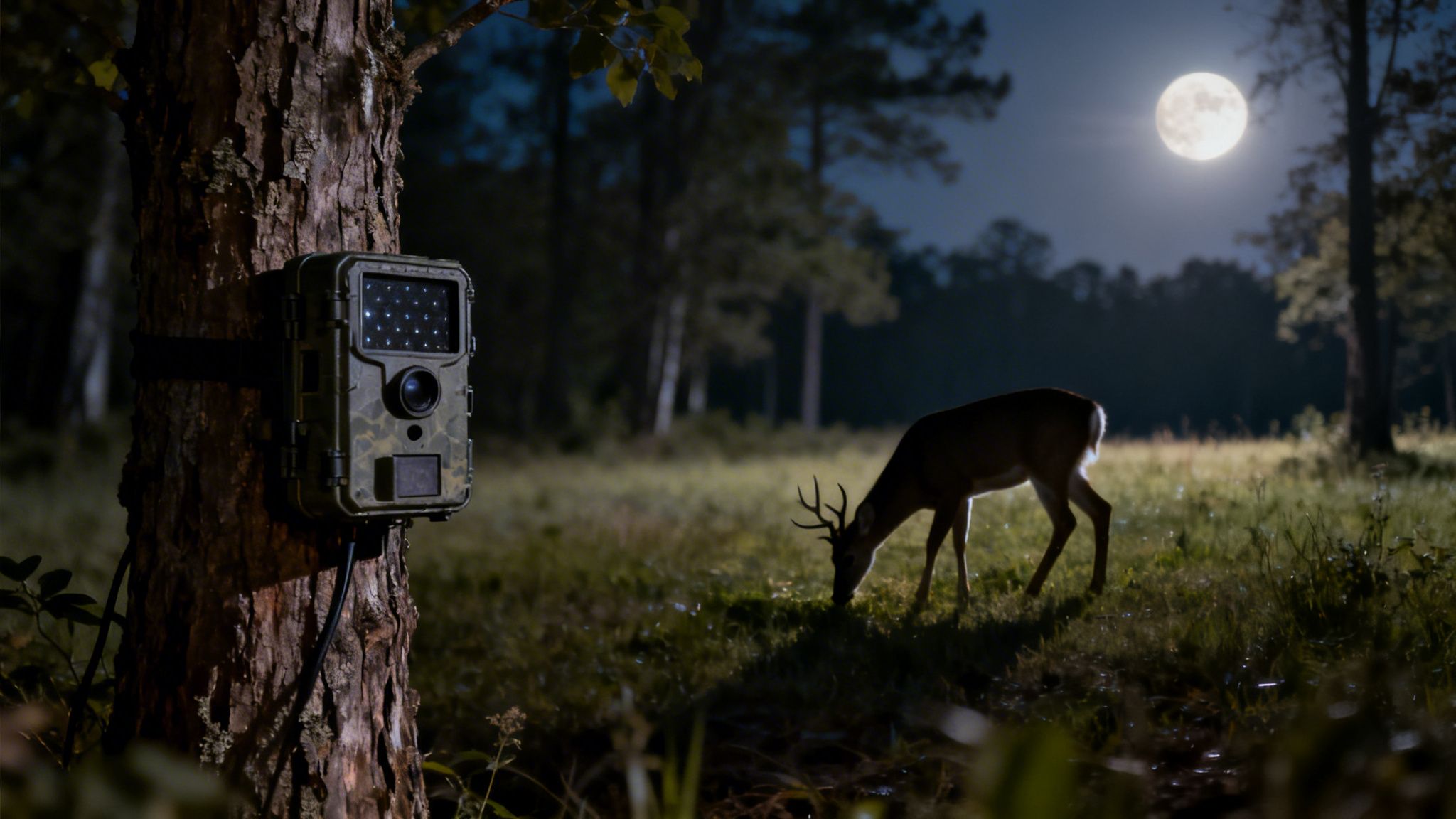
Have you ever checked your trail camera only to find pictures of a deer's tail as it bolts from the flash? Or worse, an empty food plot because the local wildlife has learned to avoid your camera's location?
This common frustration is exactly what a no glow trail cam is built to solve. It’s the difference between being a silent observer and an unwelcome intruder in the woods.
Think of it like this: a standard flash camera is like flipping on a bright searchlight in a dark forest. It immediately announces your presence, sending wary animals running for cover. A no glow camera, on the other hand, operates like military-grade night vision goggles. It sees everything clearly without revealing its position, letting you capture pure, unfiltered wildlife behavior.
How Does No Glow Technology Work?
The magic behind this stealth lies in the specific wavelength of infrared light the camera uses. No glow cameras employ LEDs that emit light at 940 nanometers (nm). This wavelength is well beyond the visible spectrum for most game animals—including whitetail deer—as well as the human eye.
The result is a burst of invisible light that illuminates the scene just for the camera's sensor, without producing any visible signature. This total invisibility is what makes a no glow trail cam an essential tool for serious hunters and wildlife researchers.
It allows you to:
- Monitor Pressured Animals: Get clear images of mature, nocturnal bucks that have grown wise to the faint red dot of low-glow cameras.
- Prevent Behavioral Changes: Make sure sensitive species continue their natural routines without being disturbed or spooked by a camera flash.
- Achieve True Stealth: Gain insights into animal patterns without ever alerting them to your scouting efforts, preserving the integrity of your hunting spot.
A truly invisible camera captures behavior, not reactions. When an animal doesn't know it's being watched, you get an honest look at its patterns, habits, and vulnerabilities. This is the fundamental advantage that sets no glow technology apart.
Why It Is More Than Just a Feature
Ultimately, choosing a no glow trail cam isn't just about picking a feature; it's about adopting a smarter scouting strategy. The whole point of a trail camera is to gather intelligence, and the best intel comes from subjects that are completely unaware they are being monitored.
By eliminating the risk of detection, you ensure the data you collect is accurate and actionable. For anyone serious about understanding the wildlife on their property—whether for hunting, research, or security—this technology is indispensable.
You can explore more about the fundamentals of these devices in our complete guide explaining what trail cameras are and how they function.
No Glow vs Low Glow: The Science of Stealth
Not all infrared flashes are created equal, and in the world of trail cameras, that difference can mean everything. Picking between a no glow trail cam and other types often decides whether you get a crystal-clear shot of a mature buck or just a blurry photo of his tail as he bolts. The secret is all in the wavelength of light the camera's flash puts out.
Think of it like a radio signal. Some stations broadcast loud and clear for anyone to tune in, while others use a secure frequency that's invisible to outsiders. A camera's flash is a lot like that—some announce their presence to the whole forest, while others operate in complete silence.
This single difference has a massive impact on how wildlife reacts. A visible flash can spook deer, teaching them to avoid a trail or food source, which completely messes up your scouting data.
Breaking Down the Wavelengths
The real technical difference comes down to the nanometer (nm) measurement of the infrared light. This one number tells you everything about its visibility, flash range, and even image quality. In the field, you'll run into three main types: No Glow, Low Glow, and the old-school White Flash.
- White Flash: This is the old-school stuff, basically the same bright, visible flash you’d find on a standard point-and-shoot camera. It gives you a full-color night photo, but it's also incredibly disruptive and will send most animals running.
- Low Glow (850nm IR): A huge step up in stealth. These cameras use infrared LEDs that give off a faint, visible red glow when they fire. While it's way less alarming than a bright white flash, a cagey, pressured buck can definitely still spot it.
- No Glow (940nm IR): This is the top-tier of stealth technology. The 940nm infrared light it uses is completely invisible to both animals and humans. This guarantees zero disturbance, letting you capture the most natural, unfiltered wildlife behavior.
The whole point of a trail camera is to gather intel without tipping off your target. A no glow camera nails this by operating on a wavelength that deer and other wildlife simply can't see, making it a truly invisible scout.
A Head-to-Head Comparison
To really get a feel for what’s right for you, it helps to see these technologies stacked up side-by-side. Each one has its place, with pros and cons that make it better for certain spots in the woods.
Here’s a quick rundown to help you decide.
Trail Camera Flash Technology Comparison
| Feature | No Glow (Black IR) | Low Glow (Red IR) | White Flash (Incandescent) |
|---|---|---|---|
| Stealth | Completely Invisible. The 940nm flash is undetectable to animals and humans. | Low Visibility. Produces a faint red glow that can be spotted by wary game. | Highly Visible. A bright, startling flash is obvious from a distance. |
| Night Image | Good quality, crisp black-and-white photos. | Brighter, often sharper black-and-white photos. | Full-color, detailed photos. |
| Range | Effective up to 100 feet. | Longer range, often exceeding 100 feet. | Very long range, but highly disruptive. |
| Best Use | High-pressure hunting, security, sensitive wildlife research. | Low-pressure areas, large open fields, general observation. | When color detail is paramount and disturbance is not a concern. |
As you can see, the choice isn't just about stealth—it's about balancing your needs for image quality, range, and avoiding detection.
The Myth of Bad Image Quality
A common knock against no glow cams is that they take poor-quality night photos. While that might have been true a decade ago, modern tech has pretty much closed that gap. Today’s cameras use advanced image sensors and smart processors that deliver sharp, well-lit photos without ever spooking your target.
In fact, hunters often report seeing 40% more nighttime bucks on their no-glow camera cards compared to glow models. Why? Because the animals are 2.5 times calmer when there’s no visible flash. Deer eyes physically can't detect light beyond the 850nm spectrum, which makes a 940nm flash truly invisible to them.
For serious hunters and researchers, giving up a little bit of flash range is a tiny price to pay for capturing honest, undisturbed animal behavior. After all, the best photo in the world is worthless if the animal you’re after never comes back. To dive deeper, you can learn more about the nuances of infrared hunting cameras in our detailed article.
Real World Scenarios for No-Glow Cameras
Let's move past the technical specs. The real magic of a no-glow trail camera isn't on a feature list—it's what happens in the field when you need total stealth. It's a problem-solver, delivering results where other cameras flat-out fail.
Whether you're deep in the backwoods or just keeping an eye on your backyard, undetectable surveillance is an absolute game-changer. Different situations call for different flash technologies, each with a specific job to do.
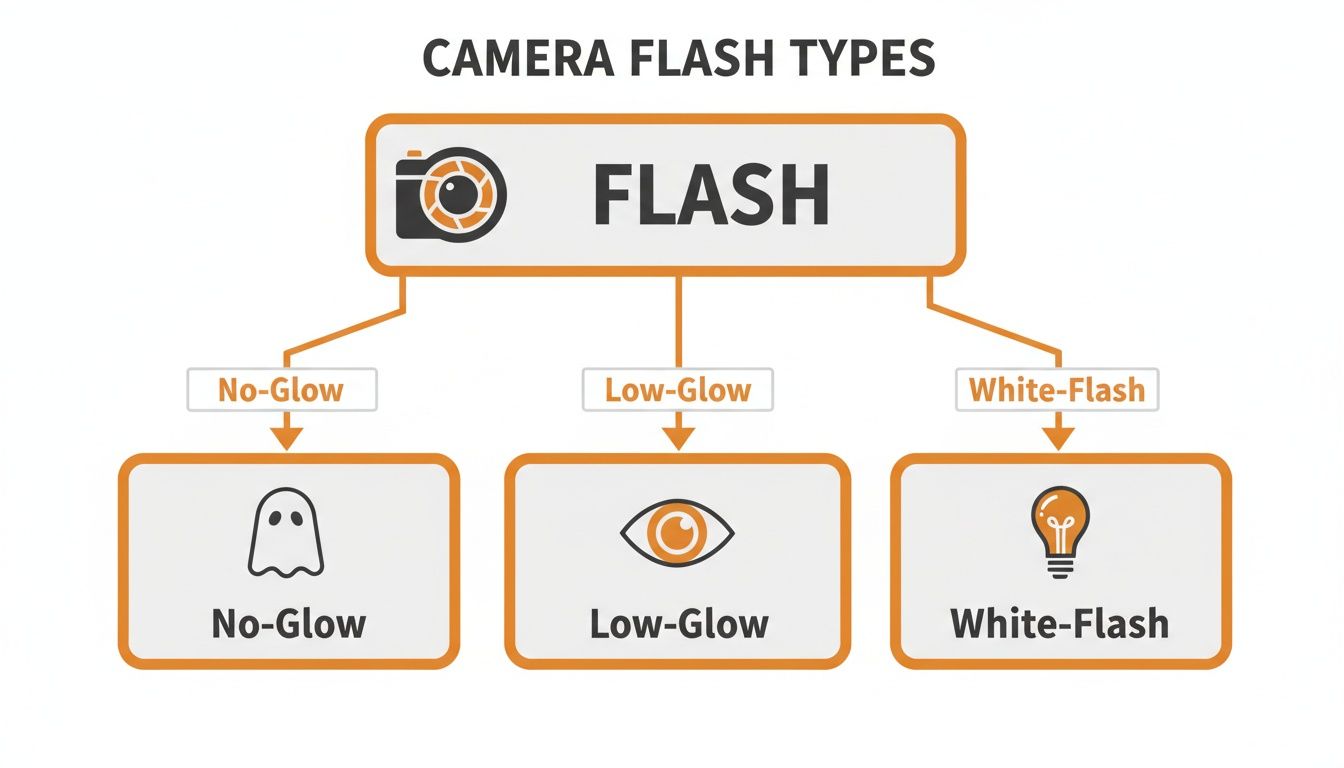
As you can see, no-glow sits at the very top of the stealth pyramid. When getting caught is not an option, this is the technology you need.
Patterning Pressured Whitetail Bucks
Every seasoned hunter knows about "the ghost." He's that wise, mature buck who seems to have a sixth sense for cameras, only showing up long after dark. A low-glow camera might get you one blurry night photo before he vanishes for good, now associating that faint red glow with danger.
This is exactly where a no-glow camera shines.
Imagine you're hunting a heavily pressured property where a trophy buck has dodged hunters for years. Standard cameras just confirm he's nocturnal but never reveal his patterns because he's smart enough to avoid the flash. Deploy a no-glow camera on a hidden travel corridor between his bedding area and a late-night food source, and the entire dynamic shifts.
The camera documents his every move without ever tipping him off. Week after week, you get clear photos showing his precise timing and direction. You learn he consistently rolls through between 2 AM and 3 AM, but only on a northwest wind. That’s actionable intelligence you simply can't get any other way. You’re not just seeing the deer; you're learning his playbook—the key to a successful hunt.
For a wary, nocturnal animal, any detectable light is a red flag. A no-glow camera removes that variable entirely, letting you gather pure, unbiased intelligence on a deer's natural routine without influencing it.
Protecting Sensitive Wildlife Research
For wildlife biologists, altering an animal's natural behavior can ruin an entire study. The whole point is to observe nature as it is, and a visible camera flash is a major contamination risk. It can cause animals to abandon nests, change feeding routes, or avoid critical habitats altogether.
Take a research project monitoring an endangered species like the pine marten or bobcat. These animals are incredibly elusive and hyper-sensitive to any disturbance. A researcher depends on a no-glow camera to:
- Conduct Population Surveys: Place cameras on a grid to capture individuals, using unique markings to estimate population density without scaring them out of the study area.
- Study Foraging Behavior: Monitor a den or feeding area to understand dietary habits without the parent abandoning its young because of a startling flash.
- Verify Habitat Use: Confirm if a species is using a new wildlife corridor between fragmented forests. A visible flash could deter them from the very path you’re trying to study.
In these scenarios, the totally invisible 940nm flash of a no-glow trail cam is non-negotiable. It ensures the data collected is a true reflection of natural behavior, preserving the scientific integrity of the work.
Securing Remote Property and Assets
Beyond the woods, no-glow cameras are exceptional tools for security. Their invisibility gives you the element of surprise—something you absolutely need when monitoring for trespassers, thieves, or vandals.
A camera with a visible glow alerts intruders to its presence. This gives them a chance to disable it, steal it, or at least know they've been spotted.
Think about securing a remote cabin, a farm gate, or a barn full of valuable equipment. A no-glow camera can be hidden overlooking these spots, capturing clear images of anyone who approaches without their knowledge. You get high-resolution photos of faces and license plates, which is exactly the kind of evidence law enforcement needs.
Best of all, because the intruder is never alerted, the camera itself stays safe and continues gathering intel. This makes it the superior choice for any location where you need discreet, effective, and reliable surveillance.
How to Choose the Right No Glow Trail Cam
Choosing the right no glow trail cam isn't about getting lost in technical jargon. It's about focusing on the practical features that will make or break your scouting season. With a market flooded with options, you need to know which specs actually matter when you're out in the woods.
This isn't just buying another piece of gear; it's an investment in a tool that gathers critical intelligence. You need something that's fast, tough, and reliable enough to handle whatever nature throws at it. Let’s break down what to look for.
Understanding Core Performance Metrics
Three key specs dictate how well a camera will capture game moving past its lens. Think of them as the camera's reflexes. If even one is too slow, you’ll end up with a folder full of empty trails and missed opportunities.
-
Trigger Speed: This is how fast the camera snaps a picture after sensing motion. A buck trotting by can cover a lot of ground in a fraction of a second. A slow trigger of 1 second might only catch its tail end, while a top-tier speed of 0.2 seconds or less will freeze the action perfectly.
-
Recovery Time: This measures how quickly the camera can take a second photo after the first one. Slow recovery is why you miss the second buck following the first. Look for a camera with a fast recovery—one second or less—to make sure you document every animal in a group.
-
Detection Range & Angle: This is the "net" your camera casts to sense movement. The range is how far out it detects an animal, and the angle defines the width of its vision. A wide detection zone is great for food plots, but for a tight deer trail, a focused angle with a long range is far more effective. Match this to where you plan to hang it.
A camera with a lightning-fast trigger and recovery is like a patient hunter with perfect timing. It sees the opportunity and acts instantly, ensuring nothing slips by undocumented.
Cellular Connectivity Versus Traditional SD Cards
Your next big decision is how you'll get your pictures. This choice fundamentally changes how you scout, affecting everything from scent control to making real-time decisions. The two options are old-school SD card models and modern cellular cameras.
A standard no glow trail cam saves every image to a physical SD card. To see what you've captured, you have to walk in, swap the card, and hike back out. While this method is affordable, it repeatedly contaminates your spot with human scent and presence, which can make mature bucks go nocturnal or disappear entirely.
A cellular no glow trail cam is the only way to go for serious scouting. It sends photos and videos straight to an app on your smartphone, giving you instant updates without ever setting foot in the woods. This gives you a massive advantage.
- Real-Time Intel: Get an alert the moment your target buck shows up, allowing you to hunt based on what's happening right now.
- Zero Disturbance: Monitor your spots from your couch or your truck without spreading scent or spooking game.
- Remote Management: Tweak camera settings, check the battery, and review photos—all from your phone.
Don't Overlook Build Quality and Battery Life
Even the most high-tech camera is worthless if it can't survive a downpour or a snowstorm. Pay close attention to its IP (Ingress Protection) rating, which tells you how well it’s sealed against dust and water. A rating of IP66 or higher means the camera is built to handle heavy rain and blowing dust, ensuring it keeps running all season.
Battery life is just as important. The market for these cameras is exploding—projected to hit USD 1.42 billion by 2032—because hunters demand long-term, low-maintenance tools. A good no glow model can last up to a year on a single set of batteries. Solar-hybrid options can push that to two years or more, saving you money and trips into the field. You can explore more about these trail camera market trends at 360iResearch.com.
Finally, if you go with a cellular model, a powerful and intuitive mobile app is non-negotiable. The app is your command center. Brands like Magic Eagle offer sophisticated apps that do more than just show you pictures—they provide live-streaming, AI species recognition, and interactive mapping tools that turn your camera into a complete scouting system.
Mastering Placement for Maximum Stealth
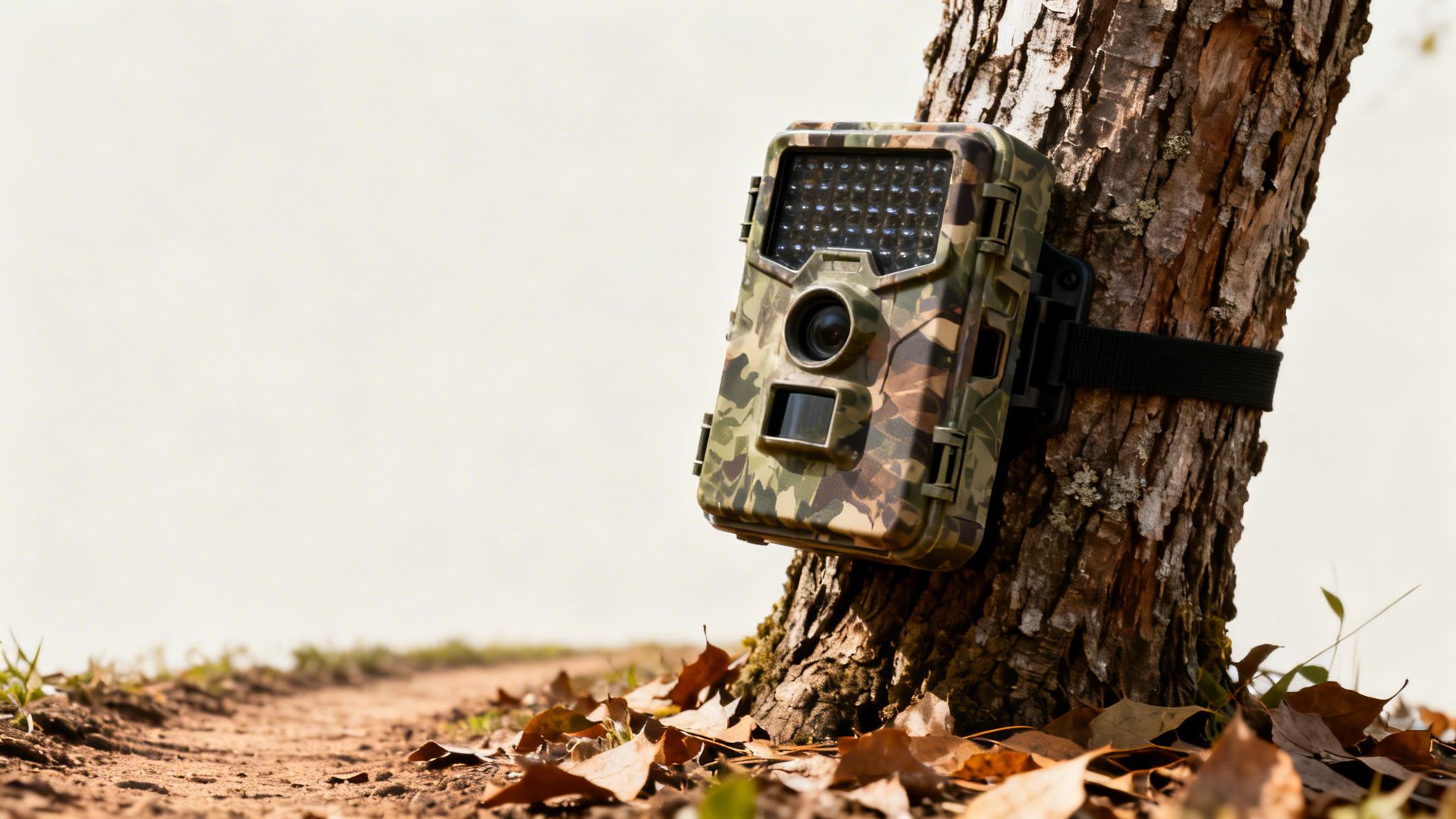
Owning the best no glow trail cam is only half the battle. Its true power is unlocked through smart, field-tested placement. A poorly positioned camera, even one with an invisible flash, can still get noticed, leading to spooked game and empty SD cards. Mastering the art of concealment is what turns your camera into a silent, invisible scout.
The first step is picking the right tree in the right spot. Look for natural funnels, intersecting trails, or pinch points between bedding areas and food sources. Don't just strap your camera to the most convenient tree. A big, straight oak on a trail edge is an obvious choice—and one a wise old buck will likely scan for anything out of place.
Instead, find a tree with irregular bark, some low-hanging branches, or surrounding brush. These little details help break up your camera's silhouette, making it virtually disappear into the woods.
Advanced Angles and Concealment
Once you’ve found the perfect tree, the next thing to consider is camera angle and height. A common mistake is mounting a camera at eye level, pointed straight across a trail. That perpendicular angle can sometimes catch an animal's attention.
Try these advanced placement tactics instead:
- Elevate and Angle Down: Mount the camera higher than you normally would—around six to eight feet—and angle it downward. This gets it out of a deer's direct line of sight and gives you a unique top-down perspective on their movement.
- The 45-Degree Rule: Instead of aiming for a direct, head-on shot, position your camera at a 45-degree angle to the trail. This gives the sensor more time to trigger as an animal moves through the detection zone, resulting in better-centered photos.
- Utilize Natural Blinds: Tuck the camera behind a cluster of leaves, a "V" in a tree trunk, or a thicket of brush. Clear only the absolute minimum needed for the lens and sensors to function, leaving as much natural cover as you can.
The goal is to make your camera part of the landscape, not an addition to it. Think like a predator: use cover, avoid direct sightlines, and approach your setup with minimal disturbance.
Scent control during setup is just as crucial as visual concealment. Always wear rubber boots and scent-free gloves. Avoid touching surrounding vegetation and spend as little time as possible at the camera site. Your scent can linger for days, alerting every deer in the area long after you’ve left. For a deeper dive, check out our guide on how to set up a trail camera for beginners.
Adapting to Different Environments
Proper placement varies a lot depending on the terrain. A strategy that works in thick woods will fail completely in an open field.
- Open Fields: Mount your camera on a fence post or a lone tree along the edge. Face it north or south to avoid sun glare at dawn and dusk, which can wash out your images.
- Thick Woods: Use the dense vegetation to your advantage. Higher mounting positions are often necessary to see over the underbrush and get a clear shot.
- High-Traffic Funnels: These spots see heavy use, so stealth is paramount. Use every concealment trick you know to keep your camera hidden from both game and other hunters.
The rise of no-glow technology has been dramatic for a reason. By 2025, an estimated 68% of U.S. trail cams featured no-glow IR, a significant jump from 32% in 2018. That's because a visible flash can slash nighttime trigger rates by 45% on wary game. The invisible 940nm flash of a no glow trail cam is the key to capturing true, unspooked behavior from the 15 million hunters hitting the woods each year.
Your No Glow Trail Cam Questions Answered
Even after getting a handle on the technology, a few questions always pop up when you're ready to put a no glow trail cam to work in the field. Let's tackle the most common ones to make sure you're confident in your gear and your strategy.
Is No Glow Night Image Quality Really Good Enough?
This is the big one, and it's a concern rooted in the past. Early no-glow models definitely had a reputation for dark, grainy night shots, but today's technology is in a completely different league.
Modern high-end cameras use incredibly sensitive image sensors paired with powerful processors. They're built from the ground up to squeeze every last drop of performance out of that invisible 940nm infrared light. The result? You get surprisingly bright, crisp, and detailed black-and-white photos.
Sure, there might be a very slight trade-off in raw brightness compared to a low-glow camera, but that's easily outweighed by the massive advantage of total stealth. The whole point is to capture natural, undisturbed animal behavior. Modern no-glow cams nail this without forcing you to sacrifice image quality.
Think of it this way: a slightly less bright photo of a calm, unaware trophy buck is infinitely more valuable than a perfectly illuminated photo of his tail as he flees from a visible flash. Modern no glow technology gives you the former, not the latter.
What Is the Effective Range of a No Glow Cam at Night?
Range is another critical piece of the puzzle. A quality no glow trail cam will typically have an effective flash range between 60 and 100 feet. That's the distance the invisible IR flash can reach to properly light up an animal for a clear shot.
The detection range—how far away the sensor can pick up movement to trigger a photo—is usually similar, sometimes even a bit farther. Always check the specific model's specs, because these numbers can vary.
And don't forget that mother nature gets a vote.
- Heavy Foliage: A thick canopy of leaves can absorb some of that infrared light, slightly knocking down the effective range.
- Weather Conditions: Heavy rain, fog, or snow can scatter the IR light, which can affect both detection and illumination distance.
For most hunting setups—like watching a scrape, mineral lick, feeder, or a tight travel corridor—a range of up to 100 feet is more than enough to get the intel you need.
Are No Glow Trail Cams Legal for Hunting?
For scouting before and after the season, using a no-glow camera is perfectly legal in the vast majority of places. In fact, it's become standard operating procedure for serious hunters who want to pattern deer without tipping them off.
Where things get tricky is during the season, especially with cellular cameras. Some states and provinces have rules restricting the use of cameras that transmit images in real-time. The concern is that it could violate "fair chase" ethics by giving hunters an unfair, live feed of animal movements.
It is always the hunter's responsibility to check their local wildlife and hunting regulations before putting a camera out. These rules change, so making a quick visit to your state's fish and game department website each year is a smart habit to get into. For property security, their use is almost always permitted.
Do I Need a Cellular Plan for My No Glow Camera?
A cellular plan isn't required for a no-glow camera to take pictures, but it completely changes the game. It turns a simple monitoring tool into a powerful, real-time scouting system.
A standard, non-cellular camera saves everything to an SD card. That means you have to physically walk in to swap cards, leaving human scent and making noise every single time. That disturbance can be enough to push a mature, wary buck to go completely nocturnal or abandon the area.
A cellular no glow trail cam solves that problem completely. It sends photos and videos straight to an app on your phone, giving you instant intel without you ever setting foot in your hunting spot.
This unlocks a few huge advantages:
- Zero Field Disturbance: You can keep tabs on your spot 24/7 without contaminating it with your presence.
- Instantaneous Alerts: Get a notification the second your target buck shows up, allowing you to make smart, immediate decisions on when and where to hunt.
- Remote Camera Management: Tweak settings, check your battery life, or format the SD card from anywhere, keeping your camera running perfectly.
For any hunter serious about getting the freshest intel with the least possible impact, a cellular model is an investment that pays for itself.
Ready to see the difference total stealth can make? The Magic Eagle EagleCam 5 delivers true no-glow performance with the added power of cellular connectivity, AI species recognition, and live-streaming capabilities. Explore our advanced scouting systems and get the edge you need this season at https://magiceagle.com.