

Picture this: you're miles away, maybe at home or in the office, and your phone buzzes. It's a real-time alert showing a mature buck standing at your feeder right now. This isn't a scene from a hunting show; it's the new reality of scouting, all thanks to trail cameras that send photos directly to your phone. This technology is a complete game-changer, turning scouting from a chore you do every few weeks into a live, dynamic advantage.
The New Era of Remote Scouting
Gone are the days of trekking deep into the woods just to swap out an SD card, spooking game along the way. Today’s connected trail cameras have completely rewritten the playbook for hunters, landowners, and wildlife lovers. Instead of waiting weeks to see what wandered past your stand, you get instant notifications right on your phone.
This leap from passively collecting old data to actively monitoring your property in real time is more than just a cool feature—it's a fundamental shift. It gives you a deeper, more accurate understanding of animal patterns and property security without ever leaving a human footprint. You can finally make decisions based on what’s happening now, not what happened last month.
It's no surprise that this powerful capability has sent the market soaring. Demand for trail cameras that connect to a phone is exploding, with the global market projected to hit USD 1,420.95 million by 2032. A huge part of that growth comes from the strong hunting culture in North America, which accounts for over 30% of all wildlife camera setups worldwide. You can dig deeper into these trends in this detailed market report.
And the benefits aren't just for one type of user:
- For Hunters: It’s the ultimate low-impact tool. You can pattern game, identify your target buck, and time your hunts with surgical precision without ever stepping foot on the property.
- For Landowners: It’s a simple and effective remote security system. Keep an eye on gates, expensive equipment, and remote fence lines for trespassers, all from your phone.
- For Researchers: It allows for instant, GPS-tagged data collection for population studies, eliminating the need for constant site visits that could disturb the ecosystem.
The core advantage is simple: you gain immediate awareness. Whether it's the buck of a lifetime showing up at a scrape or an unfamiliar truck at a back gate, you know about it the moment it happens, not days or weeks later.
This guide will cut through the tech talk and show you exactly how these cameras work, what features actually matter in the field, and how to pick the perfect one for what you need. Get ready to see your property in a whole new light.
How Do Trail Cameras Actually Send Pictures to Your Phone?
Ever wondered how a camera sitting deep in the woods can beam a photo straight to your pocket in just a few seconds? It’s not magic, but it is some seriously clever technology. If you're looking at trail cameras that connect to a phone, you'll find they mainly use a few different methods to transmit images. Knowing the difference is the key to picking the right one for your needs.
Cellular: The Long-Range Workhorse
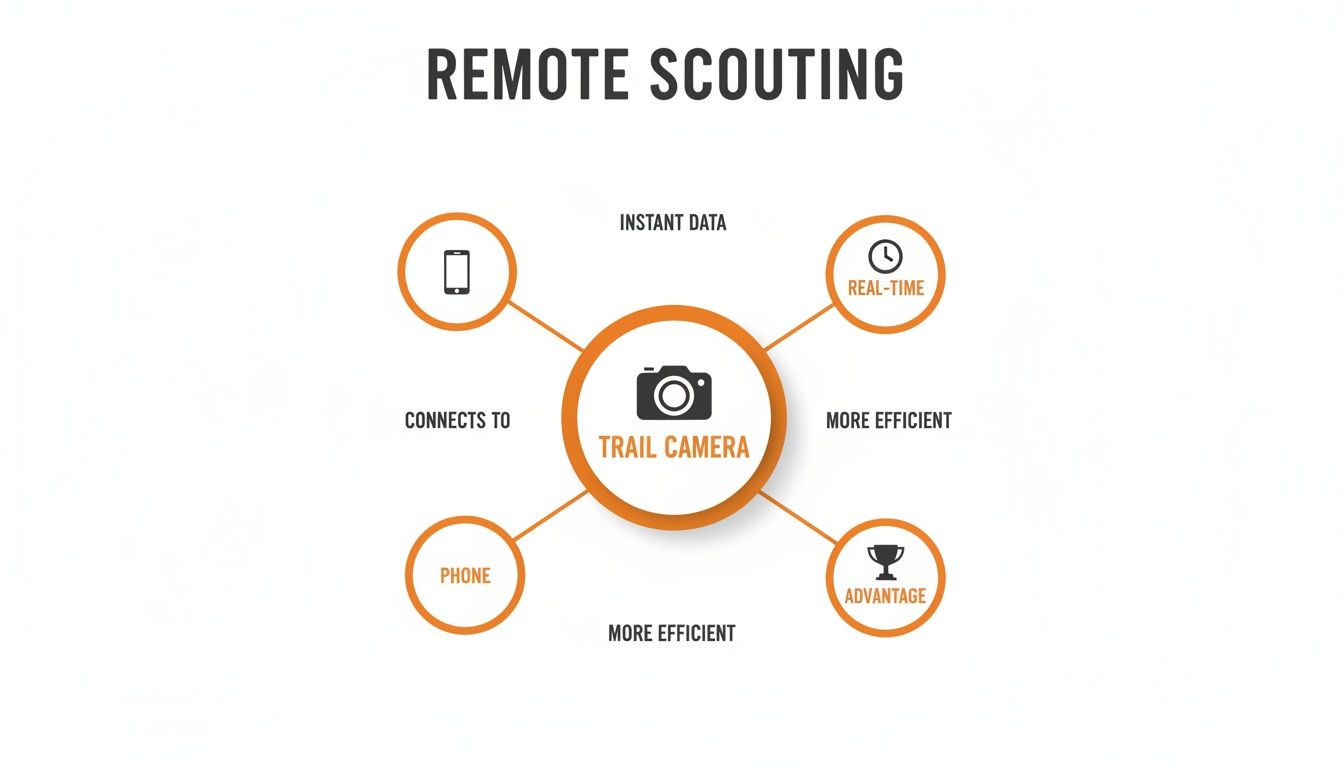
Think of a cellular trail camera as a rugged, weatherproof smartphone that’s been given one job: scouting. It has its own SIM card and connects to a 4G/LTE network, just like your phone.
When its sensor detects motion—whether it’s a buck stepping into a clearing or a trespasser crossing a fence line—it snaps a picture and sends it to you over that cell network. This means it can work almost anywhere you can get at least one bar of cell signal.
This setup gives you a massive advantage, putting real-time data right in your hand without ever having to step foot on your property and disturb the area.
Wi-Fi and Bluetooth: The Short-Range Specialists
On the flip side, a Wi-Fi trail camera acts more like a home security camera. It needs to connect to a nearby Wi-Fi network to send you anything. This makes it a great choice for monitoring areas within range of your home, barn, or cabin's internet router. Its range is limited, but you won't need a separate data plan, which can be a big cost-saver.
You'll also see Bluetooth mentioned a lot. Bluetooth isn't for sending images over long distances. Instead, it creates a short-range "handshake" between your phone and the camera. This is incredibly useful during setup, letting you stand nearby and adjust settings or check the live view to perfect the camera's aim without touching it.
Comparing Trail Camera Connectivity Methods
Here's a quick look at how different trail cameras connect to your phone, highlighting their best uses, range, and cost.
| Connectivity Type | How It Works (Analogy) | Best For | Typical Range | Cost Factor |
|---|---|---|---|---|
| Cellular (4G/LTE) | A dedicated smartphone for the woods | Remote properties, food plots, fence lines | Anywhere with cell service | Monthly data plan required |
| Wi‑Fi | Your home security camera, but for the yard | Backyards, barns, cabins, driveways | 100–300 feet from a router | Uses your existing internet |
| Bluetooth | A "digital handshake" for setup | Initial setup and aiming | 30–50 feet | Included, no extra cost |
Each method has a clear purpose. Your choice really boils down to where you plan to put your camera and what you need it to do.
The bottom line: Cellular gives you the freedom to monitor remote areas, while Wi-Fi is perfect for properties with existing internet. Bluetooth just makes the setup process a whole lot easier for both.
Putting It All Together
Ultimately, the best trail cameras that connect to a phone often use a smart combination of these technologies to give you a seamless experience.
-
Cellular (4G/LTE): This is the go-to for serious remote scouting. It offers the most flexibility but comes with a monthly data plan. We dive deeper into this in our guide on how cellular trail cameras work.
-
Wi-Fi: Perfect for backyard security or keeping an eye on buildings. It piggybacks on your existing internet but is tied to your router's signal strength.
-
Bluetooth: Think of it as a setup tool, not a way to get your pictures from the field. It lets you fine-tune your camera's position and settings by connecting directly to your phone from a short distance away.
What to Look For in a Phone-Connected Trail Cam
So, beyond the basic promise of sending a picture to your phone, what really separates a game-changing trail camera from a gadget that just causes headaches? Let's break down the features that actually matter out in the field, far from the marketing hype.
The shift to phone-connected cameras has completely changed the scouting game, with cellular models leading the way. The hunting and trail camera market is now worth over USD 224 million and is expected to climb to USD 375.16 million by 2034. That growth is driven by people like us—roughly 62% of hunters in North America now rely on trail cameras to keep tabs on game.
Image and Video Quality
It's easy to get sucked into the "megapixel race," but don't be fooled. More megapixels don't automatically equal better photos. A high-quality lens paired with a powerful image sensor is what really counts for getting sharp, usable images, especially after the sun goes down. You want a camera that delivers crisp, well-lit photos without a ton of grain or motion blur.
Video quality, usually measured in resolutions like 1080p or 4K, is just as crucial. A high-def video clip with clear audio can reveal animal behaviors and patterns that a single still photo could never capture.
Battery Life and Power Options
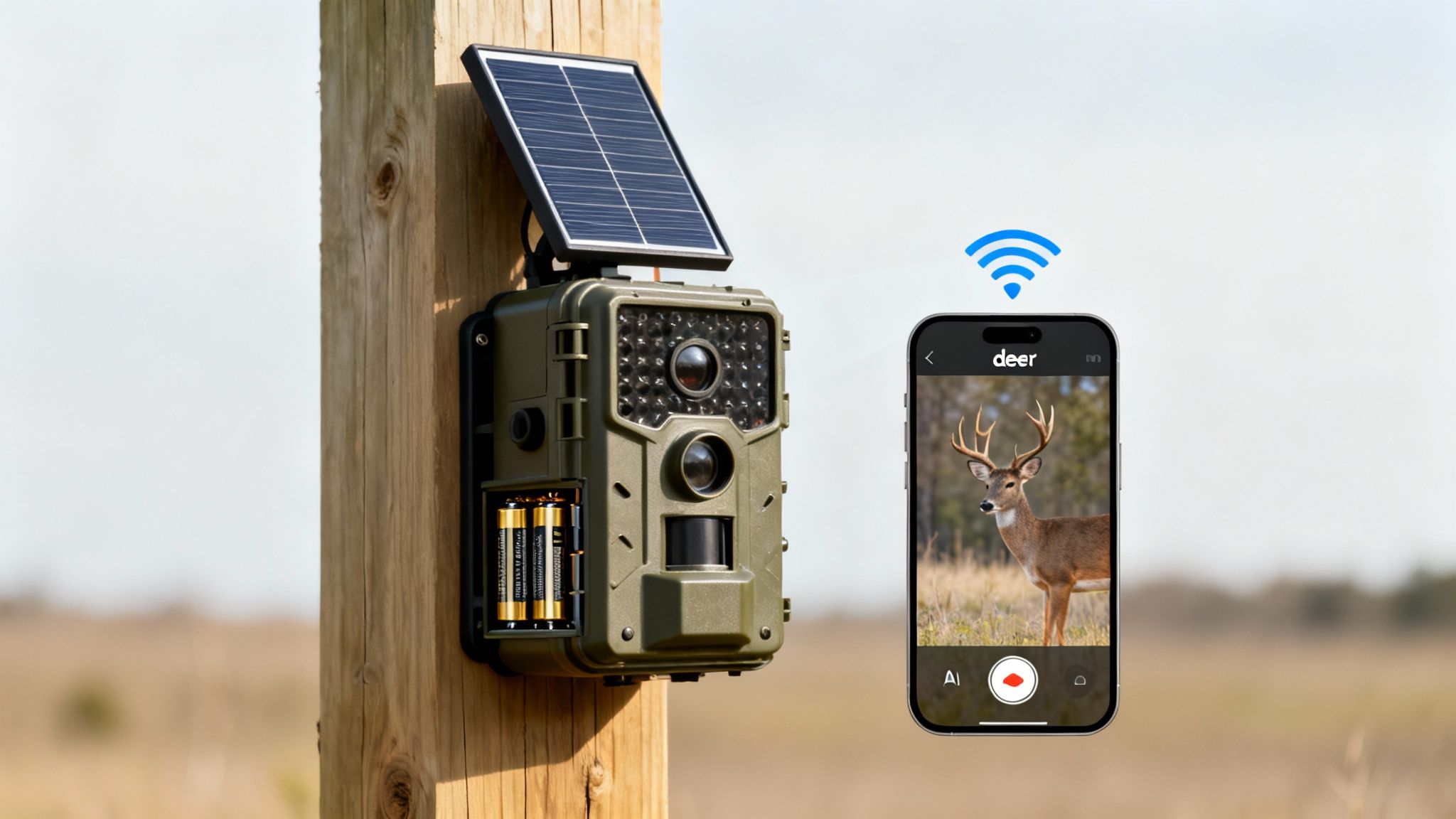
A camera with a dead battery is just a piece of plastic strapped to a tree. The best trail cameras are built for the long haul, designed to be set up and left alone for weeks or months at a time. While standard AA lithium batteries are a reliable option, many of the top-tier models now support external power sources.
- Solar Panels: A small solar panel can trickle-charge an internal battery, giving you nearly endless power as long as it gets some sun.
- External Battery Packs: For those spots deep in the timber or high-traffic areas that burn through batteries, a larger 12V battery box can keep your camera running for an entire season.
Having these options is a huge deal. It means fewer trips to your camera site, which in turn means less human pressure on the wildlife you're trying to pattern.
A camera’s real value is measured in its uptime. If you prioritize a model with flexible power options, you'll ensure your scouting is never cut short by a dead battery—keeping your eyes in the woods 24/7.
The App Experience and Smart Features
The mobile app is your command center, and a poorly designed one can ruin the entire experience. A clunky, confusing app will drive you nuts, no matter how good the camera hardware is. When you're looking at different cameras, remember that the app is just as important as the camera itself. The ongoing debate over iPhone vs. Samsung phones even plays a role here, as app performance can vary between operating systems.
You want an intuitive interface that makes it simple to change settings, view your pictures, and check the camera's status. But beyond the basics, this is where modern software really shines:
- AI Species Recognition: This is a lifesaver. The software automatically filters your images, separating photos of deer from raccoons, coyotes, or that one branch that won't stop waving in the wind. It saves you from scrolling through hundreds of false triggers.
- PIR Sensor Sensitivity: A good camera lets you adjust the Passive Infrared (PIR) sensor. This allows you to fine-tune motion detection for your specific spot, cutting down on unwanted alerts from squirrels or birds.
- GPS Geofencing: This anti-theft feature is brilliant. It sends an alert straight to your phone if the camera is moved outside of a pre-set area, helping you protect your investment. A quality https://magiceagle.com/blogs/knowledge/4-g-trail-camera will have these kinds of features baked right in.
Who Actually Needs a Connected Trail Camera?
The real magic of a trail camera that sends pics to your phone isn’t the tech itself—it's how it solves real problems for real people out in the field. Whether you're a hunter trying to pattern a ghost of a buck or a landowner keeping an eye on expensive equipment, these cameras offer a serious advantage. The uses are as different as the folks who rely on them.
This technology has quickly moved from a cool gadget to an essential tool for anyone who needs eyes on a remote spot. It’s all about getting instant information and making better decisions, all without leaving your scent all over the woods.
Let's break down who benefits the most.
The Dedicated Hunter
For any serious hunter, the biggest enemy is pressure. Every time you walk in to pull an SD card, you're leaving scent and potentially spooking the very animal you're after. A phone-connected camera wipes that problem off the map, letting you scout right from your living room.
Instead of playing a guessing game, you get a near-live look at what’s happening. You can see exactly when that target buck is working a scrape or which trail he’s using after a big cold front. This steady flow of intel helps you build a rock-solid pattern of his behavior.
- Real-Time Alerts: Get a buzz in your pocket the second your target buck steps in front of the lens.
- Low-Impact Scouting: Keep tabs on food plots, mineral licks, and travel routes without ever stepping foot on the property.
- AI Filtering: Modern apps can automatically sort your photos, showing you only the deer and filtering out the endless pictures of squirrels and raccoons. This alone can save you hours of tedious scrolling.
The Wildlife Researcher
For researchers and conservationists, good data is everything. Connected trail cameras are a game-changer, providing a constant stream of information that would otherwise take a massive amount of time and manpower to gather.
Imagine trying to track the migration of an elk herd or study the late-night habits of a reclusive predator. With cameras sending back GPS-tagged images and even environmental data, you can build an incredibly detailed picture of the ecosystem. Researchers can monitor herd health, watch how different species interact, and see the impact of environmental shifts from a single dashboard, all in near real time.
For scientists, it’s like having a team of field assistants working 24/7. The camera collects GPS-stamped evidence, tracks environmental conditions, and delivers it instantly, accelerating the pace of discovery without disturbing sensitive ecosystems.
The Landowner and Manager
Beyond the woods, these cameras are a powerful and affordable security solution for rural properties. Landowners can finally get eyes on remote assets that are often easy targets for theft or vandalism.
Think about that gate at the back of your property, a fuel tank, or a tractor left in a field miles from the house. A well-placed cellular camera is your silent watchman.
It can instantly ping your phone if an unfamiliar truck pulls up your access road or if someone is messing around near your fence line. That immediate notification gives you the chance to react fast, offering a level of security that used to require expensive, hard-wired systems.
The Modern Scouting Ecosystem in Action
All the theory and feature lists in the world don't mean much until you see how it all comes together in the field. Let's look at how a thoughtfully designed camera, like the Magic Eagle EagleCam 5, works as a complete scouting ecosystem instead of just a piece of hardware. This is about more than just getting a picture; it’s about turning that picture into real, actionable intelligence.
The most common point of failure for any trail camera that connects to a phone is a weak or unreliable signal. We've all been there—deep woods and remote hollows are notorious for spotty reception. The EagleCam 5 tackles this problem head-on with its built-in 4G connection and SignalSync technology, which automatically scans for and locks onto the strongest available network. It’s designed to keep you connected where other cameras just give up.
From Raw Data to Smart Decisions
Once an image is captured, the system’s brain kicks in. Instead of you having to manually sift through hundreds of photos of waving branches and squirrels, the AI species recognition does the heavy lifting. It automatically tags photos by animal.
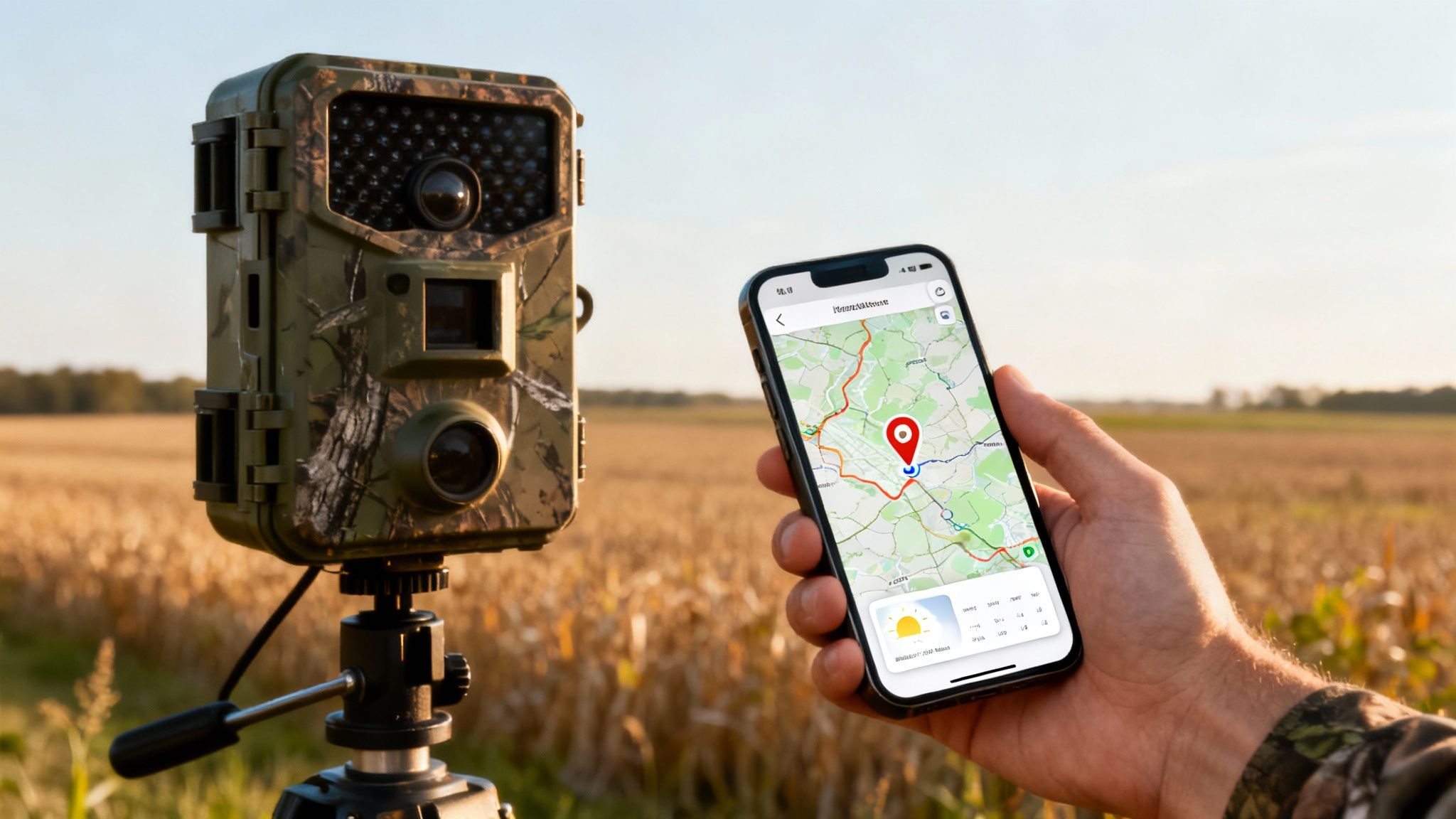
This data flows right into an interactive map inside the app, where you can see exactly where and when specific animals showed up. Suddenly, scouting goes from a reactive chore to a predictive strategy. You're no longer just looking at a photo; you're analyzing a pattern on a map.
A truly smart camera does more than just see—it understands. By combining location, species, and environmental data, it gives you the context needed to predict an animal's next move, not just review its last one.
This tight integration of hardware, software, and connectivity is a big deal, and it reflects a major shift in the industry. The global trail camera market is projected to hit USD 219.57 billion by 2033, with a huge chunk of that growth coming from smart features like 4G integration and AI-powered apps. You can dig deeper into these numbers in this detailed trail camera industry report.
Total Situational Awareness
The EagleCam 5’s ecosystem gives you the full picture by layering in even more data:
- Environmental Sensors: The camera has on-board sensors for temperature and humidity, which get combined with cloud weather data. This helps you see how changing conditions are affecting animal movement patterns.
- Asset Protection: Built-in GPS tracking and geofence alerts provide serious anti-theft security. You'll get an instant notification if your camera is moved from its spot.
When the hardware, software, and connectivity all work together this seamlessly, you get more than just a camera. You get an intelligent scouting partner that delivers clarity and confidence out in the field.
Common Questions About Phone-Connected Trail Cameras
Even after getting a handle on the tech, there are always a few practical questions that pop up before you’re ready to pull the trigger. Let’s walk through some of the most common ones we hear from folks just like you.
How Much Do Cellular Data Plans Cost?
This is usually the first thing people ask, and the good news is, it's not as bad as your phone bill. Unlike your personal cell plan, trail camera data plans are way more flexible and affordable. Most brands offer different tiers based on how many photos or videos you think you'll get each month.
A basic plan might run you just $5 to $10 a month for a few hundred photos, which is perfect if you’re monitoring a low-traffic area. If you expect more action, mid-tier plans usually land in the $15 to $25 range and give you thousands of photos, sometimes with a few HD video clips thrown in. For the power users who want unlimited everything, premium plans are available from there.
A lot of companies also offer a nice discount if you pay for a full year upfront. My advice? Start with a flexible monthly plan to see what your actual usage looks like. Once you have a good idea, you can switch to an annual plan and save some cash. We break it all down in our complete guide to trail camera data plans.
Is Setting Up a Cellular Trail Camera Difficult?
Not anymore. If you can set up a new smartphone, you can handle a modern cellular trail cam. The whole process has gotten incredibly simple over the last few years, built for regular people, not tech wizards.
Most setups boil down to four simple steps:
- Power It Up: Load the camera with the right batteries (fresh lithium AAs or a rechargeable pack are best) and make sure it’s fully charged.
- Get the App: Head to the Apple App Store or Google Play Store, download the manufacturer’s app, and create an account.
- Activate the Camera: Just open the app and scan the QR code located on the camera. This instantly links the device to your account.
- Pick Your Plan: Choose a data plan right inside the app and finish the activation.
That’s it. From there, you just mount it to a tree, turn it on, and you’re in business. The whole thing usually takes less than 15 minutes.
What is the Real-World Battery Life?
This is a huge one, because nobody wants to hike back to their spot every few weeks just to swap batteries. The honest answer is that it depends on a few key things:
- How busy is it? A camera watching a bustling food plot is going to burn through batteries much faster than one on a quiet trail.
- What’s the cell signal like? If your camera is constantly struggling to find a weak signal, it will drain the battery. You want a steady connection with at least 3 bars for the best performance.
- What are you sending? High-resolution photos and especially video clips take a lot more juice to transmit than standard-quality thumbnails.
Using a good set of lithium AA batteries, you can realistically expect anywhere from 2 to 4 months of life under normal conditions. But if you want true set-it-and-forget-it performance, a solar panel or an external 12V battery pack is the way to go. That can keep a camera running for an entire season or even longer.
The whole point of a cellular camera is to minimize your trips into the woods. An investment in a solar power option is often the smartest move to make sure a dead battery never messes up your scouting.
Can My Whole Family Connect to the Same Camera?
You bet. Most trail camera apps today are built for sharing. They let the main account holder grant access to other people, whether it’s family, hunting partners, or the co-owner of your property.
This is a game-changer for collaborative scouting. A hunting camp, for instance, can have several people monitoring different cameras across the lease, all from their own phones. You can usually control who just gets to see the pictures versus who can actually change the camera's settings. It turns one camera into a shared intelligence hub for the whole crew.
Ready to see how a truly integrated scouting ecosystem can transform your strategy? The Magic Eagle EagleCam 5 is engineered for hunters and wildlife professionals who demand reliability. With its all-in-one 4G connection, AI species recognition, and robust GPS anti-theft features, it delivers clarity and confidence from the deep woods directly to your phone.