

It’s a feeling every hunter knows and dreads: you head out to check your trail camera during peak season, only to find the batteries have been dead for weeks. All that valuable intel, lost. A solar powered game camera is the answer to this all-too-common frustration, creating a self-sustaining system that ensures you never miss a critical moment again. This isn't just a simple upgrade; it's a fundamental shift in how you scout.
The Solar Advantage for Trail Cameras
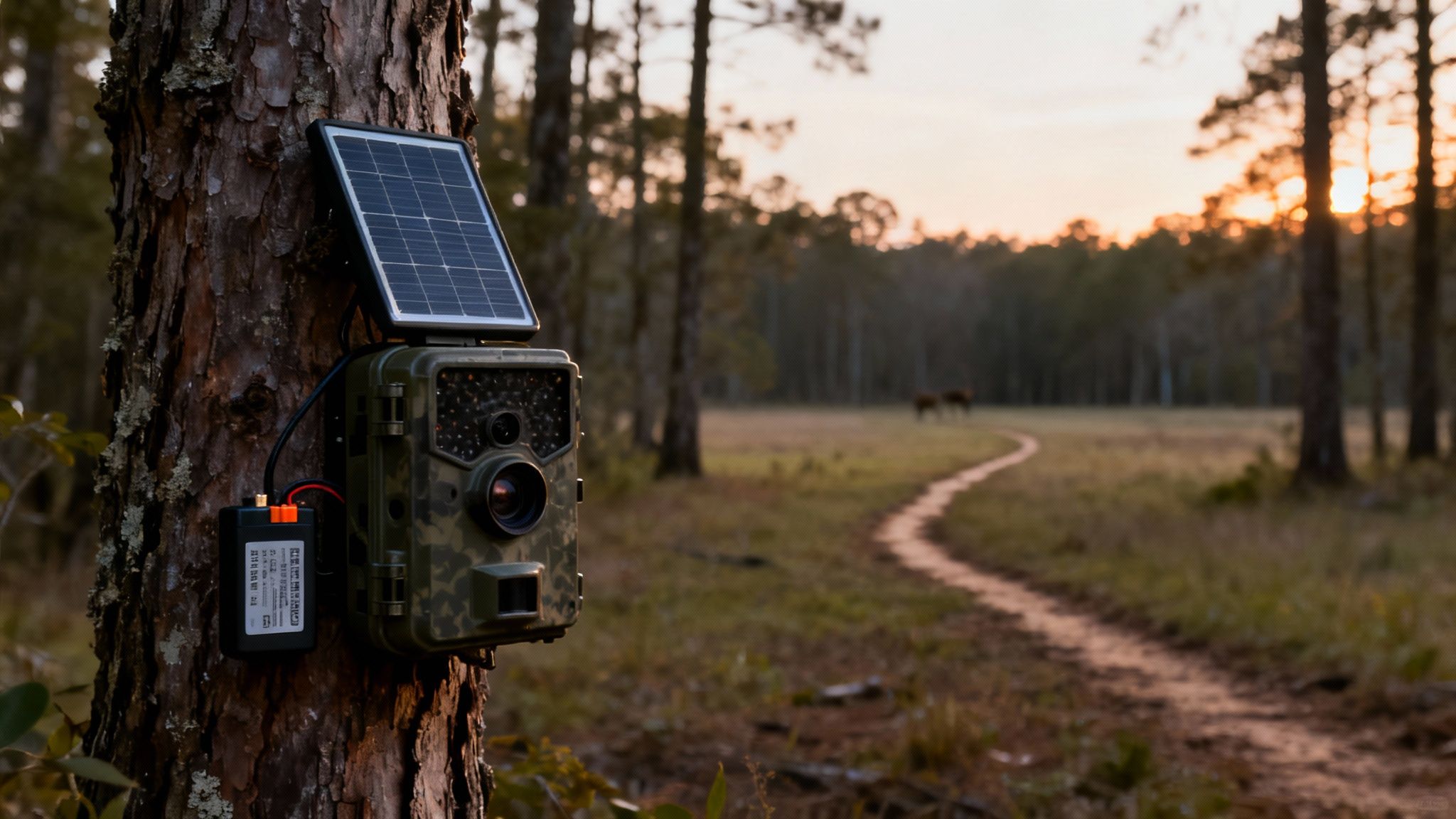
For serious hunters and wildlife managers, switching to a solar-powered game camera system isn't just a convenience—it's a massive strategic advantage. The most obvious win is the long-term cost savings. Sure, the initial investment is a bit higher, but it completely wipes out the recurring cost of disposable batteries, which can easily pile up to hundreds of dollars per camera over just a few seasons.
The real value, though, is in minimizing your human impact. Every single trip into the woods to swap out batteries leaves your scent and sound behind, which can spook game and alter their natural behavior. A self-sufficient solar setup lets you embrace a "set-and-forget" approach, drastically reducing your presence in key areas and making sure the data you collect reflects true, undisturbed animal patterns.
Maximizing Uptime and Gaining Confidence
A reliable, continuous power source is what unlocks the full potential of modern trail camera technology. There's incredible value in the confidence of knowing your camera is always active, day or night, rain or shine. This constant readiness makes advanced features that drain batteries not just possible, but practical.
- Uninterrupted Surveillance: Your camera stays operational through changing weather and seasons, capturing data 24/7 without a single gap.
- Support for Advanced Features: Power-hungry functions like cellular transmission, video recording, and live streaming finally become dependable tools in your arsenal.
- Reduced Field Maintenance: You'll drastically cut down on trips to your camera locations. That means less time, fuel, and effort spent while keeping your hunting spots pristine and undisturbed.
This move toward solar is more than just a passing trend; it's a full-blown market shift. Search data shows a massive spike in interest for 'solar trail camera,' blowing past other related terms. In a market valued at over $500 million in 2023 and projected to smash $700 million by 2026, solar-powered options are clearly what savvy hunters are demanding. You can dig into more data on hunting camera trends to see just how fast the market is evolving.
The ultimate goal is to gather crucial intelligence with the least amount of disturbance possible. A solar powered game camera is the most effective tool for doing just that, turning a reactive chore (changing batteries) into a proactive strategy (uninterrupted scouting).
How Solar Trail Camera Systems Actually Work
A solar-powered game camera might seem like some kind of high-tech wizardry, but the way it works is actually pretty simple and clever. The best way to wrap your head around it is to think of it like a tiny, self-contained water project out in the woods.
Imagine the camera's battery is a water bucket. The solar panel is a slow but steady hose filling that bucket, and your camera is constantly taking sips of water to operate. The goal is straightforward: make sure the hose puts more water into the bucket than the camera drinks.
This simple cycle is what gives your camera a virtually endless supply of power. On bright, sunny days, the hose fills the bucket much faster than the camera can drink, creating a nice surplus. That extra stored energy is what keeps your camera snapping photos all night long, surviving a week of cloudy weather, or powering through a big energy drain, like sending a video over the cellular network.
The Three Core Components
Every solar setup, no matter how simple or complex, relies on three key parts working together. Once you understand what each one does, the whole system clicks into place.
-
The Solar Panel (The Collector): This is the workhorse of the entire operation. The panel is covered in photovoltaic (PV) cells, which are engineered to convert sunlight directly into DC electrical current. It doesn't need a blazing summer sun to do its job, either—modern panels can still generate a charge on overcast days, though they'll produce less power.
-
The Rechargeable Battery (The Reservoir): You could argue this is the most critical piece of the puzzle. The battery, usually a lithium-ion pack, is where all the energy from the solar panel gets stored. A high-capacity battery is essential because it acts as a power bank, giving the camera a deep reserve to pull from at night or during those multi-day storms when the panel isn't collecting much juice.
-
The Charge Controller (The Brain): Usually tucked away inside the solar panel or battery housing, the charge controller is the system's unsung hero. Its job is to manage the flow of electricity from the panel to the battery. It prevents overcharging, which can wreck a battery, and it also stops the battery's power from leaking back into the panel at night.
A Self-Sustaining Power Cycle
Put these three components together, and you get a self-sustaining loop. During the day, the solar panel trickle-charges the battery. The camera then draws the power it needs directly from that constantly topped-off battery. The whole system is designed for a net energy gain, which just means that over a 24-hour period, the panel should generate more power than the camera uses.
The real magic of a solar powered game camera isn't just the panel itself—it's the balance between the panel’s generating capacity and the battery’s storage capacity. A well-balanced system can keep a camera running for months, or even years, without any human intervention.
This balance is what lets you confidently set up power-hungry cellular cameras in the middle of nowhere. Those cameras need a serious amount of energy to capture high-quality images and send them over the network—a task that would kill a set of standard batteries in just a few weeks. You can learn more about how to monitor your cameras remotely without ever having to worry about a dead battery again. With a solid solar setup, your camera has all the reliable power it needs to do its job, day in and day out.
Calculating Power Needs for Your Camera
One of the biggest mistakes folks make with a new solar-powered game camera is underpowering the whole system. It’s an easy trap to fall into, but it almost always leads to a dead camera right when you need it most. To get it right, you have to think a bit like an engineer and figure out a "power budget" for your specific scouting spot.
This isn't as complicated as it sounds. It really just comes down to understanding how much energy your camera actually uses day-to-day and then matching your solar panel and battery to that demand. We'll be talking in milliamp-hours (mAh), which is the standard for battery capacity.
Think of your battery's mAh rating like the size of a gas tank—the bigger the number, the more juice it can hold.
Your goal is to get a solid estimate of your camera's daily power draw in mAh. This number can swing wildly depending on where you put it and how you set it up. A camera watching a quiet, remote trail will sip power, while one over a busy food plot will be guzzling it down, constantly snapping photos and sending them out.
What Drains Your Battery the Fastest?
A few key variables have a huge impact on how quickly your camera burns through its battery. Get a handle on these, and you're halfway to building a setup that won't fail you.
- Trigger Frequency: This is the big one. A camera that captures 100 images and videos a day is going to use a heck of a lot more power than one that only triggers 20 times.
- Day vs. Night Captures: Night shots are way more demanding. Why? The camera has to power up its infrared (IR) flash every time. A single night picture can easily eat up 2-3 times more energy than a daytime one.
- Video Recording: Hitting that record button is one of the most power-hungry things a trail cam does. Just one 30-second video clip can use as much energy as dozens of still photos.
- Cellular Transmission: For a cell cam like the Magic Eagle EagleCam 5, sending all those pictures and videos over the network is a major power draw. The weaker your cell signal, the harder the camera has to work—and the more power it uses—to send a file.
This diagram breaks down the simple but critical flow of energy from the sun all the way to your camera.
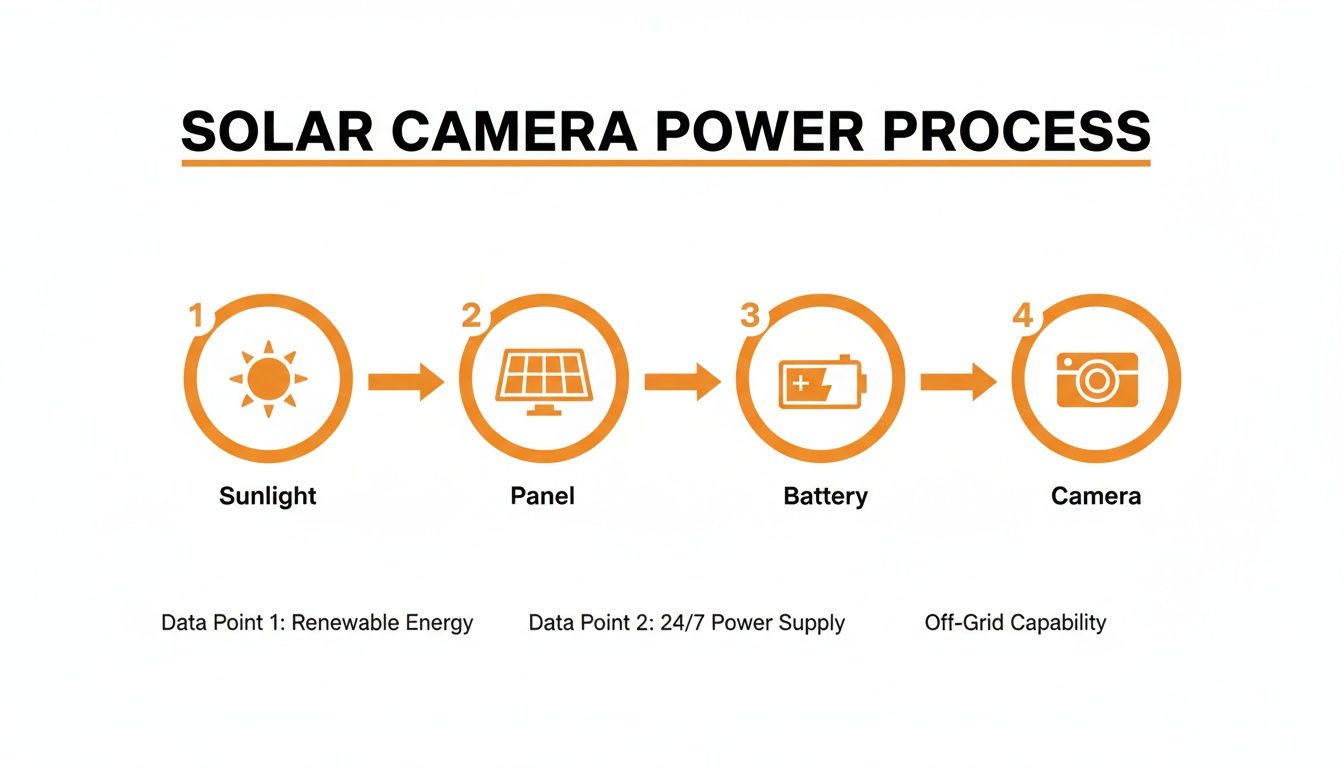
As you can see, a successful system is all about the panel collecting enough sunlight to not only run the camera but also top off the battery. That creates a surplus to get you through the night and those inevitable cloudy days.
Estimating Your Daily Power Budget
Alright, let's put some numbers to this. To figure out your daily usage, you just need to add up the power consumption from all your camera's activities over a 24-hour period.
(Number of Daytime Photos × Power per Photo) + (Number of Night Photos × Power per Night Photo) + (Number of Videos × Power per Video) + (Daily Idle Power) = Total Daily mAh
While the exact mAh values change from one camera model to the next, we can use some common estimates to see how this plays out in the real world.
Scenario 1: Low Usage (Quiet Trail)
Picture a camera on a secluded trail. It snaps an average of 15 daytime photos and 5 nighttime photos each day, with no video.
- 15 daytime photos ≈ 150 mAh
- 5 nighttime photos ≈ 100 mAh
- Idle power & check-ins ≈ 50 mAh
- Estimated Daily Total: 300 mAh
Scenario 2: High Usage (Busy Food Plot)
Now, think about a cellular camera pointed at a feeder. It's busy, sending 60 daytime photos, 40 nighttime photos, and 5 short videos every day.
- 60 daytime photos/transmissions ≈ 700 mAh
- 40 nighttime photos/transmissions ≈ 900 mAh
- 5 short video transmissions ≈ 500 mAh
- Idle power & check-ins ≈ 100 mAh
- Estimated Daily Total: 2,200 mAh
That's a massive difference. The high-usage camera needs more than seven times the power.
By running these quick numbers for your own spot, you can make sure your solar panel and battery are tough enough for the job. And speaking of batteries, picking the right kind is just as critical. You can learn more about making an informed choice in our guide on the best batteries for trail cameras. Taking a few minutes to plan this out upfront is the best way to prevent a dead camera when that buck of a lifetime finally walks by.
Choosing and Installing Your Solar Setup
Alright, you've done the homework and have a solid handle on your camera's daily power budget. Now comes the fun part: picking the hardware. This is where your planning pays off, ensuring your setup is tough enough to run year-round without a single hiccup. It all boils down to two key decisions: solar panel wattage and battery capacity.
Think of the solar panel's wattage (W) as the size of the engine that charges your system. A small 5W panel is like a fuel-sipping four-cylinder—perfect for cameras in low-traffic spots with plenty of direct sun. It’ll consistently trickle-charge the battery, easily keeping up with minimal power demands.
But for that busy food plot or a cellular cam tucked away under a dense forest canopy, you’re going to need more horsepower. A 10W panel is your V8 engine. It pumps out significantly more power, recharges your battery much faster, and performs way better on overcast days. That extra wattage gives you a critical buffer, making sure your battery stays topped off even after a string of cloudy days or a night full of triggers.
Pairing the Right Panel with the Right Battery
If the panel is the engine, the battery's capacity—measured in milliamp-hours (mAh)—is your fuel tank. A small battery hooked up to a big panel is just inefficient, like putting a tiny gas tank on a monster truck. On the flip side, a massive battery paired with a tiny panel might never get a full charge. The real secret is finding the right balance for your specific spot.
- Low Usage (Under 500 mAh/day): A 5W panel matched with an 8,000 mAh battery is usually plenty. This combo gives you enough juice in the tank to ride out several days of bad weather.
- Medium to High Usage (500-2,000+ mAh/day): This is where a 10W panel becomes non-negotiable. Pair it with a bigger battery, ideally in the 10,000 mAh to 20,000 mAh range, to build a deep energy reserve for a power-hungry cellular camera.
Here's a pro tip: Investing in a slightly oversized panel and battery is one of the smartest moves you can make. That extra capacity is your insurance policy, giving you peace of mind that your system will weather unexpected low light or high activity without going dark.
This need for reliable, off-grid power is why the trail camera market is booming. Valued at USD 905.94 million in 2025, it's projected to hit USD 1,420.95 million by 2032. Solar-powered units are a huge driver of that growth, making up nearly 20% of shipments in 2023 as hunters demand uninterrupted scouting without endless battery swaps.
Field Installation for Maximum Sunlight
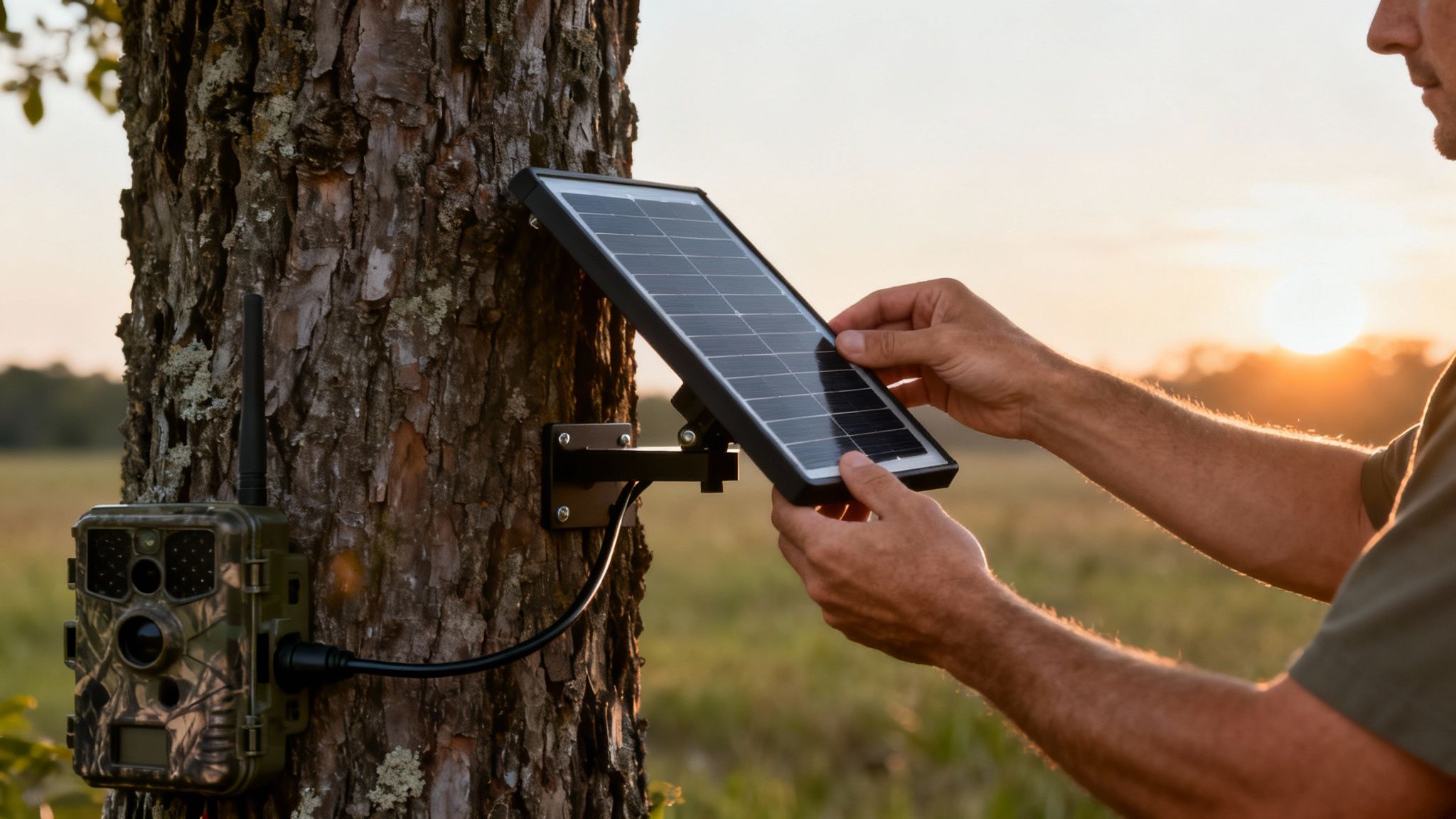
Once you've got your gear, proper installation is the final, make-or-break step. Where and how you mount that solar panel will determine the success of your entire system. The goal is simple: soak up the maximum amount of direct sunlight possible, all day long.
- Find Your Direction: In the Northern Hemisphere, your panel absolutely must face south. This aligns it perfectly with the sun's path across the sky, maximizing its daily exposure.
- Set the Perfect Angle: The sun sits lower in the sky during winter and higher in the summer. For the best year-round performance, set your panel's angle to roughly match your latitude. A simpler rule of thumb is to use a steeper angle (45-60 degrees) in the winter and a shallower one (30-45 degrees) in the summer.
- Eliminate All Shadows: This is non-negotiable. Before you mount anything, watch the spot throughout the day. A single branch casting a shadow over your panel for just a few hours can cripple its energy production. Mount it high enough to clear nearby trees and think about how leaves will fill in during the spring.
Securing Your Investment from Weather and Wildlife
Finally, a truly professional installation means protecting your equipment from the elements and curious critters. Weatherproofing and smart cable management are what separate a setup that lasts a season from one that lasts for years. If you're new to this, looking at a basic RV solar panel wiring diagram can be a huge help in visualizing how everything connects safely.
- Weatherproof Your Connections: Make sure every cable connection is tight and shielded from rain. A little dielectric grease on the plugs is a cheap and easy way to prevent corrosion down the road.
- Secure Your Cables: Don’t leave loose wires dangling. Squirrels, raccoons, and even deer are notorious for chewing on cables. Run them tightly against the tree or use a protective conduit to keep them safe. Our guide on solar panels for game cameras offers even more tips for building a bulletproof setup.
By following these steps, you go from being just a camera owner to a self-sufficient field technician. You're building a reliable scouting tool that will work flawlessly from the moment you walk away from the tree.
Long-Term Maintenance and Troubleshooting
One of the best things about a solar-powered game camera is its self-sufficiency, but "set-and-forget" doesn't mean "never-check." A little bit of seasonal maintenance goes a long way, ensuring your system runs at peak performance for years and preventing problems before they start. Think of it as a quick check-up for your most valuable scouting tool.
These simple, periodic tasks are all about maximizing solar collection and protecting your investment from the harsh realities of the outdoors. By running through these checks just a few times a year, you can dramatically extend the life of your setup and make sure it’s reliable when it counts the most.
Your Seasonal Maintenance Checklist
To keep your system running like a well-oiled machine, just fold these quick checks into your routine whenever you visit your camera site.
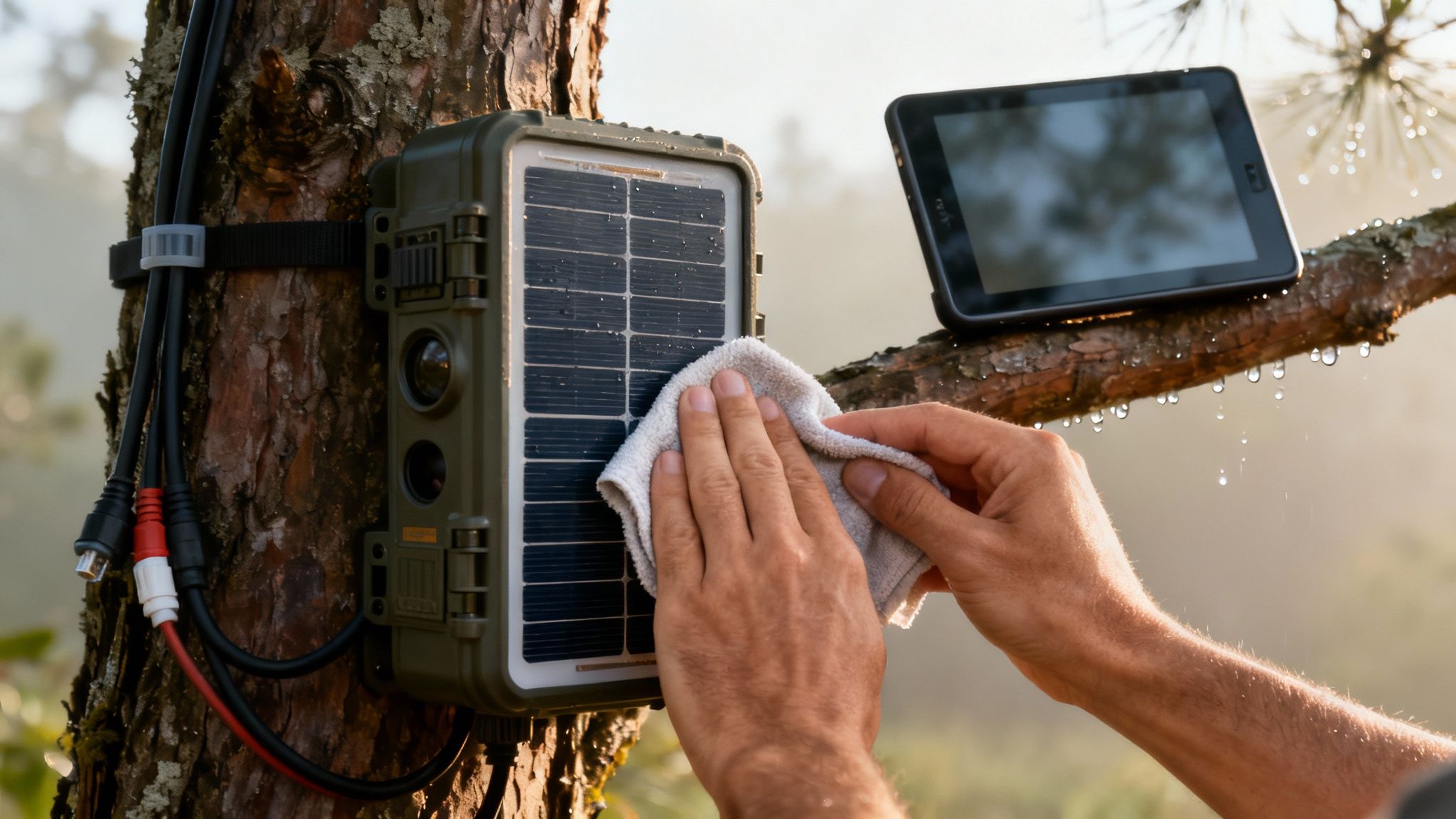
- Clean the Panel Surface: Dust, pollen, bird droppings, and tree sap can build up, creating a film that blocks sunlight and slashes efficiency. A gentle wipe with a soft, damp cloth is usually all it takes. For a deeper dive, there are guides on how to clean solar panels properly.
- Inspect All Cables: Give the wires a quick once-over. You’re looking for any signs of damage, especially chew marks from squirrels or other rodents. Make sure all connections are still snug and protected from moisture. A loose connection is a super common—and easily fixed—point of failure.
- Adjust the Panel Angle: The sun’s path changes with the seasons. A steeper angle in the fall and winter helps catch that low sun and shed snow, while a shallower angle works better for the high sun of spring and summer.
- Check for New Obstructions: Trees grow, and leaves fill in. A spot that was wide open in March might be shaded by August. Trim any new branches that could cast a shadow on your panel during those peak sun hours.
The whole point of maintenance is to ensure your solar panel always has a clear, direct view of the sun. Even a thin layer of grime or a small shadow can seriously impact its ability to generate power, putting your camera's uptime at risk.
This push for field endurance is reshaping the market. In fact, recent data shows that 21% of game camera shipments in 2023 were solar models, driven by the demand for long-term, hassle-free monitoring. This is especially vital for the 62% of new units featuring cellular links, which need that consistent power to function.
Troubleshooting Common Power Issues
Even with perfect maintenance, you might eventually hit a snag. If your battery isn’t charging or your camera dies unexpectedly, don't panic. The issue is usually something simple. Just follow this step-by-step diagnostic process to find and fix the problem right in the field.
| Problem | Potential Cause | Solution |
|---|---|---|
| Battery Not Charging | 1. Panel is dirty or obstructed. 2. Connections are loose or corroded. |
1. Clean the panel surface thoroughly. Check for and remove any new shadows. 2. Unplug and securely reconnect all cables. Check for moisture or corrosion on the connectors. |
| Camera Loses Power Often | 1. Not enough sunlight at the location. 2. Power demand is too high. |
1. Re-evaluate the panel's placement. Move it to a spot with more direct southern exposure. 2. Reduce camera activity (e.g., lower sensitivity, fewer videos) or upgrade to a higher-wattage panel. |
| System Fails in Winter | 1. Panel is covered by snow or ice. 2. Sun's angle is too low for the current panel tilt. |
1. Clear all snow and ice from the panel surface. 2. Adjust the panel to a steeper angle (closer to vertical) to better capture the low winter sun. |
Frequently Asked Questions About Solar Game Cameras
Even after you get the hang of how solar-powered game cameras work, a few specific questions always seem to come up right when you're about to head into the field. Here are some straight answers to the most common ones, so you can set up your gear with complete confidence.
Think of this as the practical, real-world advice you need before you deploy your system.
Will a Solar Camera Work on Cloudy Days or in Winter?
Yes, absolutely. Modern solar panels are surprisingly sensitive and can still generate a charge even on overcast days, though they won't be pumping out as much power as they would in direct sunlight. The system is designed for exactly this situation. The real hero here is the rechargeable battery, which acts like an energy bank.
It stores up all that extra power collected on sunny days, making sure your camera has plenty of juice to run through several cloudy days, all night, or even after a light dusting of snow. For winter, the two most important things you can do are keep snow cleared off the panel and tilt it at a much steeper angle. This helps it catch that low winter sun and lets snow slide right off.
The battery's stored energy is the bridge that carries your camera's operation through periods of low light. A fully charged, high-capacity battery can often power a camera for a week or more with zero solar input.
Can I Use Any Solar Panel with My Existing Trail Camera?
No, and this is a critical point to get right. Compatibility is everything. If you don't match the specs, you risk permanently frying your camera. You have to match two key things: voltage (V) and the connector plug type.
Most trail cameras are built to run on a specific voltage, usually 12V. If you hook up a panel with a higher or lower voltage, you can easily destroy the camera's sensitive internal circuits. On top of that, different brands use unique plug sizes for their external power ports.
To play it safe, your best bet is to:
- Use a solar panel made by your camera's manufacturer.
- Pick a reputable third-party panel that explicitly guarantees it works with your specific camera model.
- Make sure the kit comes with the right adapter cable so you get a secure fit.
How Much Power Does a Cellular Trail Camera Actually Need?
Cellular trail cameras are way more power-hungry than the standard, non-cellular models. The simple act of sending photos and videos over a 4G network takes a serious amount of energy, especially if you're in a remote spot with a weak or spotty signal.
For a modern cell cam, a 5-watt panel is a good starting point, especially in places with decent sun and not a ton of daily activity. But for more demanding situations—like a high-traffic food plot sending you videos all day or a camera deep in a shaded forest—upgrading is a smart move. A 10-watt panel paired with a big battery (10,000 mAh or more) gives you the power and reliability you need for true set-it-and-forget-it scouting.
Ready to build a scouting network you can count on? The Magic Eagle EagleCam 5 is engineered for reliability with AI detection, GPS protection, and a smart solar power system that keeps you connected. Explore the ultimate in set-and-forget surveillance at https://magiceagle.com.