

Baiting for deer is all about creating an irresistible food source—like corn or a mineral block—to draw deer into a specific spot for hunting or just to get a closer look. But to really nail it, you have to get the details right. It’s a game of understanding local laws, picking the perfect location, and knowing what makes a deer tick.
Your Foundation for a Successful Bait Site
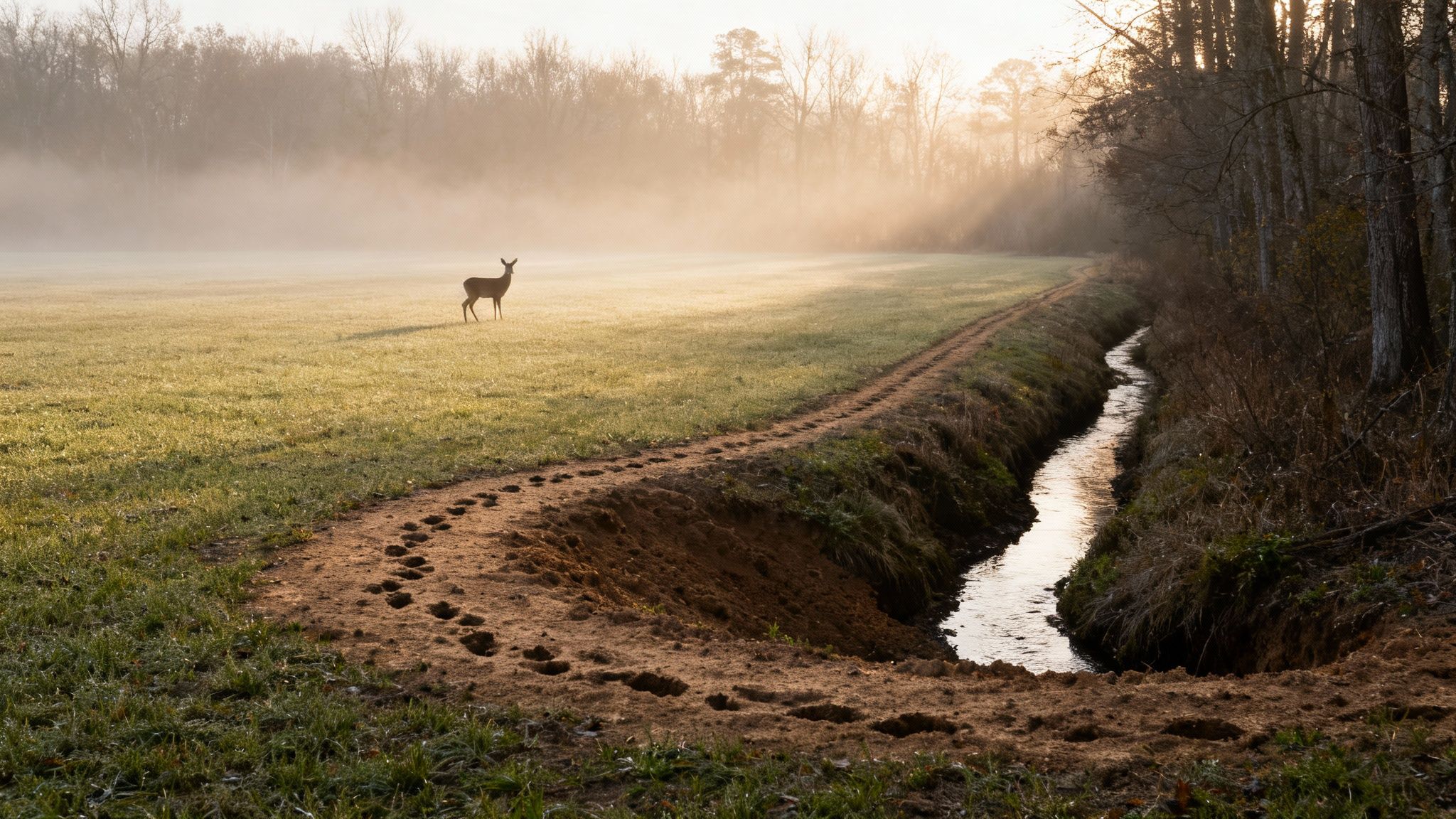
Before you even think about buying a bag of corn, your first move—and the most important one—is making sure you’re on the right side of the law. The rules for baiting deer can change dramatically from one state to the next, and sometimes even from county to county. What's perfectly legal in one spot could land you with a hefty fine and a lost license just a few miles down the road.
Always, always start on your state's Department of Natural Resources (DNR) or Fish and Wildlife website. They're the official source for the most current regulations. Keep an eye out for specifics on bait types, how much you can put out (some places limit it to two gallons at a time), and date restrictions. A lot of states only allow baiting outside of the official hunting season.
Navigating Local Regulations
Knowing these rules isn't just a suggestion; it’s non-negotiable. For instance, in areas with Chronic Wasting Disease (CWD), you'll often find total bans on baiting and feeding. The goal is to stop deer from bunching up and spreading the disease. Don't just go by what a buddy tells you or what was legal last year. These regulations change all the time.
A quick call to your local game warden is another smart move if the rules seem a bit murky. They'll give you the straight scoop and help you hunt with confidence, knowing you're doing everything by the book.
The Art of Strategic Site Selection
Once you've cleared the legal hurdles, the real fun begins. Picking the right spot for your bait site is more art than science, and it’s about a lot more than just finding a clearing in the woods. The perfect location is a sweet spot where deer habits and hunter advantage overlap, creating a place where deer feel safe enough to show up in daylight.
Look for natural travel corridors. Think of these as the invisible highways deer use to move between their bedding areas and food sources. A prime bait site is often tucked between a thick bedding area and a primary food source like a cornfield or a stand of white oaks. By placing your bait here, you're not trying to change their routine—you're just adding a can't-miss pit stop along their usual route.
Pro Tip: Whatever you do, don't dump your bait in the middle of a wide-open field. A mature buck is way too smart for that and will almost never step out into the open during legal shooting light. Tuck your site just inside the woodline or along a brushy fencerow to give him the cover he needs to feel secure.
Other spots with huge potential include:
- Inside Corners: Where two different habitats meet, like a field corner pushing into a block of timber. These create natural funnels.
- Saddles or Benches: Those low dips in a ridge or flat benches on a hillside are the path of least resistance for deer.
- Proximity to Water: A bait site near a creek or pond is a game-changer. Deer will often grab a drink right after they eat.
The mission is to find a spot that already concentrates deer movement. When you set up along these predictable routes, your bait becomes a natural part of their world instead of a weird disruption. This approach is a lot like the long-term strategy behind planting a food plot for deer, but a bait site delivers a powerful, concentrated attractant for more immediate results. Your job is to make their decision to stop by an easy one.
Picking the Right Bait and Nailing the Timeline
Okay, you’ve scouted a spot and made sure everything’s legal. Now for the fun part: figuring out what to put on the menu and when to serve it. The right bait makes your spot the hottest ticket in the woods, but your timing is what truly conditions deer to show up during shooting hours. This isn't just about dumping a bag of corn; it's a calculated strategy based on what deer need throughout the season.
Think about it from their perspective. In the early season, bucks are finishing up their racks and does are still nursing fawns, so they’re craving protein. Fast forward to the pre-rut and winter, and their bodies are screaming for high-energy carbs and fats to fuel the chase and survive the cold. Match your bait to those biological needs, and you’re in business.
Match the Menu to the Season
When it comes to pure drawing power, nothing beats high-carbohydrate baits. Deer are hardwired to seek out energy, and that’s what carbs deliver. It’s no secret that whole kernel corn is the undisputed king of deer bait—it’s cheap, available, and deer love it. But a corn-only diet isn't always the best approach.
For a more effective strategy, I like to mix things up or rotate baits as the calendar pages turn. Here’s a quick look at the heavy hitters:
- Corn: The old standby for pure energy. It works year-round but is an absolute game-changer during the pre-rut and the brutal late season when deer are desperate for calories.
- Soybeans: These are packed with protein. Roasted soybeans are my secret weapon for the early season when bucks are still building antlers and does need extra nutrition.
- Commercial Mixes: These bags often have it all—corn, soybeans, oats, and molasses, plus added minerals and attractants. They’re a fantastic all-in-one option that takes the guesswork out of creating a balanced offering.
- Mineral Supplements: Think of products like mineral blocks or granular attractants as a long-term investment in your spot. They're less about instant energy and more about herd health. Putting these out months before the season is a great way to establish travel routes as deer form habits visiting them for essential nutrients.
The whole idea is to give the deer what their bodies are telling them they need, right when they need it. A high-protein mix in September draws deer for completely different reasons than a pile of high-carb corn in December.
Hunter's Insight: Don't get so focused on bagged bait that you overlook what's already there. If you've got white oaks dropping acorns, setting up a bait site nearby can be absolutely lights out. Deer almost always prefer natural food, so placing your bait along a travel corridor leading to a primary food source makes it an easy, irresistible stop for them.
Building Your Baiting Timeline
This is where so many hunters get it wrong. They get excited, buy a bag of corn, and dump it out the weekend before opening day. That’s not a strategy; it’s a Hail Mary. The real goal of baiting is to condition deer, teaching them that your spot is a safe, reliable restaurant. That process takes time and, above all, consistency.
Your timeline should kick off at least three to four weeks before you plan to hunt. This buffer gives deer enough time to stumble upon the site, get comfortable, and weave it into their daily routine. Once you start, stick to a rigid schedule. If you refill your feeder every Saturday afternoon, keep doing it. Deer are creatures of habit and will quickly learn when to expect you—and, more importantly, when to show up without you there.
Before we dive into the table, remember that this is a guide. Local conditions, herd density, and weather patterns will all play a role, so be ready to adapt.
Seasonal Bait and Timing Strategy
This table breaks down how to tailor your bait and timing as the season progresses.
| Season Phase | Primary Goal | Recommended Bait Types | Timing and Frequency |
|---|---|---|---|
| Early Season (Late Summer/Early Fall) | Herd Inventory & Patterning | Soybeans, Mineral Blocks, Protein Mixes | Start 4 weeks pre-season; refresh weekly to build trust. |
| Pre-Rut (Mid-Fall) | Fueling for the Chase | High-Carb Corn, Commercial Mixes, Acorns | Increase volume; maintain a strict weekly refill schedule. |
| The Rut (Peak Breeding) | Intercepting Cruising Bucks | High-Energy Corn | Bucks are on the move; keep bait fresh and available 24/7. |
| Late Season (Winter) | Survival & Post-Rut Recovery | Corn, High-Fat Mixes | Focus on easy energy; replenish as needed, minimizing pressure. |
This timeline is more than just a schedule—it's how you build trust. Your consistency teaches deer that the food is always there and that human pressure is predictable and easy to avoid. That’s the secret sauce for getting those mature bucks to show their faces in broad daylight.
How to Set Up Your Bait Site for Success
Having a great location and the right bait is a solid start, but your setup on the ground is what really seals the deal for a daylight opportunity. You can't just dump a pile of corn and hope for the best. A thoughtful approach to deploying your gear is what makes deer feel secure, helps you control your scent, and funnels them into ethical shooting lanes.
The right equipment, placed correctly, can turn a good spot into a great one.
Selecting the Right Feeder for Your Needs
Your first big decision is choosing the right feeder. Every style—gravity, spinner, and trough—comes with its own set of pros and cons. What works best will depend on your property, your budget, and how often you can get out there to check on things.
A gravity feeder is as simple and reliable as it gets. It’s basically a big container that lets feed drop down as deer eat. They're dead silent, don't need batteries, and are perfect for cutting down on trips to the site. Some models hold hundreds of pounds of feed, which means you can stay away longer. The big drawback? Raccoons and other critters can clean them out in a hurry.
Spinner feeders are the total opposite. They run on a battery-powered motor and throw feed on a schedule, usually once or twice a day. This is fantastic for conditioning deer to show up at specific times and for making your bait last a whole lot longer. But, they can be noisy, which might spook a wise old buck, and you’re always at the mercy of your battery life.
Finally, you have trough feeders. These are just open containers, making them super easy for deer to access. They're great for mineral mixes and supplements, but they offer zero protection from rain or non-target animals. Troughs need the most frequent refilling, so they're best suited for spots you can check on regularly without putting too much pressure on the deer.
Hunter's Insight: No matter which feeder you choose, place it to create a predictable shot. Position it so a deer coming from a key travel corridor has to turn broadside to feed. This gives you the perfect ethical shooting opportunity from your stand or blind.
Scent Control and Stand Placement
You could have the best bait in the county, but if a mature buck gets a whiff of you, the hunt is over before it even begins. Scent control at your bait site is just as important as it is in the stand.
Anytime you refill your feeder, make sure you're wearing rubber boots and scent-free gloves. If you can time your refill with a midday rain shower, even better—the rain helps wash your scent away quickly.
And whatever you do, don't walk a straight line from your truck to the bait site. Take a roundabout route that keeps your ground scent far away from the main deer trails. Your goal is to create a completely scent-free zone around the bait, turning it into a trusted food source. For more tips on getting the right angle, check out our guide on trail camera stands, as many of the same principles apply to hunting stands.
This simple process flow breaks down the timeline for a solid baiting strategy, from picking your spot to choosing your bait and setting a schedule.
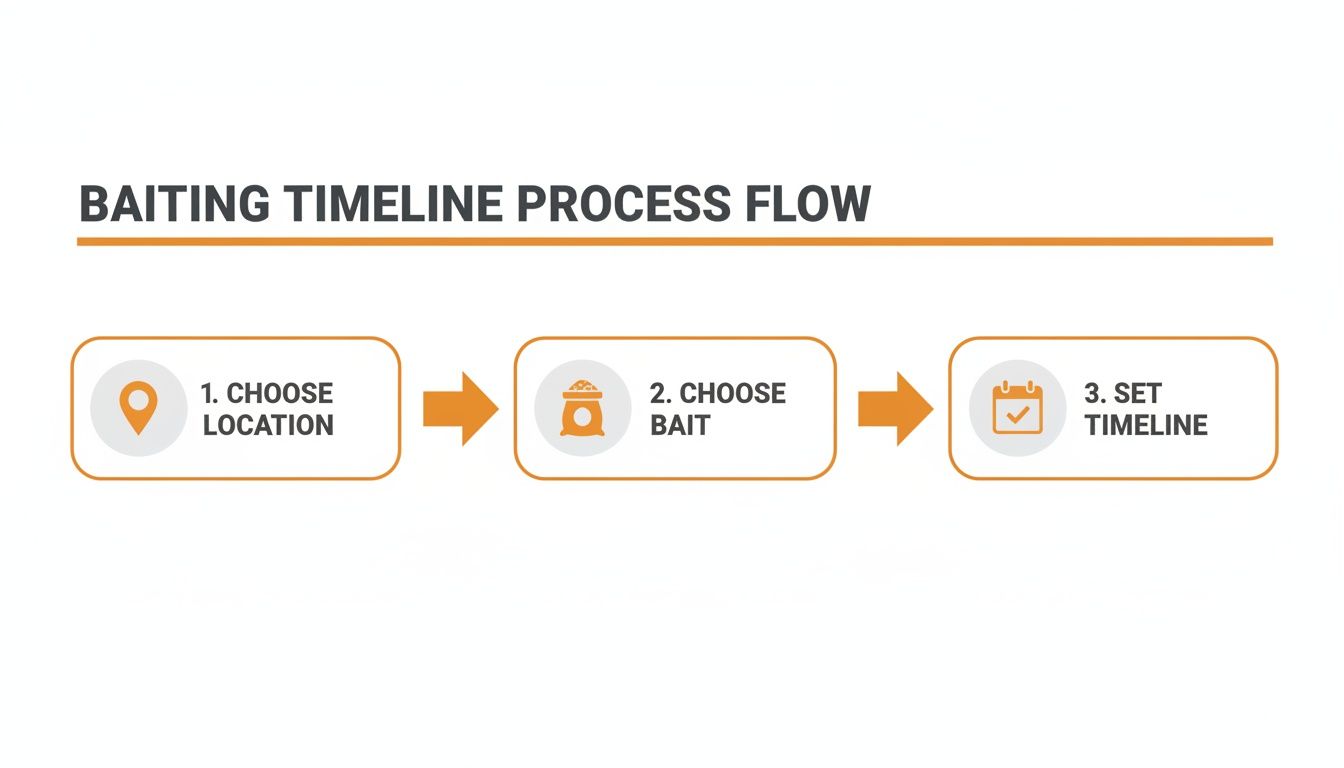
Following this sequence helps you lay the right groundwork before you ever put bait out, which is key to conditioning deer effectively.
Understanding How Baiting Changes Deer Behavior
Dropping a high-value food source into the woods fundamentally changes how deer move. Research on white-tailed deer shows that baiting often makes them expand their home ranges while concentrating their activity during twilight and nighttime hours—often at the expense of daytime movement.
This is exactly why remote scouting tools are so valuable. A cellular camera like the Magic Eagle EagleCam 5 with AI detection can ping you with real-time alerts, helping you pinpoint those rare daylight visits. A detailed study on deer space use confirms these behavioral shifts, and you can read the full study to dive deeper into the science.
The most common mistake I see hunters make is setting up their stand right on top of the bait. Mature bucks are incredibly cautious. They'll almost always circle downwind of a bait site, scent-checking for danger before they even think about committing. They might hang back in cover 50 to 100 yards away, waiting for darkness to fall.
Your best move is to use your trail camera data to pinpoint the main approach trails. Then, set your stand 20 to 40 yards downwind of the bait, overlooking one of those trails. This lets you catch a buck while he’s staging in cover and still feels safe—long before he ever makes it to the bait pile itself.
Mastering Remote Scouting with Cellular Trail Cameras
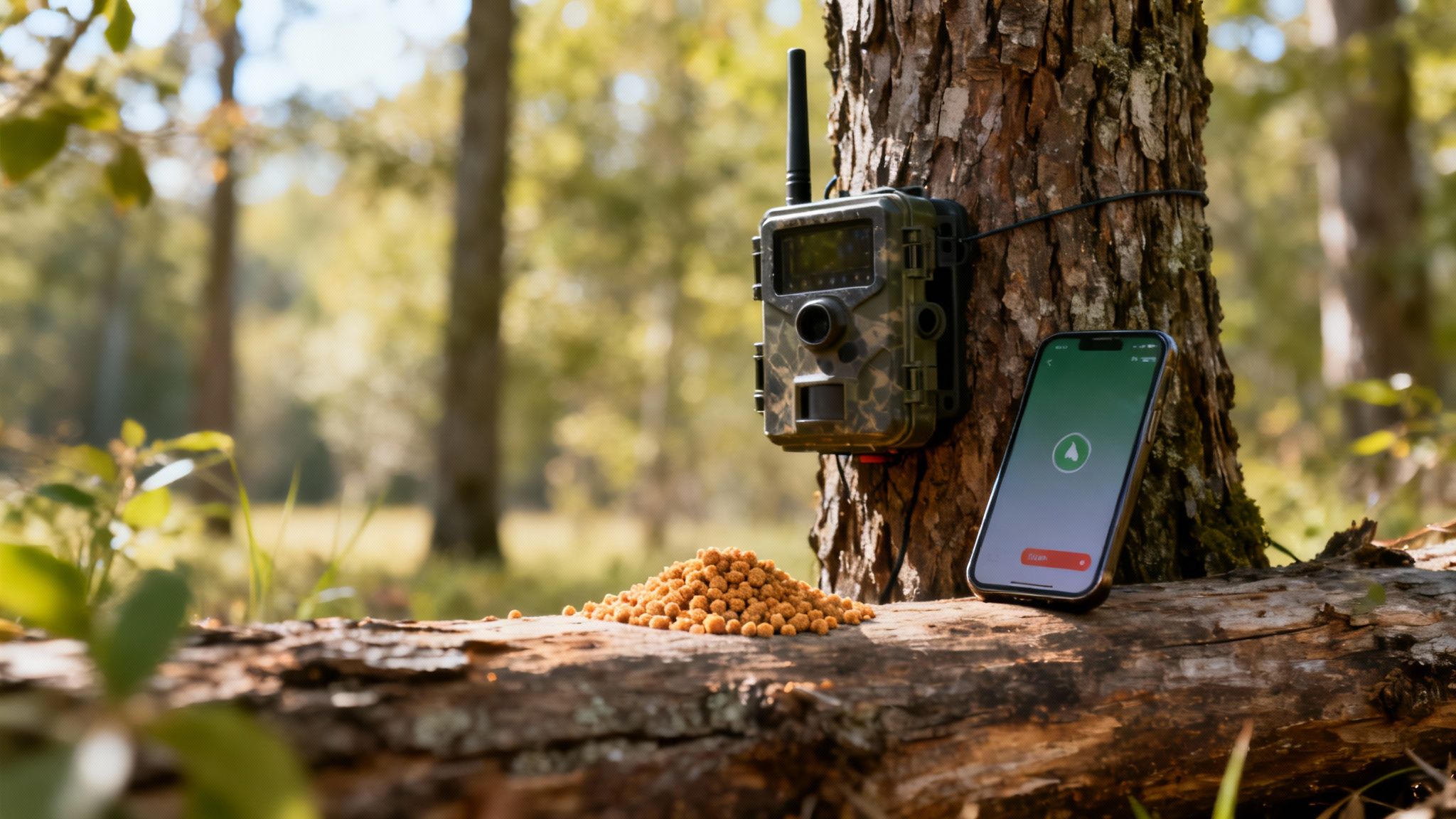
Let's be honest, the best intel wins hunts. Getting a bait site established is just the first step; the real advantage comes from gathering intelligence 24/7 without spooking every deer in a half-mile radius. This is exactly where a good cellular trail camera earns its keep, turning a simple pile of corn into a data-rich scouting hub.
The whole point of a baiting for deer strategy is to keep human pressure to an absolute minimum. Every time you stomp in to pull an SD card, you're leaving scent and making noise. You're teaching that mature buck to become nocturnal. A cellular camera like the Magic Eagle EagleCam 5 completely sidesteps that problem by beaming photos and videos straight to your phone.
Optimizing Your Camera Setup
You can't just slap a camera on the nearest tree and expect great results. Proper placement is everything. You need to think like a photographer, paying attention to light, angles, and how a deer is most likely to walk in.
For the best intel at a bait site, try these guidelines:
- Height: Mount your camera at about chest height—somewhere around three to four feet off the ground. This gives you a great broadside view for judging antler size and body condition.
- Angle: Resist the urge to point the camera directly at the bait. Instead, angle it to cover the main trails leading to the site. This way, you catch deer as they approach, not just when their head is buried in the feed.
- Direction: Whenever you can, face your camera north or south. Pointing it east or west guarantees you'll get blown-out, overexposed images at sunrise and sunset, which is prime time for deer movement.
Hunter's Insight: A rookie mistake is setting the camera too close to the bait. For a standard lens, about 15 to 20 feet away is the sweet spot. It gives you a wide enough field of view to see multiple deer at once and even observe how they interact with each other.
Turning Raw Data into a Winning Strategy
The real magic of a cellular camera isn't just seeing what's hitting your bait; it's using that stream of information to build a smart, data-driven hunting plan. Modern apps, like the one for MAGIC EAGLE, are built to turn a simple image into actionable intelligence. It goes way beyond just getting a picture of a buck.
With a system like this, you can start building an inventory of your local deer herd almost immediately. The app’s AI species recognition does the tedious work for you, automatically sorting photos of bucks, does, and those pesky raccoons. Once you start identifying specific bucks, you can build a virtual "hit list" right inside the app.
Building Your Digital Scouting Map
Here’s where it all comes together. The most powerful feature is the ability to create an interactive map of your hunting property, turning scattered photos into a coherent pattern.
Inside the app, you can drop pins for all your key locations:
- Tag Your Camera: Pinpoint the exact location of your Magic Eagle EagleCam 5.
- Mark Your Bait Site: Drop another pin right on your feeder or bait pile.
- Log Buck Sightings: When that target buck shows up, you create a pin on the map showing exactly where he was spotted. Over time, this creates a heatmap of his core territory.
- Plan Your Stand Locations: Armed with that data, you can now map out the perfect stand locations to intercept that buck on his preferred travel routes.
This process turns your phone into a central command center for your hunt. You're not just guessing where a buck might be; you're building a visual database of his daily habits. It’s the modern way to scout—more efficient, far less intrusive, and ultimately, much more successful. For a deeper look, you can learn more about how do cellular trail cameras work and the tech behind this game-changing strategy.
Protecting Your Gear and Maintaining Herd Health
Setting up a productive bait site is a serious investment of time and money. Once you've got deer hitting it consistently, the last thing you want is your expensive camera walking off or your efforts accidentally harming the local herd. That’s why protecting your equipment and the deer population should be top priorities for any responsible hunter.
Smart baiting isn't just about throwing corn on the ground; it's a proactive approach to both security and stewardship. It means making sure your gear stays put and that the deer you're managing stay healthy for seasons to come.
Securing Your Expensive Equipment
There's nothing more frustrating than hiking back to your spot only to find a bare tree where your trail camera used to be. Trail cams and feeders are prime targets for thieves, so you've got to take a few common-sense precautions.
Simple concealment is your first line of defense. Instead of strapping your camera at eye level on the most convenient tree, try placing it higher up and angling it down. Use surrounding branches or brush to break up its outline. For feeders, just picking a spot that isn't easily seen from a road or public trail can make all the difference.
Beyond just hiding it, physical security adds another critical layer of protection.
- Security Boxes: These heavy-duty steel cases are built to enclose your trail camera, making it a real pain for someone to steal without serious tools and time.
- Cable Locks: A solid python-style cable lock can cinch both your camera and its security box tightly to the tree, stopping a casual thief looking for an easy grab.
- Disguise and Camouflage: Never underestimate the power of good old-fashioned camo tape. You can even use natural elements like mud and leaves to help your equipment blend right into the environment.
Hunter's Insight: For real peace of mind, modern tech offers the best solution. The Magic Eagle EagleCam 5 comes with a built-in anti-theft suite, including GPS tracking and geofence alerts. If your camera gets moved outside a boundary you set, you get an instant notification on your phone, letting you track its exact location.
Responsible Baiting and Herd Health
Concentrating deer at a bait site brings an ethical responsibility to protect their health. When multiple deer feed nose-to-nose in a small area, they can easily pass diseases like bovine tuberculosis (bTB) or Chronic Wasting Disease (CWD) through saliva left on the bait.
The good news is, you can dramatically reduce these risks with a few smart practices. Scientific modeling has shown that even simple changes, like reducing bait pile density by 50%, can significantly slow disease transmission over time. You can dig into the research on how baiting impacts disease dynamics to get the full picture, but the takeaway is simple: avoid creating one big, crowded feeding trough.
Instead, try these simple and effective strategies:
- Spread It Out: Don't dump everything in one massive pile. Use multiple, smaller bait sites spread across your property to disperse the deer and minimize direct contact.
- Keep It Clean: Every so often, clean out your feeders to get rid of old, moldy feed and other junk. A clean "restaurant" is a healthy one.
- Choose the Right Feeder: Trough-style feeders basically force deer to eat shoulder-to-shoulder. A spinner feeder that broadcasts corn over a wider area is a much healthier choice, as it encourages them to forage naturally.
By taking these thoughtful steps, your baiting for deer strategy becomes a sustainable practice. It benefits both you and the local herd, ensuring you'll have great hunting opportunities for years to come.
Common Questions About Baiting for Deer
Every hunter, from the seasoned veteran to the weekend warrior, bumps into questions when trying to dial in a deer baiting strategy. You can follow every step perfectly, but deer behavior is never completely predictable. Here, we’ll tackle some of the most common questions with direct, field-tested answers to help you troubleshoot problems and hunt with more confidence.
Getting a handle on the nuances of deer behavior is what separates a frustrating season from a successful one. These insights will help you adapt when things don't go exactly as planned.
How Long Does It Take for Deer to Find a New Bait Site?
The discovery time for a new bait site can range from just a few hours to several weeks. A few key factors are at play here, including your local deer density, how close the site is to known travel corridors, and how potent your initial attractant is. If you set up along a heavily used trail between bedding and a food source, deer might find it that very first night.
But in a more secluded area, it could take a week or more for them to stumble upon it during their natural browsing. Consistency is your best friend here. To speed things up, try using a strong scent attractant, like a molasses drip or a commercial scent spray, right when you establish the site. This helps the wind carry the invitation much farther than the bait's scent alone can.
A cellular trail camera is invaluable during this phase. It gives you instant proof the moment the first deer shows up, saving you from making unnecessary trips that just leave your scent all over the place.
Should I Hunt Directly Over the Bait Pile?
Hunting directly over a bait pile is rarely the best move, especially if you’re after a mature, cautious buck. Wary deer, particularly the older ones, will almost always hang back in the safety of cover to observe a bait site from a distance. They might scent-check the area for a long time or simply wait until the last sliver of shooting light—or after dark—before they commit.
A much better tactic is to position your stand or blind 20 to 50 yards downwind of the bait, covering one of the primary approach trails. This lets you intercept a buck as he stages, feeling secure in cover while he checks out the scene.
Hunter's Insight: Use your trail camera data to your advantage. Don't just look at the pictures from the bait pile itself. Dig into the timestamps and the direction deer are coming from. This will reveal their preferred routes, letting you set up for a high-percentage shot on an animal that has no idea you're there.
Will Baiting Make Deer Completely Nocturnal?
This is a huge concern for many hunters, and it's not a simple yes or no. Baiting can shift deer activity toward nighttime, but it's almost always human pressure that makes a deer go fully nocturnal. If you repeatedly visit a bait site during peak movement times, make a racket, or fail to control your scent, deer will quickly learn the area is dangerous during the day.
The solution is to make your presence as minimal and predictable as you can. A remote scouting system is the single best tool for making that happen.
- Minimize Visits: Use a large-capacity feeder that only needs to be refilled every few weeks.
- Time Your Refills: When you do have to go in, do it during the middle of the day (11 a.m. to 2 p.m.) when deer are least active.
- Scout Remotely: A cellular camera eliminates the need to pull SD cards, which is one of the biggest sources of pressure at any bait site.
By keeping human intrusion to an absolute minimum, the bait site becomes a trusted, safe food source, not a danger zone. This is what encourages more activity during legal shooting light and turns all your hard work into a real hunting opportunity.
Transform your scouting from guesswork to a precise, data-driven operation with Magic Eagle. The EagleCam 5 gives you the remote intelligence you need to monitor your bait site without pressure, pattern mature bucks, and hunt smarter.