

If you’ve ever wondered where a deer sleeps, you’re not alone. Many people picture a hidden den or a cozy cave, but the truth is much simpler and a whole lot smarter. Deer don’t have permanent homes. Instead, they sleep in simple depressions on the ground called beds, often tucked into thickets, tall grass, or on sheltered hillsides.
The Secret World of Deer Beds
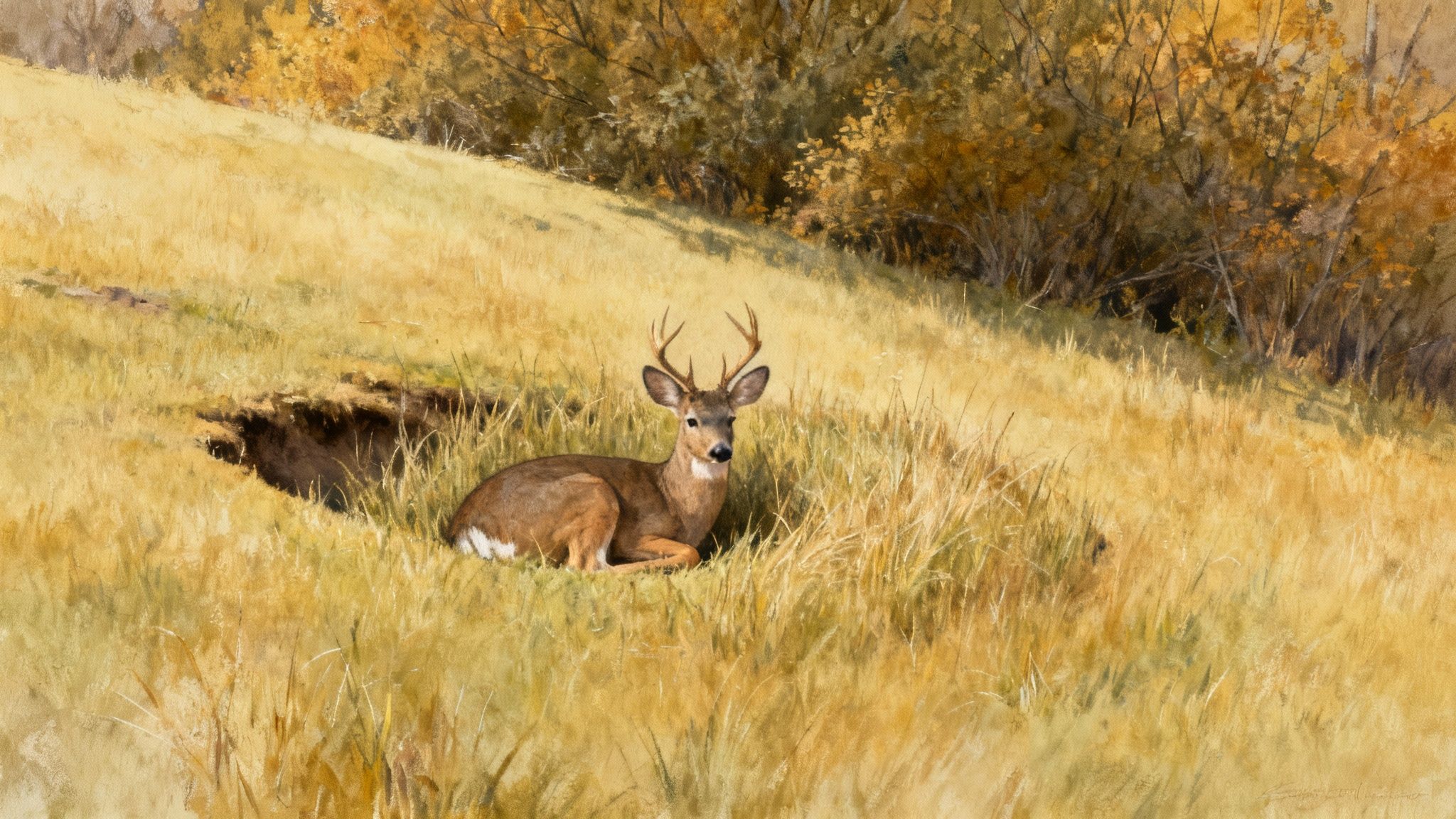
To really understand where deer bed down, you have to think like a deer. Their bed isn’t just a place to rest—it’s a carefully selected tactical position built for survival. Think of it less like a comfortable bedroom and more like a soldier’s foxhole, offering maximum protection with a clear advantage.
Every single bedding location serves a purpose, balancing the need for cover, warmth, and a quick escape route. These sanctuaries are the epicenter of a deer's world, providing a safe haven from predators and the elements.
Why Bedding Locations Are So Important
For a prey animal like a deer, choosing the right bed is a life-or-death decision. They instinctively pick spots that offer key survival benefits, turning a simple patch of ground into a fortress.
These advantages almost always include:
- Concealment: Thick brush, clusters of saplings, or tall grasses hide them from the prying eyes of predators like coyotes and humans.
- Thermal Regulation: In the winter, they’ll seek out sunny, south-facing slopes to soak up warmth. Come summer, they’ll find cool, shaded areas with good airflow to beat the heat.
- Wind Advantage: This is a big one. Deer almost always bed with the wind at their back. This lets them smell danger approaching from behind while they keep their eyes peeled for threats in front.
A whitetail’s bedding area is its sanctuary. The decision of where to sleep is dictated by an ancient formula of security, energy conservation, and environmental awareness. It’s the epicenter of their world.
For instance, whitetails often favor south-facing slopes to capitalize on the sun’s warmth, which can provide 20-30% more solar heat during their prime midday rest period. Once they find good spots, they use them over and over, creating established "bedding grounds" with multiple beds. If you want to dive deeper, you can find more great insights about deer sleeping habits on nathab.com.
For anyone interested in wildlife—from hunters to researchers—unlocking the secrets of these bedding areas is a game-changer. Knowing where deer sleep provides priceless insight into their daily patterns and core territories. Thankfully, modern tools like cellular trail cameras now allow us to observe this private world without intrusion, offering a respectful way to learn their routines and protect their essential habitats.
To break it down even further, here's a quick look at the core principles of deer bedding.
Deer Bedding Habits at a Glance
This table sums up the key characteristics of deer bedding behavior, locations, and timing to help you quickly get up to speed.
| Aspect | Description | Why It Matters for Scouting |
|---|---|---|
| Location Type | Ground depressions in thick cover, on hillsides, or in tall grass. Not a permanent "den." | Focus on areas with thick undergrowth and strategic terrain, not open fields. |
| Primary Goal | Survival. Beds are chosen for concealment, wind advantage, and thermal regulation. | Look for spots that offer deer a tactical advantage—wind at their back, view in front. |
| Seasonal Shifts | Winter: Sunny, south-facing slopes. Summer: Shaded, breezy areas. | Adjust your scouting locations based on the season and prevailing weather patterns. |
| Bed Signs | Oval-shaped, matted-down depressions in grass or leaves. Often found in clusters. | Learning to identify fresh versus old beds tells you if deer are currently using an area. |
| Timing | Deer bed down multiple times a day, typically for 30-60 minutes at a time. | Midday is a prime bedding time, making it a good period for quiet scouting. |
Understanding these fundamentals is the first step toward successfully finding where deer spend most of their time. It’s all about putting the pieces of the puzzle together.
Understanding a Deer's Sleep Schedule
To figure out where deer sleep, you first have to understand when they sleep. A deer's sleep schedule isn't anything like ours. Forget long, deep periods of rest. Theirs is a masterpiece of survival engineering, built around quick naps and constant, hair-trigger awareness. They don't run on a simple day-and-night clock; the twilight hours rule their world.
Deer are crepuscular, a fancy word meaning they're most active during the low-light hours of dawn and dusk. This is go-time for feeding and moving. Logically, that means their main rest periods happen when they're least active—smack in the middle of the night and, more importantly for anyone scouting, right in the middle of the day.
The Midday Siesta
The hours between roughly noon and 4 p.m. are when a deer settles in for its deepest rest. They pull back into their safest, most secure bedding areas to chew their cud, save energy, and completely disappear from the world. For a hunter or a researcher, this predictable habit is a massive piece of the puzzle.
Knowing this schedule opens up a huge opportunity. Now, you should never bust directly into a known bedding area—that’s a cardinal sin. But scouting the downwind fringes of these zones during midday can give you an incredible amount of information. It's the one time you're least likely to bump a deer that's up and moving, giving you a chance for a low-impact peek into their sanctuary.
A Cycle of Constant Alertness
Even when a deer is "sleeping," it's never truly off the clock. Their rest is less like a deep slumber and more like a series of hyper-alert power naps. It’s a brilliant strategy for dodging predators, keeping them ready to explode into action at the faintest sound or shift in the wind.
A deer’s sleep is a paradox: they rest to survive but can never fully let their guard down. This state of semi-awareness means they are processing their environment even while bedded, making a stealthy approach nearly impossible.
This unique sleep pattern is incredibly efficient. Deer are masters of the dawn and dusk, but they bed down hard between noon and 4 p.m. All told, they might get up to 12 hours of rest, but it comes in tiny, 30-minute cycles. Within those cycles, they doze for just 30 seconds to 3 minutes at a time before their eyes flicker open and their ears twitch to scan their surroundings. They're processing intel even while lying down, which makes catching one completely off-guard a fool's errand. You can learn more about these fascinating deer sleep patterns and habitats from a-z-animals.com.
Understanding this rhythm is the key. It’s why a mature buck can seem to materialize out of thin air—he was likely bedded down nearby, watching and listening long before you ever knew he was there. By respecting their midday siesta and tailoring your scouting to their schedule, you can gather the intel you need without ever tripping their finely tuned alarm system.
How Seasons Change Where Deer Sleep
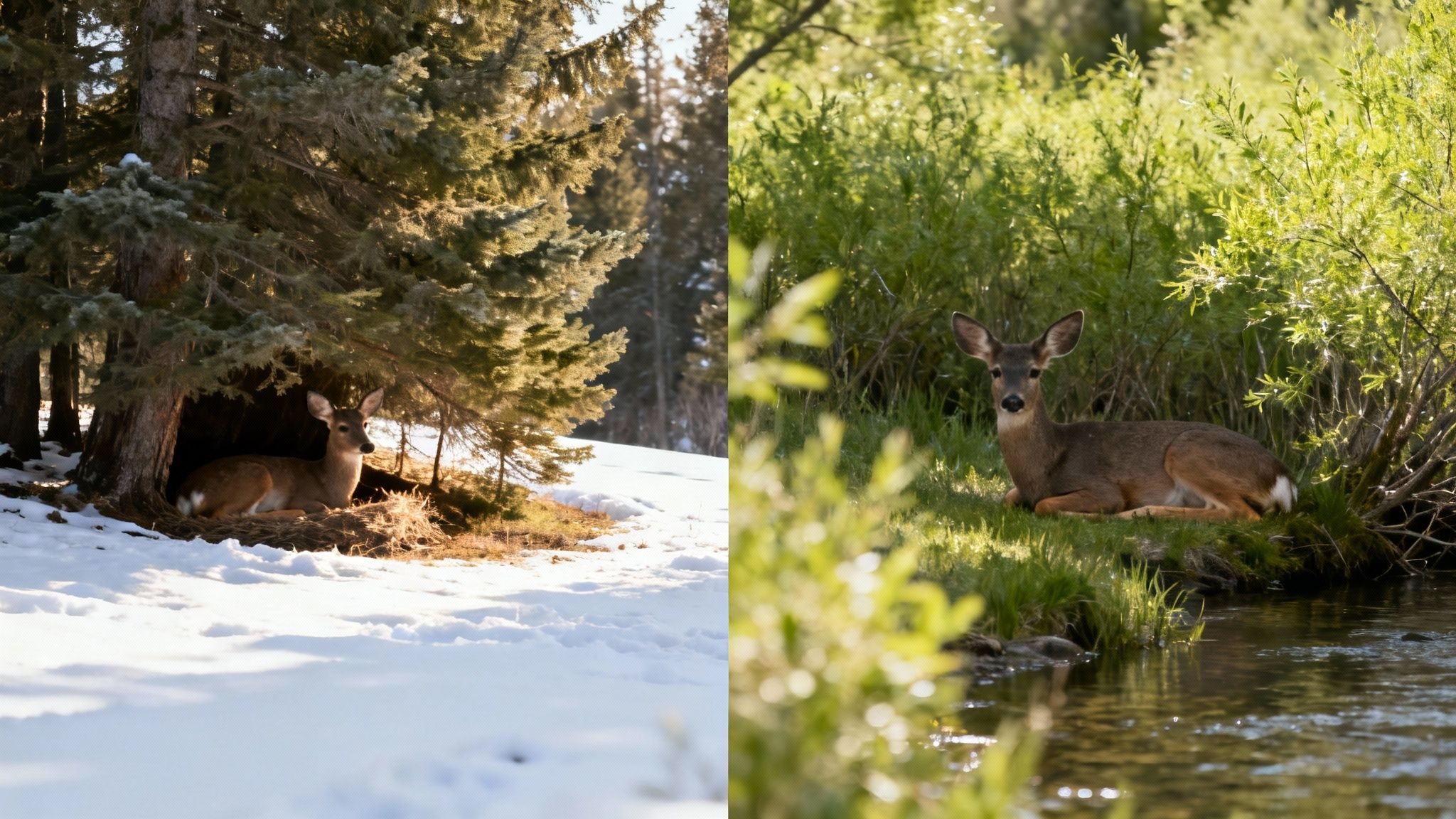
A deer's choice of a bedroom is a masterclass in survival, and you can see it plain as day in how their spots shift with the calendar. It’s all about conserving energy. They are constantly making calculated moves to find pockets of cover that give them the best thermal advantage, whether that's escaping the summer sun or surviving a blizzard.
Think of it like a person finding a sunny park bench on a chilly day. Deer do the same thing, just on a much bigger scale. They use the landscape to manage their body temperature, and it’s a core survival instinct. Staying warm or cool without burning precious calories is the name of the game.
It's not just about natural cycles, either. Human activities like forestry land clearing practices can completely reshape the landscape, forcing deer to rethink where they bed down.
Winter Bedding Strategy
When winter’s bitter cold sets in, a deer’s top priority is finding warmth and shelter from the wind. They become absolute experts at finding microclimates that offer a huge advantage over exposed areas.
Their go-to winter bedding spots often include:
- South-Facing Slopes: These hillsides catch the most direct sunlight all day long. This melts the snow faster and warms the ground underneath. A deer bedded here can soak up the sun's energy, saving a ton of calories it would otherwise burn just to stay warm.
- Thick Conifers: Dense stands of pine, spruce, or hemlock are nature’s insulators. The thick canopy catches snow, keeping the ground clearer, while the dense branches create a fantastic windbreak. It's crucial protection during a nasty storm.
Summer Bedding Strategy
Once the temperatures start soaring in summer, the entire strategy flips. Now, the goal is to beat the heat and get away from biting insects. Cool, breezy locations suddenly become prime real estate for a deer’s afternoon nap.
During the hot months, you’ll often find deer tucked away in:
- North-Facing Slopes: The exact opposite of their winter preference. These shaded hillsides stay much cooler all day and hold more moisture, making for a comfortable place to rest.
- Areas with Good Airflow: Ridge points, creek bottoms, and other spots that catch a steady breeze are gold. The airflow helps keep deer cool and gives them a break from flies and mosquitoes. Having water nearby is a huge bonus. If you want to learn more about how weather impacts deer, check out our guide on whether deer move in the rain.
The rut changes everything. A buck's focus shifts entirely from personal comfort to finding does. His bedding choices become temporary and tactical, often in less-than-ideal cover simply because it gives him the best vantage point to keep an eye on things.
This seasonal shift is a constant chess match between the deer and the elements. By learning to read the weather and the terrain, you can start to think like a deer and get a step ahead of where they’ll be seeking refuge.
How to Find a Deer Bedding Area
Alright, let's move from the whiteboard to the woods. Finding where a deer beds down is all about learning to see the world through their eyes. It’s less about stumbling upon a single spot and more about reading the subtle clues in the landscape and connecting the dots.
The most obvious sign, of course, is the bed itself—a distinct, oval-shaped depression in the leaves, grass, or snow where a deer has laid up. But you’ll rarely find these out in the open. They’re almost always tucked away in the thickest, nastiest cover you can imagine.
Think about it from a survival perspective. A mature buck isn’t just looking for a comfy spot to nap. He’s a master of tactical positioning. He’ll almost always pick a spot with the wind at his back and a clear view in front of him, giving him a powerful, built-in alarm system against anything approaching from downwind.
Reading the Landscape and Signs
Your first step is to scout for likely bedding cover. Forget the open hardwoods for now and focus on areas with dense undergrowth, overgrown clear-cuts, marshy cattails, or benches on hillsides that give a deer a commanding view. Once you’re in a promising area, you need to slow way down and start looking for more than just the beds themselves.
These key signs will tell you you’re getting warm:
- Heavy Trails: When you see multiple trails converging and funneling into a thick patch of cover, that’s a dead giveaway. These are the daily commute routes from feeding to bedding areas.
- Clusters of Droppings: Finding a high concentration of droppings in a small, secure-feeling area is a strong indicator that deer are spending a lot of time there resting, not just passing through.
- Rubs and Scrapes: A line of fresh rubs leading into thick cover is a buck’s way of marking the path to his sanctuary. Finding rubs and scrapes near thickets is one of the best confirmations that a buck is bedding nearby.
A single deer bed could just be a random napping spot. But when you find clusters of beds, heavy trails leading into impenetrable cover, and concentrated droppings, you’ve found more than just a bed—you’ve found a deer’s home base.
Doe Beds vs. Buck Beds
It's also crucial to understand that not all bedding areas are created equal. Doe family groups often bed together for safety in numbers. You’ll usually find their bedding areas in slightly more open cover with multiple escape routes, and you'll see several smaller, oval beds clustered together.
A mature buck, on the other hand, is a solitary creature who prioritizes seclusion and security above all else. His bed will almost always be a single, larger depression located in the most tangled, impenetrable cover he can find. When you crawl your way into a hard-to-reach spot and find that lone, oversized bed, you can be confident you’ve located a mature buck’s personal sanctuary.
Scouting Bedding Areas With Trail Cameras
Once you've zeroed in on a potential bedding area by reading the landscape, it’s time to let technology become your silent partner. Trail cameras are the key to confirming a buck’s presence and learning his routine without ever stepping foot inside his sanctuary. It's the ultimate low-impact approach, letting you gather critical intel while the deer remain completely undisturbed.
The absolute golden rule here is to stay on the perimeter. I can't stress this enough. Never, under any circumstances, march in and slap a camera on a tree overlooking a bed or deep inside the thicket. You'll get busted, and that mature buck you're chasing will be gone, likely for good.
Think of it like being a security guard monitoring the access points to a building. Your job isn't to be inside the room, but to watch the doors. By focusing your cameras on the trails leading into and out of the bedding area, you can see who’s using it and when, all from a safe distance.
Placing Your Cameras for Success
Effective camera placement is all about intercepting a deer's path. Those funnels and heavily beaten-down trails you found earlier? Those are your spots. You want to set up your cameras to watch the "front door" of the bedding zone without being too obvious.
Here are a few battle-tested tips for setting up your observation posts:
- Pinpoint Entry and Exit Trails: Find the most worn-down trails leading into that thick cover. These are a buck's daily commute routes, and they're exactly where you want to be watching.
- Pick the Right Tree: Choose a tree that's about 10-20 yards off the trail. This creates just enough distance so the camera's shutter click or infrared flash doesn't spook a cautious buck.
- Get the Angle Right: Don't point the camera straight down the trail. Instead, angle it roughly 45 degrees to the path of travel. This gives the sensor a wider window to detect movement and captures a much better profile shot as the deer walks by.
This flowchart is a great way to visualize how all the pieces of the puzzle—trails, rubs, and beds—fit together.
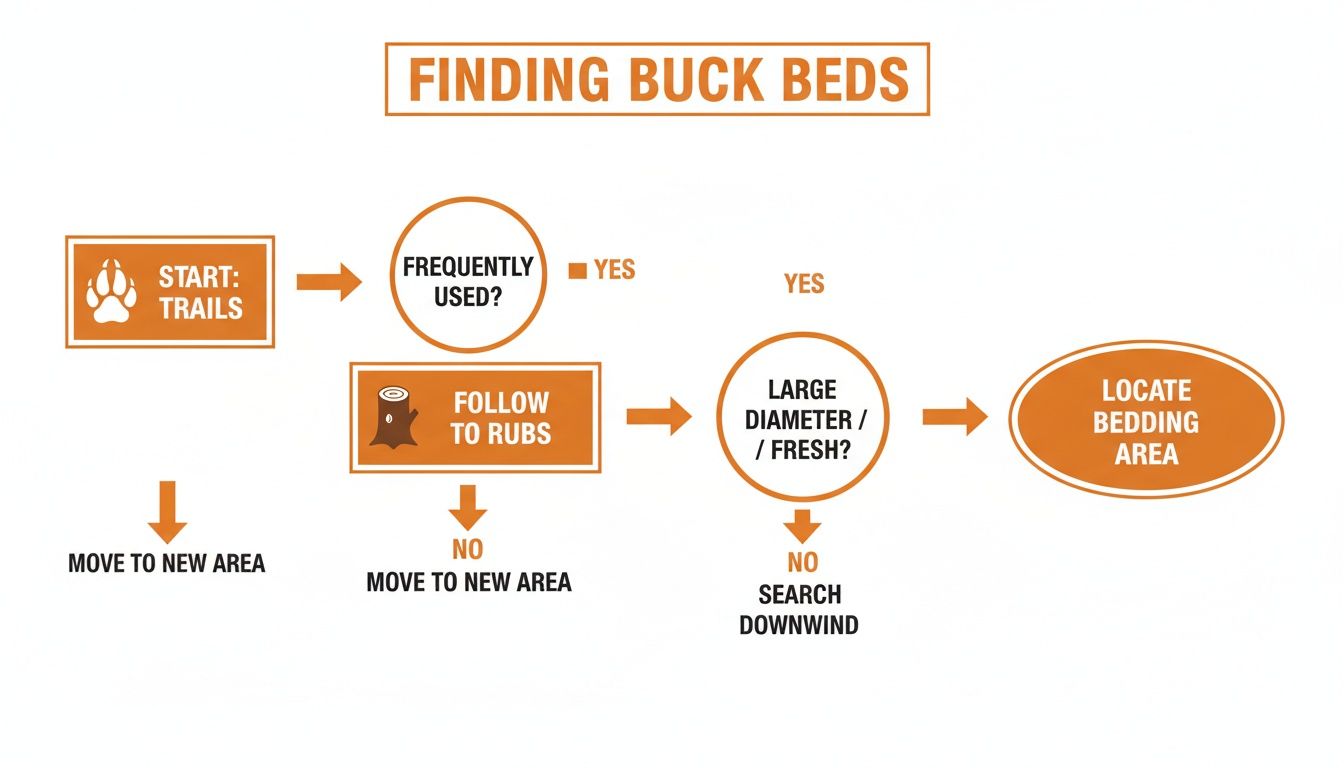
As you can see, finding the trails is your first step. Following those trails leads you to the rubs, which ultimately points you toward that secluded bed you're looking for.
Optimizing Your Camera Settings
The right camera settings can make or break your scouting. The goal is to get clear, useful information—not hundreds of pictures of squirrels and swaying branches.
For monitoring trails near bedding areas, these are my go-to settings:
- Mode: I prefer a 3-shot burst in photo mode. It gives you multiple angles of a buck, which is a huge help for positive identification and getting a good look at his rack.
- Trigger Speed: A fast trigger speed is non-negotiable. Aim for 0.5 seconds or less to get crisp images of deer on the move.
- Sensitivity: Set your motion sensor to normal or low. This cuts down dramatically on false triggers from small critters or wind-blown leaves.
Choosing the right camera strategy depends on your goals and how much you want to avoid disturbing the area. Here’s a quick breakdown of your options.
Trail Camera Strategies for Bedding Areas
| Placement Strategy | Pros | Cons | Best For |
|---|---|---|---|
| Perimeter Trail Monitoring | Low-impact, captures movement in and out. | May miss deer using other trails. | The standard approach for confirming use without applying pressure. |
| Mock Scrape Monitoring | Draws bucks in, great for inventory and rut activity. | Requires creating a mock scrape, which adds human scent. | Pre-rut and rut scouting when bucks are actively checking scrapes. |
| Time-Lapse (Field Scan) | Covers open areas leading to bedding. | Can generate thousands of images. Requires a lot of battery. | Monitoring food plots or fields adjacent to bedding zones. |
Ultimately, sticking to the perimeter trails is the safest and most reliable bet for year-round scouting. It gives you the information you need with the least amount of risk.
The real game-changer in modern scouting is the cellular trail camera. It beams photos directly to your phone, which means you never have to walk in to pull a card. This is the pinnacle of low-impact observation, letting you monitor a buck's core area in real time without ever leaving your scent behind.
By using your cameras wisely, you can piece together a buck's entire routine—when he gets up, which trail he takes, and when he heads back to bed—all while he has no idea you're even there. If you're new to this tech, our complete guide on how to set up a trail camera is a great place to start.
Scouting Bedding Areas Ethically and Safely
Finding a deer’s bed is a huge breakthrough for any hunter, but that knowledge comes with some serious responsibility. You've just stepped into their sanctuary, and how you act from here on out will determine whether you gain valuable intel or just blow them out of the area for good.
The number one rule is simple: leave no trace. Think of yourself as a ghost.
Every trip you make into these areas has to be surgically precise. Only pull a camera card when the wind is perfect, blowing your scent far away from the bedding cover, not into it. Never, ever push into a bedding area during midday when they're most likely to be hunkered down. Your scent is an alarm bell—a mature buck might forgive you for smelling him in his bedroom once, but a second time? He's probably already looking for a new home.
Tread Lightly and Stay Safe
Low-impact scouting isn't just about being a good steward of the woods; it’s a tactical necessity. You have to respect a deer's home if you want them to stick around.
Here are a few key guidelines to live by:
- Minimize Your Footprint: Stick to hard ground, rocks, or creek beds whenever you can. Avoid leaving a stomped-down trail and a thick scent path for every deer to find.
- Limit Your Visits: Fewer trips are always better. One well-planned, stealthy visit is worth more than three careless ones that leave the area contaminated with human pressure.
- Use Remote Technology: This is where cellular cameras are worth their weight in gold. They feed you real-time intel without you ever having to set foot near the sanctuary. To dig deeper, check out our full analysis on whether trail cameras scare deer and the impact of scouting tech.
A bedding area isn't just a spot on a map; it's a deer's safe space. Repeated human intrusion sends a clear message that the area is no longer secure, forcing them to relocate their core territory.
Finally, don’t forget about your own safety. These sanctuaries are often located in the thickest, gnarliest terrain you can find. It's easy to get turned around. Always let someone know where you're going and when you plan to be back, carry a GPS or a reliable map, and be ready for whatever the woods throw at you.
Respecting the animal and the environment is the only way to ensure you can keep learning from them, season after season.
Your Top Questions About Deer Bedding, Answered
Even after years in the woods, certain questions about deer bedding pop up time and again. Getting these details right can be the difference between a successful season and bumping every deer off your property. Let's clear up some of the most common ones.
Do Deer Sleep with Their Eyes Open?
Not quite, but they’re never truly "asleep" in the way we are. A deer’s rest is more like a series of catnaps. They’ll close their eyes for a few minutes at a time, then flick them open to scan for danger before dozing off again. This cycle of light rest and high alert is a pure survival instinct.
A bedded deer is a coiled spring, constantly processing sounds and scents. This state of near-constant readiness is what makes a quiet approach on a bedded deer one of the toughest challenges in the woods.
It's why you'll almost never stumble upon a deer that looks deeply asleep. They are wired to explode from their beds in a split second at the first hint of a threat.
How Close Can You Get to a Bedding Area?
Here's the golden rule: never, ever walk into it. Your goal is to gather intel without intruding. A good rule of thumb is to stay 50 to 100 yards off the edge of the thick stuff, and always play the wind so your scent is blowing away from the area, not into it.
The smartest, most ethical way to scout these spots is with cellular trail cameras. It’s a zero-impact strategy that lets you learn a deer’s routine without ever leaving your scent or spooking them from their sanctuary. You get all the information without any of the risk.
Do Bucks and Does Bed in the Same Areas?
For the most part, no—especially outside the chaos of the rut. Does and fawns tend to bed together in family groups. They often choose locations with good visibility and plenty of escape routes, relying on safety in numbers.
Mature bucks are different. They're solitary animals that crave security above all else. A big buck will seek out the thickest, gnarliest, most remote cover he can find—places most predators (including us) would rather avoid. During the rut, he might crash near a group of does he’s keeping tabs on, but his primary fortress will always be separate and secure.
Scouting these sensitive sanctuaries without leaving a trace is what separates good hunters from great ones. Magic Eagle gives you that edge. Our AI-powered cellular trail cameras are your eyes in the woods, letting you pattern a mature buck from miles away. See how the experts monitor bedding areas ethically at https://magiceagle.com.