

Finding the best tree stand harness really comes down to a personal balance of safety, comfort, and mobility. There's no single "perfect" harness that works for every hunter out there, but the top choices all share a few key traits: certified safety standards, a lightweight design you can wear all day, and a fit that doesn't get in your way. The real goal is to find a system that feels like a natural part of your gear, not some clumsy thing you have to deal with.
Your Harness Is Your Most Critical Piece of Hunting Gear
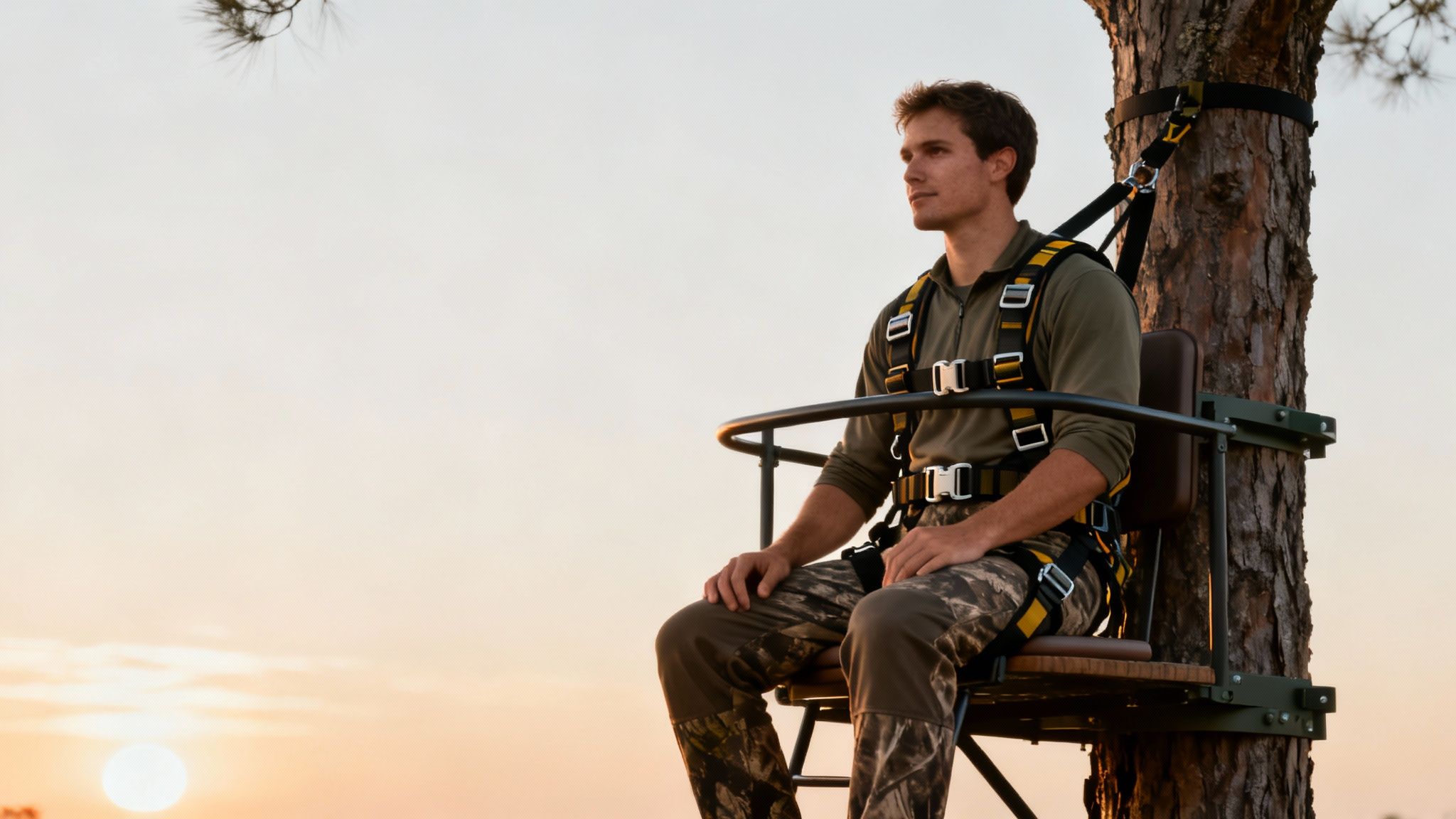
Before we get into the nuts and bolts of specific features, let's get one thing straight: your tree stand harness is the single most important piece of gear in your pack. It’s not an accessory. It’s not optional. It’s your non-negotiable lifeline.
Think of it like the seatbelt in your truck. Its presence is what separates a simple misstep from a life-changing accident.
This guide is built to shift your mindset. We're not just checking a box to say you own a harness. Instead, we're focused on helping you find the right fall arrest system for your specific hunting style—one that’s so comfortable and intuitive, you'll forget you're even wearing it.
Beyond Compliance to Confidence
A good harness does more than just catch you if you fall. It gives you the rock-solid confidence you need to put all your attention on the hunt. When you have complete trust in your gear, you can focus on scanning the timber, reading deer behavior, and setting up for the perfect shot without that nagging voice in the back of your head. That peace of mind is priceless.
The right system makes you a better hunter by getting rid of distractions. It lets you make those small, quiet adjustments in your stand, knowing you’re securely tethered from the moment your boots leave the ground until they touch back down. While your harness is a specialized piece of kit, it helps to be familiar with the principles behind all essential working at height safety equipment to truly appreciate what it does.
An Essential Tool for Success
Ultimately, the best tree stand harness stops being a piece of safety equipment and becomes a core hunting tool. It’s just as vital to your success—and your survival—as your bow, rifle, or binos. When you use it right, it becomes an extension of your preparedness, letting you hunt safely, confidently, and without compromise.
Your harness isn’t just about preventing a fall; it's about enabling a better, safer, and more focused hunt. It's the silent partner that ensures you come home safely every single time, making it one of the key hunter essentials every outdoorsman needs.
Decoding Tree Stand Harness Safety Standards
When you’re looking at tree stand harnesses, you’ll probably see labels from groups like the TMA (Treestand Manufacturer's Association). But what does a certification like that actually mean?
Think of it less like a brand’s marketing sticker and more like a crash-test rating for your safety gear. These standards aren't just polite suggestions; they represent a baseline of proven, life-saving performance. A certified harness has gone through a series of brutal tests designed to mimic the absolute worst-case scenario: a sudden, unexpected fall. Understanding what goes into these ratings helps you look past flashy features and focus on what really keeps you safe up in a tree.
What Goes Into a Safety Certification?
To earn a certification, a harness has to prove itself as a complete system. Testers don't just pull on a single buckle or a piece of webbing. They evaluate how every single component—from the stitching to the straps—works together under extreme stress. This holistic approach makes sure there are no weak links in the chain that’s supposed to save your life.
The key tests are pretty intense:
- Static Load Tests: The harness is hit with an immense, sustained weight. The goal is to ensure it can hold far more than the average hunter's body weight without any part of it failing.
- Dynamic Drop Tests: A weighted mannequin is dropped while wearing the harness to simulate a real, jarring fall. This measures how well the system absorbs shock and distributes the force, preventing both catastrophic failure and serious injury.
- Component Integrity Checks: Every single buckle, strap, and stitch is individually inspected. They're tested for durability, resistance to rust and corrosion, and how they perform under a heavy load.
These rigorous evaluations are exactly why choosing certified gear is non-negotiable. It’s the difference between a simple piece of equipment and a dedicated fall arrest system engineered to do one job: save your life. For a deeper dive into the principles behind this, general work health and safety guidelines offer a solid foundation on why these standards for protective equipment exist.
Why Industry Standards Matter More Than Ever
The focus on certified gear isn't just a hunting trend; it's part of a much bigger movement in both outdoor recreation and professional industries. The global fall protection equipment market is growing fast, driven by stronger safety regulations and a growing awareness of the risks involved.
The market was valued at $3.3 billion in 2026 and is on track to hit $5.1 billion by 2033. More importantly, harnesses are expected to be the leading product segment, which shows just how central they are to fall protection.
This growth is good news for us. It means more innovation, better products, and higher standards. When you choose a TMA-certified harness, you’re not just buying a product; you’re investing in equipment that has met an industry-wide benchmark for safety and reliability.
A safety certification is your guarantee that the harness has been independently verified to perform its one critical job: catching you when you fall. It’s the single most important factor to look for when choosing the best tree stand harness.
This verification process is what gives you the confidence to hunt from an elevated stand, knowing your gear has been pushed to its absolute limits and proven itself. It’s your silent, reliable partner that lets you focus on the hunt.
Full-Body Harness vs. Minimalist Designs
When you're choosing a safety harness, you're not just picking a piece of gear. You're making a decision about your entire hunting philosophy—how you balance safety, mobility, and comfort up in a tree. The choice between a traditional full-body harness and a more minimalist design isn't about which is "better," but which one fits your specific style and the stands you hunt from.
Think of a full-body harness as the most comprehensive safety system you can wear. It’s designed to wrap you up securely, distributing the violent force of a fall across your shoulders, chest, and thighs. Its main job is to keep you upright if the worst happens, giving you a fighting chance to self-rescue without succumbing to suspension trauma.
On the other hand, a minimalist design, like a sit-drag or a hunting saddle, is built for the hunter on the move. It’s incredibly lightweight and offers unmatched freedom of movement, perfect for the run-and-gun hunter who covers a lot of ground. But that freedom comes with a different set of rules and responsibilities when it comes to fall protection.
Let's break down the two main camps so you can see where you fit.
The Full-Body Harness: The Gold Standard for Safety
For the vast majority of hunters who use ladder stands, hang-ons, or climbers for long sits, the full-body harness is the undisputed champion. Its entire purpose is to function as a Fall Arrest System. That's a technical way of saying it’s engineered from the ground up to safely stop a fall that's already in progress.
The real magic is in how it spreads out the impact. During a fall, the harness webbing absorbs the shock across your entire torso, preventing a single point on your body from taking the full brunt of the force. This dramatically cuts down the risk of secondary injuries like spinal damage. More importantly, it holds you in a vertical position after the fall, which is the safest way to be while you figure out your next move.
- Best For: Hunters using fixed-position stands (ladder, hang-on), climbers, and anyone who puts maximum safety at the top of their priority list.
- Primary Advantage: Spreads fall forces across the body and keeps the hunter upright, which simplifies rescue and reduces the immediate risk of suspension trauma.
- Main Drawback: It can feel bulky or restrictive. Some hunters find this annoying and are tempted to wear it improperly—or not at all—which defeats the purpose.
Minimalist Designs: Kings of Mobility
Minimalist harnesses, which include both simple sit-drags and full-featured hunting saddles, are a completely different animal. They’re the go-to choice for saddle hunters and mobile hunters who hike deep into public land and set up fresh for every hunt. They are light, pack down small, and are easy to wear for miles. Many hunters also find that a good saddle is surprisingly comfortable for all-day sits. As you dial in your mobile setup, you might even pair it with specialized gear like a lightweight saddle hunting backpack.
But here's the critical difference you have to understand: how they behave in a "fall."
A saddle is less of a "fall arrest" system and more of a "fall prevention" tool. Because you hunt with virtually no slack in your tether, a slip isn't a drop—it's a swing. The system is designed to keep you from falling in the first place.
This approach is incredibly effective, but it demands a different mindset and skillset. There's no slack rope to catch you after a 6-foot drop; you're meant to be connected and under tension the entire time.
- Best For: Mobile hunters, dedicated saddle hunters, and archers who need total freedom of movement for tricky shots.
- Primary Advantage: Unbeatable mobility, lightweight design, and often praised for all-day comfort once you get the hang of it.
- Main Drawback: It takes more practice to use correctly and won't necessarily keep you in that safe, upright position after a fall event like a full-body harness will.
Full-Body Harness vs. Sit-Drag Harness Comparison
To make the choice even clearer, here’s a side-by-side look at how these two harness styles stack up across the features that matter most to hunters.
| Feature | Full-Body Harness | Sit-Drag Harness |
|---|---|---|
| Primary Function | Fall Arrest: Designed to safely stop and absorb the impact of a significant fall from a stand. | Fall Prevention: Designed to keep you tethered with minimal slack, turning a slip into a controlled swing. |
| Safety After a Fall | Excellent: Keeps the hunter in an upright, vertical position to aid breathing and delay suspension trauma. | Variable: The hunter may end up in various orientations, which can make self-rescue more complicated. |
| Mobility & Freedom | Good: Can feel somewhat restrictive, especially for archers needing to make awkward shots. | Excellent: Offers maximum freedom of movement for 360-degree shooting and all-day comfort. |
| Weight & Packability | Fair: Generally bulkier and heavier due to more webbing and padding. | Excellent: Lightweight, compact, and easy to pack for long hikes into remote areas. |
| Best Use Case | Ideal for fixed-position stands like ladder stands, hang-ons, and climbing stands where long sits are common. | Perfect for the mobile hunter, saddle hunting setups, and anyone prioritizing mobility and minimal gear. |
| Learning Curve | Low: Relatively intuitive to put on and use correctly. | Moderate to High: Requires more practice to master knots, tether management, and safe climbing techniques. |
Ultimately, there's no single "best" answer—only the best answer for you. If you're hunting from a permanent stand and want peace of mind, the full-body harness is an easy choice. If you're a minimalist who lives for the challenge of a mobile setup, a saddle might be your perfect match, provided you invest the time to learn the system inside and out.
How to Get a Perfect Harness Fit Every Time
An ill-fitting harness is just as dangerous as not wearing one at all. If the straps are too loose, the slack can turn a simple slip into a violent, jarring fall. Cinch them down too tight, and you’ll cut off circulation and struggle to draw your bow when the moment of truth arrives.
Nailing the perfect fit isn’t just about comfort—it's a non-negotiable safety step that makes sure your harness can do its job.
Think of it like getting a high-end backcountry backpack dialed in. A poorly adjusted pack will chafe, throw off your balance, and leave you with painful hot spots. But once you fit it to your body, it feels like a natural extension of your gear. Your harness is the same way; when adjusted correctly, it provides life-saving protection without ever getting in your way.
The goal is a fit that is snug but not restrictive. You want it tight enough to eliminate any dangerous slack but loose enough that you have a full range of motion, from climbing into your stand to making a shot.
This flowchart breaks down the decision-making process, showing how safety and mobility come together.
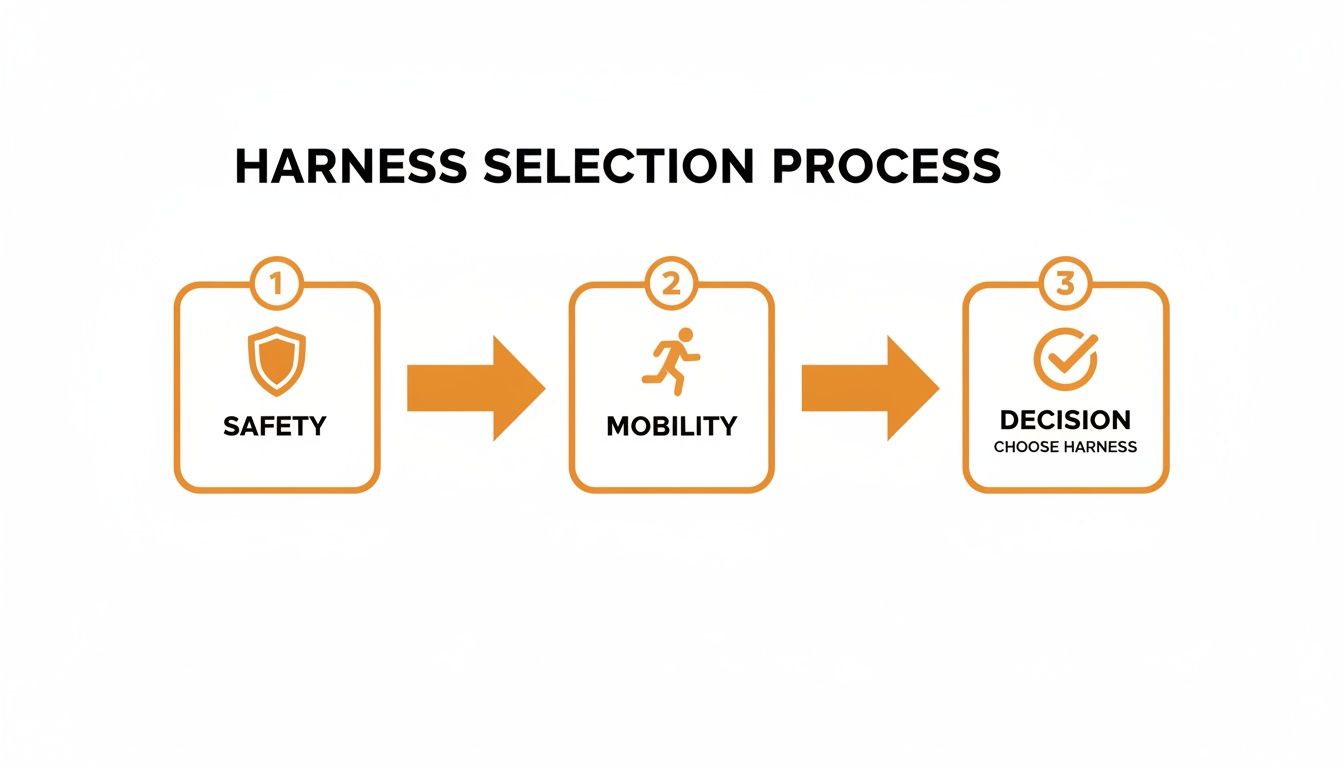
As you can see, the sweet spot for the best tree stand harness lies right at the intersection of proven safety and practical mobility, leading to a confident final choice.
Sizing It Up Before You Buy
The first step to a perfect fit happens long before you’re 20 feet up a tree. Harnesses are not one-size-fits-all, so start by checking the manufacturer's sizing chart. Most use your height and weight as a guide, and it's critical to follow their recommendations.
But a chart is just a starting point. Your body shape—and just as importantly, the clothes you hunt in—make a massive difference.
- Try It On Over Your Gear: Never, ever size a harness wearing just a t-shirt. Always try it on over the heaviest jacket and bibs you plan to wear on a frigid, late-season hunt. A harness that fits perfectly in September might be dangerously tight over bulky winter layers.
- Check for Adjustability: Look for a harness with plenty of room for adjustment in the shoulder, chest, and leg straps. That range is what allows you to get a safe fit whether you're out in the early season or bundled up for a cold snap.
This kind of attention to detail is becoming more important as hunters demand better gear. The global recreational safety harness market is projected to grow from $44.75 billion in 2026 to $54.5 billion by 2035. You can dig into the numbers and what they mean for hunters in the full recreational safety harness market report.
The Step-by-Step Adjustment Process
Once you have the right size, it's time to dial in the fit. You should run through this check every single time you put your harness on, because straps can and do loosen over time.
- Loosen All Straps: Before you even step into the harness, loosen every adjustment point. This gives you a clean slate to work from.
- Adjust the Leg Straps: Start with your legs. The straps should be snug but not so tight they cut off circulation or keep you from climbing. A great rule of thumb is the "two-finger rule"—you should be able to slide two flat fingers between the strap and your thigh, but no more.
- Secure the Chest Strap: Next, buckle the chest strap so it sits squarely across your sternum. When tightened, it should keep the shoulder straps from sliding off without pulling them inward or making it hard to breathe.
- Tighten the Shoulder Straps: Pull down on the shoulder strap adjustments until the harness fits snugly across your body. The dorsal D-ring (where your tether connects) should end up centered right between your shoulder blades.
Critical Fit Check: After everything is adjusted, try to pull the shoulder straps off your shoulders. If they slide off, the harness is too loose. A properly fitted harness will stay put no matter how you twist or turn.
Following these steps ensures there's no dangerous slack in the system. If you do fall, the harness will distribute the impact forces correctly across your body, protecting you from serious injury. This entire routine takes less than a minute, but it’s one of the most important safety checks you’ll ever do.
Your Pre-Hunt Inspection and Maintenance Routine
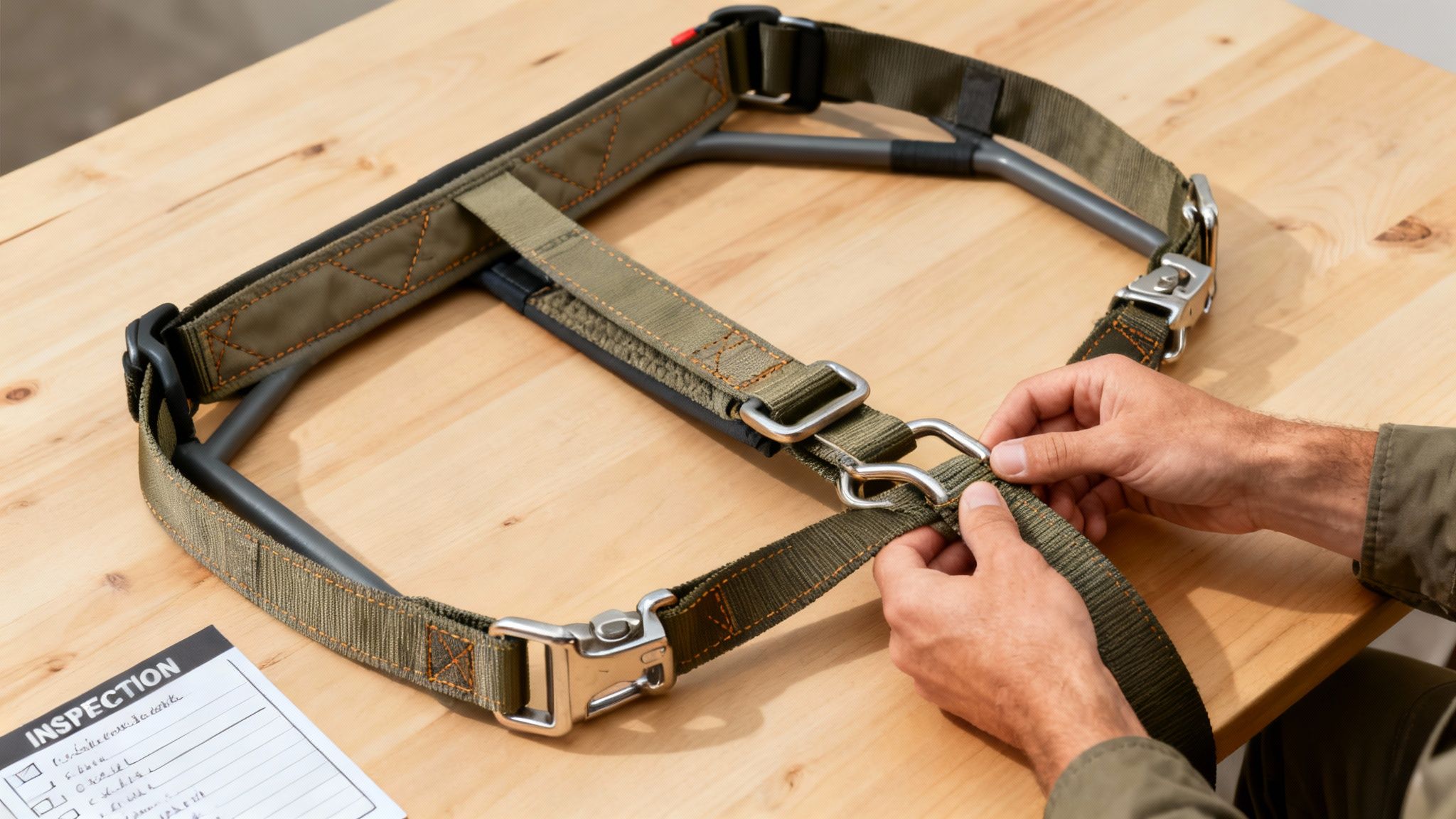
Treating your harness with respect starts long before you ever clip into a lifeline. You can own the best harness on the market, but it’s completely useless if it's been neglected. Think of this like a pilot’s pre-flight checklist—it's a simple, non-negotiable routine you must perform before every single hunt.
This isn’t just a quick glance. It's a hands-on inspection where you’re actively searching for the subtle signs of wear that could lead to catastrophic failure. Your life depends on catching these problems on the ground, not finding out about them 20 feet up a tree.
Thankfully, this level of diligence is becoming the norm. Treestand safety harness usage has climbed to roughly 80% among dedicated hunters. This shows just how seriously hunters now take fall protection, making routine checks more critical than ever. You can dig into more data on this and other key hunting industry statistics to see how safety has become a core part of modern hunting.
The Visual and Tactile Checklist
Grab your harness and find a well-lit spot. A good inspection uses both your eyes and your hands, since some damage is easier to feel than to see.
Go over every inch of the webbing, stitching, and hardware with this methodical approach:
- Check the Webbing: Look for cuts, burns, or fuzzy, frayed spots, especially around buckles and connection points. A great trick is to bend the webbing into a tight "U" shape to expose any hidden cracks or wear.
- Feel for Brittleness: The sun’s UV rays are a harness's worst enemy. Run the straps through your hands. If the material feels stiff, brittle, or has faded badly, that’s a clear sign of sun damage. Retire it immediately.
- Examine the Stitching: Pay close attention to all stitched areas. Look for pulled threads, cuts, or places where the stitching looks like it's unraveling. These are the seams holding it all together.
- Inspect All Metal Hardware: Carefully check every single buckle, D-ring, and carabiner. You’re looking for rust, corrosion, cracks, or any weird bending or deformation. Buckles should snap together smoothly and securely with a solid click.
Proper Storage and Lifespan Awareness
How you store your harness is just as important as how you inspect it. After a hunt, never just throw it in the back of your truck or leave it hanging in a damp shed.
Your harness isn't just another piece of gear; it's life-saving equipment. Store it in a cool, dry place away from direct sunlight, chemicals, and extreme temperatures. A dedicated gear bag or a plastic tub in a closet works perfectly.
Finally, remember that every harness has an expiration date. Most manufacturers recommend replacing your harness every five years, no matter how good it looks. And if you ever take a fall in it, it must be replaced immediately—no exceptions. Mark the purchase date on the tag with a permanent marker and follow the manufacturer's rules. This isn't a suggestion; it’s a hard and fast rule for your safety.
Using Your Harness Correctly from Climb to Descent
Having a top-tier harness is just the starting point. The real safety net is using it correctly, every single time you hunt, without exception. This isn't just a good idea—it's a strict procedure that needs to become pure muscle memory.
There's one golden rule that governs everything you do off the ground: stay connected to the tree 100% of the time. No excuses, no shortcuts. From the moment your boots leave the dirt until they're firmly back on it, you should never be vulnerable.
Think of it less like an airbag that deploys after a crash and more like a guardrail on a mountain road. A properly used harness, along with lineman's belts and lifelines, is all about preventing a fall in the first place, keeping you stable and secure through the entire process.
The Lineman's Belt for Setup and Takedown
Ever try hanging a stand or climbing sticks while fumbling to keep your balance? It’s awkward and dangerous. This is exactly where a lineman's belt proves its worth. This simple, adjustable strap wraps around the tree and clips into the D-rings on the sides of your harness, giving you a solid, hands-free anchor.
Using it is simple but mission-critical:
- Wrap the belt around the tree as you get ready to climb.
- Clip it to the side D-rings, creating a loop you can lean back against, fully supported.
- As you move up, you just slide the belt up the tree ahead of you, cinching it tight before you take the next step.
This keeps you anchored while freeing up both hands to attach stands and steps securely. It's especially crucial when using a climber tree stand, offering the stability you need during that initial setup phase.
Lifelines: The Key to Every Ascent and Descent
Once your stand is hung, the lineman's belt has served its purpose. It's time for the safety lifeline to take over. A lifeline is simply a rope you attach high up on the tree (above your stand) with the other end secured near the base. A special prusik knot on the rope lets you slide a carabiner up and down the line as you move.
Here's the routine: you connect your harness tether to this prusik knot before you take your first step up. It stays connected until you're back on solid ground. If a rung is slick with morning dew or a climbing stick is covered in frost, this system catches you instantly.
A lifeline transforms your harness from a passive safety device into an active fall protection system. It eliminates the single most dangerous period for hunters—the climb up and down the tree—by ensuring you are never untethered.
Understanding and Preventing Suspension Trauma
Preventing the fall is goal number one, but knowing what to do if one happens is just as critical. If you do fall and are left hanging, a dangerous condition called suspension trauma can set in frighteningly fast. The pressure from the leg straps can restrict circulation, causing blood to pool in your legs and starving your brain of oxygen.
This is precisely why a suspension relief strap is a non-negotiable accessory. It’s a small, folded-up loop that you deploy after a fall. By stepping into it, you can use your leg muscles to stand up slightly, which takes the pressure off your arteries.
This simple action restores blood flow and buys you precious time to either self-rescue or wait for help to arrive. Never, ever hunt without one already attached to your harness.
Frequently Asked Questions About Tree Stand Harnesses
Even after you've done your homework on harness safety, a few specific questions always seem to pop up. This is where we clear the air with some direct, no-nonsense answers to the most common things hunters ask. Think of it as your quick-reference guide for those last-minute uncertainties before you head out.
How Often Should I Replace My Tree Stand Harness?
Most manufacturers will tell you to replace a harness every five years, and that's solid advice, even if it looks brand new. But here's the critical part: you must replace it immediately if it's ever taken the impact of a fall or shows any signs of wear and tear.
Look for things like frayed webbing, faded material from sun exposure, any corrosion on the buckles, or stitching that's starting to pull. That expiration date printed on the tag? That's a hard deadline, not a friendly suggestion.
A tree stand harness is just like a motorcycle helmet. Once it does its job by taking a serious impact, its internal structure is shot. It has to be retired from service right away, no exceptions.
Can I Use a Rock Climbing Harness for Hunting?
Absolutely not. It's a common question, but using a rock climbing harness in a tree stand is a dangerous mistake. They are built for completely different forces and situations. A climbing harness is made to handle dynamic, short falls and keep a climber in a comfortable seated position against a rock face.
A hunting safety harness, on the other hand, is a dedicated Fall Arrest System. It's engineered specifically to absorb the jolt from a static fall out of a stand. More importantly, it's designed to keep you upright. This vertical position is what prevents suspension trauma and gives you a fighting chance to self-rescue. Stick with a harness that's certified by the Treestand Manufacturer's Association (TMA) for hunting.
What Is a Suspension Relief Strap and Do I Need One?
Yes, you 100% need one. It's a non-negotiable, life-saving piece of gear. A suspension relief strap is a simple loop of webbing that you deploy after you’ve fallen and are hanging in your harness.
By stepping into this loop, you can use your leg muscles to stand up slightly, taking the pressure off the major arteries in your groin. This simple move stops blood from pooling in your legs, which is what causes suspension trauma—a condition that can turn deadly in minutes. It’s a cheap piece of insurance that buys you the critical time you need to recover or wait for help. It should be in every hunter's pack, every single time.
At Magic Eagle, we believe that smart, reliable gear is the foundation of every successful and safe hunt. Our cellular trail cameras provide the critical scouting intelligence you need to plan your time in the stand with confidence. Explore how Magic Eagle can give you a decisive edge this season.