

A climber tree stand is a brilliant piece of engineering that lets you "inchworm" your way up a tree using a simple two-piece system—a seat section and a standing platform. The whole design is built around your own body weight, using it to create a rock-solid grip that makes it a favorite for hunters who need to stay mobile.
The Mechanical Genius of a Climber Tree Stand
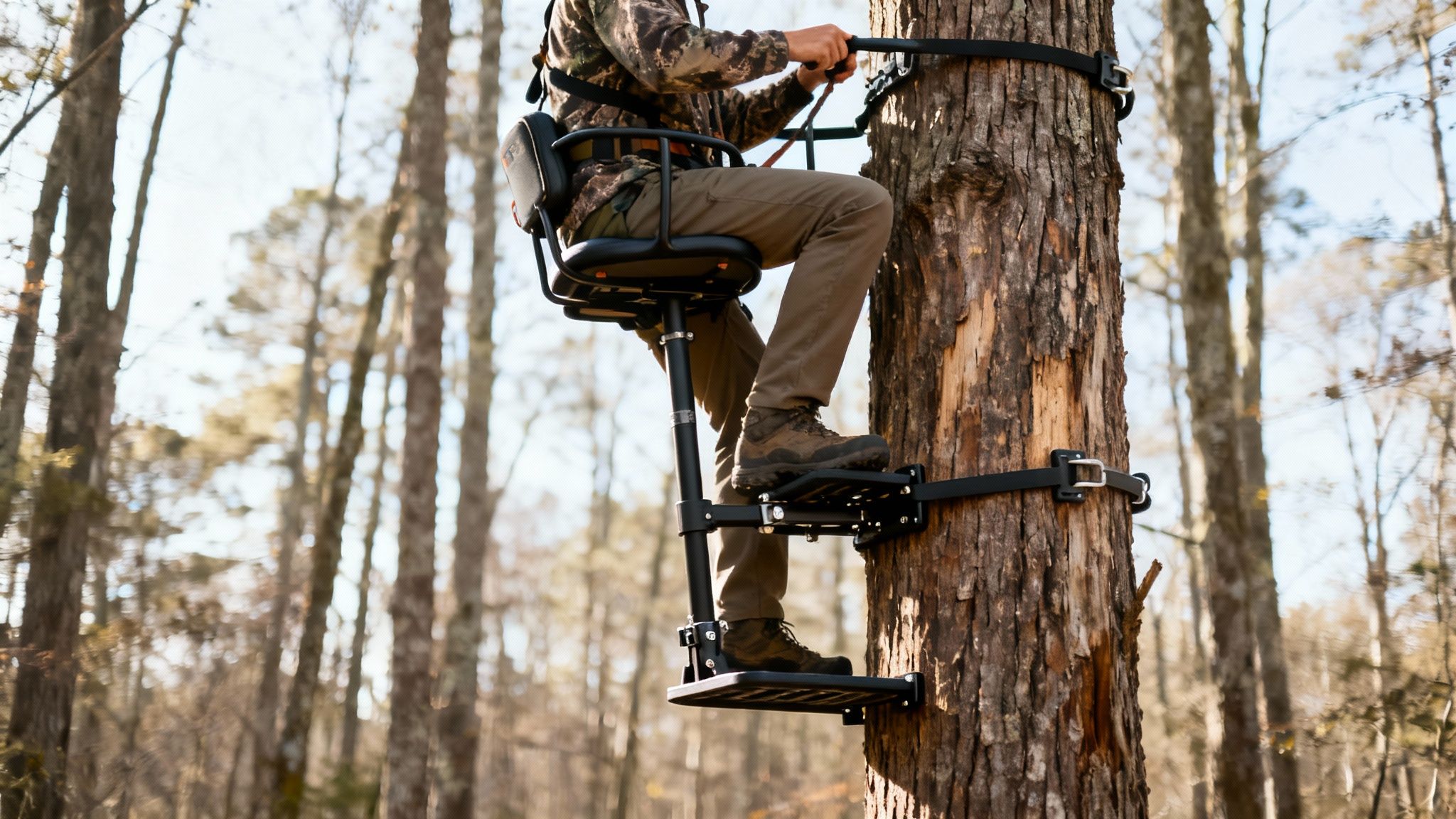
At its heart, a climber stand is a masterclass in applied physics. It turns your own movements into a secure climbing machine. Unlike a ladder or hang-on stand that stays put, a climber is built to move with you. It’s made of two separate but connected frames: the top frame (your seat) and the bottom frame (the platform you stand on).
Each frame has a tough, V-shaped bar or sharp "teeth" designed to bite into the tree's bark. The magic happens the second you put weight on it. When you stand on the platform, your weight drives that V-frame into the tree, creating an incredibly strong, non-slip grip. The same thing happens when you sit down on the top section—your weight locks it in place.
The Inchworm Motion Explained
Getting up the tree is all about a simple, rhythmic sequence: sit, lift, stand, raise. It might feel a little awkward at first, but after a few tries, it becomes second nature.
- Sit and Lift: You start by sitting on the top frame, which takes all your weight off the platform below. Now that the platform is unweighted, you just use your feet to lift it a comfortable step up the tree.
- Stand and Raise: Next, you stand up on the platform. This instantly locks it to the tree trunk and takes your weight off the seat. With the seat now free, you use your arms to slide it up the tree.
- Repeat the Cycle: You just keep repeating this "sit-lift, stand-raise" motion, working your way up the trunk until you hit the perfect hunting height.
This diagram breaks down that simple, effective motion perfectly.
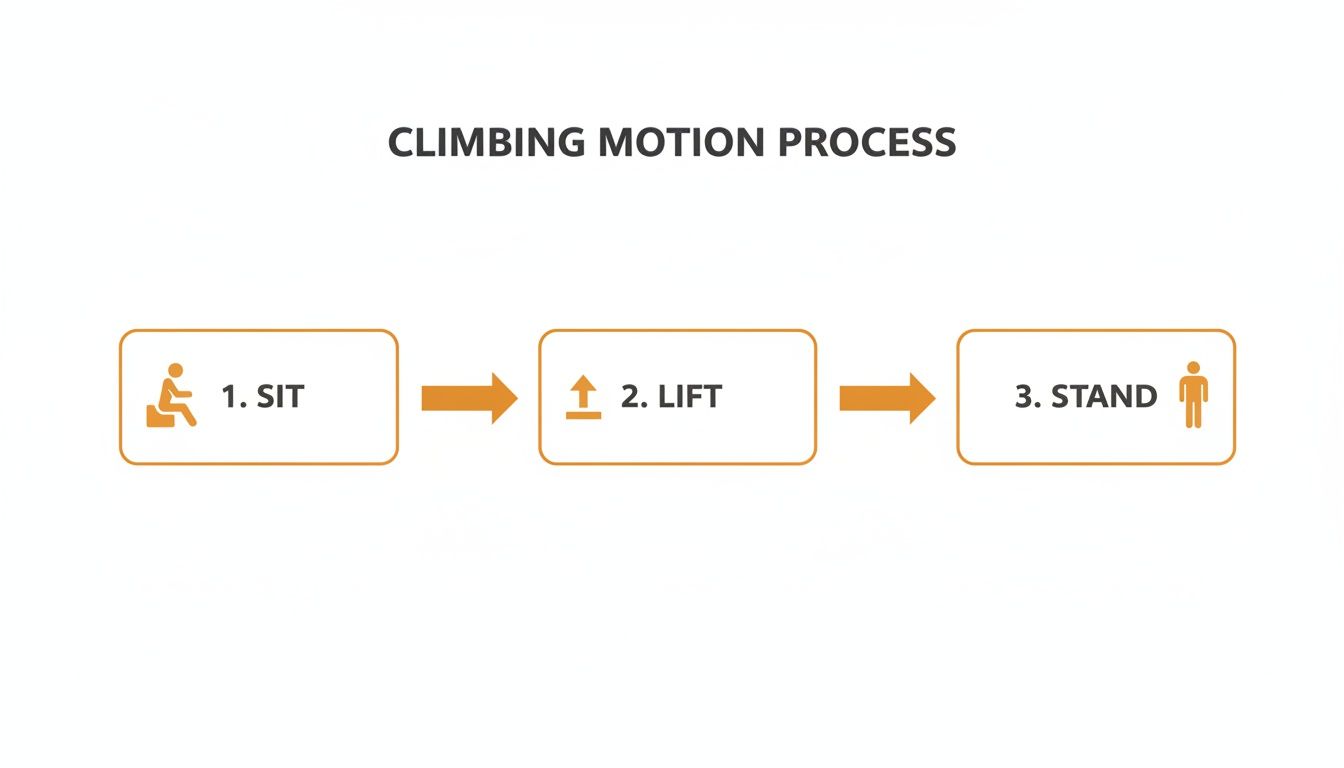
As you can see, it's all about shifting your weight between the seat and the platform to create a smooth, steady rhythm.
The Role of Cables and Straps
The two pieces are held securely to the tree with heavy-duty steel cables or rugged straps. These are the most critical connection between you, your stand, and the tree itself. It’s absolutely essential to inspect these for any fraying, cracks, or damage before every single climb.
A climber tree stand transforms your body into a simple machine. Your weight isn't just something the stand holds; it's the force that actively secures it to the tree, turning a potential liability into its greatest strength.
The angle you set the stand at when you start is also a huge deal. You need to attach the platform so it points slightly upward at the base of the tree. Why? Because most trees get narrower as you go up. This initial upward angle will naturally level out as you climb, leaving you with a perfectly flat, stable platform when you reach your hunting spot. Getting that starting angle right is the key to a safe and easy ascent.
Choosing the Right Climber Tree Stand for Your Hunt
Picking the right climber tree stand isn't just about buying a piece of gear; it's the very first strategic move you make for a mobile hunt. The market is flooded with options, but if you understand the key differences in materials, weight, and design, you can pick a stand that feels like a natural part of your hunting strategy—not a heavy burden you have to lug through the woods.
The most fundamental choice comes down to aluminum versus steel. Each material brings its own set of trade-offs that will directly shape your experience in the field. This decision really sets the tone for how you move, how you set up, and how you endure those long hours waiting for the perfect shot.
Aluminum Versus Steel: The Great Debate
Aluminum stands are the hands-down favorite for hunters who prioritize mobility and need to cover a lot of ground. They are significantly lighter, usually weighing between 15 to 25 pounds, which makes a world of difference on a mile-long trek into public land. Less weight means less fatigue and a quieter approach since you're not clanking and banging a heavy piece of metal against every branch.
Steel stands, on the other hand, are the workhorses. They’re heavier, tipping the scales at 25 to 35 pounds, but what they give up in portability, they more than make up for in rugged durability and a friendlier price tag. If your hunting spots are just a few hundred yards from the truck and you want a rock-solid feel under your boots, a steel climber is an excellent, budget-conscious choice.
This demand for specialized gear has fueled some serious market growth. The global tree stand market hit a value of $470 million in a single year and is on track to reach $710 million within the next decade. This boom is driven by better lightweight aluminum alloys and smarter ergonomic designs that make today's stands safer and more comfortable than ever.
The table below breaks down what you need to know when weighing these two options.
Climber Tree Stand Feature Comparison
When deciding between aluminum and steel, it's about matching the material to your personal hunting style. This table lays out the core differences to help you figure out which one is the right tool for your hunts.
| Feature | Aluminum Stands | Steel Stands | Key Consideration for Hunters |
|---|---|---|---|
| Weight | Typically 15-25 lbs | Typically 25-35 lbs | Lighter is better for long hikes and public land; heavier is acceptable for short walks. |
| Durability | Very durable but can be dented with extreme impact. | Extremely rugged and resistant to dents and bending. | Steel offers maximum toughness, while aluminum provides excellent durability for most hunting scenarios. |
| Cost | Generally more expensive. | More budget-friendly. | Your budget will be a major factor; steel offers great value for the price. |
| Noise | Can be quieter if well-maintained, but welds can sometimes creak. | Heavier frames can be more prone to noise if not secured properly. | Both require maintenance and careful packing to remain silent during transport. |
Ultimately, there's no single "best" material. The right choice depends entirely on where you hunt, how far you walk, and how much you're willing to spend.
Comfort and Carry Weight
Beyond the raw material, the small design details are what really dictate your comfort and how long you can stay sharp in the stand. A stand that’s miserable to sit in for more than an hour is a liability, plain and simple. Look for models with thick, padded seats, adjustable shooting rails, and platforms with enough room to subtly shift your weight and stretch your legs.
A great climber stand shouldn't just get you up the tree; it should allow you to forget you're even in a tree. Comfort equals stillness, and stillness equals success.
The carrying system is just as crucial. A stand with cheap, thin backpack straps will dig into your shoulders and turn even a short walk into a painful chore. Quality stands come with padded, adjustable shoulder straps and often a waist belt to help distribute the load, making the stand feel much lighter than it actually is.
Matching Your Stand to the Environment
Finally, the most critical factor is making sure your climber actually works with the trees in your hunting area. Climbers are specialists. They thrive in forests full of straight, limbless trees like pines, poplars, or mature oaks because they need a clean trunk to "walk" up safely.
Before you pull the trigger on a purchase, get your boots on the ground and scout your hunting spots. Take a hard look at the timber. If your woods are full of crooked hardwoods, trees with low-hanging branches, or shaggy-barked species, a climber might not be the right tool for the job.
You need a tree that is:
- Straight and Limbless All the way up to your desired hunting height.
- Within the Diameter Range Specified by the stand's manufacturer (too thin or too thick is a no-go).
- Healthy and Alive With firm bark that the stand's teeth can get a solid, secure grip on.
Of course, having the right gear is only half the battle. Successful hunting also comes down to smart preparation. You can learn more with these expert hunting season planning tips to make sure you're ready when opening day arrives.
Mastering Climber Tree Stand Safety Procedures
Using a climber is an incredible way to get a bird's-eye view of your hunting grounds, but that advantage comes with a serious responsibility. Safety isn't an afterthought or a "nice-to-have"—it's the single most important skill you need to master. Your well-being, and the success of every hunt, hinges on a disciplined and consistent safety routine.
Before you even think about leaving the ground, a thorough pre-hunt inspection is non-negotiable. Treat it like a pilot's pre-flight checklist. This ritual needs to become an unbreakable habit, something you do every single time you head into the woods.
The Pre-Climb Inspection Checklist
Your life literally depends on your gear's integrity. Take just five minutes to carefully go over every piece of your climber before you even think about attaching it to a tree.
- Cables and Straps: Look for any signs of fraying, cracking, or weathering. Give extra attention to the points where cables are crimped or attached—these are high-stress areas.
- Pins and Bolts: Are all your locking pins, nuts, and bolts in place and tight? A single missing pin could cause a catastrophic failure during your climb.
- Frame and Welds: Scan the aluminum or steel frame for any cracks, bends, or stress marks, especially around the welded joints.
- Backpack Straps: A quick check here ensures your stand won't shift or fall off your back on the walk in.
This quick but vital check can be the difference between a safe hunt and a life-altering accident.
Your Lifeline: The Full-Body Safety Harness
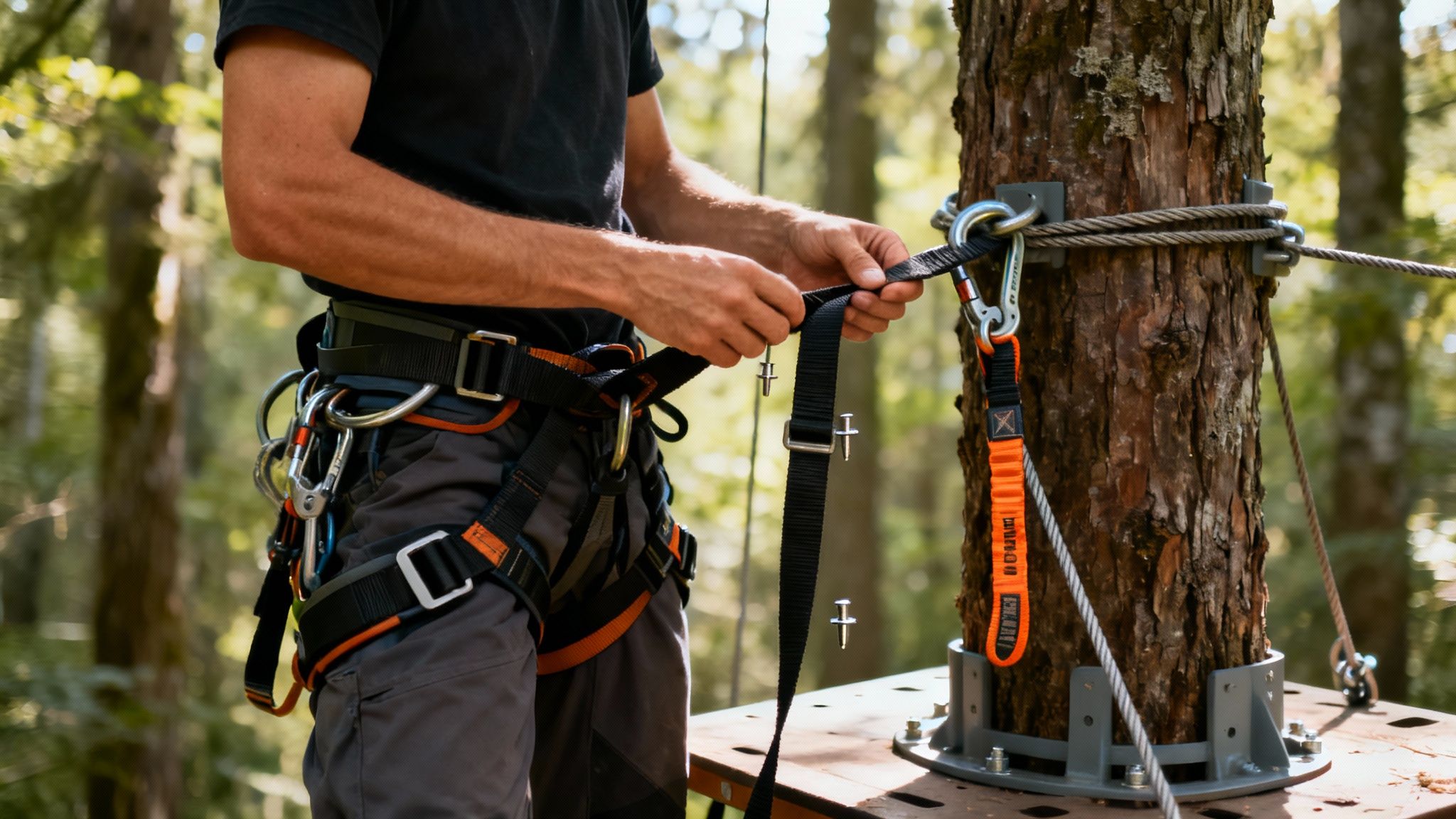
If your climber is the vehicle that gets you up the tree, your full-body safety harness is your seatbelt, parachute, and lifeline all rolled into one. Never, ever climb without it.
Tree stand falls are the number one cause of hunting-related injuries. A properly worn full-body harness is your primary defense, ensuring a slip doesn't turn into a tragedy.
Modern safety systems have been a game-changer. According to industry reports, the widespread adoption of full-body harnesses has slashed hunter fall incidents by up to 80% since the 1990s. This isn't just a recommendation; it's a proven lifesaver.
The golden rule of tree stand safety is simple: stay connected to the tree from the moment you leave the ground until you are safely back down. You do this with two key pieces of gear working with your harness.
- Lineman's Belt: This is an adjustable strap that goes around the tree, freeing up both of your hands to attach and set your stand at the base. It keeps you secure while you get ready to ascend.
- Tether and Prusik Knot: Once you're ready to climb, your harness tether connects to a rope running up the tree. As you climb, you slide a Prusik knot up the rope ahead of you. If you were to slip, that knot instantly cinches tight, stopping your fall.
Mastering Three Points of Contact
As you climb and descend, always maintain three points of contact with the stand or the tree. This means two hands and one foot, or two feet and one hand, should be stable and secure at all times. It's a simple technique that keeps you balanced and prevents a slip from turning into something worse.
Resist the urge to rush. A slow, steady, and deliberate climb is a safe climb. Most accidents happen because of haste, getting complacent, or cutting corners on these fundamental safety rules. This safety-first mindset should apply to all your gear. Our guide on using trail camera locking cables explains how to keep equipment secure, and that same discipline is critical here. By building a rock-solid safety routine, you can hunt with total confidence and peace of mind.
Your Step-by-Step Guide to Using a Climber Tree Stand
Turning that bundle of metal on your back into a solid, elevated hunting perch is a skill that takes practice. But once you get the hang of it, you’ll have a repeatable and efficient routine.
Mastering these steps isn’t just about safety—it's about stealth. A quiet, methodical setup keeps you from announcing your presence to every deer in the woods. Let's break down the entire process from start to finish.
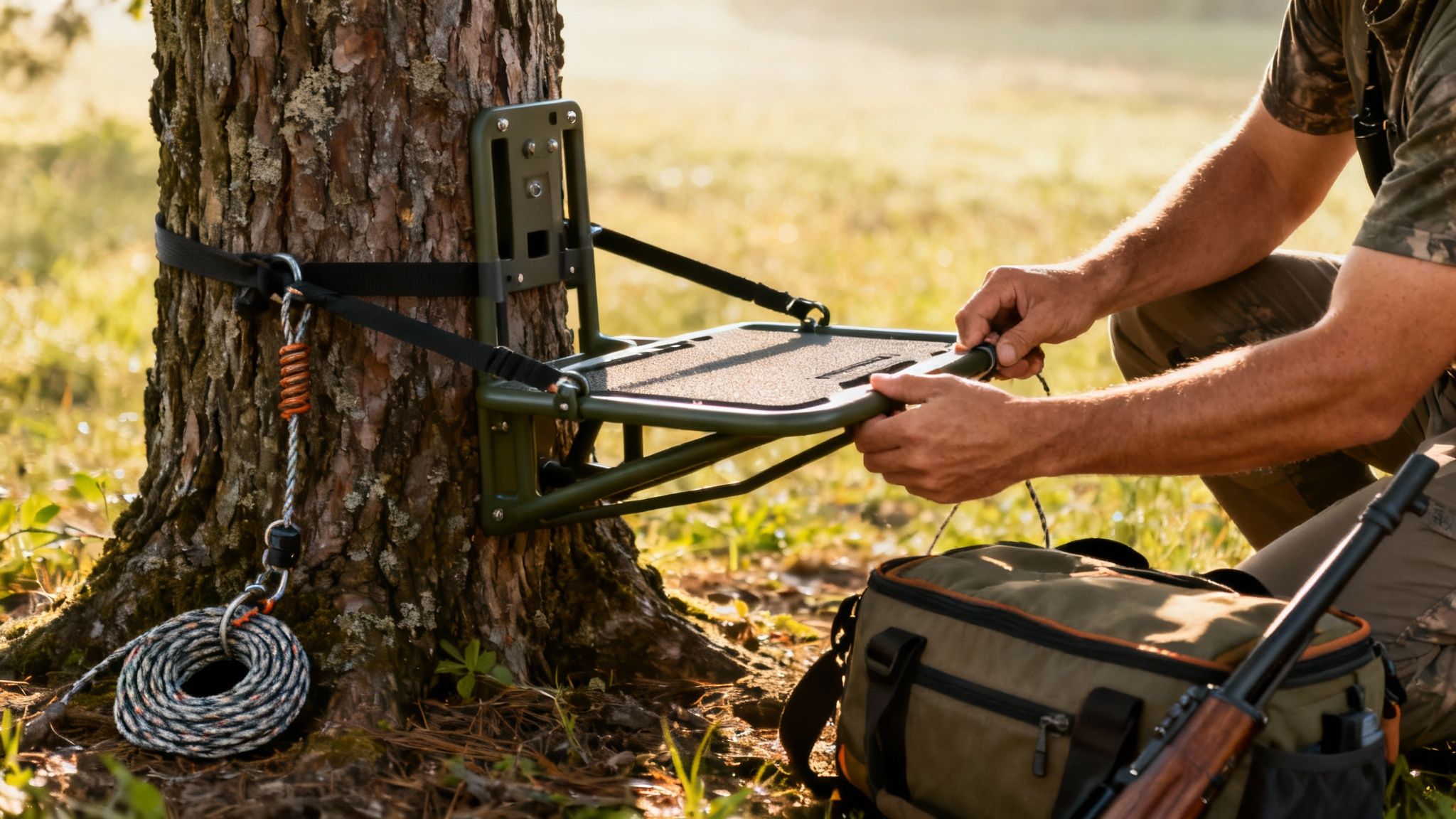
The real first step happens before you even leave the truck. Get your stand’s two sections nested and strapped down tight. Any metal-on-metal clanking during your walk-in is a rookie mistake you don't want to make.
Step 1: Selecting and Preparing the Perfect Tree
Choosing the right tree is the single most important decision you'll make. As we've covered, climbers need a straight tree with no low-hanging limbs and solid bark. Once you've picked your spot, the first thing you do is prep your workspace.
Quietly clear away all the leaves, twigs, and branches from the base of the trunk. This gives you a clean area to work and, more importantly, prevents that loud snap of a dry branch under your boot—a sound that travels a long way in a silent forest.
Step 2: Attaching the Stand Correctly
With the base cleared, it's time to get the stand on the tree. This is where getting the angle right is everything. It’s the difference between a smooth climb and a frustrating struggle.
- Harness Up First: Before touching the stand, put on your full-body safety harness. Secure your lineman's belt around the tree so you’re connected from the ground up. No excuses here.
- Attach the Platform: Unpack the two pieces of your climber. Wrap the platform’s cable around the tree and lock it in with the pin. The key is to angle the platform slightly upward to account for the tree's natural taper.
- Attach the Seat: Now, do the same with the seat section just above the platform, also angling it up. Make sure you leave enough room between the two pieces to stand up comfortably.
- Connect the Sections: Use the short tether strap to connect the top and bottom sections. This is a critical safety step that keeps the platform from falling away if it slips while you're seated.
Pro Tip: A common mistake is setting the stand perfectly level at the base. Trees get narrower as you go up, so a level start means you'll be tilting downward at hunting height. Always start with a noticeable upward angle.
Step 3: The Ascent and Hoisting Your Gear
Now for the climb. The movement is like an inchworm—slow, steady, and deliberate. Focus on rhythm, not speed. A quiet climb is a successful climb.
But before you start moving up, attach your gear to a hoist rope. Your bow, rifle, and backpack should never be on your back or in your hands while climbing. That extra weight messes with your balance and makes the ascent much harder and more dangerous. Our guide on hunter essentials lists the must-have gear you should be hoisting up.
Once you hit your desired height, lock in the stand and switch from your lineman’s belt to your harness tether. Now you can safely pull up your equipment.
It's also worth noting that many hunters are using hybrid setups, pairing a climber with climbing sticks, especially in areas with less-than-perfect trees. This niche is growing fast—the global climbing sticks market hit $315 million in one year. This hybrid method can cut down on setup fatigue by as much as 40%, which is huge when you consider that 90% of tree stand accidents happen during the climb or descent. You can dig into more climbing stick market trends on dataintelo.com.
Pairing Trail Cameras with Your Climber Setup
Take the mobility of a climber tree stand and add the 24/7 eyes of a cellular trail camera, and you’ve got a seriously potent scouting and hunting system. This combo lets you gather intel deep in the backcountry with almost zero disturbance, making your climber a tool for strategic strikes.
Think about it this way: your climber gets you into those tough-to-reach honey holes, and your cell camera acts as your silent scout, reporting back on what’s happening. You can confirm a hot scrape is still active before you commit to a long sit, saving you from wasting hours in a dead zone.
Strategic Camera Placement Using Your Climber
Your climber is more than just a hunting perch—it’s the perfect tool for getting cameras up where deer won’t spot them. A camera placed 10 to 12 feet up a tree and aimed down gives you a wider field of view and keeps it well out of a mature buck's line of sight.
This high angle also delivers a completely different kind of intel. You can see how deer use travel corridors, staging areas, and bedding transitions in a way ground-level cameras just can’t capture. It helps you build a true map of deer behavior, not just a snapshot of where they’ve been.
Here are a few pro tips for this setup:
- Mount It Securely: A camera that high up is already safer from theft. Lock it down with a quality mount so it doesn't shift or get knocked around by weather.
- Check Your Angle: Use the live view on your phone to make sure you've got a clean shot of the trail or scrape you’re watching, with no branches in the way.
- Kill Your Scent: Always wear gloves and use a scent-eliminating spray when handling your camera and mount. Don't leave your human smell all over the tree.
This simple trick transforms your climber from a hunting platform into a key part of your year-round scouting arsenal.
Your climber tree stand gives you access. Your cellular trail camera provides the intelligence. When used together, they allow you to make informed, data-driven decisions instead of hunting based on guesswork.
Correlating Data with Stand Locations
The real magic happens when you start linking your camera data directly to potential stand locations. The moment your camera pings your phone with a daylight picture of your target buck, your climber’s mobility lets you react instantly.
You can slip into that area, find the perfect tree downwind of the action, and be set up for an ambush with incredible speed. This "run-and-gun" style, fueled by real-time information, is what modern hunting is all about. You’re actively hunting, not just passively waiting.
To learn more about optimizing your camera placement, you can find in-depth information on specialized trail camera stands that can further enhance your setup.
Reducing Pressure and Hunting Smarter
One of the biggest wins with this system is how dramatically it cuts down on human pressure. Instead of tromping into your best spots every week to pull SD cards—bumping deer and leaving a trail of scent—you let the camera do the legwork.
This means you only go into a sensitive spot when you know it's the right time to strike. You keep your sanctuary areas clean and unpressured until the conditions are perfect. With a climber ready to go, you have the flexibility to capitalize on those moments without a permanent stand that deer might eventually pattern and avoid.
Climber Stands vs Other Stand Types
So, is a climber the perfect tool for every hunt? Not by a long shot.
The best hunters I know have one thing in common: they match their gear to the specific terrain, tree type, and hunting style that the day demands. A climber is a highly specialized piece of equipment. Understanding its strengths and weaknesses is the key to knowing when to use it—and when to leave it in the truck.
Think of a climber as the speed demon of the tree stand world. When the conditions are just right, nothing gets you up a tree faster. If you’re hunting a beautiful stand of straight, branch-free timber like a pine flat or a mature oak ridge, a climber is absolute king. Its mobility is why so many public land hunters and run-and-gun guys swear by them. You can react to fresh sign and be set up in a new spot in minutes.
But all that speed comes with a big string attached. With a climber, the stand picks the tree, not you. It demands a nearly perfect, limbless trunk inside a pretty specific diameter range. That can seriously limit your options, especially when the deer are hanging out in gnarly, thick cover.
Comparing Your Options
Let's break down how a climber really stacks up against the other major players in the tree stand game. Each one has its own role, and knowing which one to grab is what separates a good hunter from a great one.
To make it simple, here’s a quick-glance comparison of the different types of tree stands. This should help you figure out which one fits your hunting style and property the best.
Tree Stand Type Comparison
| Stand Type | Best For | Mobility | Stealth | Tree Requirement |
|---|---|---|---|---|
| Climber Stand | Speed and mobility in straight timber. | High | Moderate (can be noisy on ascent) | Straight, limbless trunks only. |
| Hang-On Stand | Versatility for almost any tree. | Moderate | High (once set) | Fits crooked, leaning, or branched trees. |
| Ladder Stand | Comfort, safety, and easy access. | Low | Low (bulky and permanent) | Any tree that can support the weight. |
| Box Blind | Maximum comfort and weather protection. | Very Low | High (offers total concealment) | N/A (freestanding or on a platform). |
As you can see, the climber tree stand fills a very specific niche. A hang-on gives you way more flexibility in tree selection, but you have to haul in a separate climbing method like sticks, which makes the whole setup process slower. Ladder stands are fantastic for permanent spots or for bringing new hunters along because they're so stable and safe, but you're not moving one mid-season.
Choosing a tree stand isn't about finding the single "best" one. It's about building an arsenal of options so you always have the right tool for the unique demands of the day's hunt.
Ultimately, it all comes down to where you hunt. If your property is a sea of straight-trunked hardwoods, a climber is a no-brainer. But if you spend your time in twisted river bottoms or thickets choked with limbs, a hang-on stand—or even a ground blind—is going to serve you far better. Most seasoned hunters end up owning more than one type, giving them the freedom to adapt to whatever the woods throw at them.
Frequently Asked Questions About Climber Tree Stands
Even after you get the hang of a climber tree stand, some questions always pop up once you're actually out in the woods. Getting good, practical answers to these common problems is how you build real confidence and make sure every hunt is a safe one. Here are the solutions to the queries we hear most often from hunters.
There's nothing quite like the sound of a stand clanking through the quiet woods to announce your presence to every deer for miles. Learning to move silently is a skill that separates the successful hunters from the ones who go home empty-handed.
What Is the Best Way to Carry a Climber Tree Stand Quietly?
To carry your stand without making a racket, your main goal is to kill any metal-on-metal contact. Before you even take a step, tightly cinch the two sections of your climber together with bungee cords or straps. This keeps them from banging against each other while you walk.
Good, padded backpack straps are also a game-changer. They not only make the carry way more comfortable but also cut down on squeaking from friction. Most importantly, plan your route in. Stick to clear paths, avoid thick brush, and walk slowly, rolling your feet from heel to toe to muffle your steps.
Can I Use a Climber Stand on a Pine Tree?
Absolutely. In fact, many pine trees are perfect for a climber stand. The trick is to find a pine that’s mature, straight, and has a clear trunk up to your desired hunting height. The soft, even bark on many pines gives the stand’s teeth a fantastic grip.
The one thing to watch out for is sap. It can get all over your stand, ropes, and clothes, making everything sticky and a pain to handle. Always give any tree a thorough once-over before you climb, making sure the bark is solid and healthy, not flaky or rotten. A secure grip is non-negotiable for a safe climb.
The best tree for your climber isn’t about the species—it’s about the structure. A straight, healthy trunk with solid bark is your #1 priority, whether you’re looking at an oak, a poplar, or a pine.
How High Should I Climb with My Stand?
A good rule of thumb is to aim for somewhere between 15 and 25 feet. This height usually puts you above a deer's natural line of sight and helps the wind carry your scent over and away from them.
But the perfect height is always going to depend on the cover you have. In a thick forest with a dense canopy, you might only need to go up 15 feet to vanish. In more open woods, getting closer to 25 feet might be necessary to break up your silhouette against the sky. Never climb higher than you feel comfortable with, and always make having clear, safe shooting lanes your top priority.
At Magic Eagle, we believe that the best hunts are built on smart scouting and reliable gear. Our cellular trail cameras give you the real-time intel needed to make every climb count.
Discover how Magic Eagle can elevate your hunt.