

A saddle hunting backpack isn't just a bag you haul into the woods; it's a piece of specialized gear designed from the ground up for the mobile hunter. It's built to quietly carry your entire saddle system—the saddle, platform, and climbing sticks—while keeping every single item organized and right where you need it.
Think of it as your mobile command center for a minimalist, run-and-gun hunting style.
What Defines a Saddle Hunting Backpack
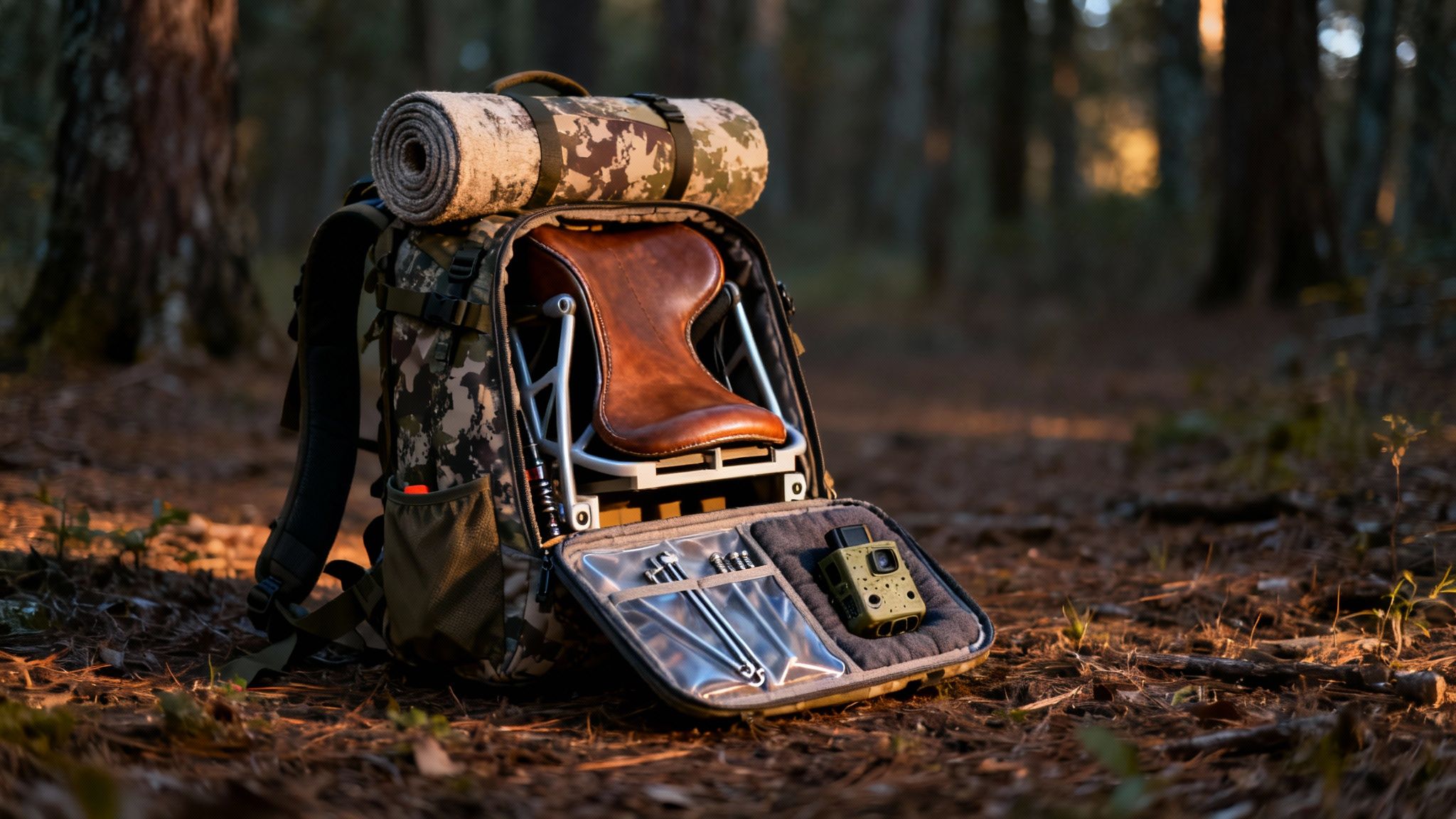
Unlike your standard hiking pack, a true saddle hunting backpack is built around three core principles: silence, organization, and accessibility. These aren't just buzzwords; they're critical when you're slipping through the woods and setting up in the pre-dawn quiet. The slightest metallic clank or fabric rustle can blow your cover and alert every deer in the county.
It’s the difference between a mechanic's neatly organized toolbox and a chaotic junk drawer. The toolbox has a specific spot for every wrench, allowing for quick, efficient work. The junk drawer is a mess. A good saddle pack is that mechanic's toolbox, where every piece of gear has a home for quiet, rapid deployment.
To really get what makes these packs different, let's compare them side-by-side.
Standard Hiking Pack vs Saddle Hunting Backpack
| Feature | Standard Hiking Pack | Saddle Hunting Backpack |
|---|---|---|
| External Attachments | General-purpose loops for trekking poles. | Purpose-built straps for climbing sticks & platform. |
| Fabric | Often uses noisy nylon or polyester for durability. | Made with quiet, brushed fabrics to minimize sound. |
| Internal Layout | Large main compartment, a few small pockets. | Highly compartmentalized for specific gear. |
| Accessibility | Designed for access when the pack is on the ground. | Pockets are placed for in-tree access. |
| Profile | Taller and wider for bulk gear. | Sleek, compressed profile to avoid snagging. |
This table shows it's not about which is "better," but which is built for the job. You wouldn't use a screwdriver to hammer a nail.
A Purpose-Built System
The key difference is the specialized design. These packs have external compression straps and lash points specifically made to lock down climbing sticks and a platform. This keeps your gear from shifting, snagging on branches, or clanking together as you walk. You just won’t find these kinds of purpose-built attachments on a typical daypack.
The entire system is also built for stealth. That means:
- Quiet Fabrics: Materials like brushed tricot or micro-suede are used to deaden sound when you brush up against a branch.
- Logical Layout: Pockets are arranged for easy access to gear you need at the tree, like your lineman's belt or bow rope.
- Secure Storage: There are dedicated spaces to ensure your essentials, from your rangefinder to modern electronics like a cellular trail camera, are protected and easy to grab.
The anatomy of a saddle hunting backpack is a direct response to the needs of a mobile hunter. Every strap, pocket, and material choice is intentional, serving the ultimate goal of getting into position undetected.
The Foundation of Mobility
This laser focus on specialized design makes the right pack the foundation of an effective mobile hunting strategy. It lets you carry all your essential hunter gear with an efficiency that a generic bag can't even come close to matching.
Ultimately, it’s the hub that connects your climbing method, saddle, and platform into a single, cohesive, and silent unit. Grasping this distinction is the first step toward understanding how this piece of equipment can completely transform your approach in the field.
The Anatomy of a High-Performance Pack
To really get what makes a top-tier saddle hunting backpack tick, you have to look past the camo pattern and see it for what it is: a specialized piece of gear where every single feature has a job. It’s an engineered system built from the ground up for silence, easy access, and managing awkward loads. Let's break down its core components to understand the "why" behind each design choice. Once you get it, you'll be able to size up any pack on the market.
Think of the outside of the pack as your transport rig. Its number one job is to haul your climbing sticks and platform without making a peep. This is where external compression straps and lash points earn their keep. These aren't just flimsy straps; they’re strategically placed to lock your gear down tight, killing the noisy shifts and snags that can blow a hunt before you even get up the tree. A great pack lets you cinch everything down so it moves as one solid, silent unit with your body.
That obsession with silence carries right over to the fabrics.
The Critical Role of Quiet Fabrics
In the dead calm of the morning woods, the sound of a branch scraping against a cheap nylon pack can sound like a fire alarm. The best pack manufacturers know this, and they choose their materials to eliminate that risk entirely.
- Brushed Tricot: This is a fan favorite for a reason. Its soft, fleece-like texture deadens sound on contact, so it's incredibly quiet when brushing against bark or your own clothing.
- Micro-Suede: Another fantastic choice for stealth, micro-suede offers a silent touch, rugged performance, and it does a great job shedding burrs and moisture.
- High-Count Polyester: Some packs use a very dense polyester that’s been treated to be both quiet and weather-resistant, striking a perfect balance between stealth and durability.
On the flip side, most standard hiking packs use ripstop nylon. While it's awesome for its strength-to-weight ratio in the backpacking world, its loud, crinkly texture is a massive liability for a hunter trying to be invisible. The fabric choice is one of the quickest ways to tell if a pack was truly designed for hunting or just painted camo.
Suspension Systems for Heavy Loads
Carrying climbing sticks, a platform, a saddle, ropes, and the rest of your kit adds up fast. A pack’s suspension system is the engine that helps you manage that weight comfortably over the long haul. It's what transfers the load from your shoulders to your hips, which are built to carry the burden.
You’ll generally run into two types of suspension systems:
- Internal Frame: These packs use rigid but lightweight stays—usually aluminum or carbon fiber—to give the pack its structure. This design is king for transferring weight to the hip belt, making it the go-to for loads over 20-25 pounds. It gives you the support and stability you need on steep, uneven ground.
- Frameless: A frameless pack is simpler, relying on the gear packed inside and maybe a foam back panel to create its structure. They are ultralight and flexible, but they really start to sag and become uncomfortable with heavier loads. They're a solid choice for the true minimalist with a featherlight setup, but they get overwhelmed quickly.
A pack's suspension is the bridge between you and your gear. A stout internal frame is like a proper foundation—it distributes weight evenly and prevents the fatigue that can cut a hunt short. A frameless pack is like a tent without poles; it works for very specific, lightweight uses but collapses under pressure.
Pocket Layout and Accessibility
Finally, pocket layout is all about tactical efficiency. A good saddle hunting pack is organized like a surgeon's tray, where everything has its place. Pockets aren't just slapped on wherever they fit; they're designed for quick, quiet access to the gear you need once you're settled in the tree.
This means you’ll find dedicated spots for your rangefinder, lineman’s belt, and pull-up rope. Many of the best packs now include side-access zippers that let you get into the main compartment without having to unhook the pack from the tree and dig in from the top—a massive advantage for staying still while in the saddle. Every single compartment is a deliberate design choice aimed at making your in-tree experience as smooth and silent as possible.
Achieving the Perfect Fit for All-Day Comfort
Even the most tricked-out saddle hunting backpack is just dead weight if it fits poorly. A bad fit isn’t just about annoying aches and pains; it creates a deep fatigue that can mentally and physically take you right out of the hunt.
Think of your pack like a good pair of boots. If it doesn't mold to your body's unique shape, every step becomes a miserable grind. The whole point is to make the pack feel like an extension of you—hugging your back, not hanging off it. A modern suspension system is designed to shift 80% or more of the weight off your shoulders and onto your hips, which are built to carry heavy loads.
Torso Length: The Most Important Measurement
Forget about your height. The single most crucial measurement for fitting a backpack is your torso length. This is the distance from your C7 vertebra (that bony bump at the base of your neck) down to your iliac crest, which is the very top of your hip bones. Most quality packs come in different sizes based on this measurement, and getting it right is the first and most important step to all-day comfort.
An ill-fitting pack almost always comes down to the wrong torso length. If it’s too long, the pack will feel sloppy and throw off your balance. Too short, and it will dump all the weight directly onto your shoulders, making the hip belt completely useless.
A Step-by-Step Guide to a Custom Fit
To really dial in the fit, you need to follow a specific order of operations. First things first: load your pack with your actual hunting gear—saddle, sticks, platform, water, the works. An empty pack will never fit the same as a loaded one.
Once it's packed, run through these steps:
- Loosen All Straps: Before you even put the pack on, loosen every single strap: shoulder, hip, sternum, and load lifters.
- Position the Hip Belt: Put on the pack and settle the hip belt so the padding rests directly over your hip bones. Cinch it down so it’s snug but not crushing you. This is your foundation.
- Adjust Shoulder Straps: Pull down on the shoulder straps until they wrap smoothly over your shoulders. There shouldn't be any major gaps between the strap and your body.
- Connect the Sternum Strap: Buckle the sternum strap and slide it to about an inch below your collarbones. This little strap is a game-changer for keeping the shoulder straps from sliding off and stabilizing the entire load.
- Fine-Tune Load Lifters: Finally, gently pull the load lifter straps—those are the small straps connecting the top of your shoulder straps to the pack frame. This pulls the top of the pack closer to your body and improves your balance.
This process ensures your pack’s core components work together to distribute weight exactly where it should be.
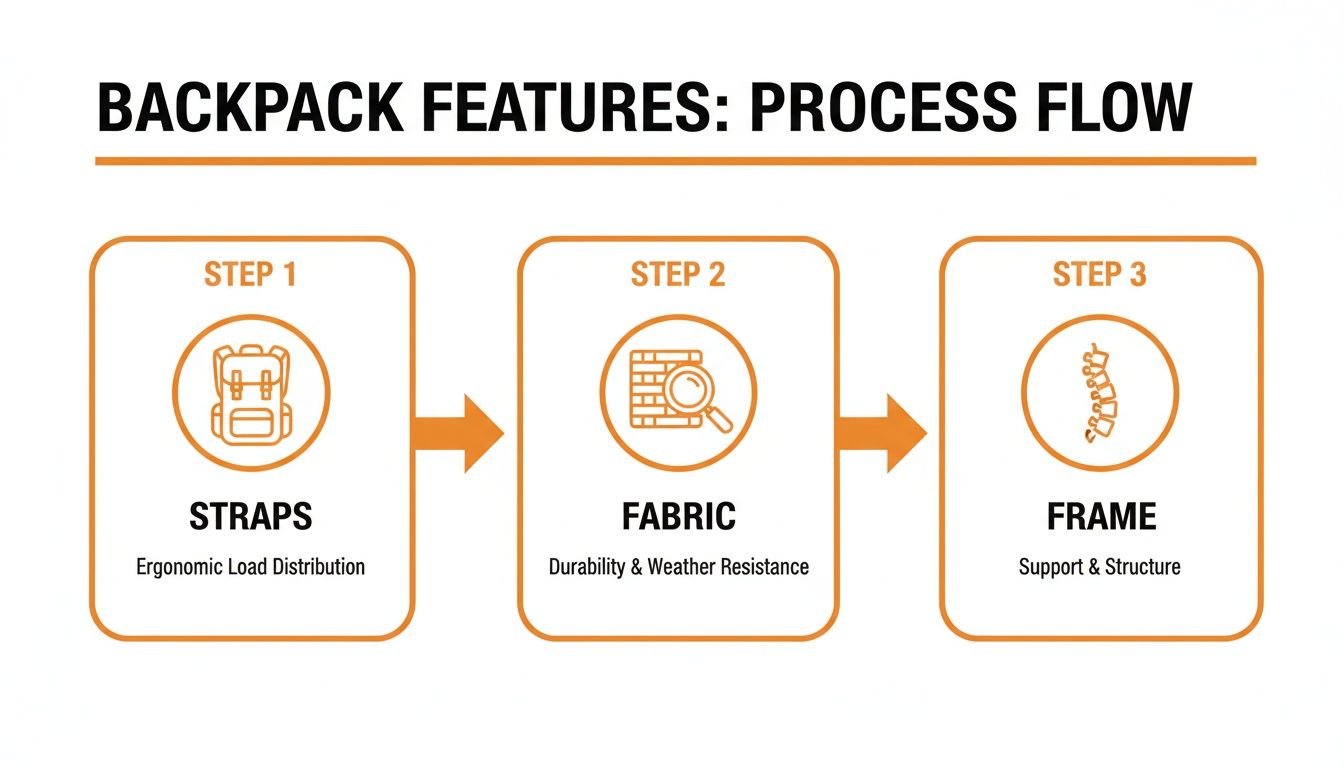
The image above breaks down how straps, fabric, and frame must work in harmony for the best performance. These quick adjustments make your pack feel like it was custom-molded to your body, stopping that physical strain from building up on a long trek. Beyond comfort, a proper fit is key to avoiding nagging pains. It’s always a good idea to learn how to prevent sports injuries to ensure you stay in the field season after season.
A proper fit isn't a luxury; it's a strategic necessity. Taking ten minutes to correctly adjust your pack before you leave is one of the highest-return investments you can make in your hunt’s success.
Strategic Packing for Stealth and Efficiency
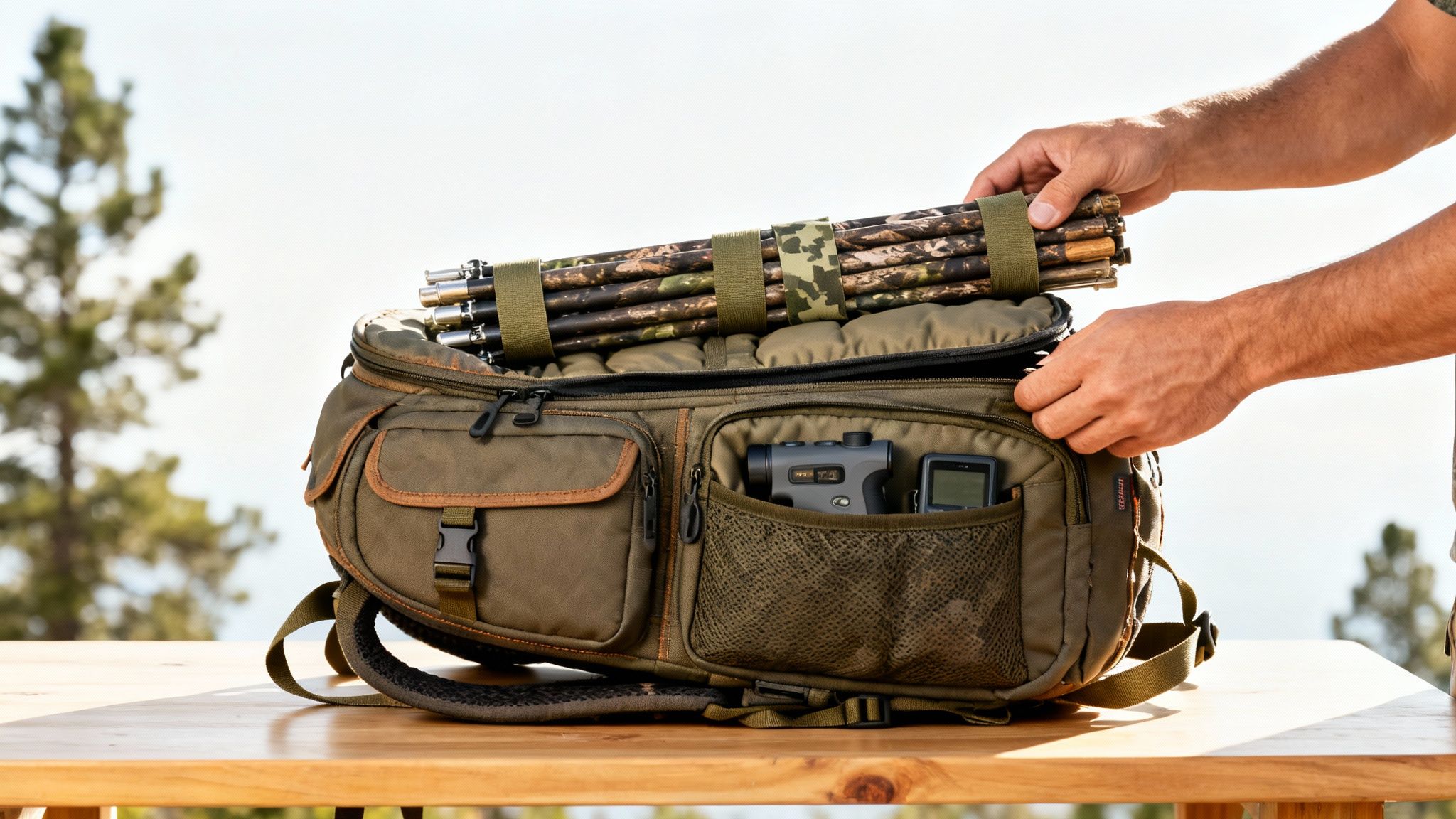
A good saddle hunting pack is more than just a bucket for your gear—it's a tactical tool. But its real value only shines through when you pack it strategically. Just tossing everything inside is a surefire way to make noise, get frustrated, and waste precious time when a buck is closing in.
The whole art of packing for a mobile hunt comes down to silence, balance, and quick access. Think of your pack not as a bag, but as a field-ready deployment system. The key principle is simple: pack in reverse order of use. The gear you need first when you get to the tree should be the last thing you put in your pack.
This "last in, first out" method means you’re not digging through everything in the dark, clanking metal while a target might be just over the ridge. It's a game-changer.
The Last In, First Out Method
Picture yourself at the base of your chosen tree. What’s the very first thing you need? Your lineman's belt to get hooked in safely. Then, your climbing method. That means those two items should be right on top or strapped to the outside, ready to go.
Here’s a proven packing order that works for most hunters:
- Bottom Layer (Deep Storage): This is for stuff you won’t touch until you're settled up in the saddle. Think extra layers, your lunch, a water bladder, or a small emergency kit. Bury it deep.
- Middle Layer (Core System): Your saddle and platform are next. They're bulky, but you won't need them until you’re already partway through your ascent.
- Top Layer (Immediate Access): Your lineman's belt and bow rope live here. As soon as you hit the tree, this is the gear you grab to start climbing safely.
- External Storage (Climbing Method): Your climbing sticks almost always belong on the outside, cinched down tight with the pack’s compression straps. This keeps them secure and out of the way.
This methodical approach is becoming standard as the saddle hunting community explodes. It’s part of a larger trend—the outdoor backpack market is projected to grow by USD 997.1 million between 2024 and 2029. With North America making up over 30% of that revenue, the demand for specialized packs is through the roof, especially since saddle hunting adoption has jumped an estimated 300% since 2015.
The Art of Silence
A quiet approach is everything. Your pack can either be your best friend or your worst enemy in the woods. The quietest fabric in the world can’t stop the sound of your gear clanking together inside. Your number one goal is to kill any metal-on-metal or hard-surface contact.
A truly silent pack is the result of deliberate preparation, not luck. Every piece of gear should be secured and padded as if it were fragile, because your stealth is exactly that—fragile.
To get there, you need to silence individual items before they even go in the pack.
- Wrap Your Sticks: Use stealth strips, hockey tape, or even pieces of an old bicycle inner tube to cover any metal buckles and contact points on your climbing sticks.
- Bundle Securely: Don't just trust one strap. Tightly bundle your sticks with gear ties or a dedicated strap first, then attach them to your pack's compression system. This stops them from shifting and rattling.
- Pad Internal Gear: Use soft items like a down jacket, spare gloves, or a beanie to cushion hard gear like your platform or bow hanger inside the main compartment.
Organizing for In-Tree Efficiency
Your pack’s job isn’t over once you’re up the tree. It becomes your hanging pantry, toolbox, and office. A well-organized pack means you can grab what you need with the absolute minimum amount of movement.
This comes down to giving every small item a permanent home. Your rangefinder always goes in the left hip belt pocket. Your wind checker is always in the right. Your phone and a backup battery bank should have their own padded, dedicated slot. Building this muscle memory prevents you from fumbling around when a deer is walking into your lane.
This level of organization is especially critical when you're pushing into new territory and need to be light on your feet. When you’re trying to figure out how to find deer bedding areas and set up on fresh sign, a quiet, efficient system is your biggest advantage. Consistency is what turns a good pack into a great hunting system.
Integrating Your Pack with Your Saddle System
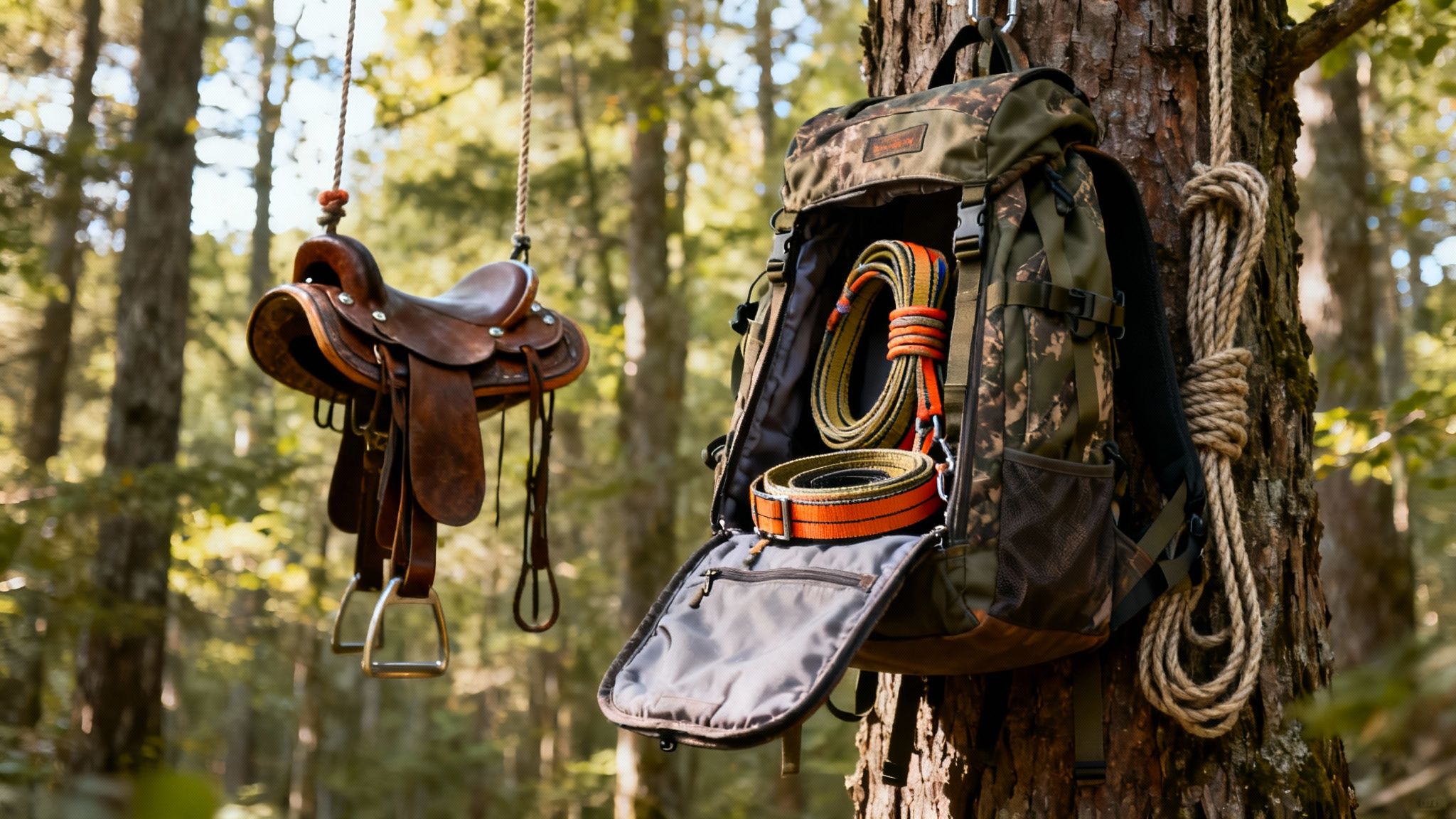
Here's a fundamental shift in thinking: your saddle hunting backpack and your saddle aren't just two separate pieces of gear. They're two halves of a single, integrated system.
Too many hunters see their pack as just a taxi for getting equipment to the tree. But in reality, it's an active tool you’ll use from the walk-in, during the climb, and all the way through the hunt itself.
This symbiotic relationship becomes crystal clear the moment you reach your tree. You need a seamless way to manage your pack as you ascend. Whether you climb with it on, use a gear hoist, or hang it from a hook once you're at hunting height, your pack's design directly impacts your efficiency and stealth.
Managing Your Pack at Hunting Height
Once you’re safely tethered in and settled into your saddle, your pack transforms from a transport vessel into your hanging command center. This is where packs designed specifically for saddle hunting really start to shine.
They’re built to hang open quietly, giving you one-handed access to the main compartment without broadcasting your position to every deer in the county.
A great saddle hunting backpack is your silent partner in the tree. Its job is to serve you the gear you need, when you need it, with minimal movement and zero sound.
Packs with features like side-access zippers are a game-changer. Instead of fumbling with a top lid and making a racket, you can unzip a side panel and grab an extra layer, your rangefinder, or a camera with barely a motion. For guys who enjoy filming their hunts, this level of easy access is non-negotiable. If that sounds like you, check out our guide on choosing the best camera for filming hunts.
Your Pack as a Critical Safety Component
Beyond just convenience, your saddle hunting backpack plays a vital role in your safety system. It provides a secure, organized home for your lineman’s belt and tether—the absolute lifelines that keep you connected to the tree at all times. Knowing exactly where these items are allows for a smooth, confident, and safe transition from climbing to hunting.
This kind of gear integration is more important than ever as saddle hunting's popularity continues to explode. The entire hunting backpack market is a slice of the massive global backpack industry, which hit a $19.11 billion valuation in 2024 and is projected to climb to $29.73 billion by 2033.
With saddle hunting participation seeing a potential 400% increase between 2010 and 2025, the demand for specialized packs that can handle 20-30 lb loads over miles is at an all-time high.
Three Methods for Handling Your Pack
Your personal style and the pack you choose will determine how you manage it at the tree. There are really three main ways to go about it, each with its own pros and cons:
- Wearing the Pack: Some minimalist hunters prefer to keep a small, light pack on their back for the entire hunt. This keeps your gear extremely close, but it can get cumbersome and limit your movement.
- Using a Gear Hoist: This is the most common method. You simply tie a pull rope to your pack and hoist it up after you've reached your desired height. It's the safest and easiest way to manage a fully loaded pack without a struggle.
- Hanging the Pack: Once at height, the pack is hung from a gear hook or a spare strap. This is where a pack designed to hang open gives you a huge advantage, letting you see and access everything inside without making a sound.
Taking Care of Your Pack: Essential Maintenance for Longevity
Your saddle hunting pack is more than just a bag—it's a critical tool. And just like a rifle or bow, it needs regular care to perform when it counts. Ignoring it is a recipe for disaster. Sooner or later, a neglected pack will fail you, whether it's a blown zipper mid-hike or a noisy buckle that spooks a buck.
A little bit of consistent upkeep goes a long way. It not only extends the life of your investment but also keeps your pack a stealthy asset instead of a noisy, scent-filled liability.
Post-Hunt Cleaning and Care
After every hunt, your pack is covered in dirt, sweat, and whatever else the woods threw at you. Letting that grime sit is a bad idea, as it will slowly break down the quiet fabrics and waterproof coatings that you paid good money for.
First things first: empty it out completely. Flip it upside down and give it a good shake to get rid of leaves, dirt, and that one snack wrapper you forgot about. For mud and stains, grab a soft brush and a damp cloth with some mild, unscented soap. Whatever you do, avoid harsh detergents or throwing it in the washing machine. That's the fastest way to strip its water-repellent treatment and ruin the quiet exterior.
Think of your pack's DWR coating like the wax on a good pair of boots. Harsh soaps will wash it right off, leaving your gear vulnerable and making the material louder when it brushes against a branch.
Once it's clean, hang the pack up to air dry completely. The best spot is outdoors in the shade. This simple step prevents mildew from growing, which not only ruins the material but also creates odors that a whitetail can smell from the next county over.
Mastering Scent Control and Storage
A clean pack is a scent-neutral pack. But let's be honest, your backpack is a magnet for odors—from your truck's air freshener to last night's campfire.
- Scent Elimination: After the pack is totally dry, give it a light spray-down, inside and out, with a quality scent eliminator. Pay extra attention to the shoulder straps and back panel where you sweat the most.
- Airtight Storage: The absolute best way to keep your pack scent-free between hunts is to store it in an airtight plastic tote or a big scent-control bag. This seals it off from all the garage, basement, and closet smells that can sabotage your next hunt.
Pre-Season Inspection Checklist
Before opening day rolls around, give your pack a thorough once-over. Finding a small problem in the garage is a whole lot better than discovering a catastrophic failure a mile deep in the woods.
- Check All Stitching: Look closely for any frayed or pulled threads, especially around high-stress areas like where the shoulder straps and hip belt connect to the main pack body.
- Inspect Buckles and Straps: Click every single buckle to make sure it engages securely and doesn't slip. Check all the webbing for signs of fraying or sun rot that could weaken it.
- Test Zippers: Run every zipper open and closed a few times. You want to make sure they glide smoothly without catching or separating. A busted zipper can make an entire pocket useless when you need it most.
Frequently Asked Questions
Even after you've done your homework, a few specific questions always seem to pop up right before you pull the trigger on a new piece of gear. Let's tackle some of the most common ones we hear from hunters about saddle hunting backpacks.
What Is the Ideal Size for a Saddle Hunting Backpack?
The sweet spot for most saddle hunters lands somewhere between 1,500 and 2,500 cubic inches, which is about 25 to 40 liters. This size range gives you enough room to comfortably pack your entire system—saddle, platform, sticks, and extra layers—without feeling like you're hauling a massive expedition pack.
If you’re planning a frigid, late-season hunt where bulky insulated gear is non-negotiable, you’ll want to lean toward the larger end of that spectrum. On the flip side, for those minimalist early-season sits, a smaller, more streamlined pack is usually all you need. It's all about matching your pack to your specific gear list so everything can be cinched down tight and silent for the walk in.
How Do I Keep My Climbing Sticks from Making Noise?
Getting your climbing sticks completely silent is one of the most critical steps for a stealthy approach. This process starts long before you ever strap them to your saddle hunting backpack.
- Apply Stealth Strips: The first move is to wrap any metal parts—buckles, standoffs, you name it—with stealth strips or even old-school hockey tape. This kills that tell-tale metal-on-metal clang.
- Bundle Them Together: Next, use an extra strap or a couple of gear ties to lash your sticks together into one solid, immovable unit.
- Cinch Them Down: Finally, use your pack's compression straps to lock that bundle down as tight as humanly possible. No wiggle room allowed.
Following these steps prevents the subtle shifting and rattling that can alert every deer in the area to your presence.
A quiet pack is a prepared pack. Taking a few extra minutes to silence your gear at home is one of the single most effective things you can do to improve your odds in the field.
Can I Use a Regular Hiking Backpack for Saddle Hunting?
Look, in a pinch, you could probably make a standard hiking pack work. But it's far from ideal and comes with some serious drawbacks. A purpose-built saddle hunting pack is designed from the ground up with features that regular packs just don't have.
These specialized packs are engineered with external lash points specifically for sticks, built from quiet-brushed fabrics, and have pocket layouts that make sense for a hunter's gear. When you try to force a hiking pack to do the job, you usually end up with a noisy, disorganized, and uncomfortable mess because it simply wasn't made for the unique demands of a mobile hunter. Investing in a dedicated pack makes for a much stealthier and more efficient hunt.
At Magic Eagle, we know that a successful hunt starts with reliable scouting. Our smart cellular trail cameras give you the field intelligence you need to make every trip into the woods count. Discover the advantage of real-time insights and plan your hunt with confidence. Check out our gear.