

A live trail camera isn't just a motion-activated camera anymore; it's your real-time window into the wild. It streams photos and videos directly to your phone, moments after they’re captured.
Unlike the old-school models that forced you to physically hike out and pull an SD card, these modern cameras use cellular networks to give you instant access. This completely changes how you scout, monitor wildlife, and even secure your property.
What Is a Live Trail Camera and How Does It Work
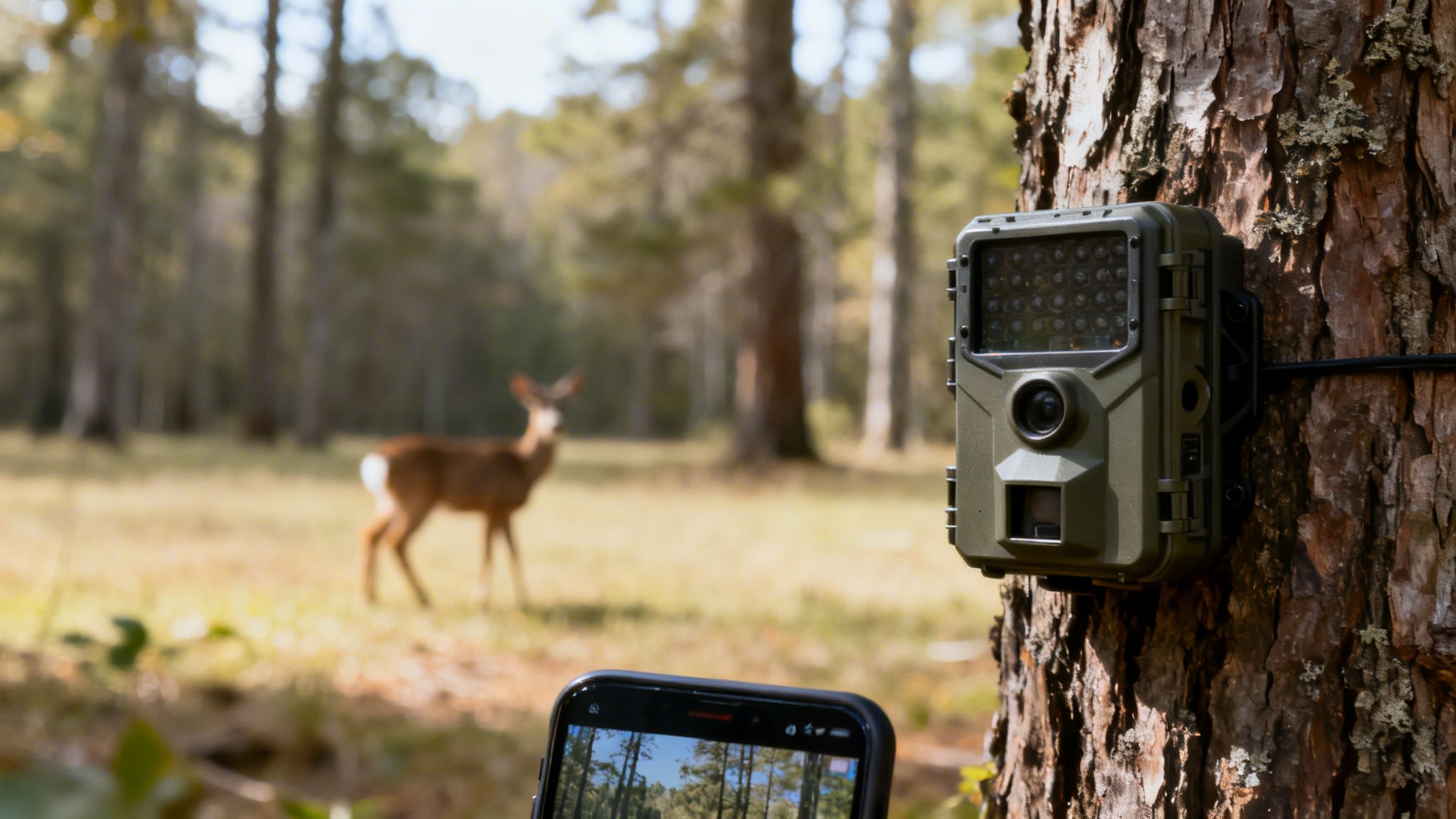
Imagine checking your favorite hunting spot or food plot without ever leaving your couch. That's the simple promise of a live trail camera. It's a massive upgrade from older tech, which always felt more like developing film—you had to wait days, sometimes weeks, to finally see what you got.
This modern approach gives you an immediate, dynamic view of what's happening out there. Think of it as upgrading from snail mail to instant messaging for the outdoors.
The Basic Workflow of a Live Camera
At its core, a live trail camera operates on a simple but powerful principle. When its motion sensor picks up activity, it snaps a picture or records a video. But instead of just saving it to an SD card, the camera uses a built-in cellular modem—just like the one in your phone—to send that file over a 4G network.
Within seconds, you get a notification on a dedicated mobile app. From there, you can see the image, watch the video, or even tap into a live stream to see what’s happening right now. This is a game-changer for hunters, landowners, and researchers who need timely information to make their next move.
This instant feedback loop means you don't have to physically visit the camera, which accomplishes two huge things:
- Reduces Human Pressure: You stop tromping through the woods, leaving your scent behind and potentially pushing mature bucks to go nocturnal.
- Saves Time and Effort: No more wasted trips just to check empty SD cards. You can focus your energy on actual strategy instead of legwork.
A live trail camera bridges the gap between passive monitoring and active surveillance. It transforms scouting from a guessing game based on old data into a proactive strategy driven by real-time intelligence.
More Than Just a Live Feed
While the live-streaming feature gets all the attention, these cameras are packed with technology that gives you a much deeper understanding of your environment. Many advanced models have sophisticated sensors that log crucial environmental data. For a full rundown, check out our detailed guide on choosing a camera with live feed.
This means you get more than just a picture of a deer; you get the context behind its visit. Was it a cool morning? Was the wind blowing from the north? This information helps you build a detailed pattern of animal movement, linking specific behaviors to weather conditions.
This immediate access to both visuals and data gives you an incredible advantage, turning a simple camera into a powerful field intelligence tool.
The Technology That Powers Your Live Feed
A live trail camera might seem like magic, but what’s happening behind the scenes is a powerful mix of smart hardware and even smarter software. Think of it as having a biologist and a security guard watching your spot 24/7. It all starts with one crucial element: the connection.
Just like your phone needs a good signal to stream a video, a live trail camera depends on a solid cellular connection. The engine driving this is a 4G LTE modem that beams data from the middle of nowhere straight to your device.
But let's be real—remote locations rarely have perfect cell service. This is where high-end systems, like Magic Eagle’s SignalSync technology, really shine. Instead of being stuck with one provider, these cameras automatically scan for and lock onto the strongest network in the area. This multi-carrier capability is a game-changer for keeping that live link stable where other cameras would just give up.
You can learn more about the nuts and bolts in our guide on the essentials of a 4G trail camera.
Beyond Connectivity The Rise of AI
A strong signal is the highway, but Artificial Intelligence (AI) is the traffic cop making sure only the important stuff gets to you. Early cellular cameras had a huge flaw: they sent you everything. A branch swaying in the wind or a curious squirrel would set it off, blowing up your phone with hundreds of useless alerts.
Modern AI-powered species recognition completely solves this problem. It acts like a smart filter, analyzing each image right on the device before it ever sends you a notification.
- Intelligent Sorting: The AI knows the difference between a deer, a turkey, a person, or just background noise.
- Customized Alerts: You can tell the camera to only ping you when it spots a specific animal, like a mature buck.
- Organized Galleries: Your photo library gets automatically tagged and sorted, which makes tracking patterns for a specific animal incredibly easy.
This onboard processing doesn't just save you from endless notifications—it also saves precious battery life and data by not wasting them on junk images. It’s the difference between a raw, unfiltered data dump and a curated highlight reel of what actually matters.
Safeguarding Your Investment with GPS and Anti-Theft
Putting an expensive piece of gear out in a remote spot always comes with the risk of theft. That’s why the best cameras now have security features that go way beyond a simple lock and cable. The most effective of these is a GPS anti-theft system.
This tech creates a virtual "geofence" around your camera's location. If the camera is moved outside that pre-set boundary, it immediately shoots an alert to your phone with its new coordinates.
A live trail camera with GPS is more than just a monitoring tool; it's a secured asset. If it's stolen, it actively reports its own location, drastically increasing the chances of recovery.
Some cameras, like the EagleCam 5, take it even further. You can set them to snap a photo of the thief the moment it’s moved and to keep reporting its location even after it's been powered down. This turns the camera from a passive target into an active player in its own security.
Building a Complete Environmental Picture
Finally, the most advanced live trail cameras are packed with environmental sensors that do more than just capture images. They log critical data points with every photo and video, giving you invaluable context for what you're seeing. These often include:
- Temperature: See how animal movement lines up with temperature swings.
- Humidity: Understand how moisture in the air affects activity.
- Barometric Pressure: Track how pressure changes might be influencing feeding times.
When you combine this information with the weather data already in your app, you can start building a highly detailed, predictive model of animal behavior. For long-term deployments, pairing your camera with high-quality portable solar panels is a must. This ensures your sensors and live feed are always running, helping you finally connect the dots between a weather front and that trophy buck's appearance.
How to Choose the Right Live Trail Camera
Finding the perfect live trail camera can feel like a hunt in itself, but it really boils down to one simple idea: matching the technology to your mission. Whether you're a hunter, a researcher, or a landowner, the right camera is the one that solves your specific problems—without making you pay for bells and whistles you’ll never use.
First thing's first: define your primary goal. Are you trying to pattern a single, elusive buck? Monitor a large property for trespassers? Or are you collecting data for a wildlife study? Your answer will steer every other decision you make, from the image quality you need to the type of connectivity that's non-negotiable.
Assess Your Location and Connectivity Needs
The single most critical factor for any live trail camera is its ability to connect to a cellular network. It’s simple: a camera with all the best features is useless if it can't send you updates from the field. Before you even start comparing camera models, you have to know the signal strength in your specific area.
This is where multi-carrier technology becomes a game-changer. Many top-tier cameras, like the Magic Eagle EagleCam 5, have it built-in. This feature allows the camera to automatically find and connect to the strongest signal from major providers, which drastically boosts its reliability in remote or spotty service areas. For any serious user, this is a non-negotiable feature. You just can’t afford to have your connection drop at a critical moment.
This decision tree helps visualize which core features to prioritize based on your main objective, whether that’s connectivity, AI sorting, or security.
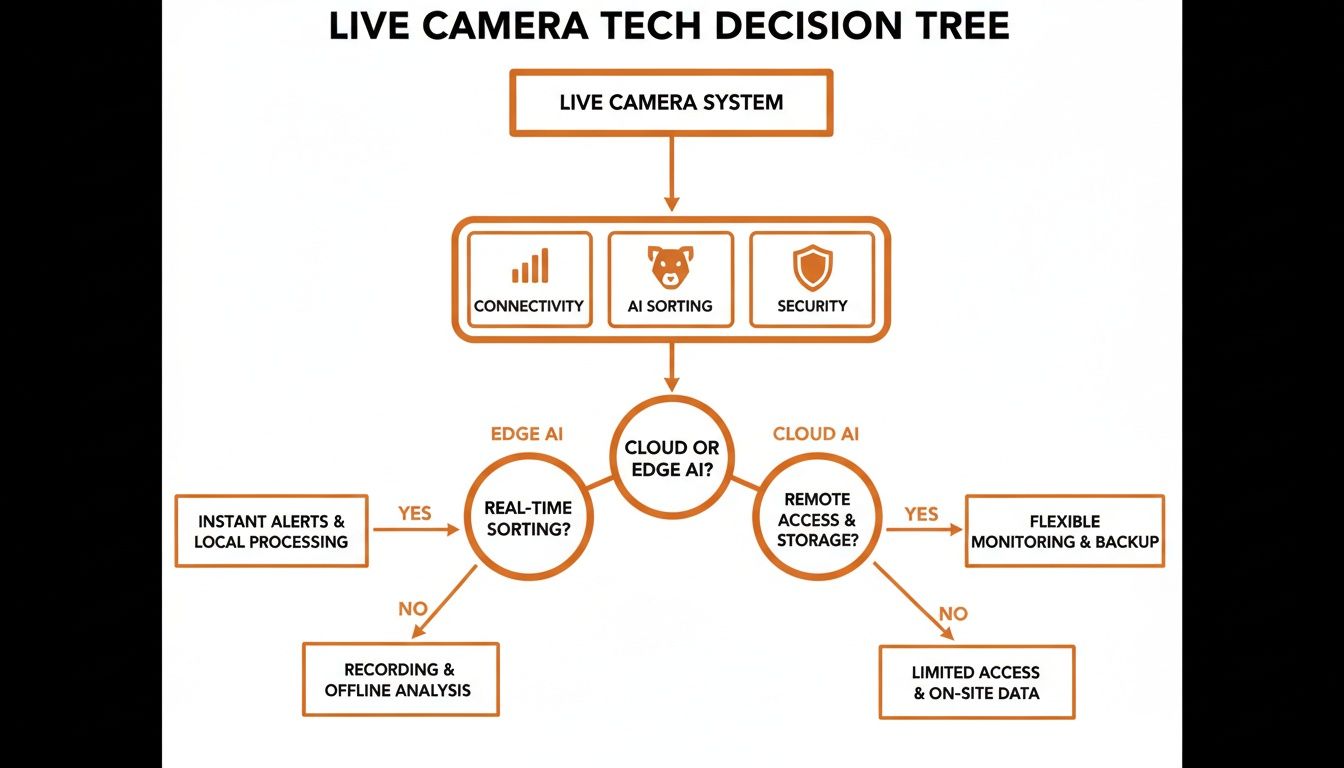
As you can see, all the features are connected, but your primary goal—tracking, research, or security—should always be the deciding factor for what you prioritize first.
Prioritize Image and Video Quality
Once you've confirmed you have a solid connection, the next step is to look at the camera's optics. The megapixel (MP) count is what most brands advertise, but it's not the whole story. Pay close attention to the sensor and lens quality, because those are the components that actually determine the clarity, color, and low-light performance of your images.
For hunters, clear, high-resolution photos are essential for identifying individual animals and judging antler size from a distance. For security, you need an image sharp enough to make out faces or license plates, even in tough lighting. Always look for models that offer high-definition video, too, since movement can reveal details a single photo might miss.
Don't just chase the highest megapixel number. Focus on real-world image samples and reviews to judge a camera's true performance, especially its nighttime infrared or flash range and clarity. A blurry 40MP image is less useful than a crisp 10MP one.
Evaluate Battery Life and Power Options
A live trail camera is only as good as its power source. Constantly transmitting data and live streaming can drain batteries fast, especially in cold weather or areas with a weak signal where the camera has to work harder to stay connected.
Consider these power solutions:
- Internal Battery Type: Lithium-ion batteries almost always perform better in cold weather than standard alkaline batteries.
- External Power Ports: A camera with an external power jack gives you the flexibility to hook up a larger battery pack or a solar panel.
- Solar Panel Compatibility: For long-term, set-it-and-forget-it deployments, a compatible solar panel is the best investment you can make. It provides a continuous charge, ensuring your camera stays online indefinitely without you having to make trips to swap batteries.
Choosing the right camera means balancing these technical features with your budget and your goals. For a deeper dive into specific models and what they're best at, check out our guide on what are the best trail cameras for different scenarios. At the end of the day, the best live trail camera is the one that reliably delivers the information you need, right when you need it.
Putting Your Live Camera to Work in the Field
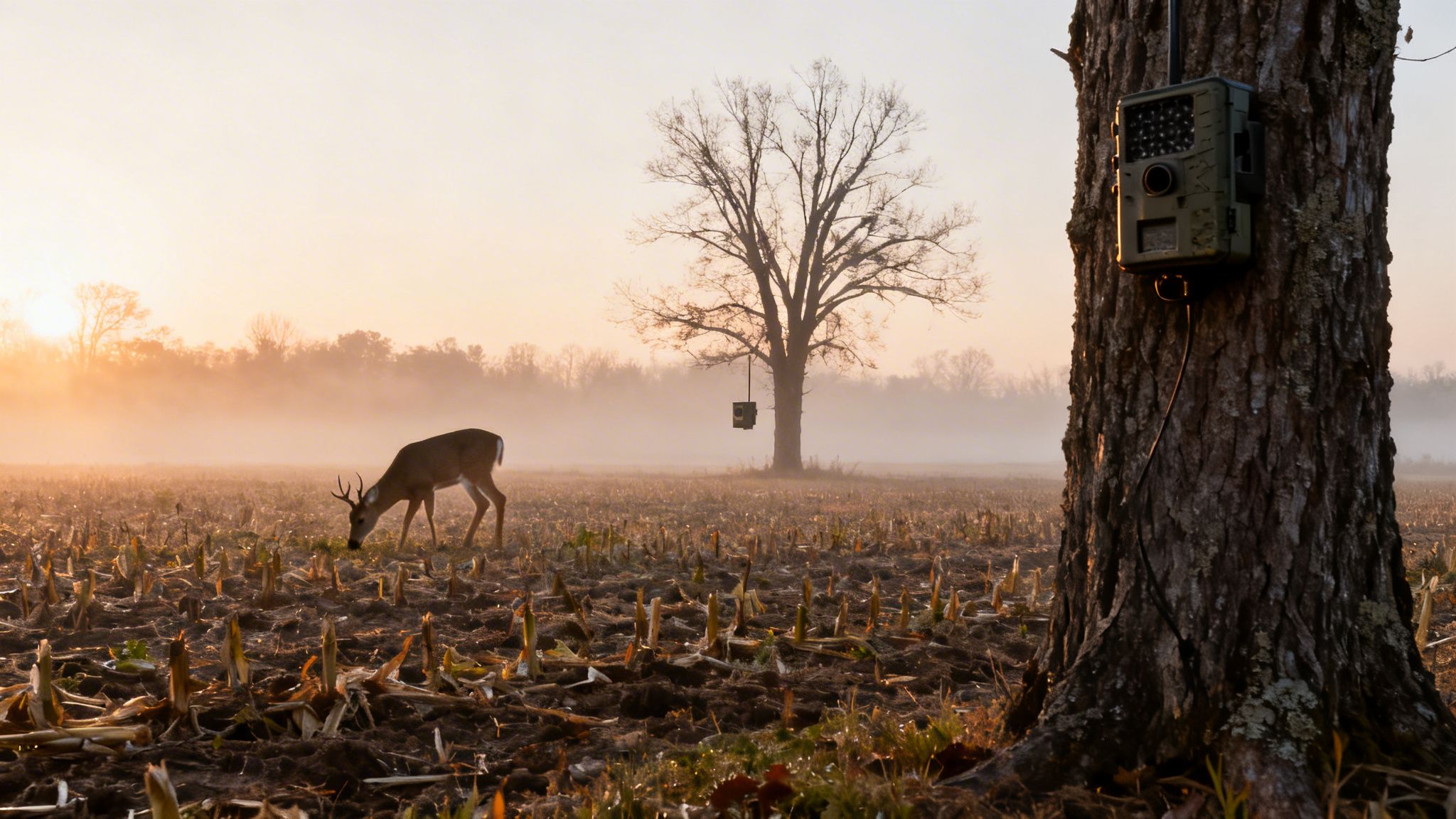
This is where the rubber meets the road—where all that fancy tech starts paying off. A live trail camera isn't just another cool gadget to add to the gear pile. It's a strategic tool that gives you a serious advantage, whether you're trying to outsmart a once-in-a-lifetime buck, manage wildlife populations, or just keep an eye on your property.
These cameras have exploded in popularity, moving from a niche item to a go-to for anyone who spends time outdoors. The global trail camera market is on track to hit USD 211.3 million by 2033, with over 30% of that action happening in North America. A massive driver for this growth? The hunting community. Roughly 62% of hunters now rely on trail cameras to get the job done right. You can dive deeper into the research on the expanding trail camera market yourself.
It’s easy to see why. The power to see what’s happening, as it’s happening, without spooking everything in a half-mile radius is a total game-changer. You stop reacting to old information and start making decisions based on what’s going on right now.
For the Dedicated Hunter: Patterning and Strategy
Every serious hunter knows that human pressure is the number one reason mature bucks go nocturnal. Each trip you make into the woods to pull an SD card leaves a trail of scent and noise, broadcasting your presence. A live trail camera cuts that intrusion down to almost zero.
Imagine this: you're at home, watching a monster buck work a scrape line in real-time on your phone. You see his exact entry and exit routes. You learn the precise time of day he feels safe enough to move. You see how he reacts to a wind switch. All without ever contaminating his core area. This isn't just scouting; it's next-level surveillance.
- Food Plot Monitoring: See exactly what’s hitting your plots and when, so you can fine-tune your hunt schedule for peak activity.
- Scent-Free Scouting: Pattern a buck’s daily movements from miles away, keeping his sanctuary completely undisturbed until it’s time to move in.
- Instant Confirmation: Get an alert, tap into the live feed, and confirm that your target buck is on his feet and headed your way.
With a live feed, you’re no longer relying on old photos to piece together a story. You are watching the story unfold as it happens, giving you the power to react instantly to fresh, actionable intelligence.
For the Wildlife Professional: Efficient Data Collection
Wildlife biologists and researchers have the tough job of monitoring animal populations across huge, often remote, landscapes. The old way involved countless hours in the field and then manually sorting through thousands of photos. A live trail camera armed with AI becomes a force multiplier.
AI-powered species recognition handles the grunt work. Instead of a person having to identify and log every single animal, the camera does it for you. It instantly tags photos and organizes everything into clean, usable data, freeing up critical time for actual analysis and conservation work.
Take a project tracking deer herd health. A network of live cams can deliver:
- Automated Species Counts: The AI filters out raccoons, squirrels, and everything else you don't need, giving you an accurate deer census.
- Health Monitoring: High-resolution video and live streaming let biologists visually assess an animal's physical condition from a safe distance.
- Behavioral Studies: Researchers can observe natural behavior—like feeding habits or social dynamics—without their presence influencing the animals.
This technology transforms a slow, manual chore into a highly efficient, automated monitoring system. It means better data, faster, leading to smarter conservation decisions.
For the Property Manager: Robust Security and Oversight
If you own land or manage a ranch, you need a bulletproof way to watch over your property. From remote gates to back corners where trespassers might sneak in, security is key. One live trail camera is a great sentinel, but a network of them creates a complete surveillance grid covering your entire property.
The combination of instant motion alerts, live viewing, and GPS anti-theft is what delivers true peace of mind. A truck pulls up to a gate at 2 AM? You get an immediate notification and can pull up the feed to see what's going on. And with GPS-enabled cameras like the Magic Eagle EagleCam 5, you get an alert the second a camera is moved and can track its location in real-time.
These aren't just features on a spec sheet. They're practical, field-proven tools that give you a strategic edge and a real sense of control.
Setup Tips for Optimal Performance and Reliability
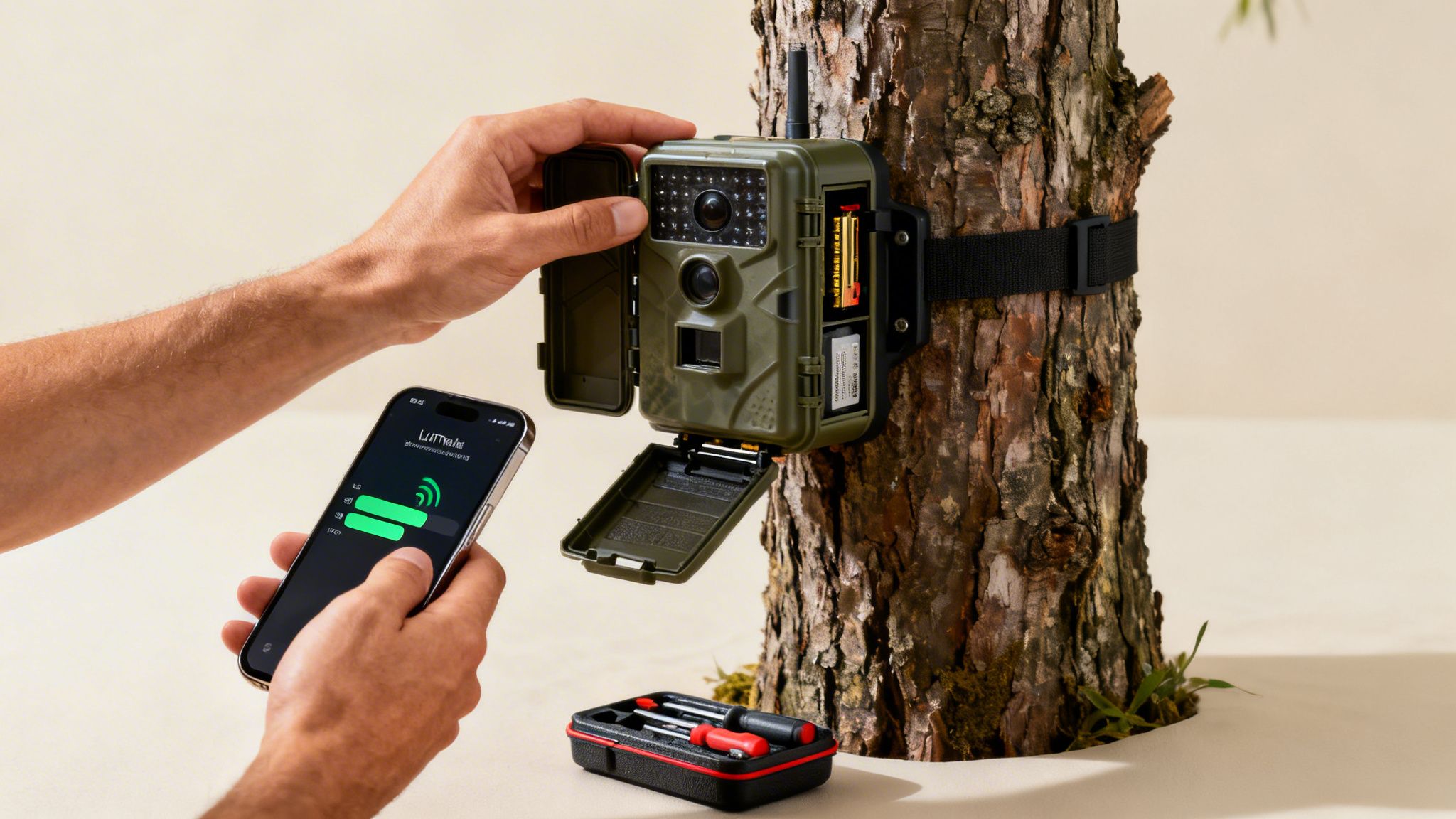
Unboxing your new live trail camera is just the start. To really get the most out of it, you need to think strategically about where you put it and how you set it up. The goal is to create a reliable set-it-and-forget-it system that sends you clear, useful images and stays connected when it counts.
Before you even head outside, the first step is activating and configuring the camera through its companion app. This initial process pairs the camera to your account, gets its cellular plan fired up, and lets you dial in the basics. It’s the perfect time to get comfortable with the interface and make sure everything is talking to each other properly.
Finding the Perfect Spot
Honestly, where you place your camera is the single most important decision you'll make. It directly impacts everything—signal strength, photo quality, and how long your battery lasts. Finding that sweet spot is all about balancing a clear view for the lens with a strong enough cell signal to send you the goods.
Use the phone in your pocket as a scouting tool. Walk your property and keep an eye on the signal bars to find areas with the strongest, most stable connection. A camera stuck in a low-signal pocket will chew through its battery trying to stay online.
The perfect camera location offers more than just a good view. It needs a stable cellular signal, should avoid direct sunlight that causes false triggers, and must be positioned at the right height and angle to capture your target animal.
Strategic placement is also your best defense against a gallery full of pictures of… well, nothing. The rising and setting sun is a classic culprit, as the direct light and moving shadows can easily trip the motion sensor. To avoid this headache, always try to face your camera north or south whenever you can.
Dialing in Your Camera Settings
Once your camera is mounted, it’s time to fine-tune the settings right from the app. Don't just stick with the factory defaults. Modern cameras give you a ton of control, and tailoring the settings to your specific spot and goals can dramatically improve performance.
Start by tweaking these core adjustments:
- Motion Sensitivity: High sensitivity is great for an open field, but in the woods, it’ll trigger on every swaying branch. Start on a medium setting and adjust from there based on what you see in the first few days.
- Trigger Speed: For animals moving quickly down a trail, a faster trigger is a must-have. But if you’re watching a stationary feeder, a slightly slower speed is perfectly fine and can help save a little battery life.
- Photo Burst & Video Length: A 3-shot burst often tells a much better story about an animal’s behavior than a single, lonely photo. Decide whether you want a series of stills or a short video clip with each detection.
Troubleshooting Common Field Issues
Even the best setup can run into hiccups. Knowing how to quickly diagnose and fix the usual suspects will keep your camera online and minimize your frustration. Nine times out of ten, the problems you’ll face are related to power or connectivity.
If your battery is draining way faster than you expected, it's almost always one of two things: a weak cellular signal or way too many transmissions. If the signal is spotty, try moving the camera or adding a booster antenna. If it’s sending you hundreds of junk photos of squirrels, just dial back the motion sensitivity.
For those times when your camera just drops offline, the first step is to force a sync from the app. This tells the camera to re-establish its connection with the network. If that doesn't do the trick, make sure your data plan is still active and check for firmware updates—manufacturers are constantly releasing them to improve performance and squash bugs.
Live Trail Camera FAQs
Jumping into live trail camera tech can bring up some practical questions. This is advanced gear, after all, and understanding how it actually works in the field is key to making a confident choice. Let's clear up the most common queries about data, batteries, security, and what happens when you lose signal.
These are the real-world details that separate a good camera from a great one. Getting clear answers helps you know exactly what to expect when you get your camera out in the woods.
How Much Cellular Data Do These Cameras Really Use?
This is probably the number one question we hear, but the good news is you are in total control. Data usage is tied directly to how you use the camera. If you’re live-streaming for hours or constantly pulling down full-resolution videos, you'll use more data. But for typical scouting? The consumption is surprisingly low.
Most of your data will go toward sending motion-triggered photos and short video clips to your phone. For that purpose, standard data plans are almost always more than enough to get you through the month.
The real data-saver is the onboard AI. By filtering out false triggers from wind, rain, or squirrels, the AI makes sure your camera only sends images that matter. This smart filtering means your data plan is spent on valuable intel, not junk photos.
Plus, you can manage everything right from the app. You can set the camera to send low-resolution thumbnails first, then only request the high-res version when you see a buck worth a closer look. This puts you in complete command of your data plan.
What's the Real-World Battery Life?
Battery performance is a classic "it depends" situation, and it boils down to a few key factors. The biggest drains on power are cellular signal strength and how often the camera has to transmit images.
Think of it like your smartphone—when you're in a spot with a weak signal, your phone’s battery dies faster because it's working harder to stay connected. The same thing happens with your live trail camera. A camera in a fringe service area will burn through a lot more power than one with a strong, stable connection.
Frequent live-streaming will also use more energy than just sending occasional photos. To counter this, quality cameras are built for maximum power efficiency. But for true long-term deployment, nothing beats an external power source.
- External Battery Packs: These can easily extend your camera's life for weeks or even months.
- Solar Panels: The ultimate solution. Pairing your camera with a solar panel creates a self-sustaining system, providing a continuous trickle charge that can keep it running indefinitely, even through a string of overcast days.
How Secure Are Live Trail Cameras From Theft?
Putting valuable gear in a remote spot naturally raises security concerns. That’s why leading brands have made anti-theft measures a top priority, building in layers of protection to safeguard your investment. The most powerful tool in the arsenal is GPS tracking.
This feature lets you see your camera's exact location on a map right inside your app. You can also set up a geofence—a virtual perimeter around the camera. If the device gets moved outside that zone, you get an instant alert on your phone with its new coordinates. Some advanced models like the Magic Eagle EagleCam 5 take it a step further: they can be set to snap a photo of the thief when moved and continue reporting its location, turning the camera into its own best security guard.
On the digital side, all data sent between the camera and your app is encrypted. Reputable companies use secure cloud platforms to protect your images and account information from anyone trying to get unauthorized access.
What Happens When There’s No Cell Service?
Even with the best tech, you might find yourself in a true dead zone with zero cellular signal. When that happens, a live trail camera can’t send you real-time updates, notifications, or live feeds.
But the camera doesn't just stop working. It simply reverts to functioning like a traditional, non-cellular trail camera. It will keep detecting motion and saving all photos and videos to its onboard SD card. You can then pull the card and retrieve the footage manually, just like you would with an older model.
This is why cameras with multi-carrier technology are so valuable. Instead of being locked into a single network, these devices automatically scan for and connect to the strongest signal available from any major provider. This dramatically increases the odds that your live trail camera will stay online and keep you connected in those remote areas where a single-carrier camera would have already given up.
Ready to see what’s happening in your woods right now? The Magic Eagle EagleCam 5 delivers crystal-clear live streaming, intelligent AI species recognition, and unbreakable GPS security, giving you a real-time advantage. Discover the EagleCam 5 today.