

We’ve all been there. You set up a game camera in that perfect, remote spot, only to pull the SD card weeks later and find the batteries died right before the big buck showed up. It’s a gut-wrenching feeling that can ruin weeks of scouting. That exact frustration is what solar-powered game cameras are designed to end for good. They give you reliable, long-term eyes in the woods, delivering a true set-it-and-forget-it advantage for any serious hunter, wildlife researcher, or property owner.
The Unseen Advantage of Solar Game Cameras
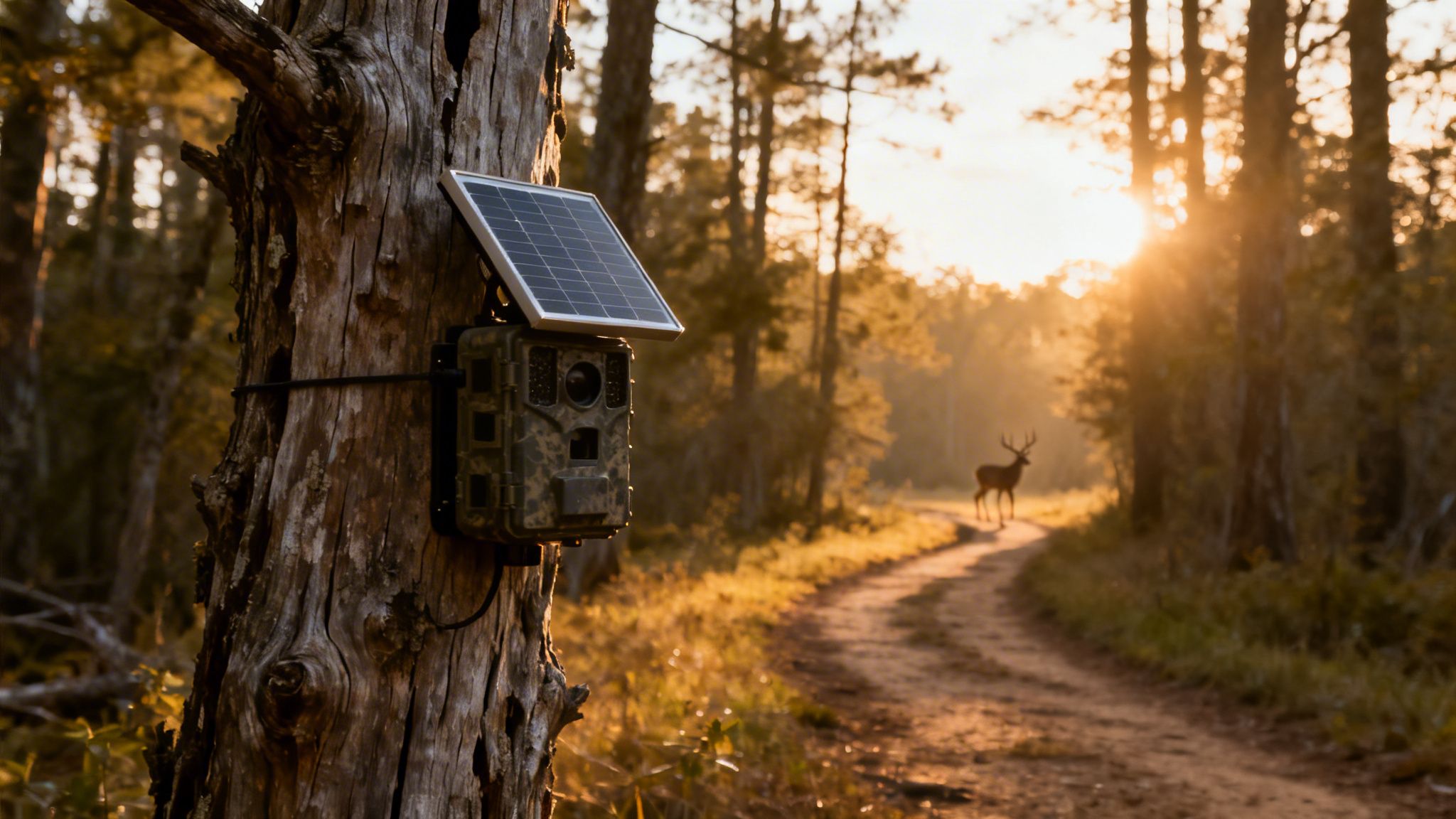
Trail cameras have always been a game-changer, but their Achilles' heel has consistently been power. Standard AA batteries can burn out in just a few weeks, especially on a busy trail or food plot. This forces you to make repeated trips back to the site, which is never a good thing.
Every single trip you take to swap out batteries creates a disturbance. You leave your scent, make noise, and risk altering the very animal behavior you’re trying to pattern. For serious hunters and researchers, keeping human impact to an absolute minimum is everything. A mature whitetail buck might go nocturnal or abandon an area for days after catching a whiff of human scent, making all your scouting efforts worthless. This is where solar power changes the entire equation.
A Truly Autonomous Scouting System
A solar-powered game camera is more than just a camera with a panel slapped on it; it’s a self-sufficient system designed to run indefinitely. It soaks up sunlight, banks that energy in an internal battery, and keeps the camera running day and night, rain or shine.
This constant trickle of power means you can stay out of the woods for much longer, allowing wildlife to settle into natural patterns without your interference. It turns your camera from a needy device into a self-sustaining intel asset that works for you around the clock.
The core benefit is simple but powerful: you dramatically reduce human pressure on your scouting locations. This leads to more authentic animal behavior and better data, whether you're patterning a target buck or running a scientific survey.
More Than Just Convenience
While not having to swap batteries every few weeks is a huge plus, the real advantages run much deeper. A reliable power source means you’ll never miss crucial activity because of a dead camera. This is especially vital when you’re running modern cellular trail cameras with AI features that can drain batteries faster.
Let’s break down the key benefits:
- Reduced Field Disturbance: By eliminating frequent battery swaps, you keep your hunting or research areas pristine and undisturbed. Less pressure equals more natural movement.
- Long-Term Reliability: A properly installed solar setup keeps your camera rolling for months on end, capturing data through changing seasons without a single hiccup.
- Cost Savings Over Time: That initial investment in a solar setup pays for itself pretty quickly. You’ll stop burning through disposable batteries, which can easily cost $20-$50 per camera every season.
- Enhanced Performance: Consistent power lets you actually use those high-drain features you paid for—like video recording, rapid-fire photo bursts, and real-time cellular transmission—without constantly worrying about your battery percentage.
How Do Solar Powered Game Cameras Actually Work?
Think of a solar powered game camera as a tiny, self-sufficient outpost. It’s sitting out there in the woods, generating and storing its own energy, day in and day out. This isn't some overly complex technology; it’s a smart, rugged system built from three core parts working in perfect harmony. Once you get how this trio operates, you'll see why these cameras are such a massive advantage in the field.
The whole process is a simple loop: capture energy, store it, and use it wisely. It’s this cycle that ensures your scouting efforts are never cut short by a dead battery again.
The Three Pillars of Solar Power
At its heart, the system is all about capture, store, and manage. Each piece of the puzzle plays a vital role in delivering that set-and-forget reliability that makes solar cameras so effective for long-term monitoring.
-
The Solar Panel (The Collector): This is the engine of the whole operation. The panel is covered in photovoltaic cells that turn sunlight directly into electricity. It’s like a tiny solar farm whose only job is to soak up energy whenever the sun is shining. Even on cloudy days, it's still pulling in ambient light and producing a charge—just a smaller one.
-
The Integrated Battery (The Reservoir): All that energy captured by the panel needs a place to go, especially for nighttime use or during a string of rainy days. That's the job of the internal rechargeable battery, usually a high-capacity lithium-ion pack. This battery acts like a reservoir, constantly being topped off by the solar panel so the camera has a deep well of power to draw from when the sun goes down.
-
The Power Management System (The Brain): This is the unsung hero. This intelligent little controller manages the flow of electricity—from the panel to the battery, and from the battery to the camera. It’s what prevents overcharging, optimizes power draw, and makes sure the camera operates as efficiently as possible, stretching every last drop of stored energy.
This simple but incredibly effective design is why solar tech has absolutely taken over the trail camera world. Hunters and researchers realized that cutting the cord on disposable batteries was a game-changer for deploying cameras in remote hunting grounds and wildlife sanctuaries.
A well-designed solar camera system isn’t just a regular camera with a panel slapped on. It’s a fully integrated power solution. The panel, battery, and management system are all sized and tuned to work together, giving you a reliable stream of power that a pack of AAs just can't compete with.
Thriving When the Weather Turns Foul
So, what happens when you get a week of solid cloud cover? This is where a quality system really earns its keep. A robust solar powered game camera is designed with an internal battery big enough to run the device for days, sometimes even weeks, without seeing a single ray of direct sun. The solar panel’s job is simply to top off that reservoir whenever it gets a chance, keeping it as close to full as possible.
This approach creates a huge power buffer. A few cloudy days or a passing storm won't knock your camera offline. The system is built for resilience, making sure you keep getting intel even when the conditions are far from ideal.
The industry has definitely listened to what users in harsh environments need. Many of the newer models now come with an IP68-rated construction, which means they can handle being submerged in 1.5 meters of water and shrug off extreme rain. When you combine that durability with a self-sustaining power source, these cameras become indispensable. In fact, some studies have shown that solar trail cams can slash maintenance costs by up to 50%—a massive win for outfitters prepping for clients or researchers working with a tight budget. You can dig into more data on market trends and technology adoption to see the full picture.
Calculating Your Power Needs for Uninterrupted Scouting
Getting your solar-powered game camera to run year-round isn't luck; it's a bit of math. The best way to think about it is like a bank account for your camera. Your solar panel makes the deposits (energy), and every photo, video, or cellular upload is a withdrawal. If you want to avoid going "bankrupt" with a dead camera, you've got to understand your power budget.
This budget gets hit by everything your camera does. High-resolution video clips drain the account way faster than a single still photo. Similarly, a cellular camera sending you pictures in real time is going to be a much bigger spender than one that just sends a daily report. The whole game is about balancing what you need for scouting against the power you have available.
Understanding Your Camera's Power Drain
Every single setting on your game camera affects how much juice it uses. Before you can even think about picking the right solar panel or battery, you have to get a handle on your camera's typical workload. A camera watching a busy food plot in November is going to have a much bigger power budget than one sitting on a quiet mineral site in July.
Think about these key factors as the biggest withdrawals from your power bank:
- Capture Mode: Video is, without a doubt, the biggest power hog. A camera set to record 30-second HD video clips will burn through its battery many times faster than one just snapping single photos.
- Trigger Frequency: It's simple math. A camera on a high-traffic trail firing off hundreds of times a day will use dramatically more power than one watching a remote scrape that only gets a few hits a week.
- Night Vision Intensity: Those infrared (IR) or black flash LEDs are essential for night shots, but they are a major power draw. The brighter you set them for clear night images, the more energy gets zapped with every flash.
- Cellular Transmissions: This is a big one for cellular models. How often the camera connects to the network to send you photos is critical. Instant uploads give you that real-time intel but come at the highest energy cost.
This flowchart breaks down the simple but crucial process of how your camera captures, stores, and manages power to keep running 24/7.
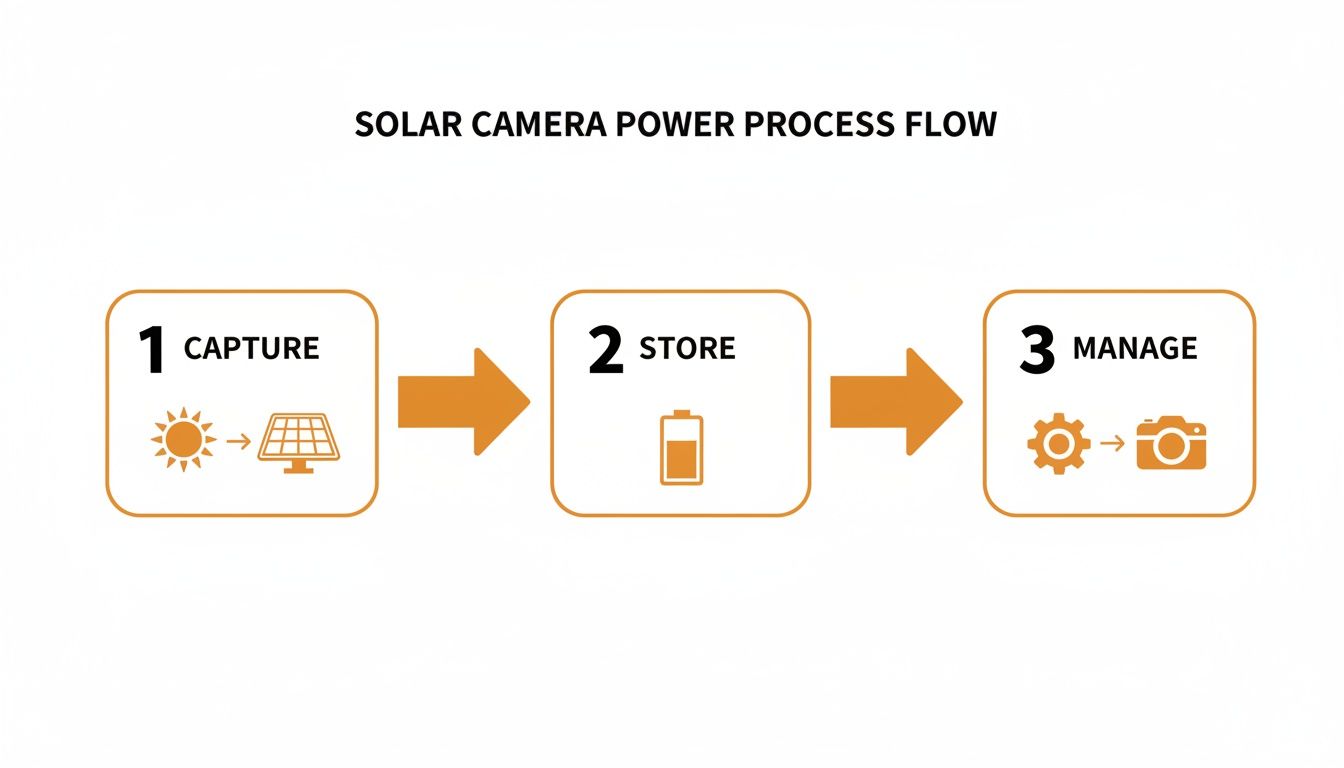
As you can see, the sun hits the panel, the panel charges the battery, and the camera's brain allocates that stored power based on the settings you've chosen. Simple.
The table below gives you a rough idea of what to expect. Use it to estimate your camera's daily power consumption based on a few common scenarios.
Trail Camera Power Consumption Estimator
| Camera Setting/Activity | Low Usage Scenario | Medium Usage Scenario | High Usage Scenario (e.g., Live Streaming) |
|---|---|---|---|
| Photos per Day | 10-20 stills | 50-100 stills | 200+ stills or constant motion triggers |
| Videos per Day | 1-2 short clips (10s) | 10-15 clips (15s) | 30+ clips (30s+) or frequent video uploads |
| Cellular Transmissions | 1 daily report | 4-6 reports per day | Instant uploads for every trigger |
| Night Vision Usage | Low, minimal nighttime activity | Moderate, balanced day/night activity | High, primarily nighttime activity with max brightness |
| Estimated Daily mAh Usage | ~100-250 mAh | ~500-1,200 mAh | ~2,000-5,000+ mAh |
This isn't an exact science—every camera model is different—but it gives you a solid ballpark to work from when planning your setup.
Sizing Your Solar Panel And Battery
Once you have a good idea of your camera’s power habits, you can start matching it with the right hardware. A common mistake I see all the time is people thinking any old solar panel will do the trick. An undersized panel is a recipe for failure, as it just can't keep up with a high-use camera, especially during those short winter days or a week of cloudy weather.
A good rule of thumb is to always oversize your power system. Think of it as creating a "power buffer" that guarantees your camera stays online through back-to-back cloudy days or a sudden spike in deer activity.
It really comes down to getting these two components right:
- Solar Panel Wattage: The wattage rating (like 5W or 10W) tells you how much power the panel can kick out in direct, ideal sunlight. If you're running a high-traffic cellular camera that records a lot of video, a higher wattage panel is a non-negotiable. It needs to recharge that battery fast.
- Battery Capacity (mAh): Milliampere-hour (mAh) is just a measure of the battery's storage—think of it as the size of its gas tank. A higher mAh rating means the camera can run for much longer without seeing a single ray of sun. This is your main defense against a long stretch of miserable, overcast weather.
If you really want to get into the weeds on power sources, check out our complete guide on the best batteries for trail cameras, where we break down all the different types and how they perform out in the field.
At the end of the day, a successful solar setup is all about creating a system where the daily energy deposits from your panel are consistently bigger than the daily withdrawals made by your camera. Get that right, and you'll never miss a thing.
Field Guide to Installing Your Solar Camera System
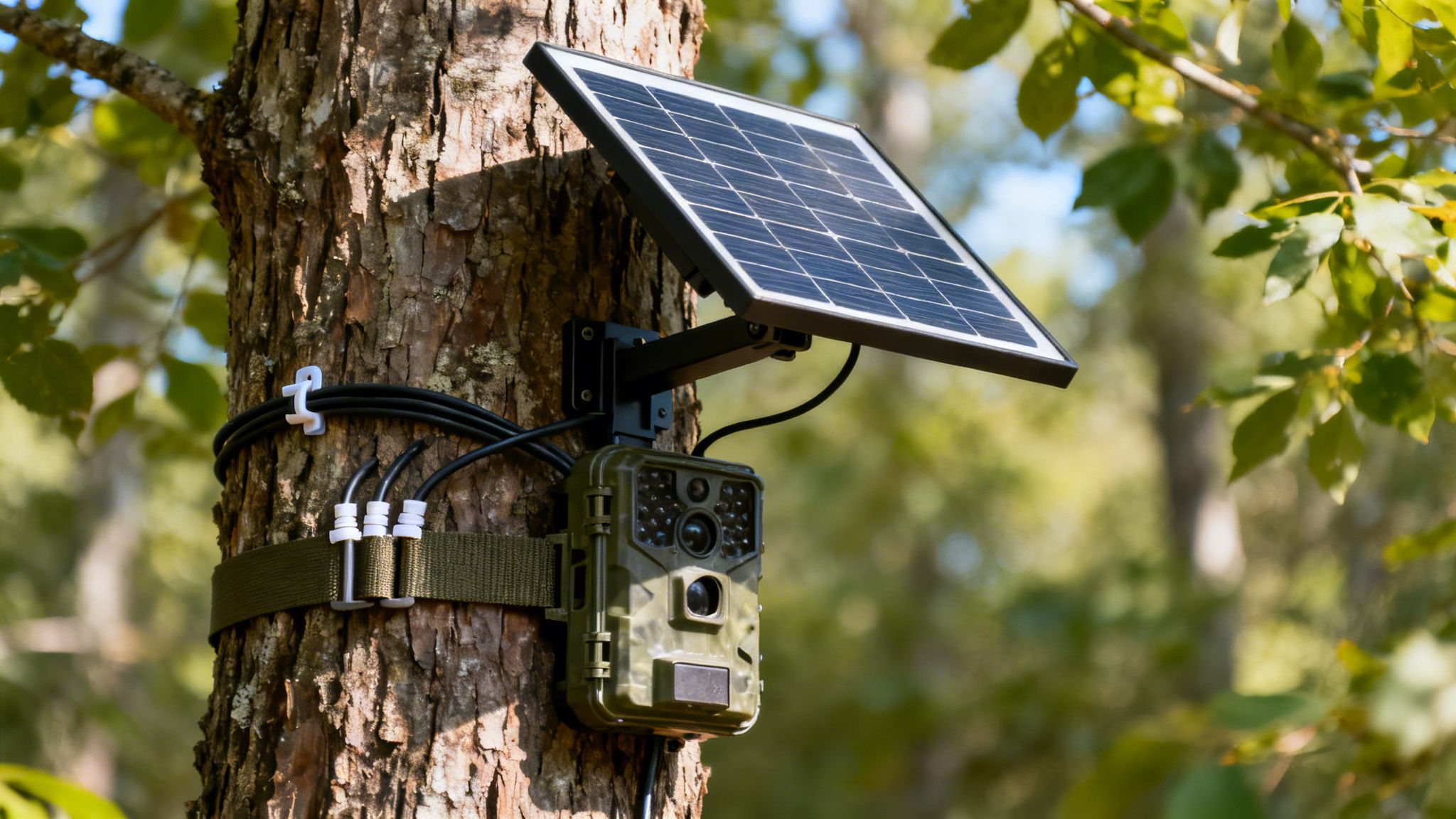 Getting a solar camera set up right is about more than just strapping it to a tree and walking away. The whole point is to create a self-sufficient outpost that runs for months on its own, and proper installation is the only way to unlock that "set-and-forget" advantage.
This isn’t just about pointing the camera at a game trail. It’s about strategically placing its power source—the solar panel—to soak up every bit of energy the sun offers. A poorly placed panel can hamstring even the best camera, leading to the exact dead batteries you were trying to avoid.
Mastering Solar Panel Placement
Think of your solar panel like a tiny sunflower; its only job is to follow the sun. To do that right, its orientation and angle are everything. For anyone in the Northern Hemisphere, this means one thing above all else: face the panel south.
A south-facing panel gets the most direct sunlight as the sun moves from east to west. But that's only half the battle. You also have to consider the angle, which changes with the seasons.
- Summer Angle: A shallower angle, around 30-35 degrees, is perfect when the sun is high in the sky.
- Winter Angle: A steeper angle of 45-50 degrees helps catch the low winter sun and lets snow or debris slide right off.
The sweet spot is an unobstructed, south-facing view of the sky, angled for the current season. Nailing this one step is the single most important thing you can do to keep your camera’s battery topped off.
Smart Mounting Strategies
Once you’ve scouted the perfect spot, it's time to get the system mounted securely. Most solar cameras ship with a versatile mounting bracket you can attach to a tree or T-post. The trick is to find the right balance between the best sun exposure for the panel and the perfect vantage point for the camera.
Don't be afraid to mount the panel and camera separately. If the best sunlight is a few feet away from your ideal camera location, use the included cables to your advantage. Put the panel high up on a tree where it clears the canopy, then run the cable down to your camera, which can stay hidden at deer-level.
The demand for this kind of energy independence is growing fast. In 2023, solar-powered models grabbed nearly 20% of the entire trail camera market. For advanced systems like Magic Eagle's EagleCam 5, that solar support means hunters can actually use power-hungry features like 4G live-streaming and AI species recognition without worrying about the camera dying.
Protecting Your System from the Elements
Out in the woods, your camera and its wiring will face everything from rain and snow to curious squirrels and falling branches. Protecting your connections is non-negotiable for long-term reliability. Never leave extra cable dangling where it can be chewed on or snagged.
Here are a few simple rules for cable management:
- Secure All Wires: Use zip ties or cable clips to fasten the cord tightly against the tree trunk.
- Create a Drip Loop: Before the cable plugs into the camera, make a small downward loop. This forces rainwater to drip off the bottom instead of running straight into the power port.
- Seal Connections: For ultimate protection, make sure all external connections are snug and shielded. When you're in the field, it's crucial to learn how to waterproof electrical connections to prevent moisture from wrecking your setup.
Taking a few extra minutes to optimize the panel placement and secure your wiring ensures your solar camera runs at peak performance. For a deeper look at the hardware itself, check out our guide on solar panels for game cameras. That little bit of upfront effort will pay you back with months of uninterrupted scouting.
Choosing the Right Solar Game Camera for Your Mission
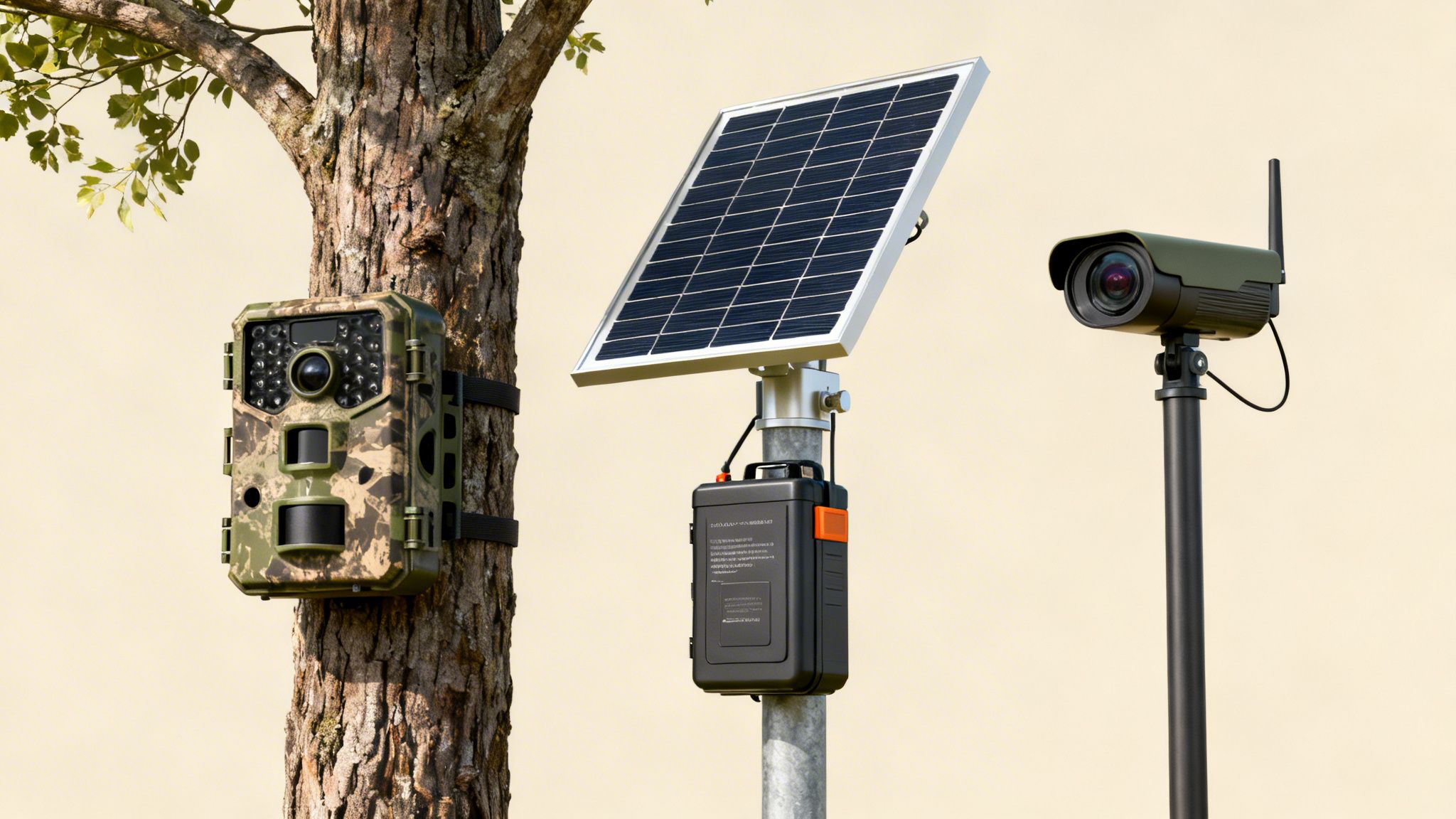
Not all solar game cameras are created equal, and they certainly aren't all built for the same job. The best camera isn't the one with the longest spec sheet; it's the one that matches your specific mission in the field. A camera that’s perfect for a hunter patterning a single buck might be a terrible choice for a biologist studying herd dynamics.
This guide is designed to cut through the marketing noise by focusing on your end goal. We'll break down what really matters for three different users: the dedicated hunter, the wildlife researcher, and the vigilant property manager. By lining up your needs with the right features, you can invest in a tool that delivers exactly what you need.
For the Dedicated Hunter
As a hunter, your mission is surgical. You need timely, actionable intelligence on specific animals at specific locations. It's all about getting the right information at the right time to make a smart move. Speed, accuracy, and stealth are your priorities.
A hunter-focused solar powered game camera is all about instant communication and smart filtering. You don't need a thousand pictures of squirrels and raccoons; you need to know the second your target buck shows up at a scrape.
Look for these critical features:
- Instant Cellular Alerts: This is non-negotiable. The camera must send photos or video clips to your phone within seconds, letting you react to changing patterns in near real-time.
- AI Species Recognition: Think of this as your digital filter. A camera that can tell the difference between a whitetail deer and a passing coyote saves you time, battery life, and countless false alarms.
- High-Quality Night Vision: Mature bucks are most active at dawn, dusk, and overnight. A camera with a powerful, no-glow (black flash) infrared system is essential for getting clear, identifiable images without spooking your target.
For a hunter, the camera is a real-time intel tool. It's not about gathering massive amounts of data; it's about getting the right piece of data—that one picture of your target buck—at the exact moment you need it to plan your next hunt.
For the Wildlife Researcher
A researcher’s mission is totally different. Your goal is data collection—comprehensive, high-quality, and unbiased. You need a workhorse that can capture detailed information about animal behavior, population density, and environmental conditions over long stretches of time.
Reliability and image quality are paramount here. You need a camera that can stand up to the elements and produce media that's clear enough for scientific analysis. Unlike a hunter, you'll probably care more about high-resolution video than instant alerts.
Key features for researchers include:
- High-Resolution Video: 1080p or 4K video with clear audio is vital for studying animal behaviors, interactions, and vocalizations.
- Large Data Storage: The ability to handle high-capacity SD cards (128GB or more) is crucial for storing weeks or even months of footage without having to overwrite important data.
- Environmental Sensors: Onboard sensors that log temperature, barometric pressure, and moon phase with each file provide critical context for analyzing animal activity.
- GPS Geotagging: This feature automatically embeds location data into every photo and video, which is essential for managing multiple study sites and mapping species distribution.
For the Property Manager
If you’re managing land, a farm, or a remote property, your mission is security and broad-scale monitoring. You need to know who or what is coming and going—whether it’s trespassers, livestock, or wildlife causing damage. Your camera needs to cover a lot of ground and act as a reliable deterrent.
For this job, detection range and field of view are far more important than trigger speed or species recognition. You're less concerned with a buck’s rack size and more concerned with a vehicle showing up at a gate late at night.
Prioritize these security-focused features:
- Wide Detection Angle and Field of View: Look for cameras with a detection angle of 60 degrees or more to monitor wide areas like gates, fields, or building perimeters with a single device.
- Long Detection Range: A camera that can detect motion out to 80-100 feet gives you an early warning, capturing subjects long before they get close to a sensitive area.
- Hybrid Lighting Modes: Some models offer a visible "white flash" option that can act as a deterrent, brightly illuminating an area and making it obvious to any intruder that they are on camera.
By defining your mission first, you can confidently choose a solar powered game camera with the right tools for the job. To explore how these features come together in modern devices, you can learn more by checking out our guide on what is the best cellular trail camera for different applications.
Troubleshooting Common Solar Power Issues
Even the most reliable solar-powered game cameras can hit a snag out in the wild. Nothing's more frustrating than getting a low-power alert or finding a battery that just won't hold a charge—it can completely derail your scouting. But before you assume the camera or panel is a dud, the fix is often surprisingly simple.
Most of the time, the problem isn't the equipment itself but something interrupting the power flow. Think of it like a garden hose: if the water stops, you check for kinks and make sure the spigot is on before you blame the hose. A quick field diagnosis can usually get you back online in minutes.
Diagnosing the Root Cause
When your camera system starts acting up, it’s best to work through a checklist, starting with the easiest and most likely culprits. This methodical approach will save you a ton of time and keep you from pulling your hair out over what's probably a simple fix.
First, give the solar panel a good look. Over weeks and months, a film of dust, pollen, or bird droppings can build up. This grime acts like a shade cloth, slashing the panel's charging efficiency. A quick wipe with a soft, damp cloth is often all it takes to get it back to full power.
Don’t overlook the obvious. More than 80% of solar power issues boil down to three things: a dirty panel, a loose connection, or new shadows blocking the sun. Always check these first.
Next, trace the power cable right from the panel to the camera. Give the connection a gentle push to make sure it's seated firmly in the power port. It's not uncommon for wind vibrations or even a curious deer rubbing against the tree to work these plugs loose over time.
A Step-by-Step Field Checklist
If a clean panel and a tight connection don't solve the problem, it’s time to dig a little deeper. The woods are always changing, and what worked in August might not work in October.
Here’s a quick troubleshooting list to run through while you're out in the field:
- Inspect for New Obstructions: Has a tree branch grown out and started shading the panel? As the seasons change, the sun’s path across the sky shifts, and a spot that was wide open in summer might be in the shadows by fall.
- Verify Panel Functionality: If you think the panel itself might be the problem, it helps to confirm it's actually generating a charge. Knowing how to tell if a solar panel is working correctly is a critical first step when things go wrong.
- Review Camera Settings: Pop open your camera’s app and check the settings. Did you recently switch it to high-resolution video or instant cellular uploads? Those features are power hogs and can easily drain a battery faster than your panel can replenish it.
- Check Battery Health: Finally, think about how old the internal battery is. Just like the battery in your phone, its ability to hold a full charge will fade after a few years of hard work out in the elements.
Frequently Asked Questions About Solar Game Cameras
To wrap things up, let's go over some of the most common questions our team gets from hunters and land managers out in the field. These quick answers should clear up any last-minute questions and give you the confidence to get your solar powered game camera system running perfectly from day one.
Can I Add a Solar Panel to My Existing Camera?
In most cases, yes. Many modern trail cameras—even those not sold as "solar" models—come equipped with a DC input port specifically for hooking up an external power source. You can usually plug a compatible solar panel kit right into that port.
The key is making sure the hardware matches up perfectly. Before you buy a panel, you absolutely have to confirm its voltage output and connector plug are an exact match for your camera’s needs. You can almost always find this info in the camera's user manual or on the manufacturer's support site. Mismatched voltage is a quick way to fry your camera, so it pays to double-check.
How Long Will a Camera Run Without Sun?
That really boils down to two things: the size of your camera's internal battery (measured in mAh) and how much power your settings are drawing. A quality camera with a big battery might last for weeks on a full charge if it's just snapping a few photos a day.
But if you have it recording dozens of HD video clips or using cellular features to send instant updates, that runtime is going to drop off a cliff. A well-placed solar panel solves this problem by constantly topping off the battery, which is how you achieve a nearly infinite runtime.
Think of the internal battery as a power reservoir, built to get your camera through a string of cloudy days. The solar panel's job is to keep that reservoir full, creating a buffer against bad weather.
Do Solar Panels Need Much Maintenance?
The maintenance is incredibly simple, but it's absolutely critical for getting the best performance. All it takes is wiping the panel's surface with a soft, clean cloth every so often. This gets rid of the film of dust, pollen, or bird droppings that builds up and blocks sunlight, which in turn kills your charging efficiency.
A quick check every few months is usually all you need. While you’re at it, it’s a good idea to give the mounting bracket a wiggle to make sure it's still tight and check that the power cable hasn't been chewed on or damaged.
Will a Solar Panel Work Well in Winter?
Absolutely. In fact, solar panels often run more efficiently in cold, sunny weather than they do in blistering heat. The real challenges in winter are the shorter daylight hours and the chance of snow covering the panel.
You can get ahead of this with a little smart installation. Mounting your panel at a steeper angle helps snow slide right off and does a better job of catching the low winter sun. As long as that panel is clear of snow and getting direct sunlight, it’ll generate power just fine, no matter how cold it gets.
Ready to experience the set-and-forget reliability of a truly autonomous scouting system? Explore the field-tested technology of Magic Eagle and see how our smart cellular trail cameras can give you the edge you need.