

At its heart, an outdoor wildlife camera is your patient, digital scout in the woods. It’s built to capture photos and videos of animals in their natural element, completely free from human interference.
These devices, better known as trail cameras, combine motion detection with infrared technology. This lets them automatically snap a picture or record a clip the moment something walks by, giving you a secret window into the wild, day or night. That core function has made them a go-to tool for everyone from deer hunters tracking bucks to conservationists studying elusive species.
How an Outdoor Camera for Wildlife Actually Works
Think of a trail camera as a simple but brilliant three-part system: the sensor, the lens, and the flash. When they work together, it's a perfectly timed sequence. And it all starts with the camera's silent watchman—its motion sensor.
The Brains of the Operation: The PIR Sensor
Nearly every modern trail camera uses a Passive Infrared (PIR) sensor. This isn’t your average motion detector that gets tricked by a swaying branch. A PIR sensor is a heat-seeking specialist. It establishes a baseline temperature for its surroundings and then waits.
When a warm-blooded animal steps into its detection zone, the sensor instantly picks up on the change in heat signatures combined with movement.
This dual-trigger system—needing both heat and motion—is the secret sauce that prevents false alarms. A falling leaf or a gust of wind doesn't give off body heat, so the camera smartly ignores it. This saves you tons of battery life and SD card space for the shots that actually matter.
The Capture Sequence in Action
Once that PIR sensor is tripped, a lightning-fast chain reaction kicks in:
- Waking Up: The sensor zaps an electrical signal to the camera's processor, waking it from its low-power sleep mode.
- Getting the Shot: The processor instantly tells the lens to either snap a photo or start recording a video, depending on how you've set it up. This whole process happens in a fraction of a second—a spec known as "trigger speed."
- Lighting the Scene: If it's dark out, the camera simultaneously fires up its infrared (IR) flash. Unlike a startling white flash from a regular camera, IR light is almost invisible to animals, letting you get natural, candid shots without spooking them.
This foundational tech is so effective it has become wildly popular. Global demand is skyrocketing, with the wildlife camera market projected to jump from around USD 241.3 million in 2025 to USD 3,200 million by 2033. This boom is driven by a massive surge of interest from hunters, researchers, and wildlife enthusiasts. To get a better handle on the basics, you can learn more about trail cameras in our detailed article.
This simple yet elegant "detect, wake, and capture" system is the engine that powers every outdoor wildlife camera. It’s a mechanism so reliable it's remained at the core of trail cam technology for decades. Of course, today’s cameras have built on that foundation, adding things like cellular connectivity and AI to turn a simple picture-taker into a powerful, real-time field intelligence tool.
Comparing the Must-Have Features of Modern Wildlife Cameras
Not all trail cameras are created equal. Once you get past the marketing hype, you'll find a few core features that truly determine whether a camera is a powerful field tool or just a glorified toy. The whole point of an outdoor wildlife camera is to capture clear, usable intelligence, and three specs form the foundation of that capability: image resolution, trigger speed, and detection range. Each one plays a critical role in turning a fleeting moment into a valuable piece of data.
Think of image resolution, measured in megapixels (MP), as the raw detail in your photos. Higher megapixels mean sharper images, letting you zoom in to count antler points, identify a specific buck, or even read an ear tag from a distance. While a basic camera might get the job done, models pushing 8-12 MP are quickly becoming the standard for hunters and researchers who need that crisp detail for accurate analysis.
Understanding Trigger Speed and Detection Range
Next up is trigger speed—the tiny fraction of a second it takes for the camera to snap a photo after its sensor detects motion. A slow trigger is the difference between a perfect shot of a buck and a blurry photo of its tail disappearing out of the frame. The best cameras on the market now boast trigger speeds of 0.2 seconds or less, ensuring you get a perfectly centered shot every time.
Then there's the detection range, which is how far out the camera's sensor can pick up heat and motion. A long range is great for monitoring big open fields or long shooting lanes. But here's the catch: the detection range has to match the camera's flash range. A camera that can "see" an animal at 100 feet but only light it up at 60 feet is going to deliver a lot of dark, useless images.
This diagram breaks down how these key parts work together in that split second to capture a great wildlife photo.
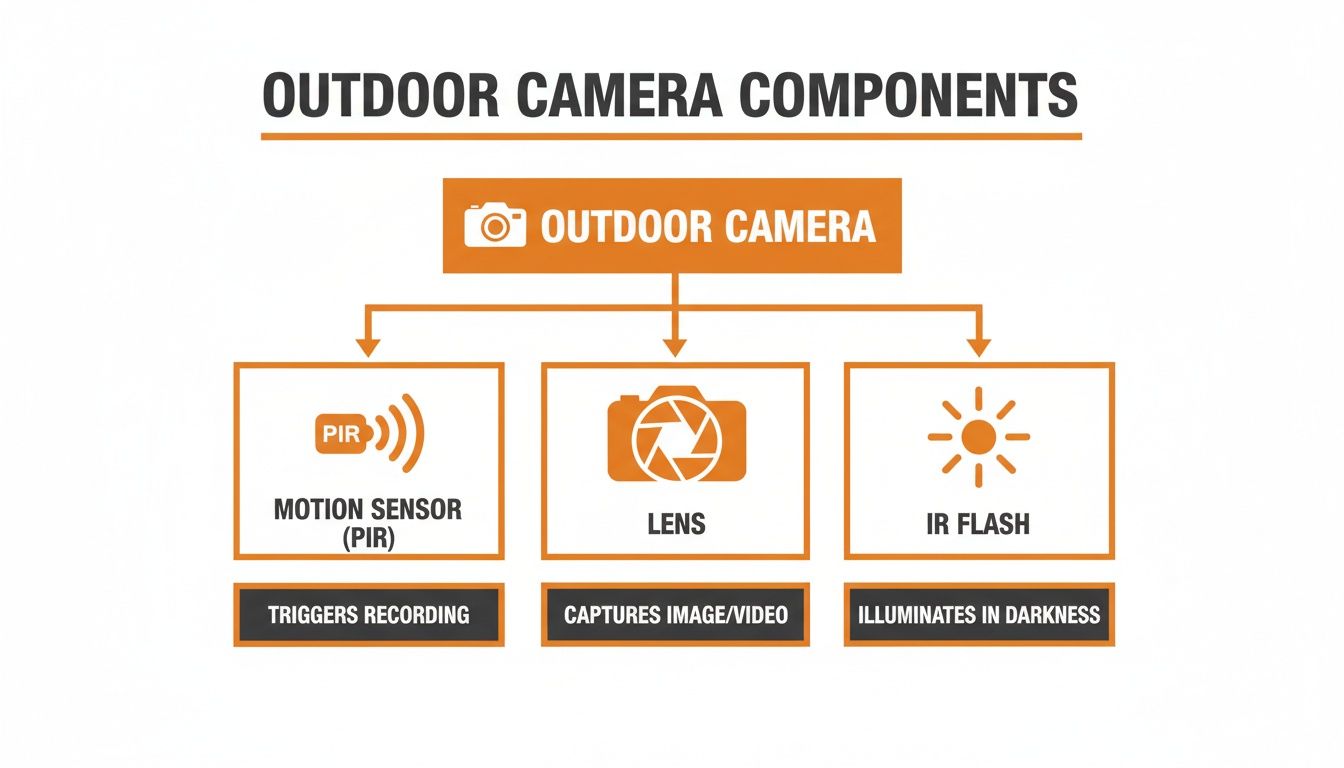
As you can see, the motion sensor acts as the trigger, the lens captures the image, and the IR flash provides the light, all working in a rapid, seamless sequence.
The Leap to Cellular and AI Cameras
While those core mechanics are vital, the real game-changer in modern wildlife cameras is connectivity and intelligence. A traditional camera is a passive data collector—you have to physically go retrieve the SD card to see what it caught. A cellular trail camera, on the other hand, is an active intelligence agent, sending photos and videos straight to your phone almost instantly.
This instant access is so much more than a convenience. It fundamentally changes how you scout.
- Reduce Scent Pressure: Fewer trips into the woods mean less human disturbance, keeping deer and other game on their natural patterns.
- Act on Real-Time Intel: Get an alert the moment a target buck shows up, letting you make immediate decisions about your next hunt.
- Monitor Remotely: Check on remote food plots, bait sites, or research areas from anywhere, saving huge amounts of time and gas.
It's no surprise the market for these advanced cameras is booming, with North America holding over 40% of the global market share, driven by a strong hunting culture and growing conservation needs. In 2023 alone, U.S. sales topped 2 million units as more people adopted this tech to manage wildlife. The entire market is projected to grow to USD 219.57 billion by 2033, which tells you everything you need to know about where this technology is headed.
The table below breaks down just how much things have changed, comparing the old-school trail cams with the smart, connected models available today.
Key Feature Comparison Traditional vs Modern Wildlife Cameras
| Feature | Traditional Camera | Modern Smart Camera (e.g., Cellular/AI) |
|---|---|---|
| Data Retrieval | Manual (requires visiting camera to swap SD cards) | Automatic (transmits images/videos to phone/cloud) |
| Alerts | None | Real-time notifications for motion events |
| Remote Control | No (settings changed on the physical device) | Yes (adjust settings, request photos via an app) |
| Image Sorting | Manual (user sifts through all photos) | AI-powered (auto-tags species, filters out non-target animals) |
| Security | Minimal (easily stolen with no tracking) | GPS tracking and anti-theft alerts |
| Firmware Updates | Manual (requires downloading to SD card) | Over-the-air (OTA) automatic updates |
This evolution shows a clear shift from simple data capture to active, intelligent monitoring that saves time and delivers far better insights.
AI-powered species recognition acts like a smart filter for your camera. Instead of manually sifting through hundreds of photos of squirrels and swaying branches, the camera's AI automatically identifies and tags the species in each image, saving you countless hours.
This "smart sorting" is a lifesaver. You can find every photo of a deer, bear, or turkey with a single tap. When you combine that with cellular delivery, you're transforming your scouting from a slow, manual chore into a highly efficient, automated system for gathering wildlife intelligence. Throw in features like GPS tracking that alert you if your camera is moved, and you have a secure, powerful tool that protects your investment in the field.
Mastering Camera Placement and Setup in the Field
An elite outdoor camera wildlife system is only as good as its placement. A high-tech camera in a lousy spot will capture nothing but waving grass, while a well-placed basic camera can deliver incredible insights. Mastering setup means learning to think like the animals you want to observe, and that process starts long before you ever strap a camera to a tree.
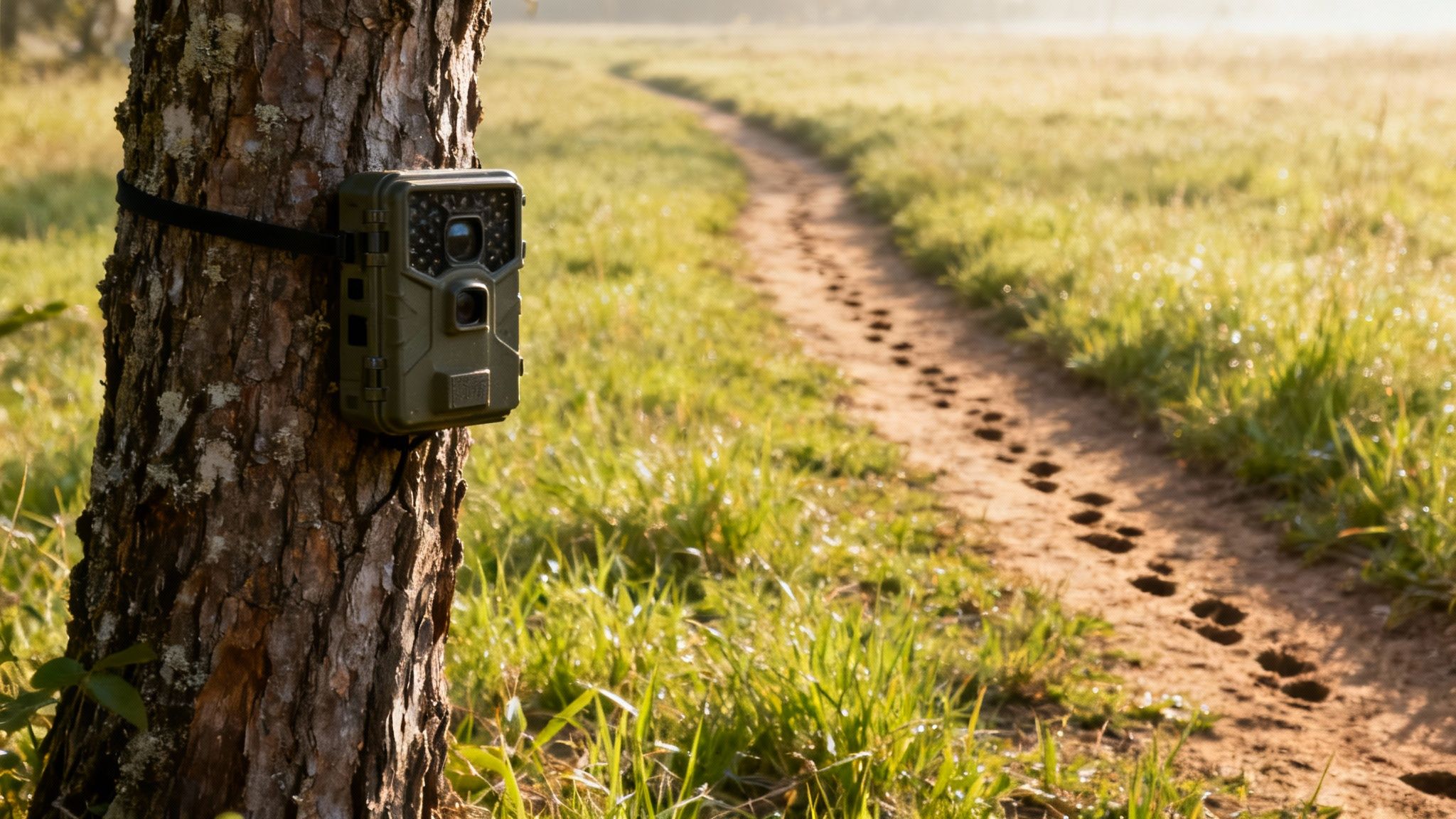
Getting great shots isn't about luck; it's pure strategy. The goal is to position your camera along the natural paths wildlife already use. Think of it like setting up a toll booth on a busy highway—you want to be where the traffic is guaranteed to pass.
Scouting High-Traffic Wildlife Locations
Before you even think about deploying your camera, get your boots on the ground and scout your property for features that attract or funnel animal movement. Animals are creatures of habit, and their travel is surprisingly predictable if you know what to look for.
Your scouting should zero in on a few key types of locations:
- Game Trails: These are the well-worn paths animals use to travel between food, water, and bedding areas. Look for distinct trails with fresh tracks, scat, or rubs.
- Pinch Points: These are natural funnels like narrow creek crossings, gaps in a fence, or saddles in a ridge that force animals down a predictable path. They're absolute goldmines for camera placement.
- Water Sources: Creeks, ponds, and even large puddles are essential for wildlife, especially during dry seasons. They're a magnet for activity.
- Food and Bedding Areas: Find where the animals eat and where they rest. Placing a camera on a trail leading into a secluded bedding thicket or near an oak flat dropping acorns is a fantastic strategy.
Once you’ve found a prime location, the technical details of the setup become critical for capturing high-quality images and avoiding common headaches.
Fine-Tuning Your Camera Angle and Height
The ideal height for your camera really depends on what you're trying to see. For larger animals like deer or bears, mounting the camera two to three feet off the ground is standard practice. This puts the lens right at body level, ensuring you get full-frame shots instead of just legs or backs.
If you’re after smaller critters like foxes or turkeys, you'll need to drop the camera lower to capture them effectively. The angle is just as important. A common mistake is pointing the camera straight down a trail. Instead, angle it at about 45 degrees to the path. This gives the sensor more time to detect an animal as it moves across the detection zone, resulting in perfectly centered photos.
Pro Tip: Always try to face your camera north or south. Pointing it east or west will cause the rising or setting sun to blast the lens, triggering a flood of false photos and washing out your images.
Preparing the Site for Flawless Operation
A few final steps on site can make all the difference. The biggest enemy of any trail camera is false triggers caused by moving vegetation. Before walking away, take a minute to clear the area directly in front of the camera.
- Trim Branches and Grass: Snip away any branches, leaves, or tall weeds within the camera's detection range that could blow around in the wind.
- Check Your View: Turn the camera on and use its test mode or viewfinder to confirm the field of view is clear and aimed exactly where you want it.
- Confirm Cellular Signal: If you're using a cellular model, this step is non-negotiable. Check the camera's display or your app to ensure you have a strong and stable signal before you leave. There’s nothing worse than thinking your camera is transmitting, only to find it's been offline for weeks.
By combining smart location scouting with meticulous setup, you transform your camera from a passive device into an active intelligence-gathering tool that delivers consistent, valuable insights.
Unlocking the Power of Cellular and AI Technology
The old-school wildlife cameras were passive observers, patiently waiting for you to come to them. Today's models? They’re active intelligence agents, and two key pieces of tech are driving this shift: cellular connectivity and artificial intelligence (AI). When you put them together, you’re not just getting a camera; you're getting a powerful, real-time monitoring system.
Think of cellular tech as having a dedicated scout in the field who never sleeps and reports back instantly. Instead of waiting weeks to hike in and pull an SD card, you get photos and videos sent right to your phone just moments after they're snapped.
This isn't just about convenience—it's a massive strategic advantage. Every trip you make to check a camera leaves your scent and disturbs the area, which can completely change an animal's patterns. Cellular delivery lets you cut that pressure down to almost zero, keeping wildlife relaxed and on their natural routines.
The Advantage of Real-Time Information
Imagine getting an alert on your phone the second a target buck walks into your clearing. That’s the power of real-time intel. It lets you make decisions on the fly, whether you're a hunter figuring out your evening sit or a researcher tracking a specific animal's territory. You’re no longer working with old data; you’re acting on what’s happening right now.
Beyond just sending you pictures, modern wildlife cameras are becoming sophisticated remote monitoring systems that let you watch over a property from hundreds of miles away. The market reflects this shift in a big way—the global trail camera market hit a staggering USD 101.7 billion in 2023 and is expected to climb to USD 203.3 billion by 2032. This isn't just a hobbyist trend; it's driven by professionals who rely on these non-intrusive tools every day.
Moving from manual card-pulling to instant delivery fundamentally changes the game. It saves you countless hours and gas money, but more importantly, it gives you a much clearer, unfiltered picture of wildlife activity as it actually happens.
AI: Your Virtual Field Biologist
If cellular is the delivery truck, AI is the smart sorter at the warehouse. A busy camera can easily snap thousands of photos a week, and let’s be honest, most of it is "noise"—a branch swaying in the wind, a curious squirrel, or the same doe for the hundredth time. Sifting through all that manually is a tedious chore.
This is where AI species recognition comes in. It acts like your personal biologist, automatically sorting every photo for you.
- Automated Tagging: The AI looks at each image, identifies the animal, and tags it—deer, turkey, bear, you name it.
- Intelligent Filtering: This lets you instantly filter your gallery to see only what you care about. Want to see every buck that hit a scrape last week? Just tap a button.
- Pattern Analysis: By organizing everything so cleanly, AI makes it simple to spot patterns, like the specific times a mature buck tends to show up.
The combination of cellular delivery and AI filtering creates a powerful feedback loop. You get instant alerts, and the AI makes sure those alerts are for the animals that actually matter, saving you from getting pinged every time a raccoon walks by.
A rancher, for instance, could use AI to monitor feeders and get alerts only when feral hogs show up, not every time a deer passes through. A researcher can track an elusive predator without wasting hours sorting through photos of other animals. That's what smarter scouting is all about. To go deeper on this, check out our guide on AI species identification technology in our guide.
Ultimately, cellular and AI work together to solve the biggest headaches of traditional trail cams. They eliminate the need to physically visit your camera, reduce human disturbance, and automate the painful task of sorting photos. This frees you up to spend more time on strategy, armed with the best, most current intel straight from the woods.
Protecting Your Investment with Proper Maintenance and Security
Your outdoor wildlife camera is a serious investment built to take a beating from the elements, but a little preventative care can make all the difference. Think of it as routine upkeep for your most reliable field scout.
Consistent maintenance means your camera will operate flawlessly season after season, while smart security measures protect it from thieves and tampering. A well-maintained camera captures sharper images, gets more out of its batteries, and is far less likely to fail right when that monster buck finally shows up.
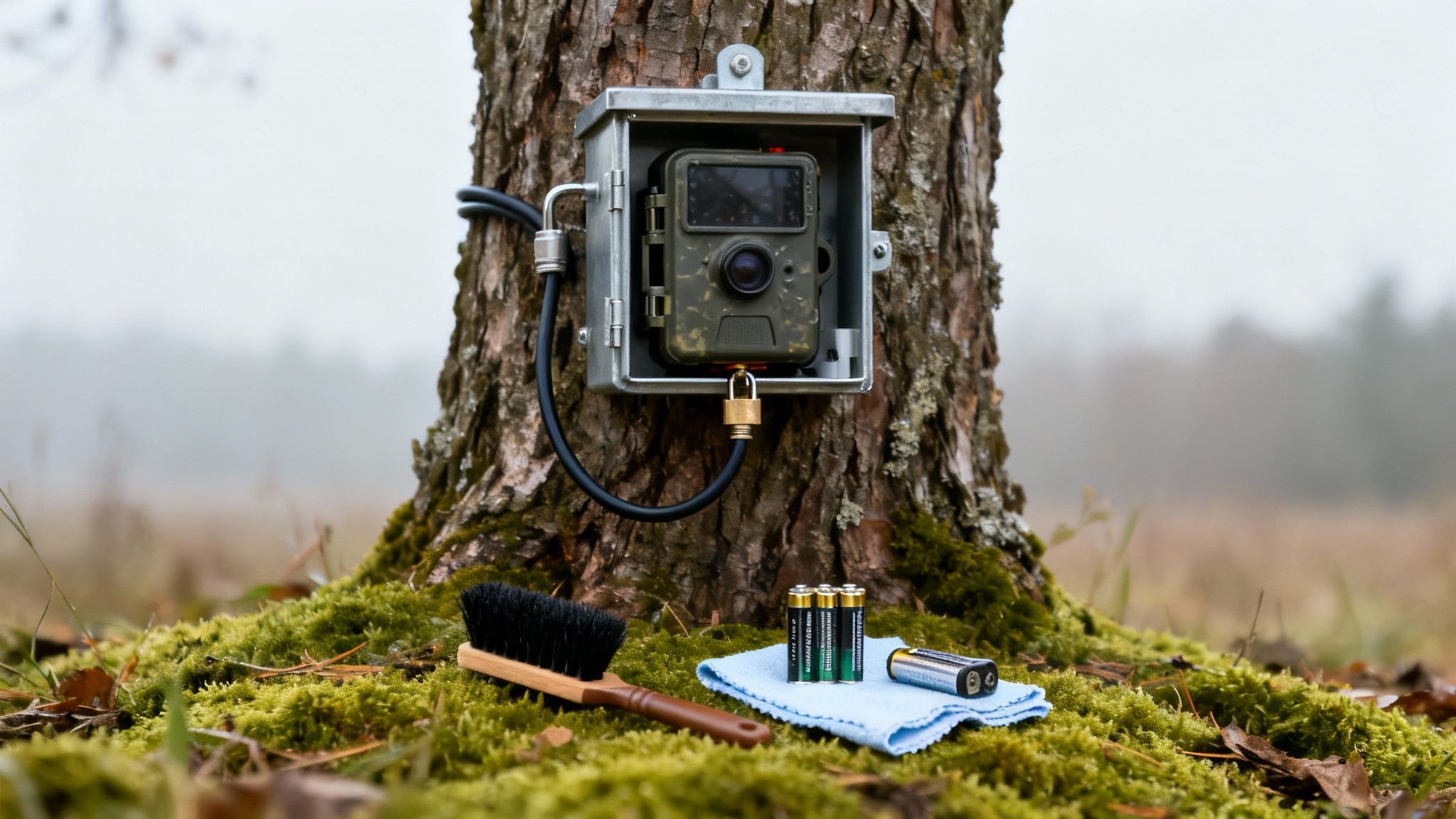
Essential Maintenance Checklist
Every time you visit your camera, run through this quick checklist. It only takes a few minutes but can save you from huge headaches later on.
- Clean the Lens and Sensors: Grab a soft microfiber cloth and gently wipe the camera lens, PIR sensor, and the IR flash cover. Even a little dirt, pollen, or a few water spots can completely ruin an otherwise perfect shot.
- Inspect Weatherproof Seals: Take a close look at the rubber gasket lining the camera's housing. If you see any cracks or wear, it's a problem. A bad seal is an open invitation for moisture—the #1 killer of trail cameras.
- Check Battery Connections: Pop the batteries out and check the terminals for any corrosion, especially after a long, wet season. A small brush can clean off any buildup and ensure you're getting a solid connection.
- Format Your SD Card: Before you walk away, always format the SD card. The trick is to do it in the camera itself, not on your computer. This prevents file corruption and makes sure the card is perfectly set up for that specific device.
This simple routine ensures your gear is always ready to perform at its best.
Physical and Digital Security Measures
Let’s be honest—an outdoor camera sitting in the woods is an attractive target for thieves. That makes security a top priority. Luckily, today's cameras offer layers of protection that go way beyond a simple strap.
The best security strategy combines physical deterrents with digital tracking. A thief might be able to cut a cable, but they can't easily defeat GPS tracking that alerts you the moment your camera moves from its location.
Physical security starts with making your camera a pain to steal. A heavy-duty steel lockbox is your first line of defense, shielding the camera from both two-legged thieves and curious four-legged critters like bears. Pair the box with a high-quality Python cable or one of the many specialized trail camera locking cables to cinch it tightly to the tree.
Digital security is where modern cellular cameras really pull away from the pack. These anti-theft features give you powerful peace of mind when you can’t be there.
- GPS Tracking: This is a game-changer. You can see your camera's exact location on a map in your app. If it gets stolen, you can give law enforcement its live coordinates.
- Geofencing: You can set a virtual perimeter around your camera’s location. The second the device is moved outside that boundary, you get an instant alert on your phone.
- Remote Photo Capture: Some models even let you remotely trigger a photo, which could potentially snap a picture of the thief in the act.
By layering these physical and digital protections, you create a tough security system that makes thieves think twice and gives you the best possible chance of getting your gear back if it ever goes missing.
How to Choose the Right Outdoor Wildlife Camera for You
Picking the perfect wildlife camera isn’t about finding a single “best” model—it’s about matching the right tool to your specific mission in the field. Before you get lost in marketing hype, you have to ask yourself one simple question: What problem am I trying to solve?
The ideal camera for a hunter zeroing in on a target buck is fundamentally different from what a biologist needs to study long-term herd dynamics. By defining your purpose first, you can focus on the features that matter and avoid paying for tech you’ll never use. A hunter might need instant alerts to his phone, while a property owner may care more about battery life and a wide detection angle for security.
Tailoring Features to Your Field Goals
Let’s dig into how different users should approach this choice. Each profile has distinct needs, making some features mission-critical and others just nice to have.
For the Dedicated Deer Hunter:
Your mission is surgical. You need real-time intel on specific animals at key locations, right now.
- Must-Haves: Cellular connectivity is non-negotiable for instant photo delivery. AI species recognition is just as vital to filter out squirrels and raccoons, so your phone only buzzes when a buck shows up. You’ll also need a lightning-fast trigger speed—think under 0.3 seconds—to get clear shots of deer moving quickly down a trail.
- Nice-to-Haves: High-res video is great for confirming a buck’s tine length, but it’s a battery and data hog. GPS tagging is good for peace of mind, but it’s not as crucial as getting that immediate scouting data.
For the Wildlife Researcher or Biologist:
Your goal is gathering consistent, high-quality data over long periods with the least possible disturbance.
- Must-Haves: Long battery life, often paired with solar panels, is paramount for deployments that last months, not days. High-resolution video with audio delivers far richer behavioral data than still images ever could. And a no-glow infrared flash is absolutely essential to avoid spooking animals and altering their natural behavior.
- Nice-to-Haves: Cellular delivery is useful for spot-checks but isn't always necessary if you're only pulling cards every few months. AI filtering helps, but it’s less critical since you often need to analyze every single species that wanders by.
Your choice of an outdoor wildlife camera should be a direct reflection of your strategy in the field. A hunter invests in speed and intelligence for immediate action, while a researcher invests in endurance and discretion for long-term study.
When you align your purchase with your own user profile, you can confidently pick a tool that delivers exactly the results you need, season after season. It’s the best way to make sure your camera is working for you, not the other way around.
Got Questions? We've Got Answers.
When you're getting into the world of wildlife cameras, a few questions always seem to pop up. Getting these sorted out early will save you a lot of headaches and help you get the most out of your gear from day one.
How Much Data Does a Cellular Wildlife Camera Actually Use?
This really boils down to what you’re sending and how often. If you’re just having the camera send you low-resolution thumbnails to check on activity, a basic data plan can easily handle thousands of images a month. For most scouting situations, that’s more than enough.
But if you start requesting full HD photos or streaming video clips, you'll burn through data much faster. The smartest approach is to start with a modest plan and see what the animal traffic in your area is like. You can always adjust it later, ensuring you only pay for what you actually use.
Can These Cameras See in Pitch-Black Darkness?
Absolutely. They are built for 24/7 work and truly shine in total darkness. Instead of a startling visible flash, they use infrared (IR) technology to light up the scene without spooking animals.
You’ll generally run into two kinds of IR flash:
- Low-Glow: This puts out a very faint red glow from the LEDs. It’s pretty subtle, but some sharp-eyed, sensitive animals might catch a glimpse of it.
- No-Glow: Also known as black flash, this is 100% invisible to both animal and human eyes. It’s the perfect choice for capturing the most natural wildlife behavior or for any kind of security monitoring.
The biggest mistake new users make is poor placement. It leads to hundreds of false triggers, which drains your battery and clogs your storage with empty photos of swaying branches.
What’s the Biggest Mistake People Make When Placing a Camera?
Hands down, the most common error is aiming the camera where it picks up constant false triggers. This usually happens when the camera is pointed toward the rising or setting sun, or when there are moving branches and tall grass right in its detection zone.
Every time the wind blows, those objects will trick the motion sensor into firing. To fix this, always trim away any moving vegetation from the camera’s line of sight. It also helps to aim your camera north or south whenever you can to keep direct sunlight out of the lens.
Ready to get a clear, real-time view of your property? The Magic Eagle EagleCam 5 combines rugged reliability with powerful AI and cellular technology to give you the ultimate scouting advantage. Discover the difference today at magiceagle.com.