

When winter finally breaks, putting in a spring deer food plot is single-handedly the most impactful thing you can do to help your herd bounce back. Planting high-protein forages like clover and chicory gives them the exact nutrition they need to recover body condition, support does carrying fawns, and get a jumpstart on antler growth.
Why Spring Food Plots Are Crucial for Your Herd
After a long, hard winter, deer are running on empty. Natural food is still scarce, and their fat reserves are completely tapped out. This post-winter window is a critical time where your habitat work can make a world of difference for the health of your local deer population.
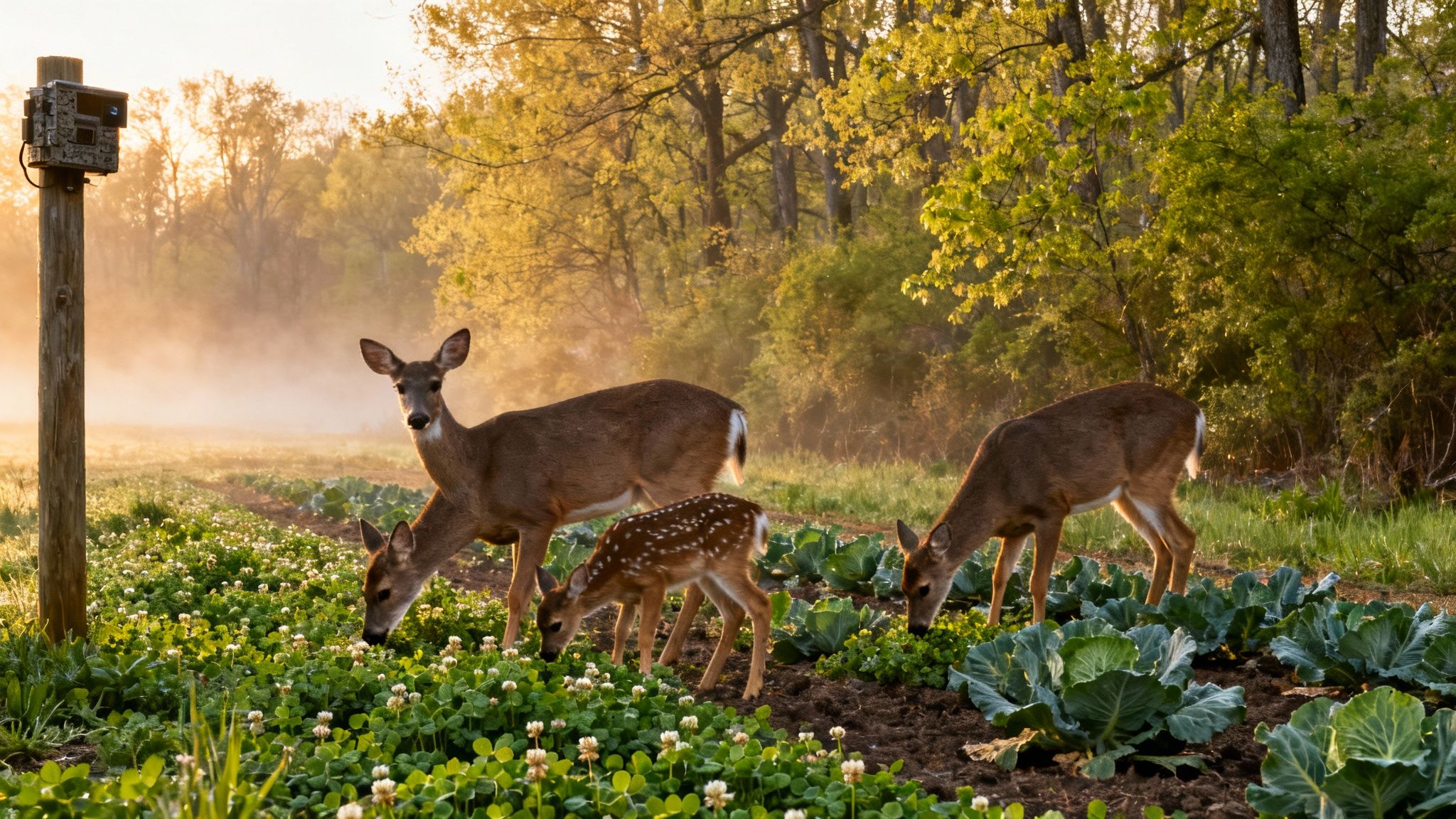
A well-planned spring plot becomes a magnet for deer that are desperate for high-quality food. This isn't just about attracting them for a few weeks; it's about fundamentally improving the herd's health from the ground up.
Fueling Antler Growth and Fawn Health
For bucks, what they eat in early spring has a direct line to their antler development. Growing antlers is a biologically taxing process that demands a massive amount of protein and minerals. If they can't find quality forage during this phase, you'll see it in their racks come fall.
It's the same story for does. They have incredible nutritional demands while carrying fawns. Giving them access to protein-rich greens ensures they can deliver healthy, strong fawns and have the milk to support them. Healthy does mean healthy fawns, and that's the bedrock of a sustainable herd.
A strategically placed and properly managed spring plot does more than just feed deer—it becomes the nutritional engine that drives herd health for the entire year. It’s an investment in bigger bucks, healthier does, and higher fawn survival rates.
This approach also helps hold deer on your property, making them less likely to wander off looking for better groceries next door. By providing what they need from the first green-up all the way through the summer heat, you create a core area they'll call home. As the season progresses, you can shift your efforts to planning productive summer food plots for deer, creating a seamless nutritional bridge. This year-round strategy is what separates good habitat from truly great habitat.
Building a Foundation for Food Plot Success
Jumping straight to planting is one of the biggest mistakes you can make. I’ve seen it happen time and again. The most successful spring deer food plots are built on a solid foundation, and that work starts long before a single seed hits the dirt. Getting this part right is the difference between a lush, green deer magnet and a patchy, weed-infested failure.

First things first, you have to think like a deer. Don't just pick a spot that's easy to get to with your tractor. Analyze how deer are already using your property. Look for those natural travel corridors between bedding areas and other food or water sources.
From my experience, a small, secluded plot tucked just inside the woods off a main trail will almost always see more daylight activity than a massive plot sitting in the wide open.
Keep these factors in mind when you're scouting a location:
- Sunlight: Most forage blends need at least 4-6 hours of direct sunlight every day. An open spot near a south-facing treeline is often a perfect compromise.
- Accessibility: Can you get your equipment in and out without spooking every deer for miles? Your entry and exit routes for planting and maintenance are just as important as the plot itself.
- Staging Areas: Plots near thick, nasty cover provide a sense of security. They encourage those mature bucks to step out and grab a bite right before dark.
The Most Important Step You Cannot Skip
Once you have a few potential locations picked out, it’s time for the single most crucial task: the soil test. Guessing about your soil’s condition is like building a house without checking the foundation. It’s just not going to end well. A simple soil test is cheap and gives you a clear roadmap for what your plot needs to thrive.
You can grab a test kit from your local county extension office or an agricultural co-op. Follow the instructions—take several small samples from across the entire plot area and mix them all together in a bucket. This gives you a true average of your plot's soil, not just one random spot.
The report you get back will tell you two critical things: the soil’s pH level and its nutrient deficiencies.
A soil test isn’t just a recommendation; it’s a prescription for success. Skipping it is the fastest way to waste hundreds of dollars on seed and fertilizer that your soil can't even use.
Turning Dirt into a Buffet
The pH scale runs from 0 to 14, with 7.0 being neutral. Most food plot forages, like clovers and chicory, do best in a slightly acidic to neutral range, typically between 6.2 and 7.0 pH. If your soil is too acidic (a low pH number), the plants are "locked out" and can't absorb the nutrients, no matter how much fertilizer you throw down.
This is where lime comes into play. Your soil test will tell you exactly how much lime to apply, usually in tons per acre, to raise the pH to that sweet spot. Applying lime isn't a quick fix; it can take months to really work its magic. That's why getting it on the ground in the fall or winter before your spring planting is a fantastic strategy.
Finally, the test will pinpoint which key nutrients—Nitrogen (N), Phosphorus (P), and Potassium (K)—are lacking. Armed with this information, you can buy the exact fertilizer blend your plot needs. For instance, if your report shows low P and K but plenty of N, you'd buy a blend like 0-20-20 instead of a generic, all-purpose bag of 13-13-13. This targeted approach saves you money and gives your new spring plots exactly what they need to explode with growth.
Choosing the Right Seeds for Your Spring Plot
Walking into the seed aisle can be a bit overwhelming. You’re hit with a wall of bags, all promising giant racks and fields so lush they look like a golf course. It’s easy to get lost in the marketing hype.
But here’s the secret: picking the right seeds for your spring deer food plots really just comes down to understanding your goals, your dirt, and the two main players in the forage game: annuals and perennials.
Think of it this way: annuals are the sprinters, and perennials are the marathon runners. Each one has a critical job in a well-rounded food plot program.
Annuals for Fast Growth and Immediate Attraction
Annual plants live their whole life in one season. They sprout, grow like crazy, put out seed, and then they're done. For spring plots, this means you get a massive burst of highly attractive, nutrient-dense forage in a hurry.
Some of my go-to spring annuals include:
- Crimson Clover: This stuff pops up fast and gives deer a serious protein boost right out of the gate.
- Oats and Wheat: These cereal grains are perfect for creating instant tonnage. They also act as a fantastic "nurse crop," sheltering slower-growing perennials as they get established.
- Forage Soybeans: If you want to talk about top-tier summer nutrition, soybeans are it. Once they get a foothold, they can stand up to some serious browse pressure.
Annuals are the perfect tool for creating "kill plots" or any spot where you need to pull deer in right now. The only trade-off is that you’ll be replanting them every year, which means a little more seat time on the tractor and a bit more cash over the long haul.
Perennials for a Long-Term Food Source
Perennials are the absolute workhorses of any serious food plot strategy. Once you get them established, these plants come back year after year—often for 3-5 years or even longer if you take care of them. They build a reliable, season-long food source that becomes a permanent fixture in a deer's daily routine on your property.
When I’m planting perennials in the spring, I almost always lean on a clover-based mix.
- White Clover (Ladino/Durana): Deer absolutely love these varieties. They’re built to withstand heavy grazing and provide a steady diet of protein from early spring all the way through fall.
- Chicory: This is a fantastic partner for clover. It has a deep taproot that makes it incredibly drought-resistant, and it’s loaded with minerals. When other plants are browning up in a dry summer, chicory is often still green and drawing deer.
The most powerful strategy I’ve found is to plant a mix of both. By broadcasting a fast-growing annual like oats right alongside a perennial clover blend, you give deer something to munch on immediately while your long-term clovers are busy establishing their root systems below.
This approach truly gives you the best of both worlds: instant attraction and lasting nutritional value. A well-planned plot system doesn't just attract deer; it builds a healthier herd. In fact, recent data shows a strong link, with antlered buck harvests climbing near historic highs at 2.9 million and antlerless harvests exceeding 3 million for the first time since 2013. A lot of that success starts with what we plant in the spring.
The table below breaks down some common seed choices to help you decide what fits your property best.
Annual vs Perennial Spring Plot Seed Comparison
| Seed Type | Primary Benefit | Establishment Speed | Best For |
|---|---|---|---|
| Oats/Wheat | Fast tonnage & nurse crop | Very Fast | Quick attraction, protecting perennials |
| Crimson Clover | Early-season protein | Fast | High-protein spring/early summer plots |
| Forage Soybeans | Peak summer nutrition | Moderate | High-browse areas needing summer forage |
| White Clover | Season-long protein | Slow to Moderate | Long-term, foundational nutrition plots |
| Chicory | Drought tolerance & minerals | Slow to Moderate | Mixing with clover, dry/sandy soils |
Ultimately, choosing between annuals and perennials—or better yet, combining them—allows you to create a food source that keeps deer on your property from the first green-up of spring until the last leaf drops in the fall.
Blends vs. Single Seeds
So, should you grab a pre-made blend off the shelf or mix up your own concoction?
Honestly, for most folks, buying a quality commercial blend is the simplest and most effective route. Reputable companies have already done the hard work, formulating mixes with varieties that grow well together and provide deer a diverse buffet. It just takes the guesswork out of it.
However, if you're dealing with very specific conditions—like the acidic, sandy soil in a pine thicket versus that rich, black dirt in a creek bottom—creating a custom mix is a game-changer. It lets you hand-pick the exact species that will truly thrive in your unique spot. For a deeper dive on this, check out our complete guide to planting a food plot for deer.
5. Getting Seeds in the Ground and Early Plot Care
Alright, your soil is dialed in and you've got your seed bags ready. Now for the fun part: planting. How you get those seeds into the dirt is just as crucial as what you’re planting, and it can make or break your food plot's success right out of the gate.
There are really two main ways to go about this: the old-school conventional tillage method or the more modern no-till approach. I’ve used both, and each has its time and place depending on your gear, soil, and what you’re trying to accomplish.
This chart breaks down the simple choice between fast-growing annuals and long-lasting perennials.
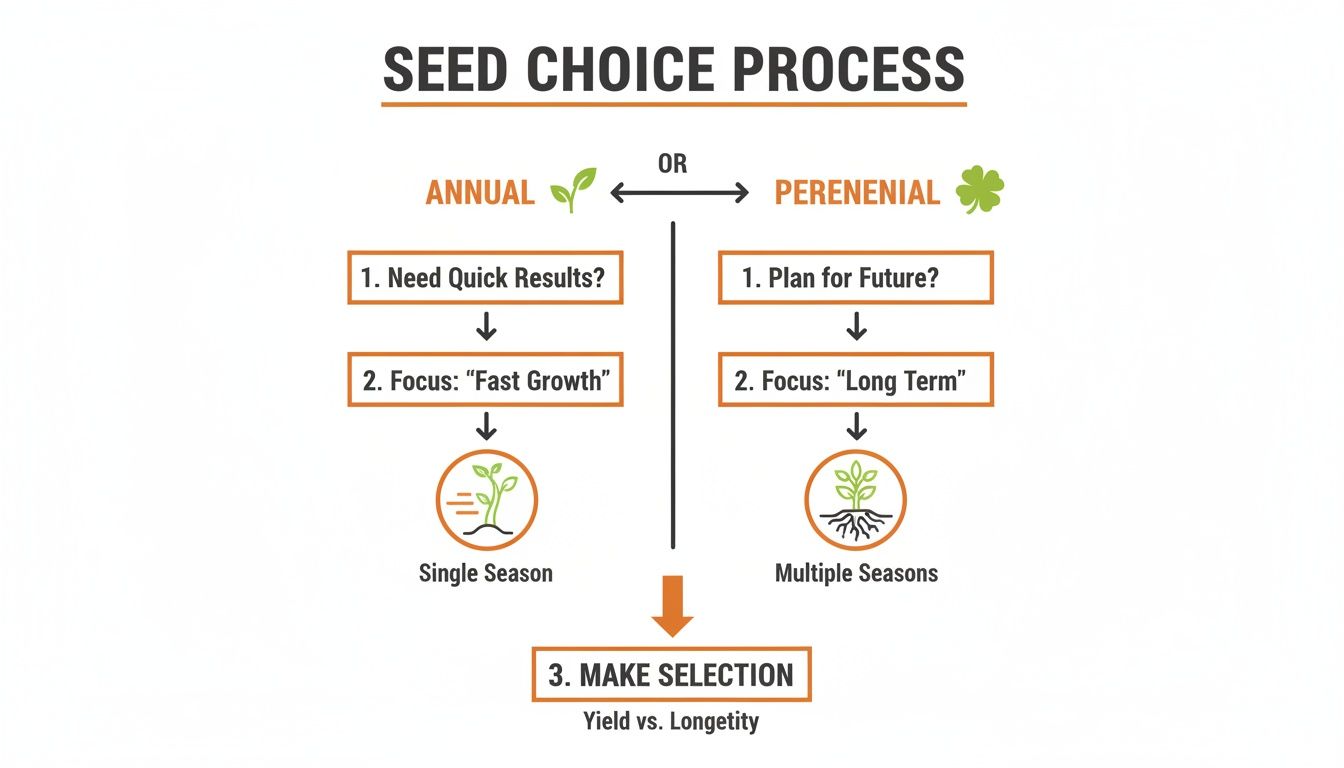
It's a good reminder that annuals give you that quick green-up, while perennials build a nutritional foundation for years to come.
Choosing Your Planting Method
Conventional tillage means firing up a disc or tiller to break up the ground, leaving you with a fluffy, clean seedbed. This is a fantastic way to work your lime and fertilizer deep into the soil and get excellent seed-to-soil contact. Just don't get carried away and work the ground into powder—overdoing it can dry out your soil and leave it vulnerable to erosion.
The other route is a no-till drill. This beast of a machine slices right through whatever is already growing and drops the seed directly into the ground with very little disturbance. It’s an incredible tool for saving soil moisture, preventing erosion, and keeping a whole new crop of weed seeds from seeing the light of day. The drill itself is a bigger investment, but the payoff in long-term soil health is huge.
Regardless of your method, planting depth is everything, especially for those tiny seeds like clover and chicory.
Here's a rule of thumb I live by: never plant a seed deeper than twice its diameter. For something as small as a clover seed, that means you’re barely covering it with a dusting of soil—think 1/8 to 1/4 inch deep, max. Planting too deep is probably the #1 mistake I see people make.
After I broadcast tiny seeds, I’ll often just run my cultipacker over the plot. Don't have one? Just drive your ATV back and forth across it. The tires will press the seeds into the soil just enough for perfect contact without burying them.
Nurturing Your New Green Carpet
Once the seeds are down, your job isn't done. Those first few weeks are a critical window for getting the plot established. Your biggest enemy at this stage? Weeds. Young clover seedlings just can't hang with fast-growing grasses and broadleaves that shoot up and steal all the sunlight and nutrients.
A strategically timed mowing can be your best weapon. Once your clover hits about 6-8 inches tall, knock it down to about 4-5 inches. This will stress the taller weeds but encourage the clover to spread out and form a thick, dense carpet that will eventually muscle out most of its competition.
Once established, your plot needs consistent care. This involves understanding proper fertilization techniques to keep the growth coming. I like to give my perennials a light boost with a starter fertilizer that's low in nitrogen, something like a 0-20-20 blend. Remember, legumes like clover make their own nitrogen, so dumping a high-nitrogen fertilizer on them only feeds the weeds you’re trying to fight.
Using Smart Tech to Monitor Your Plot
Your spring deer food plot is in the ground, but your work isn’t over. Now comes the fun part: the intelligence-gathering phase. This is where you find out exactly how deer are using your investment. Modern tech like cellular trail cameras can turn a simple feeding spot into a 24/7 scouting hub, giving you a serious advantage.
These cameras send photos and videos straight to your phone. You get a real-time look at which deer are visiting, when they feel safe enough to feed in daylight, and how your plot is holding up to browse pressure. It’s like having eyes in the woods around the clock.
Turning Pictures into Actionable Data
Gone are the days of just counting deer. Today's camera technology, especially when paired with a solid app, offers so much more. AI-powered species recognition automatically sorts your images, saving you hours of scrolling through pictures of raccoons and squirrels.
This lets you focus on what actually matters:
- Identifying Specific Bucks: Start building a catalog of the bucks using your property. You can track their antler growth all spring and summer.
- Monitoring Herd Health: Keep an eye on the doe-to-fawn ratio. Seeing lots of healthy fawns in your plot is a direct sign your nutritional program is paying off.
- Pinpointing Peak Activity: The data will reveal clear patterns in feeding times. You’ll quickly learn the exact morning and evening windows when deer are most active—information that is pure gold come hunting season.
This level of detail moves you from guessing to knowing. The preference deer show for cultivated spring food plots is overwhelming; studies confirm deer heavily favor these supplemental forages. This helps fuel population growth, which has rebounded to over 35.2 million whitetails and mule deer in recent years, making smart management more crucial than ever.
Mapping Deer Movement for a Smarter Hunt
The best systems integrate your camera data with powerful mapping tools. The MAGIC EAGLE app, for instance, lets you drop pins for every camera, stand, feeder, and scrape right on an interactive map of your property.
By logging key sightings directly on your map, you begin to build a visual, season-long story of deer movement. You're no longer just looking at a food plot; you're analyzing a key piece of a much larger puzzle.
When you combine these sightings with weather overlays, predictive patterns start to emerge. You might notice a specific buck only uses a certain plot when the wind is out of the northwest, or that deer activity spikes just before a rainstorm. For even more precision in managing water or liquid supplements, some landowners are even starting to integrate agricultural tank monitoring systems into their high-tech plot setups.
This combination of real-time visuals and data mapping is a complete game-changer. Our guide on how to monitor cameras remotely offers more tips on setting up an effective network. It transforms your spring deer food plot from a simple buffet into a dynamic scouting tool that pays dividends all year long.
Answering Your Toughest Spring Food Plot Questions
Even the best-laid plans run into snags once you get dirt on your boots. It’s just part of the game. Let's walk through some of the most common questions and curveballs we see land managers face with their spring deer food plots. Nailing these details can make a huge difference in your results.
One of the first things guys always ask about is timing. "Did I plant too early, or did I wait too long?" Spring weather is a wild card, and a late frost can knock a new plot on its heels. You want to get seed in the ground to catch those early rains, but jumping the gun before your soil temperatures are consistently above 50°F often leads to spotty, weak germination.
If you do get a surprise frost after planting, don't hit the panic button just yet. Many of the go-to cool-season forages like clover and cereal grains are surprisingly tough and can shrug off a light frost once they've sprouted. The real trouble comes from a hard freeze that locks up the ground again, as that can kill off tender young seedlings before they get established.
How Can I Tell if My Plot Is Getting Overgrazed?
Honestly, this is a great problem to have—it means the local deer herd loves what you've planted. The downside is that if they hammer it too hard right out of the gate, the plants never get a chance to build the deep root systems they need to survive the summer heat.
The tell-tale sign of overgrazing is a plot that looks like it's been constantly mowed down to the dirt, never getting more than an inch or two tall. To be certain, you can build a small utilization cage (also called an exclosure) out of some wire fencing and stake it down in the middle of your plot. This little cage protects a small patch from getting browsed.
If the forage inside your cage is a foot tall while the rest of the plot looks like a golf course putting green, you’ve got your answer. Your plot isn't failing to grow; it's getting absolutely devoured.
This is a classic signal that you might need to plant more acreage or even add another plot nearby to spread out the grazing pressure. Established perennial plots are much better at handling this kind of constant attention. For instance, data from a study on forage production showed that second-year clover mixes produced a ton of biomass, with ungrazed exclosures protecting 43% more forage than the open, browsed areas. It really drives home how intensely deer can zero in on a quality food source. You can dig into the full research on food plot forage production if you're interested.
Can I Save a Patchy or Weedy Food Plot?
You bet. A few bare spots or a weed invasion doesn't mean you need to nuke the whole thing and start over. For those patchy areas, you can simply broadcast more seed into the thin spots right before a good rain is in the forecast. We call this overseeding, and it’s a simple, effective way to thicken up an existing stand.
When it comes to weed control, your strategy depends on what you're up against.
- Grasses: If you have a pure stand of clover, alfalfa, or chicory, a grass-selective herbicide is an incredible tool. It will wipe out the unwanted grasses without touching your broadleaf forages.
- Broadleaf Weeds: These are the trickier ones to deal with in a mixed plot. Often, your best defense is a well-timed mowing. Cutting the plot before the weeds produce seeds can knock them back significantly and give your good stuff the sunlight and space it needs to take over.
Don't get discouraged by a few imperfections. Managing spring food plots is a marathon, not a sprint. It’s an ongoing process of observing, learning, and adjusting. Every season teaches you something new about your ground.
At Magic Eagle, we build the tools to help you gather that crucial intel. Our smart cellular trail cameras give you a real-time view of how your plots are performing, turning your hard work into a predictable hunting advantage. https://magiceagle.com