

You've spent the time and money to pick the perfect trail camera, find the best spot, and dial in the settings. But leaving that piece of gear out in the woods by itself is a risky game. It's an unfortunate truth that as trail cameras get more popular, they become bigger targets for thieves and vandals.
A simple trail camera cable lock is your first line of defense. It's a straightforward but highly effective security tool designed to anchor your camera to something solid, like a tree trunk, making it much harder for someone to just walk off with your investment.
Why Your Trail Camera Needs a Cable Lock
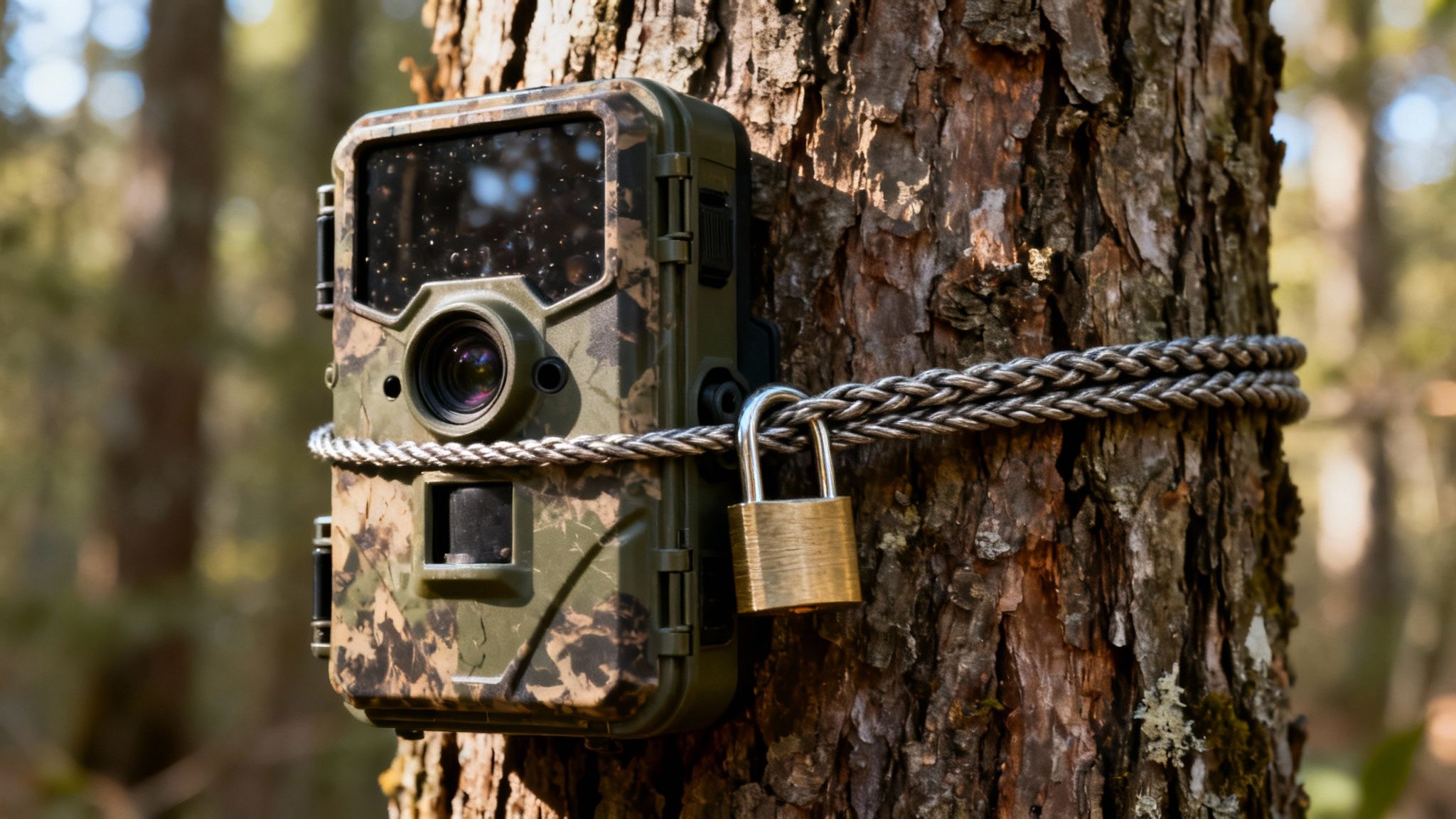
The numbers don't lie. The global trail camera market was valued at USD 105.88 million in 2023 and is on track to hit USD 192.53 million by 2032. That’s a whole lot of new cameras going up in the woods, and every single one is a potential target. This isn't just about protecting a piece of hardware; it's about safeguarding your entire scouting or security effort.
The Dual Cost of a Stolen Camera
Losing a camera is a gut punch that hits you in two ways:
- Financial Loss: First, there’s the obvious hit to your wallet. Replacing a quality camera can set you back anywhere from a hundred to several hundred dollars.
- Data Loss: This one often hurts more. You lose all the valuable images and videos you've collected—weeks or even months of irreplaceable data. All that time tracking a target buck or monitoring your property is just gone.
A tough trail camera cable lock is a powerful deterrent. It’s a clear visual signal that your gear is secured, and most opportunistic thieves will simply move on to find an easier score. For a deeper dive into protecting your valuables, it’s worth reading up on general theft protection strategies.
A simple cable lock can be the difference between months of successful scouting and returning to find an empty tree and a severed strap. It’s the most fundamental layer of security you can deploy.
For those who want to build a truly robust security system, combining a physical lock with modern tech is the way to go. A trail camera with GPS tracking gives you a way to find your gear if a determined thief manages to break through your physical defenses, offering a crucial backup plan.
Choosing the Right Cable Lock for Your Camera
Picking the right cable lock for your trail camera isn’t something to rush. It's tempting to just grab the first one you see, but the difference between a good lock and a great one can mean the difference between seeing your camera next season or finding an empty tree. A little thought up front on materials, length, and the lock itself will save you a world of frustration later.
At the heart of any decent cable lock is, you guessed it, the cable. You absolutely want one made from braided steel. Single-strand wire is a piece of cake for a thief with a good pair of bolt cutters, but the interwoven design of braided steel makes it a nightmare to snip through quickly. It’s designed to fray and resist a clean cut, buying you precious time and often discouraging the attempt altogether.
Cable Construction and Durability
Don't just stop at the material, though. The physical size of the cable matters. A thicker cable, say 3/8 inch (about 10mm), is a much bigger visual and physical deterrent than a thinner 5/16 inch (8mm) one. Both will do the job, but that extra thickness can make a thief think twice and move on to an easier target.
Another non-negotiable feature is a weather-resistant coating, usually vinyl or PVC. This outer jacket does two critical things:
- It shields the inner steel cable from rust and corrosion after months of being hammered by rain, snow, and humidity.
- It keeps the cable from scratching up the housing of your expensive trail camera.
I’ve seen unprotected steel cables rust through in a single wet season. That vinyl coating isn't just for looks; it's essential for making sure your lock holds up year after year when you need it most.
Finding the Perfect Length and Lock Type
When it comes to length, six feet is the sweet spot for most situations. It gives you plenty of room to wrap around a respectable-sized tree without leaving a ton of extra cable dangling. Too short, and you’ll be stuck mounting your camera on skinny saplings. Too long, and the excess slack can be awkward to manage or even give a thief something to use for leverage.
Next up is the lock mechanism itself. Your choice here usually boils down to two options:
- Keyed Locks: These are my personal preference for pure, brute-force security. They often have complex pin tumbler systems that are tough to pick. The only real downside is keeping track of that tiny key out in the woods.
- Combination Locks: The convenience is undeniable—no keys to lose. But be warned: cheap combo locks can sometimes be forced or decoded. If you go this route, invest in a quality one from a reputable brand.
Trail Camera Cable Lock Feature Comparison
To help you decide, here's a quick breakdown of what each style brings to the table.
| Feature | Braided Steel Cable | Python-Style Lock | Keyed Padlock Style |
|---|---|---|---|
| Best For | All-around security and flexibility | Adjustable, tight-fitting security | Maximum brute force resistance |
| Adjustability | Fixed length | Fully adjustable | Fixed length |
| Cut Resistance | High | High | High |
| Ease of Use | Simple and fast | Easy to cinch tight | Straightforward, but requires key |
| Weak Point | Lock mechanism quality varies | Lock mechanism can be picked on cheaper models | Potential to lose the key |
Ultimately, the best choice depends on where you're setting up your camera and your personal preference for convenience versus old-school reliability.
Ensuring Compatibility with Your Gear
Last but not least, make sure the cable will actually work with your camera setup. Before you buy, double-check that the cable end is small enough to thread through your camera’s security loops. Even better, run it through a dedicated steel security box. Pairing a cable lock with a lockbox creates a one-two punch that’s incredibly tough for thieves to beat.
This isn't just a niche product for paranoid hunters; the global market for all cable locks hit around USD 2.8 billion in 2024. While trail cams are a small slice of that pie, it shows how seriously people take this kind of security. You can find more market analysis over at Deep Market Insights. By thinking through these details, you'll end up with a lock that fits your gear perfectly and gives you the peace of mind to leave it in the field.
Mastering the Installation for Maximum Security
Getting your hands on a quality trail camera cable lock is a great start, but a sloppy installation can make even the toughest lock pretty much useless. It’s all in the technique. A proper setup is what turns a simple cable into a serious theft deterrent, and that process starts before you even touch the camera. It begins with picking the right anchor.
Your anchor point is the foundation of your entire security setup. Always, always choose a sturdy, live tree that’s obviously wider than the loop of your cable. A rookie mistake is picking a small sapling that a thief could just cut down or bend to slide the whole setup right off the top. A thick, solid tree trunk makes that impossible.
Once you’ve found your tree, it's time to thread the cable correctly to create the secure loop that holds everything in place.
- First, run the adjustable end of the cable through your camera's dedicated security loops. For even better protection, thread it through a steel lockbox.
- Next, wrap the cable around the tree trunk.
- Finally, pass the locking mechanism back through the loop at the opposite end of the cable.
This simple "cinch" method creates a noose-like grip on the tree that only gets tighter if someone tries to pull on it.
Fine-Tuning for a Flawless Fit
Now it's time to eliminate any weak spots. Yank that cable as tight as you possibly can, getting rid of every last inch of slack. A loose cable is an open invitation for a thief to slip in a pair of bolt cutters or another tool to get some leverage. You want the camera and its lockbox pulled so snugly against the tree that there’s absolutely no room to work.
Positioning the lock itself is another detail that matters more than you’d think. Don’t just leave it hanging where it’s obvious and easy to get to. Instead, try to tuck it away where it’s facing downward or hidden in a crevice in the bark. This simple move makes it incredibly awkward for a thief to get a clean angle to cut, pick, or smash the lock.
This quick guide covers the basic steps to lock down your camera.
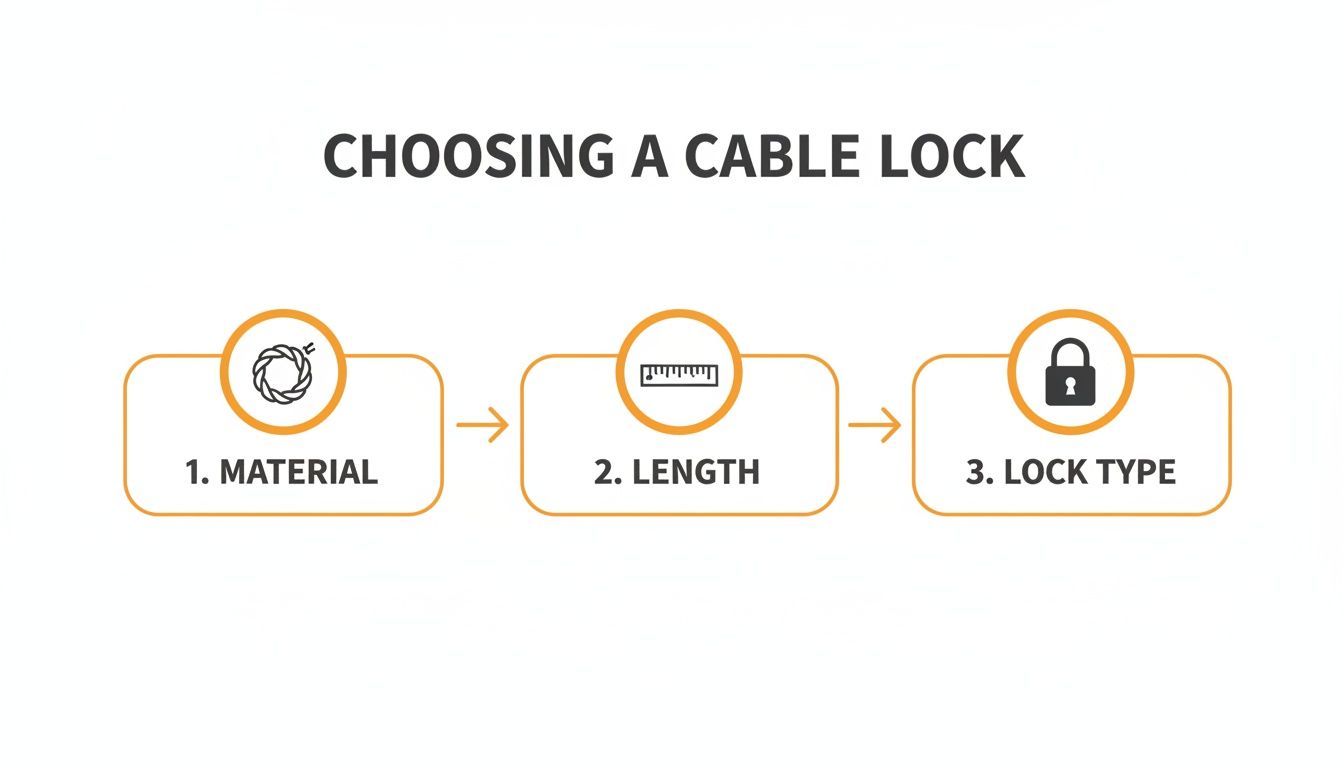
The flowchart above simplifies the selection process, making sure you start with the right materials, length, and lock type for whatever you’re trying to do.
Avoiding Common Installation Pitfalls
Even with perfect technique, a few small mistakes can leave your gear vulnerable. One of the most overlooked things I see is camera placement relative to the anchor. A cable lock is great, but it’s not a substitute for smart concealment.
A perfectly installed lock on a camera placed at eye level right next to a busy trail is still a target. The best security is always a combination of physical deterrents and smart, discreet placement.
What if there isn’t a good tree? You've still got options. For setting up in open fields or specific clearings, you might want to look into different types of trail camera stands. Many of these can be secured to ground anchors using the very same cable lock. That kind of adaptability means you can get your camera in the perfect spot without ever having to compromise on security.
Advanced Security Strategies Beyond the Cable Lock
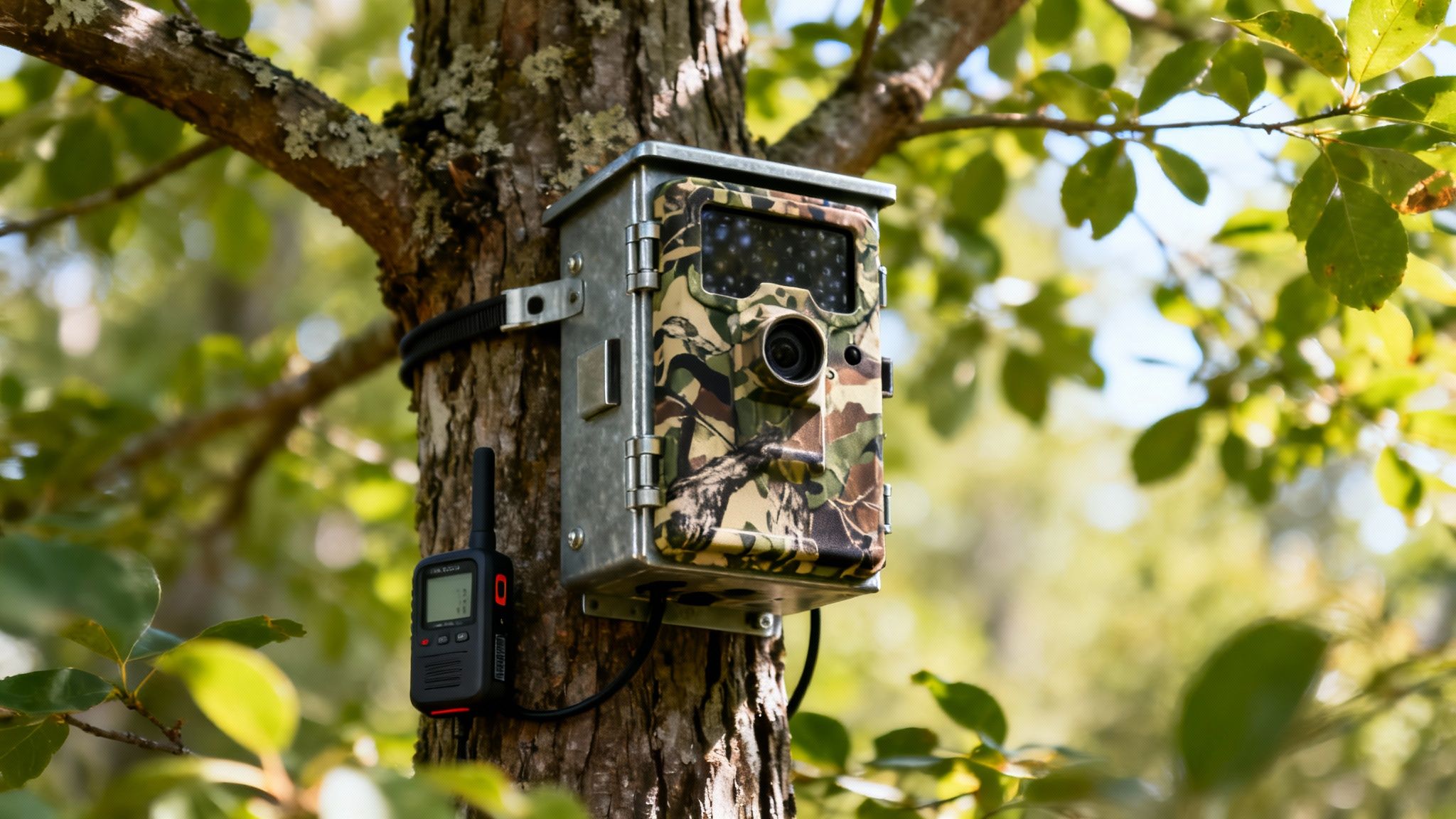
A solid trail camera cable lock is a great starting point, but real security isn’t about a single solution. It's about layering your defenses. Think of that cable as your first line—it's brilliant for stopping the casual, grab-and-go thief.
But for someone more determined? You’ll need to think bigger by combining tough physical barriers with smart concealment and modern tech.
The single best physical upgrade you can make is pairing your cable lock with a steel security box. These aren't just generic cases; they're heavy-gauge steel enclosures built to fit your specific camera model, shielding it from direct assault. When you run your cable lock through both the box and the camera, you’ve created a setup that's incredibly resistant to hammers, prying, and even most bolt cutters.
Field Tip: Trail camera pros consistently say that combining a cable lock with a security box and a quality padlock is the trifecta. Industry reports suggest this simple combo can slash opportunistic theft by 60–80% compared to an unsecured camera. With most cameras running between $150 and $350, that’s an investment that pays for itself.
Blending In: The Art of Camouflage and Concealment
Your next layer of security is making your camera a ghost. A thief can't steal what they can't find in the first place. A few simple tricks can make all the difference.
- Go High: Mount your camera higher than eye level, somewhere around 8 to 10 feet up, and angle it down. Most people just don't look up when they're walking through the woods. It's a simple adjustment that works wonders.
- Use Natural Cover: Don't just strap your camera to a bare trunk. Tuck it behind a cluster of branches, inside a hollowed-out log, or against bark that perfectly matches its camo pattern. The goal is to break up that unnatural rectangular shape.
- Get Off the Beaten Path: Placing a camera directly on a main trail is like putting out a welcome mat for thieves. Instead, set it back 15-20 yards off the trail and have it look back at an angle. This keeps it out of the direct line of sight while still capturing all the action.
For total property protection, some landowners even integrate professional security cameras installation to monitor access points and wider areas around their land.
Integrating Modern Anti-Theft Technology
The final layer—and maybe the most powerful—is technology. This is where modern cellular trail cameras really shine. Brands like Magic Eagle have built-in anti-theft features that give you real-time alerts and recovery tools, turning your camera from a passive recorder into an active security device.
These high-tech defenses are game-changers:
- GPS Tracking: See your camera’s exact location on a map in an app. If someone does manage to make off with it, you can track its every move and give law enforcement precise coordinates for recovery.
- Geofencing: This lets you draw a virtual boundary around your camera’s location. The second it moves outside that zone, you get an instant alert on your phone.
- Instant App Alerts: Paired with internal sensors, the camera can notify you the moment it's moved or tampered with. This gives you a critical head start to react before it's long gone.
These smart features are your ultimate safety net. To see exactly how these systems work in tandem, you can learn more about a smart anti-theft system for trail cameras.
By combining a tough trail camera cable lock, a steel box, clever concealment, and GPS tracking, you build a security system that’s about as close to impenetrable as it gets.
Field Tips and Troubleshooting Common Issues
Even the best gear can run into trouble out in the wild. A trail camera cable lock is no exception. Harsh weather and constant use will eventually test any piece of equipment, but with a bit of foresight, you can keep your camera secure season after season. Knowing what to expect is half the battle.
One of the most common headaches, especially for those of us in northern climates, is a frozen lock. When the temperature drops, any moisture trapped inside the mechanism can freeze solid, making it impossible to get your key in or turn the dial. Whatever you do, don't try to force it—that’s a surefire way to snap a key or wreck the internal pins.
The easy fix here is prevention. Ditch the oil-based lubricants like WD-40, which can attract dust and gum up in the cold, making things worse. Instead, a quick puff of graphite lubricant into the keyhole before winter hits will displace moisture and keep everything moving freely.
Navigating Lockouts and Damage
It’s a sinking feeling—you're miles from civilization and realize you’ve lost your key or forgotten the combo. It feels like a disaster, but it doesn't have to be. Your first move should be to contact the lock's manufacturer. Most reputable brands keep records of key codes or have master keys available, and they can often help you out if you provide proof of purchase.
Field Tip: Before you even head out, take a clear photo of your key and any serial numbers on the lock itself. Save it to a secure folder on your phone or in the cloud. If you ever need to call customer support for a replacement, you'll have all the info you need right at your fingertips.
Consistent check-ups are also crucial for long-term reliability. Every time you visit your camera, take 30 seconds to give the cable lock a quick once-over.
Here’s what I always look for:
- Cable Condition: Scan the cable for any signs of fraying, rust, or spots where the vinyl coating has been scraped away. Exposed steel is a weak point that will quickly corrode and compromise the cable's strength.
- Lock Body Health: Make sure the locking mechanism is clear of dirt, mud, or other gunk. I carry a small, stiff brush in my pack just for cleaning out the keyway or combination dials.
- Function Test: Open and close the lock a couple of times. Does it feel smooth? Any grittiness or resistance is an early warning that it needs a good cleaning or a bit of lubrication.
Catching these little things early on prevents them from turning into big failures when you’re deep in the woods. A well-maintained lock is a reliable one, and that means your expensive camera stays exactly where you put it.
Your Top Questions About Trail Camera Cable Locks
Even with the best guides, questions always pop up when you're actually out in the woods trying to get your gear secured. Let's tackle some of the most common ones we hear from folks in the field.
Can a Thief Cut a Trail Camera Cable Lock?
Let's be honest: with the right tools and enough time, any cable can be cut. The real goal here isn't to be indestructible—it's to be a massive pain for a thief.
A quality braided steel cable lock is designed to be highly cut-resistant. When someone tries to hit it with bolt cutters, the interwoven steel strands don't give a clean snap. Instead, they fray, bind up, and make the process slow, loud, and frustrating. That's usually more than enough to send an opportunistic thief looking for an easier target.
What's the Best Length for a Cable Lock?
For most situations, a six-foot cable is the sweet spot. It gives you plenty of length to wrap around a decent-sized tree or a sturdy fence post without being so long that it's just a hassle to manage.
Go too short, and you'll be limited to saplings. Go too long, and you'll have a bunch of extra slack that a thief could potentially use as leverage to try and break the lock. Stick with six feet for the best mix of versatility and security.
How Do I Keep My Lock From Freezing Up in Bad Weather?
Weather is the number one enemy of any lock you leave outside. The key to making it last is a little prep work before you deploy it for the season, especially if you're in a place with cold, wet winters.
Grab some graphite lubricant and give the locking mechanism a good squirt.
A common mistake is using oil-based sprays like WD-40. Oil attracts dust and dirt, and it can gum up or freeze solid in the cold, leaving you with a lock you can't open. Graphite is the field-tested solution that won't fail you when temps drop.
It's also a good idea to give the cable's vinyl coating a quick check for any nicks or cuts and make sure mud and debris aren't caked onto the lock body.
Can I Use One Cable to Secure Multiple Cameras?
You could, but I'd strongly advise against it. While you might find a cable long enough to loop through two cameras on the same tree, you're creating a single point of failure.
If a thief defeats that one lock, they walk away with all your gear in one go.
For the best protection, always use one dedicated trail camera cable lock for each camera. It costs a little more upfront, but it forces a thief to defeat multiple locks to steal multiple cameras, which drastically improves your odds.
Ready to pair that physical security with some serious tech? The Magic Eagle EagleCam 5 comes loaded with a smart anti-theft suite, including GPS tracking and geofencing, giving you a powerful digital safety net. Check out our advanced trail cameras today at https://magiceagle.com.